What’s new · Law firm ops · Clio · Sep 2026
What's new in Clio (Sep 2026): September Clio Work, Manage AI, and Grow updates to verify before turning them on
Clio's press page lists five announcements dated September 2026: Clio Manage and Clio Work in Spain (9 September), Vincent as a Codex plugin (17 September), Canadian case law in Vincent and legal accounting in Clio Manage for Canada (23 September), and the Learned Hand acquisition for courts (30 September). None is a Manage AI or Clio Grow release note, so for a firm the useful question is “does this reach our plan and region, who approves its output, and which matters do we check first?” For the product review, see our Clio AI review.
What this page covers
This page is for a managing partner, firm administrator, or practice support lead at a firm on Clio who wants September's changes without reading every announcement — especially anything that changes where Clio's legal AI can be called from, which law it can research, and how the firm's books and trust accounts are kept. It is educational and not legal advice.
We list only entries dated September 2026 on Clio's own Clio press page and enterprise blog: Clio Manage and Clio Work in Spain (9 September), Vincent as a Codex plugin with Clio's engineering post (17 September), Canadian case law in Vincent and legal accounting in Clio Manage for Canada (23 September), and the Learned Hand acquisition (30 September). Hiring news and recognition lists are left out. We found no dated September clio.com page about Manage AI or Clio Grow; Clio's July What's New in Clio Work post (Clio for Word, Grow integration, Skills, Memory) predates this month and is covered in Clio AI.
Ground rules stay the same: a licensed attorney owns any filing, citation, demand, deadline, client message, or discovery response that draws on Clio's AI. Research answers get read against the cited authority before they reach a brief, and the responsible lawyer for trust accounting signs off on reconciliations. Counts in these announcements are Clio's figures, not our measurement.

Major features (with how someone uses them)
Examples at a glance: each feature has a concrete example from a real job plus a short Try this you can run this week.
1. September items to decide on (primary)
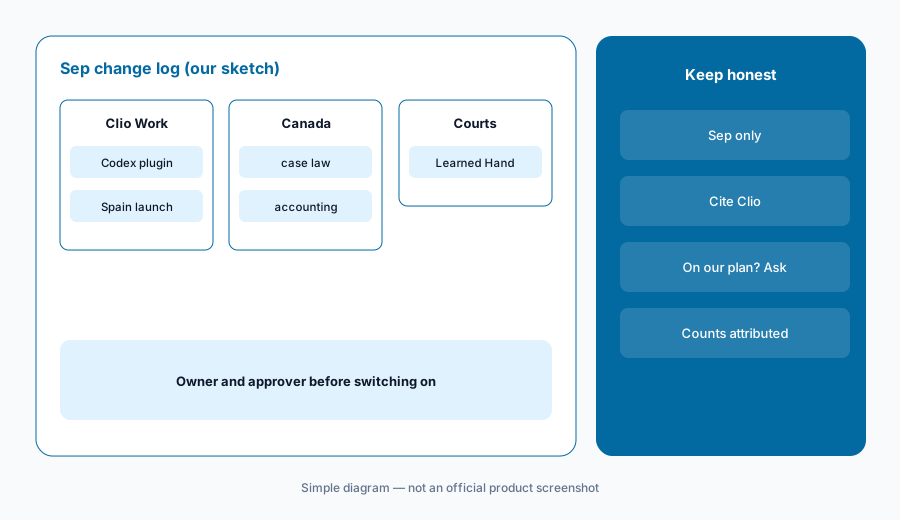
What it is: From Clio's dated September announcements, five need an owner: (1) Clio Manage and Clio Work launching in Spain, built on vLex's legal data (Clio press release, 9 Sep); (2) Vincent available in Codex through an MCP plugin that links Codex to a firm's Clio account (Clio press release, 17 Sep); (3) Canadian case law and legislation in Vincent, which Clio puts at more than 567,000 judicial decisions (Clio press release, 23 Sep); (4) legal accounting in Clio Manage for Canadian firms, including three-way trust reconciliation (Clio press release, 23 Sep); and (5) the Learned Hand acquisition, an AI workspace for judges and clerks (Clio press release, 30 Sep). We list only entries dated September 2026.
Primary workflow:
Pick one September Clio item your firm might enable. Have the managing partner write who approves its output and which ten matters you'll check first.
2. Vincent as a Codex plugin (17 Sep)
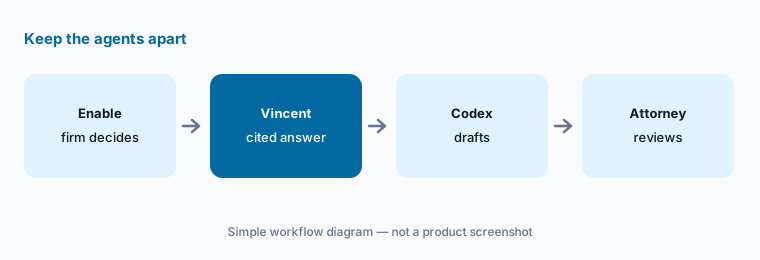
What it is: Per Clio's 17 September release, Vincent is now available in Codex through an MCP plugin for Vincent and Clio Work customers. Once enabled, the plugin links Codex to the firm's Clio account and Codex can call on Vincent's legal research and docket capabilities inside a broader task; Clio's engineering post says Codex calls Vincent as a separate legal agent with its own context, shows Vincent's research trail and exact output, and routes requests to the firm's Clio region. Clio says firms decide whether to enable the plugin, records stay governed in Clio, and lawyers remain responsible for reviewing any output before relying on it.
The boundary matters for review. Clio says you can tell Vincent's output apart from what Codex produced afterwards — the reviewing attorney should check which part of a draft came from which agent before anything is filed.
Keep the agents apart:
On three closed matters, have the associate keep Vincent's cited answers separate from the Codex draft, and have the litigation partner read every cited authority before the plugin is used on an open matter.
3. Canadian case law in Vincent (23 Sep)
What it is: Clio's 23 September release says Vincent now includes Canadian case law and legislation, building on its June 2026 acquisition of Jurisage. Clio puts the collection at more than 567,000 judicial decisions plus federal and provincial legislation across the common law provinces, with Quebec and Nunavut legislation still in progress. It says Vincent can trace answers back to the underlying authorities and check existing citations against the law.
Coverage gaps are the thing to write down. If a matter touches Quebec civil law or Nunavut legislation, the research attorney should know that before trusting a “nothing found” answer.
Test on answered questions:
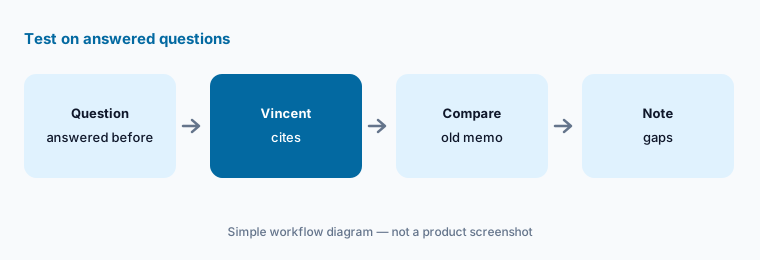
Have the research lawyer run three Canadian questions the firm already answered through Vincent and compare every cited decision and statute with the original memo, noting any province where coverage looks thin.
4. Legal accounting in Clio Manage for Canada (23 Sep)
What it is: Also on 23 September, Clio launched legal accounting in Clio Manage for Canadian firms: three-way reconciliation of the trust ledger, client ledgers, and trust bank statement; GST, HST, QST, and PST tracking by province with input tax credits; accrual or cash reporting; Canadian bank feeds and cheque printing; guided onboarding; and bank-feed categorization with suggested matching. Clio notes that lawyers stay responsible for the accuracy of their financial records whoever keeps the books.
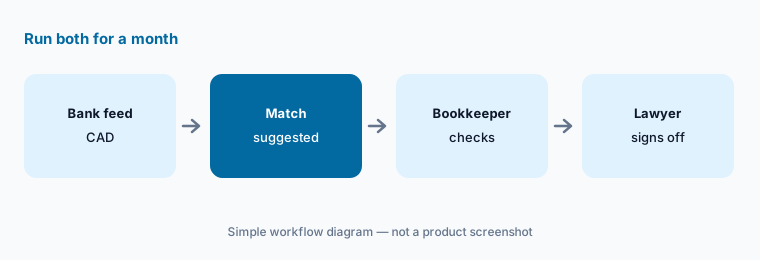
Suggested matching is a suggestion. In trust accounting, the responsible lawyer still signs off the reconciliation the law society asks for.
Run both for a month:
For one month, have the bookkeeper run the old trust reconciliation next to Clio's three-way reconciliation, and have the responsible lawyer compare the two before switching over.
5. Spain launch and Learned Hand (9 and 30 Sep)
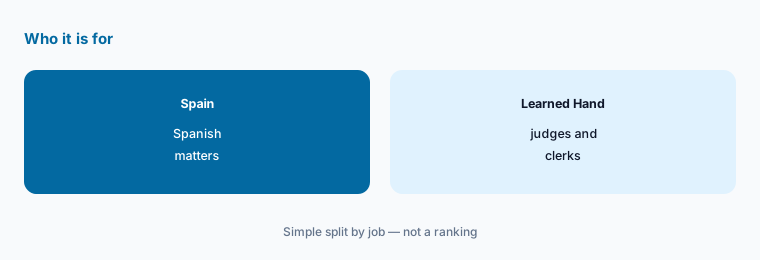
What it is: On 9 September Clio launched Clio Manage and Clio Work in Spain, built on the legal data of vLex, the Barcelona company Clio acquired; Clio says it now has more than 400,000 customers across 130 countries. On 30 September Clio announced it had acquired Learned Hand, which builds an AI workspace for judges and clerks that connects to court case management systems and helps prepare bench memoranda and draft orders; Clio says Learned Hand will form the foundation of its products for courts and that more will be announced in the coming months.
Most firms have nothing to switch on from either item. A firm with Spanish matters has a language and data-region question; a firm whose lawyers sit as part-time judges or clerks has a separate question about which tools the court allows.
Questions first:
If your firm has Spanish matters, have the office managing partner ask Clio where Spanish data is hosted and which language the AI answers in, and write the answer and date down before any matter moves.
6. Manage AI and Grow: what to ask
What it is: No dated September clio.com announcement covers Manage AI or Clio Grow. What Clio's pricing page says on 20 October 2026: AI is included on Core and above (drafting bills on a schedule, turning documents into calendar events and tasks confirmed against the source, drafting client updates); Grow is included in Elite and an add-on for Core and Signature; and Grow AI's phone, web, and email agents are priced per matter hired with Grow AI's help. Clio's September social roundup mentions Grow on mobile, a Grow and Zoom connection, multiple task assignees, and fee allocation, but we found no dated clio.com page for those, so treat them as questions for your Clio account manager.
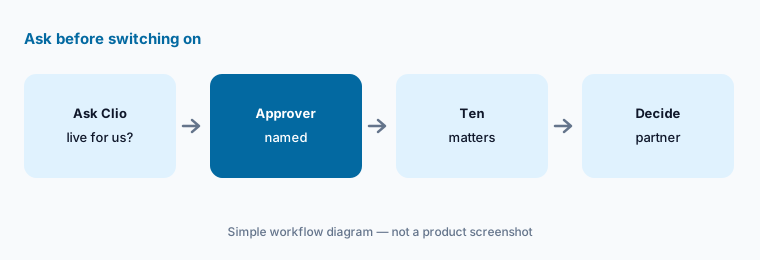
Turning a feature on is a firm decision. AI-calendared deadlines need the responsible attorney's check, and anything Grow AI says to a prospective client is a client message.
Ask before switching on:
Have the practice support lead ask Clio which Manage AI and Grow features are live on your plan, and have the managing partner name an approving attorney for each before any is turned on.
Pricing context (October 2026)
Clio's pricing page (read 20 Oct 2026) prints one figure: Starter starting at $49 per user per month (its FAQ: “Clio's plans start at $49 USD per user per month”). Core, Signature, and Elite show “Get pricing” or “Book a demo”, and the FAQ says AI is included on Core and above rather than sold as a separate add-on. Clio Grow is included in Elite and an add-on for Core and Signature; Grow AI agents are priced per matter hired, with no figure shown. Clio Work uses per-user pricing with no printed figure.
None of the September announcements gives a price. Ask whether the Codex plugin, Canadian content in Vincent, and Canadian accounting change your plan or bill (as of 20 Oct 2026).
Uncertainty: We list only dated September 2026 entries from clio.com read on 20 Oct 2026; Clio's site blocks automated fetching, so pages were read through a reader. Announcements give no rollout schedule by plan; Quebec and Nunavut legislation are still in progress for Vincent. Counts (decisions, customers, countries) are Clio's. No dated September clio.com page covers Manage AI or Grow.
When it’s useful (honest take)
Useful when your firm runs on Clio and you need September's dated items with an owner, an approving attorney, and ten test matters for each.
Less useful when you need the product deep-dive — use Clio AI — or you are choosing between practice management systems (Clio vs 8am MyCase, Smokeball AI).
Paying for Clio and a few other AI tools? The $9 AI toolkit spreadsheet lists every AI subscription you have, what each one costs, and how fast it pays for itself, so you can see which ones are worth the money.
Want someone to do it for you? AI toolkit audit — $19
Related options (educational)
| Need | Better home | Why |
|---|---|---|
| Clio product review | Clio AI | Tool review |
| Clio vs MyCase | Clio vs 8am MyCase | Compare |
| Research platforms | CoCounsel Legal vs Lexis+ with Protégé | Compare |
| Harvey's September changes | What’s new in Harvey (Sep 2026) | What’s new |
| Law firm stack inventory | Stack map for law firm ops | Stack map |
FAQ
Which September 2026 Clio items did you read?
Clio press releases dated 9 Sep (Spain launch), 17 Sep (Vincent in Codex, plus the enterprise blog post), 23 Sep (Canadian case law in Vincent; legal accounting in Clio Manage for Canada), and 30 Sep (Learned Hand acquisition), all read 20 October 2026.
Was there a Manage AI or Clio Grow release in September?
We found no dated September clio.com announcement for either. Clio's pricing page says AI is included on Core and above and Grow AI agents are priced per matter hired; ask Clio what is live on your plan.
Does the Codex plugin move our matter data out of Clio?
Clio says matter information, documents, calendaring, filing, and billing stay in Clio, that firms decide whether to enable the plugin, and that lawyers review output before relying on it. Ask Clio for the plugin's data terms in writing.
Can we rely on Vincent's Canadian answers?
Clio says Vincent traces answers to authorities and checks citations, and that Quebec and Nunavut legislation are still in progress. A research lawyer should read every cited authority before it goes into advice or a filing. This is not legal advice.
How much does Clio cost in October 2026?
Clio prints only Starter from $49 per user per month; other tiers are quote-based and AI is included on Core and above (pricing page, 20 Oct 2026).
Optional next step (if seats overlap)
If September's Clio items overlap with a research platform, a document tool, or chat seats your firm already pays for, map that overlap before you add another seat. Map the overlap with the $19 AI toolkit audit or the $9 AI toolkit spreadsheet. Email Audit $19 or Toolkit spreadsheet $9.
Checkout is live via Stripe. After you pay, we email delivery (spreadsheet) or intake next steps (audit).