Tool · Law firm ops · Legora · Oct 2026
Legora AI review (Oct 2026): Legora aOS agentic operating system, Legora Agent, Skills, and Monitors for law firms
Legora (Stockholm) sells legal AI to law firms and in-house teams. On 7 May 2026 it introduced the Legora aOS, which it calls an agentic operating system for legal work, with the Legora Agent at its center: give it a task and it plans, executes, reviews, and delivers, pausing where a lawyer's judgment is needed. Around the Agent sit Skills (launched 5 October 2026), Tabular Review, Lists, and Monitors. This page is about handing the Agent real work while a supervising associate still reviews everything before a client sees it. Each section has a Try this.
What this Legora page covers
This page is for a practice-group partner, supervising associate, knowledge lawyer, or innovation lead at a firm evaluating or already paying for Legora. It is educational and not legal advice. We did not test Legora; facts come from Legora's press releases, blog, and product pages read on 20 October 2026.
Legora's 7 May 2026 announcement describes the aOS as one connected system that “orchestrates agents to perform legal work autonomously and continuously,” from matter intake through research, drafting, and review to client delivery, drawing on each firm's playbooks, precedent libraries, clause banks, and negotiated positions. It connects to document management systems, research databases, email, and matter systems, and lawyers use it on the web, in Word and Outlook, and on mobile. Legora pairs each rollout with its own Legal Engineers, lawyers and legal technologists who configure the system with the firm. The same features were shown at Legora's Precedent London event.
Legora says it is used at more than 2,000 law firms and in-house teams across 80+ markets, and its homepage lists SOC 2 Type II, ISO 27001, ISO 42001, GDPR, HIPAA, and “zero AI training on your data” (security). Those are Legora's statements, not our audit.
Ground rules: a licensed attorney owns any filing, citation, demand, deadline, client message, or discovery response that comes out of Legora. The supervising associate reviews every Agent work product before client delivery, the partner decides every judgment call the Agent flags, and a knowledge lawyer tests every Skill before it is shared.
Major features (with how someone uses them)
Examples at a glance: each feature has a concrete example from a real job plus a short Try this you can run this week.
1. The Legora Agent on a closed data room (primary)
What it is: Legora made the Agent available to all customers on 4 June 2026. It picks its own tools — a Tabular Review, Legal Research, Monitors — and in Legora's due-diligence example it reads a 100-document data room, builds a multi-phase plan that mirrors how a deal team splits work, sends sub-agents across eight practice areas, pauses where judgment is needed, and returns a draft report in house style with risks flagged red, amber, or green in about forty minutes. Those timings are Legora's example, not our measurement.
A closed deal is the safest first test: you already know which issues mattered, so every miss and every extra flag shows up.
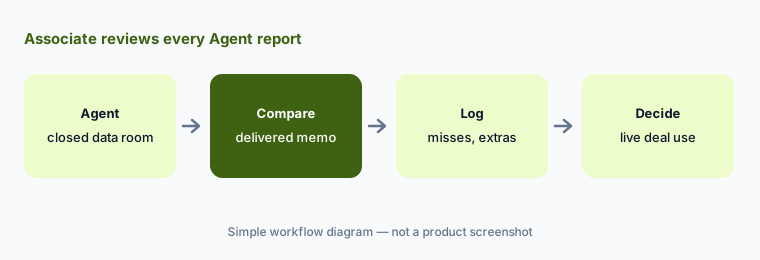
Primary workflow:
Give the Legora Agent one closed due-diligence data room. Have the supervising associate compare its issues list with the memo your team actually delivered before using it on a live deal.
2. Skills: the firm's standards, written down for the Agent
What it is: Legora launched Skills for all customers on 5 October 2026. A Skill is a set of plain-language instructions saved as a Markdown file, plus optional templates, reference material, and past examples (including what the output should not look like). The Agent uses a matching Skill on its own, or you pick one by typing “/”; if none exists, the Agent can build one from documents you already produced or by asking you questions, then asks whether to install it. Legora's Skills Library ships with 250+ Skills written by its legal engineers across 20+ practice areas.
Legora's governance rules help: a shared Skill is not used until the recipient installs it, org-wide sharing needs a permission admins control, every Skill can be read, and matter permissions still apply. None of that tells you whether the Skill is right — a knowledge lawyer has to test it.
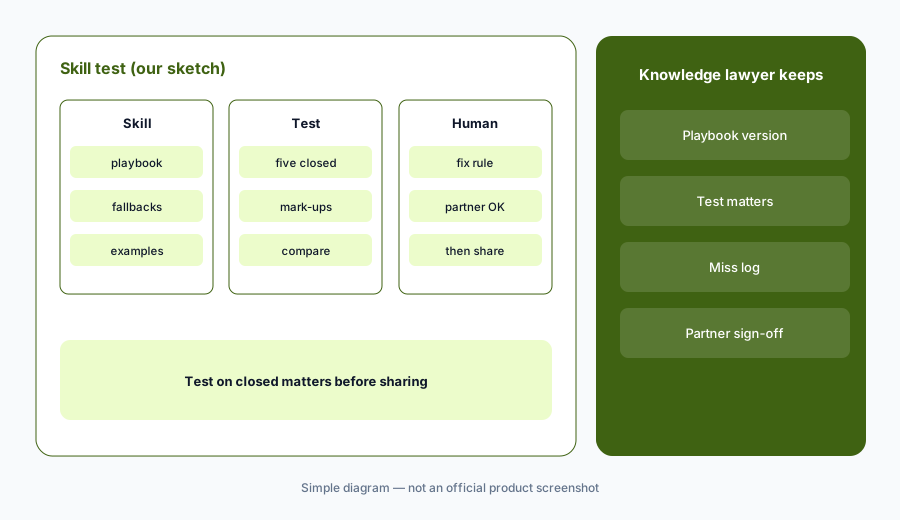
Test before sharing:
Turn one playbook into a Skill and run it on five matters the firm already closed. Have the knowledge lawyer and one partner compare every mark-up with the signed version before the Skill is shared beyond its author.
3. Tabular Review with cited cells
What it is: Legora's Tabular Review turns a document set into an AI spreadsheet: each document is a row, each question a column, and Legora says each answer is cited to its source. You import from a DMS, internal repository, or virtual data room, and reviewers can use Mark as Reviewed, Lock Cells, and Review Mode while working together.
Citations make checking faster, not optional. A sample tells you which columns can be trusted and which need a full human pass.
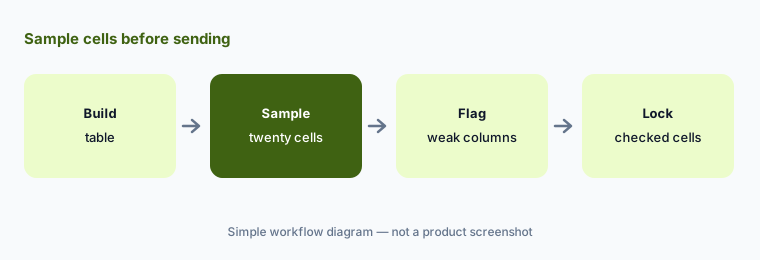
Sample before sending:
Build one Tabular Review across fifty documents. Have the associate click twenty random cells through to the cited source and mark each right or wrong before the table goes to the partner.
4. Lists: closing checklists from deal documents
What it is: With Lists, the Agent reads transaction documents and drafts a closing checklist — conditions precedent extracted with description, reference clause, assignee, and due date — as structured rows that link back to the source clause. Every change is logged for partner or general counsel sign-off. On 19 October 2026 Legora announced an Ansarada data-room integration (beta): users sign in with their own Ansarada login, see only what Ansarada lets them see, and every import is recorded in the data room's own audit trail.
A missing condition precedent can delay a closing. The checklist is a draft until a lawyer has checked it against the agreement.
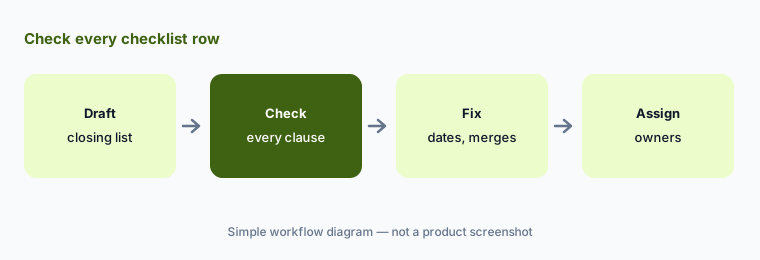
Check every row:
Ask the Agent for a closing checklist from one signed agreement. Have the transaction associate check every row against its clause and date before any task is assigned.
5. Monitors for regulatory change
What it is: Legora's Monitors scan regulation inside a perimeter you set (jurisdictions, topics, sources). Each article arrives with a summary, metadata, and a link to the original source; teams filter, assign owners, keep an audit trail, and can turn a development into research and a client deliverable without switching tools. Legora pitches it to firms as the base for client-facing horizon-scanning services.
A summary is not the rule. Before an alert reaches a client, a lawyer reads the source text.
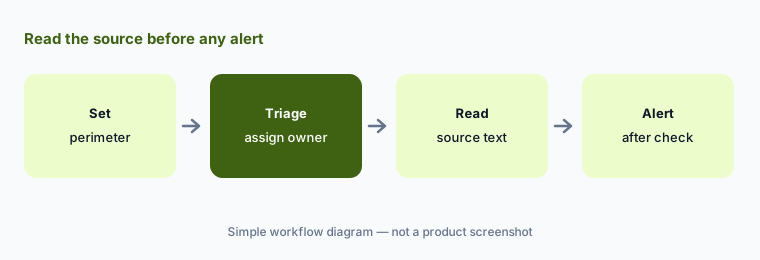
Read the source first:
Run one Monitor for a month on a perimeter your team already tracks by hand. Have the regulatory partner compare what it surfaced with your own list and read the source behind every item before any client alert.
6. aOS connections, Word and Outlook, and Intake for in-house teams
What it is: The aOS page describes connections to document management systems, knowledge bases, third-party legal services, and MCP connectors, with Word and Outlook add-ins and a mobile app. On 13 October 2026 Legora launched Intake for in-house teams, available in Slack (Teams, email, and MCP planned): the Agent scopes a request, routes it as a tracked task, and prepares the work; by default a lawyer reviews every piece of work before it goes back. Intake is aimed at legal departments, not law firms, so we note it rather than focus on it.
Every connection widens what the Agent can read. Decide which repositories and matters a pilot may touch before anyone connects them.
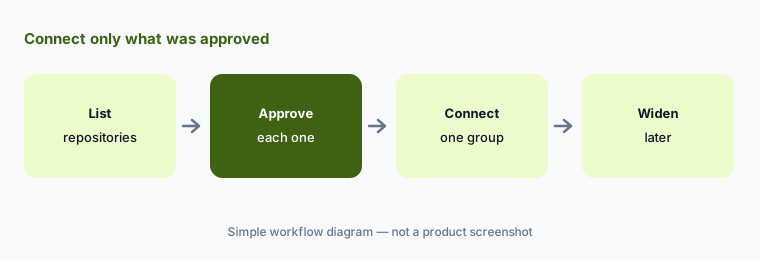
Connect on purpose:
Before a pilot, have the innovation lead list every repository and matter Legora may read, get the responsible partner's approval for each, and connect nothing else.
Pricing context (October 2026)
Legora does not publish prices: legora.com/pricing returned a 404 when we checked on 20 Oct 2026, and every route leads to “Book a demo.” Pricing is quote-only, and we print no third-party figures.
Ask what the quote covers: which products (Agent, Tabular Review, Legal Research, Lists, Monitors, Portal, Word and Outlook add-ins), how Legal Engineer support is charged, whether third-party content such as tax research or data-room connections costs extra, and whether usage is tied to seats, matters, or both.
Uncertainty: We did not test Legora. Features and dates come from Legora's press releases, blog, and product pages read on 20 Oct 2026. Timings in Legora's examples (a forty-minute due-diligence report, a thirty-minute pleadings matrix) and its customer and certification figures are Legora's claims. The Ansarada integration is in beta, and Intake is for in-house teams.
When it’s useful (honest take)
Useful when you are a mid-size or large firm with repeatable diligence, review, and regulatory work, a knowledge team that will write and test Skills, and supervising associates who review every Agent output before a client sees it.
Less useful when you mainly need small-firm practice management (Clio AI or 8am MyCase AI), plaintiff PI case work (Eve AI, Supio, or Litify AI), or a research platform of record with a citator (CoCounsel Legal or Lexis+ with Protégé). If you are choosing between large-firm platforms, see Harvey vs Legora.
Paying for Legora AI and a few other AI tools? The $9 AI toolkit spreadsheet lists every AI subscription you have, what each one costs, and how fast it pays for itself, so you can see which ones are worth the money.
Want someone to do it for you? AI toolkit audit — $19
Related options (educational)
| Need | Better home | Why |
|---|---|---|
| Agent, Skills, Tabular Review, Lists, Monitors | Legora AI (this page) | Quote only |
| Agents in matter Spaces, Vault, LexisNexis workflows | Harvey AI | Quote only |
| Westlaw-grounded research and briefs | CoCounsel Legal | Configurator or quote |
| Lexis research with Shepard's and Protégé | Lexis+ with Protégé | Quote only |
| In-house contract lifecycle | Ironclad | Narrower job |
FAQ
What is the Legora aOS?
Legora's name for its agentic operating system for legal work, introduced on 7 May 2026: one system that connects documents, firm knowledge, research, and drafting tools, with the Legora Agent doing the work and lawyers making the judgment calls.
When did the Legora Agent become available?
Legora made the Agent available to all customers on 4 June 2026. Skills followed for all customers on 5 October 2026.
How much does Legora cost in October 2026?
Legora publishes no prices; legora.com/pricing returned a 404 on 20 Oct 2026 and every route leads to a demo. Treat it as quote-only and ask for an itemized quote.
Can the Legora Agent send work to a client on its own?
Legora describes the Agent as pausing where judgment is needed. Firms should keep a rule that the supervising associate reviews every Agent work product before it reaches a client.
Who should check Legora output?
The supervising associate for Agent reports and tables, the partner for every flagged judgment call, the knowledge lawyer and a partner for every shared Skill, and the assigned lawyer for every Monitors alert before it reaches a client.
Optional next step (if seats overlap)
If you pay for Legora, a research platform, and general chat seats that all draft the same first-pass memos, that overlap is worth mapping. Map the overlap with the $19 AI toolkit audit or the $9 AI toolkit spreadsheet. Email Audit $19 or Toolkit spreadsheet $9.
Checkout is live via Stripe. After you pay, we email delivery (spreadsheet) or intake next steps (audit).