Tool · Law firm ops · Supio · Oct 2026
Supio AI review (Oct 2026): Supio Agent for plaintiff case prep, medical record analysis, YoCierge record retrieval, and Supio Intake
Supio (Seattle) sells AI built for plaintiff personal-injury and mass tort firms. Its center is Supio Agent, launched at SupioSphere on 14 May 2026: one agent that works across every case, builds chronologies and demands, tracks bills and liens, and proposes work it can do with a legal professional's approval. Since then Supio has added YoCierge record retrieval inside the agent (25 August), long-horizon agents (3 September), and Case Communications (2 October). This page is about using it while a case manager and the handling attorney still check every flag and figure. Each section has a Try this.
What this Supio page covers
This page is for a managing attorney, pre-litigation lead, case manager, or paralegal at a plaintiff PI firm. It is educational, not legal advice and not medical advice. We did not test Supio; facts come from Supio's press releases, blog, and product pages read on 20 October 2026.
Supio calls Supio Agent “the first end-to-end agentic AI platform built exclusively for plaintiff law” (14 May 2026). That is Supio's claim, as are its homepage figures ($500–1,000 saved per case; 437 hours saved across six cases at one firm) and the customer results it cites, such as Phillips Law Group's 1,400 added cases at a 2.7x average fee (3 Sep 2026). We report them as vendor figures, not our measurements.
Supio says Supio Agent runs on a closed, HIPAA-compliant system, that client data is never used to train foundation models, and that it can draw on Thomson Reuters Westlaw Advantage, part of CoCounsel Legal (Westlaw link-up, 16 Apr 2026). Its security page lists SOC 2 Type II and data centers in the U.S., UK, and Canada.
Ground rules: a licensed attorney owns any filing, citation, demand, deadline, client message, or discovery response that comes out of Supio. The case manager checks every treatment-gap flag before a records request goes out; the handling attorney checks every injury, date, and dollar figure before any demand; and an attorney approves every script before an agent talks to a client, carrier, or provider.

Major features (with how someone uses them)
Examples at a glance: each feature has a concrete example from a real job plus a short Try this you can run this week.
1. Supio Agent and treatment-gap flags (primary)
What it is: Supio Agent (SupioSphere, 14 May 2026) works on one case, across cases, or across the whole firm. Supio says it builds timelines, drafts demands, tracks liens and medical expenses, supports litigation, and “can identify tasks it can perform across every active matter and can execute with a legal professional's approval.” Its product page describes pre-built plaintiff-law skills that firms shape to their own demand style and chronology format, and memory that learns from accepted and edited work.
A treatment-gap flag is a lead, not a finding. A gap can be real, a record that never arrived, or a provider the client never mentioned. The case manager decides which, before anyone orders records or tells the client.
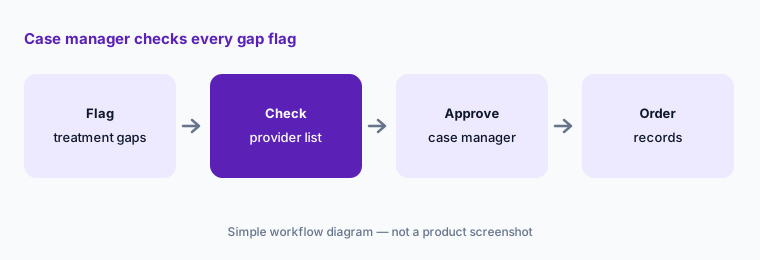
Primary workflow:
Have Supio Agent flag treatment gaps on ten active cases. Have the case manager check each flag against the provider list before ordering any new records.
2. Medical chronologies and Case Signals
What it is: Supio's medical chronology page describes an Instant Timeline that pins every fact to its source page and cross-links events, providers, injuries, and treatment, with filters by date, provider, injury, or treatment. Case Signals sit on top of the timeline and flag gaps, possible undiagnosed injuries, and missing documents. Supio says human subject-matter experts verify its chronologies.
Vendor review of a chronology is not your firm's review. Prior injuries and gaps in care decide how a carrier reads the file, so those entries get checked first, against the record itself.
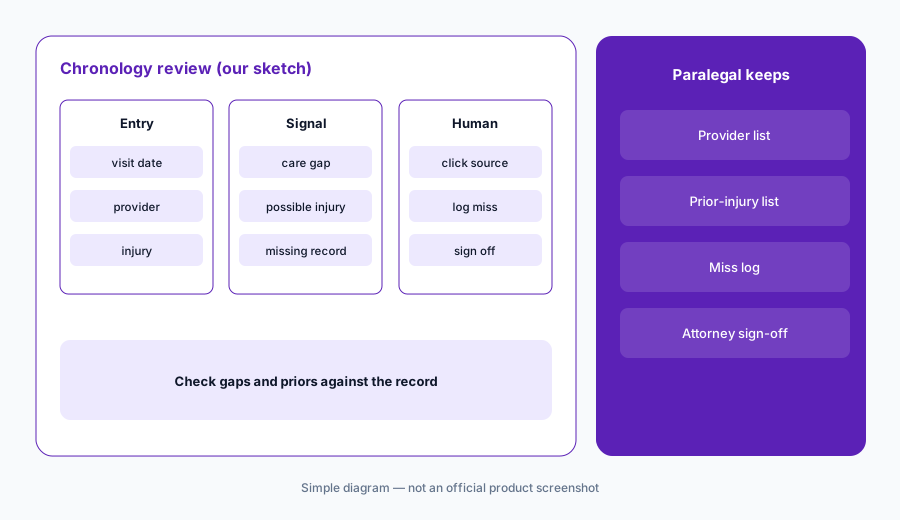
Check priors and gaps first:
Run Supio chronologies on two closed cases that already have a firm chronology. Have the paralegal and handling attorney click every gap and prior-injury entry through to the source page before relying on it for open files.
3. YoCierge record retrieval inside Supio Agent
What it is: On 25 August 2026 Supio and YoCierge announced HIPAA-compliant record retrieval inside Supio Agent, extending a partnership first announced in January 2026. Staff upload a signed HIPAA authorization in Supio; it attaches to the request; YoCierge retrieves the records through its provider network; and Supio Agent then reviews them for undiagnosed injuries, treatment gaps, and missing documentation. Supio says that when the review finds a gap, the agent “can trigger the next record request from within the case itself.”
Automatic re-requests save chasing, but every request uses the client's authorization and can cost the firm money. Decide who approves a request before the agent sends one.
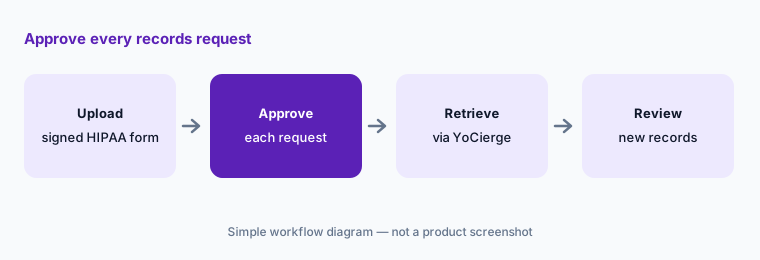
Approve every request:
For ten cases, have the case manager approve each YoCierge request against the signed authorization and the provider list before it is sent, and log any request the agent proposes that you would not have made.
4. Case Economics: bills, liens, and duplicates
What it is: Supio's Case Economics builds an Instant Ledger of billed amounts, adjustments, insurance payments, and patient responsibility by facility, and an Instant Liens ledger that sorts statutory and contractual liens by type and tracks negotiated reductions line by line. Supio says duplicates are detected across bills and liens, each item links to its source document, and a complete picture is ready “for most cases, under 30 minutes” — its claim.
Specials and liens end up in a settlement statement the client signs. A ledger that links to source pages is easier to check, but someone still has to check it.
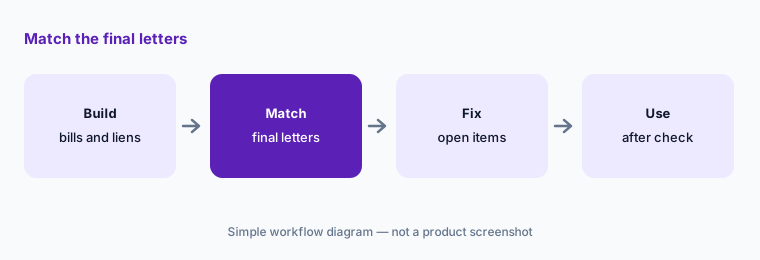
Match the final letters:
On two closed cases, have the handling attorney reconcile Supio's bills and liens ledger with the final bills, lien letters, and settlement statement before using any ledger total on an open case.
5. Case Communications and long-horizon agents
What it is: Supio's 3 September 2026 update added long-horizon agents that carry work over days and weeks across email, fax, phone, and text and escalate to an attorney when judgment is needed, plus a vetted medical provider referral network (California first). On 2 October 2026 it launched Case Communications: calls, texts, emails, and faxes are linked to the right case, the agent updates case memory and files tasks, and it can reach out to clients, carriers, and providers by voice, text, email, or fax, with staff “informed and in control.” It also announced Agent Simon, a licensable agent built on Simon Law Group's methods.
An agent that calls a carrier or texts a client speaks for the firm. What it may never say — case value, advice, settlement talk — needs a written rule and an attorney's sign-off before it sends anything.
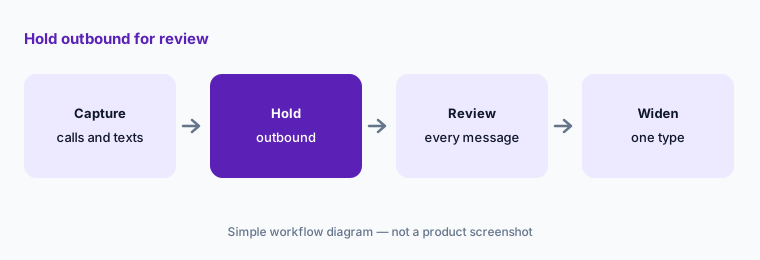
Hold outbound for review:
Run Case Communications with every outbound message held for review on ten active cases for two weeks. Have the managing attorney approve the scripts and read every proposed client and carrier message before any of them can send on their own.
6. Supio Intake: voice agent, lead ranking, and coaching
What it is: Supio Intake (launched 14 May 2026) combines a 24/7 voice agent for overflow and after-hours calls, an agent that qualifies and ranks every lead by severity and urgency, and a coaching agent that gives intake staff report cards on each call (Supio). Supio says it is configured to your intake script and case criteria and syncs with Litify, SmartAdvocate, Salesforce, and others.
A declined lead is a person who called for help. Rules that rank or turn away callers are firm policy and need a named owner, not just a vendor default.
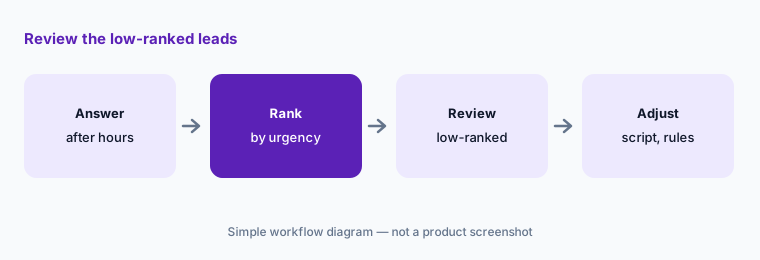
Review the low-ranked leads:
For two weeks, have the intake manager review every lead Supio Intake ranked low or would decline before letting its rankings route any lead without a person looking.
Pricing context (October 2026)
Supio publishes no price list (re-checked 21 Oct 2026). Its old pricing address now redirects to a demo request form that shows no prices. When we read the pricing page on 20 Oct 2026, it described flexible pricing based on firm size and case volume, unlimited users and pages, no lock-in contracts or platform fees, pilots on a handful of cases, and per-case invoices. Supio no longer shows that wording publicly, so treat it as a dated note and ask for each term in the written quote. We treat Supio as quote-only and print no third-party figures.
Ask what your quote counts (cases, case volume, or a case pack), which modules it includes (chronologies, demands, Case Economics, drafting, Intake, Case Communications), whether YoCierge record fees are billed separately, and what a pilot costs.
Uncertainty: We did not test Supio. Features and dates come from Supio's press releases, blog, and product pages read on 20 Oct 2026; pricing re-checked 21 Oct 2026. Time-saved, fee, settlement, and adoption figures and “first” language are Supio's or its customers' claims. The provider referral network starts in California; Case Communications launched 2 Oct 2026 and may not be live in every account yet.
When it’s useful (honest take)
Useful when you are a plaintiff PI or mass tort firm where medical records and follow-up are the bottleneck, and a case manager, paralegal, and handling attorney will check every flag, ledger line, and figure against the records.
Less useful when you want a done-for-you demand service (EvenUp), your demands already live in your case system (Filevine AI), you run general small-firm practice management (Smokeball AI lists Supio as an app inside Archie; 8am MyCase AI), or you mainly need legal research (CoCounsel Legal).
Paying for Supio and a few other AI tools? The $9 AI toolkit spreadsheet lists every AI subscription you have, what each one costs, and how fast it pays for itself, so you can see which ones are worth the money.
Want someone to do it for you? AI toolkit audit — $19
Related options (educational)
| Need | Better home | Why |
|---|---|---|
| PI agent, chronologies, records, ledgers | Supio (this page) | Quote only; ask via demo request |
| PI demands, chronologies, pre-lit service | EvenUp | Case-based quote |
| PI case management with demand drafting | Filevine AI | Custom quote |
| Small-firm practice management with Archie | Smokeball AI | Quote only; Archie is an add-on |
| Westlaw-grounded research and briefs | CoCounsel Legal | Configurator or quote |
FAQ
What does Supio do?
Supio builds AI for plaintiff personal-injury and mass tort firms: Supio Agent for case prep across matters, medical chronologies with Case Signals, Case Economics bill and lien ledgers, drafting, Supio Intake, YoCierge record retrieval, and Case Communications.
When did Supio Agent launch?
Supio launched Supio Agent and Supio Intake at its SupioSphere conference on 14 May 2026. YoCierge retrieval inside the agent followed on 25 August 2026 and Case Communications on 2 October 2026.
How much does Supio cost in October 2026?
Supio publishes no prices. As of 21 Oct 2026 its pricing address redirects to a demo request form, so pricing comes only through a quote. On 20 Oct 2026 that page described pricing by firm size and case volume; ask for those terms in writing.
Can Supio order medical records on its own?
With the YoCierge integration, Supio says the agent can trigger the next record request when it finds a gap. Firms can keep a person approving every request; we suggest the case manager does.
Who should check Supio output?
The case manager for treatment-gap flags and record requests, the paralegal and handling attorney for chronologies and ledgers, the intake manager for lead rules, and an attorney for every demand, client message, and agent script.
Optional next step (if seats overlap)
If you pay for Supio, a PI case-management system, and a separate demand or records service that all touch the same file, that overlap is worth mapping. Map the overlap with the $19 AI toolkit audit or the $9 AI toolkit spreadsheet. Email Audit $19 or Toolkit spreadsheet $9.
Checkout is live via Stripe. After you pay, we email delivery (spreadsheet) or intake next steps (audit).