Compare · Law firm ops · Oct 2026
Harvey vs Legora (Oct 2026): Harvey II Spaces and Agent Builder vs Legora aOS, Agent, and Skills for law firm AI
Harvey and Legora are the two legal AI platforms large firms most often pilot side by side. Harvey relaunched as Harvey II in August 2026, with agents working inside matter Spaces, plus Vault, review tables, Agent Builder, and LexisNexis-backed workflows. Legora introduced its aOS in May 2026, with the Legora Agent, Skills, Tabular Review, Lists, and Monitors. Both are quote-only. This page splits them by job, explains how to run one closed matter through both pilots without client data leaving approved workspaces, and is not a ranking. Each section has a Try this.
What this comparison covers
This page is for a knowledge-management partner, innovation director, or practice-group leader choosing between Harvey and Legora, or running a pilot of both. It is educational, not legal advice.
Facts come from our Harvey AI and Legora AI reviews, checked on 20 October 2026 against Harvey's Harvey II announcement and release notes, and Legora's aOS announcement, Agent post, and Skills post. We did not test either product. Neither vendor publishes prices.
Both vendors describe an agent that plans and does multi-step legal work while a lawyer makes the judgment calls, so features overlap more than names suggest. The useful differences are in where the agent works, how firm know-how is captured, how big document sets are handled, and what sits behind research and litigation drafting.
Ground rules for either pilot: a licensed attorney owns any filing, citation, demand, deadline, client message, or discovery response that either platform produces. The supervising associate checks every agent output, the litigation partner owns strategy, and the KM partner approves which matters and repositories each pilot may touch. This comparison is not a ranking.
| Question | Harvey | Legora |
|---|---|---|
| Latest platform launch | Harvey II, 18 Aug 2026 | Legora aOS, 7 May 2026; Agent for all customers 4 Jun 2026 |
| Where agents work | Inside matter or project Spaces with documents, parties, permissions, and ethical walls | Inside the aOS, drawing on playbooks, precedents, and connected systems; matter permissions apply |
| Firm know-how | Agent Builder (9 Mar 2026); Custom Agents usable on save, 14 Oct 2026 | Skills (5 Oct 2026); 250+ Skills in the library |
| Large document sets | Vault with agentic search (26 Aug 2026) and organization; review tables | Tabular Review with cited cells; Agent data-room review; Ansarada link (beta, 19 Oct 2026) |
| Litigation drafting | Motion to Dismiss workflow with LexisNexis (7 Oct 2026) | Agent examples include a pleadings matrix; agentic legal research |
| Price | Quote only (pricing page 404); seat-based per Law360 | Quote only (pricing page 404; demo only) |
| Who signs off | Supervising associate on agent first passes; litigation partner on motion strategy | Supervising associate on Agent work; knowledge lawyer and partner on Skills |
Major features (with how someone uses them)
Examples at a glance: each feature has a concrete example from a real job plus a short Try this you can run this week.
1. Run one closed matter through both pilots (primary)
What it is: Both vendors sell through demos and pilots: Harvey's pricing page returns a 404 and Legora's every route leads to “Book a demo” (checked 20 Oct 2026). A pilot is where you learn what each one misses on your own work. A closed matter is the safest test set, because the team already knows which issues mattered and nothing new goes to a client.
Ask each vendor in writing whether its pilot terms allow a closed client matter, where that data is stored, and how it is deleted when the pilot ends. If either says no, sanitize the matter or pick one with client consent.
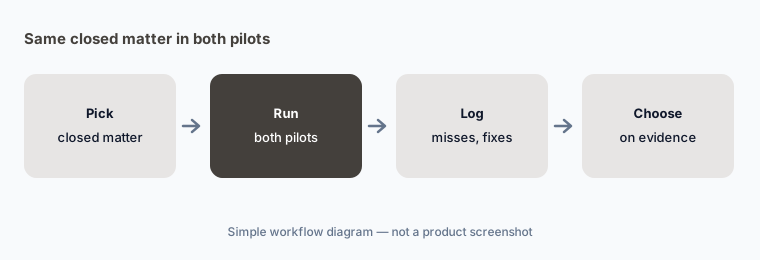
Primary workflow:
Run the same closed matter through both pilots if both vendors allow it. Have the KM partner compare which issues each missed and who had to fix the output before choosing.
2. Where the agent works: Harvey Spaces vs the Legora aOS
What it is: In Harvey II, an agent opens inside a matter or project Space with its documents, parties, tasks, permissions, and ethical walls already attached, and Harvey says usage and cost stay tied to that matter. Legora's aOS orchestrates the Legora Agent across research, drafting, and review, drawing on playbooks, precedents, and connected systems such as the DMS, email, and matter systems; Legora says matter permissions apply to everything the Agent uses.
Both models depend on your permissions being right before the agent runs. An ethical wall that is wrong in the DMS is wrong for the agent too.
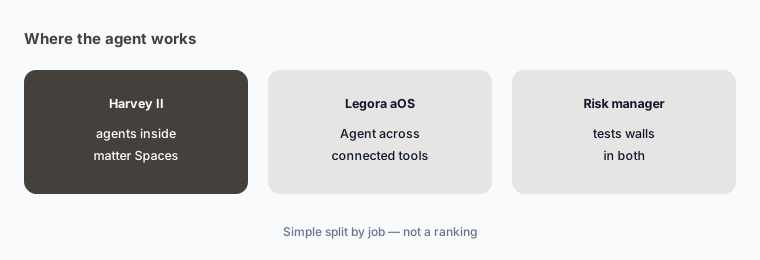
Test the walls:
Before either pilot touches client work, have the risk manager ask for a walled matter from an account outside the wall in both tools and record the result.
3. Firm know-how: Agent Builder vs Skills
What it is: Harvey's Agent Builder (9 Mar 2026) turns a team's process into a reusable workflow agent; since the 14 Oct 2026 release, Custom Agents are usable as soon as they are saved, with admin approval only at the sharing levels a firm chooses. Legora's Skills (5 Oct 2026) are readable Markdown instructions with templates and examples; a shared Skill is not used until the recipient installs it, and org-wide sharing needs a permission.
Both let one good process spread quickly — and one flawed process too. Decide who approves sharing before anyone builds.
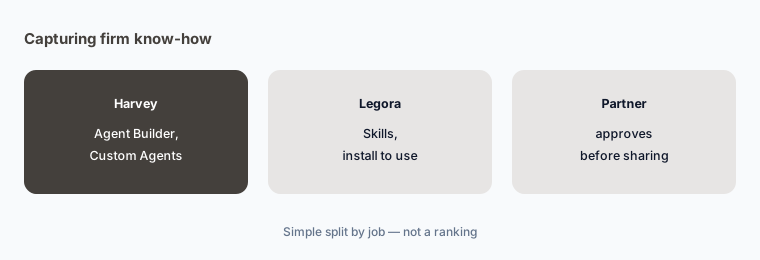
Approve before sharing:
Build one repeat process in both tools and run it on the same five closed matters. Have the knowledge lawyer and a partner approve each version before either is shared beyond the team.
4. Large document sets: Vault vs Tabular Review
What it is: Harvey's Vault holds data rooms and productions, with agentic search (26 Aug 2026) and agentic organization that proposes a plan, waits for confirmation, can undo the latest changes, and never edits file contents (Harvey); review tables pull terms across documents. Legora's Tabular Review puts documents in rows and questions in columns with each cell cited, and on 19 Oct 2026 Legora announced a beta Ansarada data-room integration that respects Ansarada permissions and logs imports in the room's audit trail.
Cited cells and logged moves make checking easier. They do not make sampling optional.
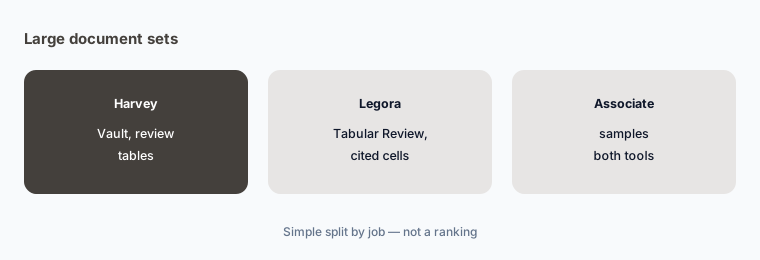
Sample both:
Build the same review table in both pilots across fifty closed agreements. Have the associate check twenty random cells in each against the source before trusting any column.
5. Research and litigation drafting
What it is: Harvey's Motion to Dismiss workflow, co-developed with LexisNexis (7 Oct 2026), proposes up to eight grounds, has the lawyer approve the plan, returns research memos with the Shepard's Signal, and drafts the motion; it needs Ask LexisNexis access or a Lexis+ with Protégé subscription. Legora describes jurisdiction-aware research inside the aOS and introduced agentic legal research at Precedent London; its Agent post gives a pleadings matrix of 82 paragraphs in about thirty minutes as an example — Legora's figure.
Neither is your citator of record unless your contract says so. Firms usually keep CoCounsel Legal or Lexis+ with Protégé for authority they will cite.
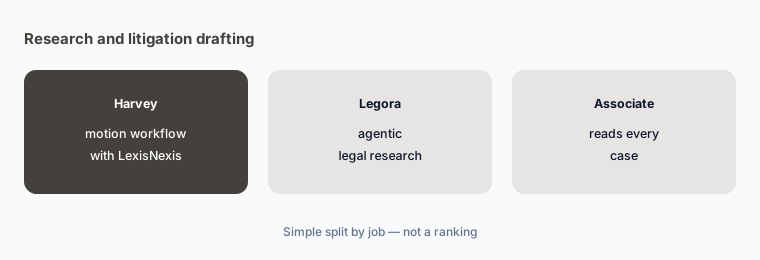
Read every case:
On one closed motion, have the litigation partner compare each platform's grounds with what you filed and have an associate read every cited case before either output counts as a draft.
6. Pilot rules: keep client data inside approved workspaces
What it is: Harvey says Memory can be viewed, changed, or turned off and is never used to train models, and that ethical walls apply to agents as to the user (Harvey II). Legora says Skills used on one matter don't carry information into another and lists “zero AI training on your data” among its commitments (Skills post; homepage). Those are vendor statements; your pilot agreement is what binds them.
A side-by-side pilot doubles the places client data can live. Write down which matters, repositories, and users each pilot may touch, and how data is deleted at the end.
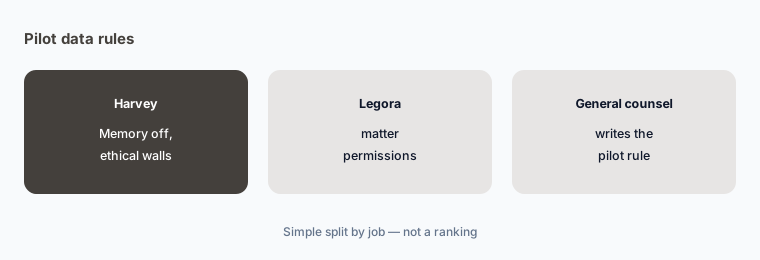
Write the pilot rule:
Before loading any matter, have the firm's general counsel write which matters, repositories, and users each pilot may touch and get both vendors to confirm deletion terms in writing.
Pricing context (October 2026)
Harvey (as of 20 Oct 2026): no published prices; harvey.ai/pricing returns a 404. Law360 reported on 19 Aug 2026 that Harvey sticks with seat-based pricing. Per-seat figures circulating online are unconfirmed third-party reports, so we do not print them.
Legora (as of 20 Oct 2026): no published prices; legora.com/pricing returns a 404 and every route leads to a demo. We print no third-party figures. Both are quote-only; ask each for an itemized quote covering seats, add-ons (LexisNexis content for Harvey's motion workflow; third-party content and Legal Engineer support for Legora), and pilot terms.
Uncertainty: We did not test either product. Features and dates come from each vendor's own announcements as read on 20 Oct 2026; timings and usage figures are vendor claims. Pilot terms, data handling, and availability differ by contract and region, so confirm them in writing.
When it’s useful (honest take)
Useful when you are a mid-size or large firm shortlisting Harvey and Legora and want to compare them on your own closed work, with a KM partner who will run the pilot and a risk manager who will test walls.
Less useful when you are a small firm that mainly needs practice management (Clio AI, Smokeball AI), a plaintiff PI firm (Eve AI, Litify AI, EvenUp), or you need a research platform rather than an agent platform (CoCounsel Legal).
Still choosing between Harvey and Legora? The $19 AI toolkit audit gives you a written plan for which tools to keep using and which to drop across your whole AI stack, including this pair.
Prefer to do it yourself? Spreadsheet — $9
Related options (educational)
| Need | Better home | Why |
|---|---|---|
| Agents in matter Spaces, Vault, LexisNexis workflows | Harvey AI | Quote only |
| aOS, Agent, Skills, Tabular Review, Monitors | Legora AI | Quote only |
| Westlaw-grounded research and briefs | CoCounsel Legal | Configurator or quote |
| Lexis research with Shepard's and Protégé | Lexis+ with Protégé | Quote only |
| PI and litigation case management with AI | Filevine AI | Custom quote |
FAQ
What is the main difference between Harvey and Legora?
Harvey II puts agents inside matter Spaces and adds Vault, review tables, Agent Builder, and LexisNexis workflows. Legora's aOS centers on the Legora Agent with Skills, Tabular Review, Lists, and Monitors. The features overlap; this page is not a ranking.
Which is cheaper in October 2026?
Neither publishes prices. Both pricing pages returned a 404 on 20 Oct 2026, so a comparison needs itemized written quotes from both.
Can we pilot both on the same matter?
Only if both vendors' pilot terms allow it and the client has consented, or the matter is sanitized. Use a closed matter so nothing new reaches a client.
Do Harvey Custom Agents and Legora Skills do the same thing?
Both capture a team's process for reuse. Harvey Custom Agents are workflow agents usable on save with admin-set sharing approval; Legora Skills are readable instruction files a user must install before the Agent uses them.
Who should approve output in a side-by-side pilot?
The supervising associate for every agent output, the litigation partner for strategy, the KM partner for which matters each pilot may touch, and the firm's general counsel for pilot data terms.
Optional next step (if seats overlap)
If your firm pays for Harvey or Legora on top of a research platform and general chat seats that draft the same first-pass work, that overlap is worth mapping. Map the overlap with the $19 AI toolkit audit or the $9 AI toolkit spreadsheet. Email Audit $19 or Toolkit spreadsheet $9.
Checkout is live via Stripe. After you pay, we email delivery (spreadsheet) or intake next steps (audit).