Compare · Law firm ops · Oct 2026
EvenUp vs Supio (Oct 2026): demand-letter platform and pre-litigation service vs Supio Agent case prep for PI firms
EvenUp and Supio both sell AI only to plaintiff personal-injury firms, and both now reach well beyond a single document. EvenUp is built around demand letters and MedChrons, and since May 2026 also sells Pre-Litigation as a Service, where its own team runs the claim up to settlement talks. Supio is built around Supio Agent, which works across a firm's cases on records, gaps, bills, and liens, with YoCierge record retrieval inside it. Both are quote-only. This page splits them by job, explains how to test both on closed cases, says when a firm should keep its own demand writers, and is not a ranking. Each section has a Try this.
What this comparison covers
This page is for a managing attorney, pre-litigation lead, case manager, or demand writer at a plaintiff PI firm choosing between EvenUp and Supio, or running a pilot of both. It is educational, not legal advice and not medical advice.
Facts come from our EvenUp and Supio reviews and were re-checked on 20 October 2026 against EvenUp's demands page, PLAAS announcement, and subscription terms, and Supio's Supio Agent launch, YoCierge announcement, and Case Communications announcement. We did not test either product. Outcome figures on both vendors' sites — settlement amounts, days saved, hours saved — are their claims, not our measurements, and we leave them out.
The two overlap on chronologies, demands, and outreach, but they start from different places. EvenUp starts from the demand and can take the whole pre-litigation file off your desk. Supio starts from the case file and keeps the work inside your team, with agents that run longer jobs and hand decisions back to a person.
Ground rules for either pilot: a licensed attorney owns any filing, citation, demand, deadline, client message, or discovery response that either platform produces. The handling attorney checks every injury, treatment date, and specials figure against the records and bills and signs every demand; the case manager checks every treatment-gap flag before records are ordered. This comparison is not a ranking.
| Question | EvenUp | Supio |
|---|---|---|
| Best known for | Demand letters and MedChrons medical chronologies | Supio Agent case prep across medical records, bills, and liens |
| Demand route | AI + You (your team finalizes) or AI + Professional Review (EvenUp staff, 1–5 days) | Agent drafts inside the case for your team to review |
| Records | Records and bills retrieval inside PLAAS; agents chase records | YoCierge retrieval inside Supio Agent (25 Aug 2026) |
| Service option | PLAAS: EvenUp's case team runs pre-litigation (13 May 2026) | Long-horizon agents work for days or weeks and escalate to an attorney (3 Sep 2026) |
| Client and provider outreach | Communication Agents by voice and text (28 Jan 2026) | Case Communications by voice, text, email, fax (2 Oct 2026) |
| Research link | Lexis+ with Protégé inside Companion (1 Sep 2026) | Westlaw Advantage connection (16 Apr 2026) |
| Price | Quote only; “case-based pricing”, no figure | Quote only; pricing page now a demo request form |
| Who signs off | Handling attorney on every demand figure | Case manager on every gap flag; handling attorney on every demand |
Major features (with how someone uses them)
Examples at a glance: each feature has a concrete example from a real job plus a short Try this you can run this week.
1. Run five closed cases through both chronologies (primary)
What it is: A chronology is the base for everything else both vendors sell: the demand, the specials total, the gap flags. EvenUp's MedChrons link each timeline entry to the source record, and Supio says every fact in its medical chronologies is pinned to its source. Closed cases are the safest test set, because your team already knows which treatment dates and bills mattered and nothing new goes to a carrier.
Ask each vendor in writing whether its pilot terms allow closed client files, where the records are stored, and how they are deleted when the pilot ends. Medical records carry health information, so the firm's privacy and engagement terms apply.
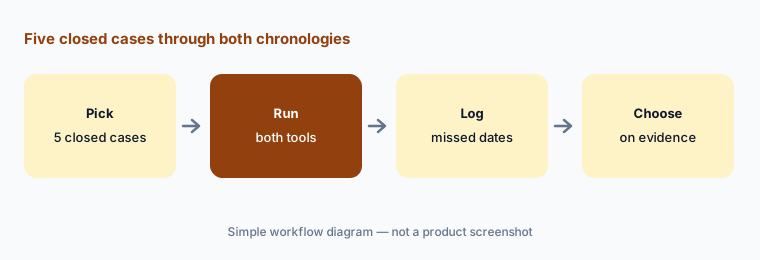
Primary workflow:
Pick five closed PI cases. Have the handling attorney run each tool's chronology and compare missed treatment dates and specials before choosing.
2. Demand letters: two EvenUp routes vs drafting inside Supio Agent
What it is: EvenUp's demands page offers AI + You (drafted by its Piai model; your team reviews, edits, and finalizes) or AI + Professional Review (EvenUp's legal professionals review before delivery, in 1–5 days). Supio says it drafts demands and litigation documents, and its Supio Agent page describes pre-built skills for plaintiff work that a firm shapes, such as demand style and chronology format; the same page says your team reviews and makes the judgement.
Vendor review is not attorney review. Whichever route you pick, the handling attorney still owns every figure and every word that goes to a carrier.
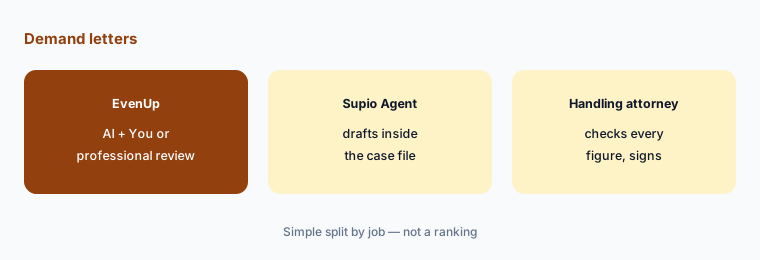
Check every figure:
Ask both pilots for a demand on the same closed case. Have the handling attorney check every bill, wage figure, and treatment line against the file before either draft counts.
3. Records retrieval and treatment gaps
What it is: Supio added YoCierge record retrieval inside Supio Agent on 25 Aug 2026: you upload a signed HIPAA authorization, YoCierge requests records through its provider network, and Supio Agent reviews what comes back for treatment gaps, undiagnosed injuries, and missing documents and can trigger the next request from inside the case. EvenUp includes records and bills retrieval in PLAAS, and its Communication Agents chase records and verify balances.
An automatic follow-up request is still a request sent in the client's name. Decide who approves it before anyone turns it on.
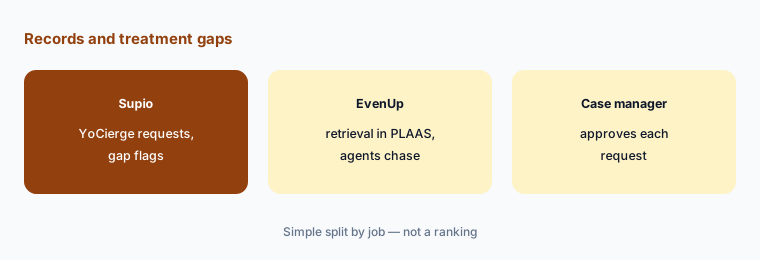
Approve each request:
Have each pilot flag treatment gaps on ten active cases. Have the case manager check every flag against the provider list and intake notes before any record request goes out.
4. Hand off pre-litigation or keep your own demand writers
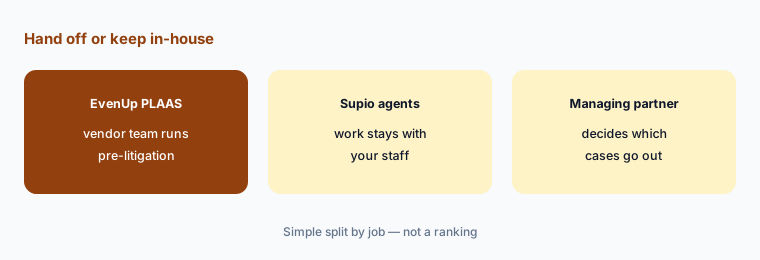
What it is: EvenUp's Pre-Litigation as a Service (13 May 2026) has its US-based case team handle claim setup, treatment tracking, records and bills, the demand, settlement negotiation with carriers, and optional lien resolution. Supio's long-horizon agents (3 Sep 2026) work on a case over days or weeks across email, fax, phone, and text and escalate to an attorney, so the work stays with your staff.
Keep your own demand writers when your firm's demands are a differentiator, your cases turn on judgement about liability or damages, or you cannot supervise an outside team closely. Outsourcing work does not outsource the attorney's duty to supervise it.
Decide the split:
List last month's cases by type. Have the managing partner mark which ones your own demand writers must keep and who supervises any case handed to an outside team.
5. Client and provider outreach by agent
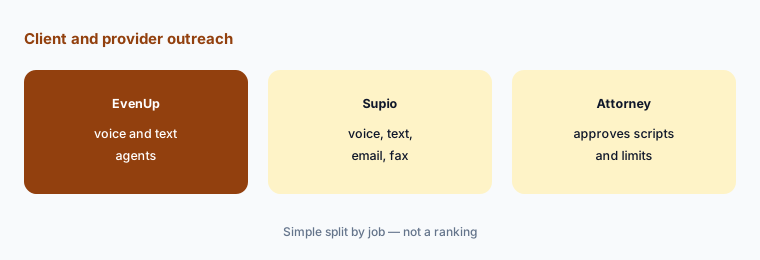
What it is: EvenUp's Communication Agents (28 Jan 2026) use AI voice and text to open claims, confirm liability and coverage, check in on treatment, chase records, and verify balances. Supio's Case Communications (2 Oct 2026) link calls, texts, emails, and faxes to each case, let its agent reach out by voice, text, email, or fax, draft HIPAA authorization requests, and keep staff able to step in.
Anything an agent says to a client is a client message. An attorney approves the scripts and the topics an agent may not touch, such as case value or legal advice.
Approve the scripts:
Before any agent contacts a client, have the handling attorney approve the scripts and a list of topics the agent must hand to a person, then test both pilots with a case-value question.
6. Research links: Lexis+ with Protégé vs Westlaw Advantage
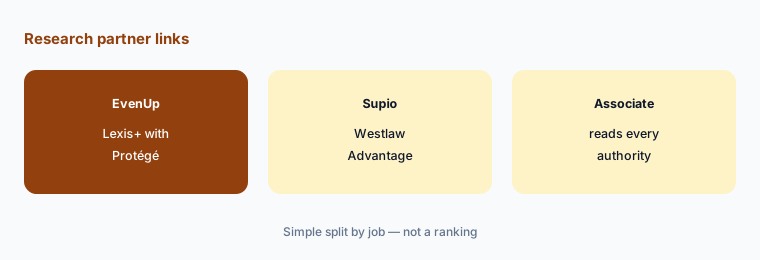
What it is: EvenUp's Companion assistant is powered by Lexis+ with Protégé under the LexisNexis alliance (1 Sep 2026); each user needs their own Protégé entitlement, and EvenUp says only case details such as jurisdiction, case type, and key dates are shared with LexisNexis. Supio connects to Westlaw Advantage (16 Apr 2026) for deep research and jurisdictional surveys. Which side fits may depend on the research platform your firm already pays for — see CoCounsel Legal vs Lexis+ with Protégé.
A research link inside a PI tool is not a citator check. Any authority that goes into a demand or a filing is read by an attorney.
Read every authority:
Ask both pilots one research question your firm answered last month. Have the associate read every cited authority in its current form before any answer goes into a demand.
Pricing context (October 2026)
EvenUp (as of 20 Oct 2026): no published prices. evenuplaw.com/pricing redirects to the homepage, and the demands page says “All-In-One, Case-Based Pricing” with no figure. EvenUp's subscription terms (version 9.3.26) say fees are set in an Order Form, usage limits may be counted in credits, cases, or pages, and overage is billed monthly. Quote-only.
Supio (as of 20 Oct 2026): no published prices. When we read supio.com/pricing on the morning of 20 October it said “flexible pricing based on firm size and case volume,” “unlimited usage, unlimited users, unlimited pages,” and no lock-in contracts or platform fees; by the afternoon the same address redirected to a demo request form. Quote-only. Ask both vendors for an itemized quote covering cases or credits, overage, record-retrieval fees, and pilot terms.
Uncertainty: We did not test either product. Features and dates come from each vendor's own pages and announcements as read on 20 Oct 2026; settlement, speed, and hours-saved figures are vendor claims and are not repeated here. Pricing structures and pilot terms differ by contract, and Supio changed its pricing page during the day we checked it, so confirm everything in writing.
When it’s useful (honest take)
Useful when you run a plaintiff PI firm shortlisting EvenUp and Supio and want to compare them on your own closed cases, with a handling attorney who will check every figure and a case manager who will check every gap flag.
Less useful when you mainly need PI case management with AI built in (Filevine AI, Litify AI), an agent platform for plaintiff work that drafts discovery and pleadings (Eve AI), or intake CRM rather than case prep (Lawmatics AI).
Still choosing between EvenUp and Supio? The $19 AI toolkit audit gives you a written plan for which tools to keep using and which to drop across your whole AI stack, including this pair.
Prefer to do it yourself? Spreadsheet — $9
Related options (educational)
| Need | Better home | Why |
|---|---|---|
| Demands, MedChrons, pre-litigation service | EvenUp | Quote only, case-based |
| Agent case prep, record retrieval, gap flags | Supio | Quote only |
| Plaintiff agents for discovery and pleadings | Eve AI | Quote only |
| PI case management with DemandsAI and MedChron | Filevine AI | Custom quote |
| Salesforce case platform; demands powered by Supio | Litify AI | Quote only |
FAQ
What is the main difference between EvenUp and Supio?
EvenUp starts from the demand letter and can also run pre-litigation for you through PLAAS. Supio starts from the case file, with Supio Agent working across records, bills, and liens and YoCierge retrieval built in, and keeps the work with your team. This page is not a ranking.
Which is cheaper in October 2026?
Neither publishes prices. EvenUp describes case-based pricing set in an Order Form; Supio's pricing page redirected to a demo request on 20 Oct 2026. Compare itemized written quotes.
Can we test both on the same cases?
Only if both vendors' pilot terms allow closed client files and your engagement and privacy terms permit it. Use closed cases so nothing new reaches a carrier, and have the handling attorney log every missed treatment date and specials line.
Should we keep our own demand writers?
Keep them where your demands set your firm apart, where cases turn on judgement about liability or damages, or where you cannot supervise an outside team closely. Outsourced work still needs attorney supervision.
Who approves output in a side-by-side pilot?
The handling attorney for every demand and specials figure, the case manager for every treatment-gap flag and record request, an attorney for every client-facing agent script, and the managing partner for which cases go to any outside team.
Optional next step (if seats overlap)
If your firm pays for a PI platform, a case-management system with AI, and general chat seats that all draft the same chronologies, that overlap is worth mapping. Map the overlap with the $19 AI toolkit audit or the $9 AI toolkit spreadsheet. Email Audit $19 or Toolkit spreadsheet $9.
Checkout is live via Stripe. After you pay, we email delivery (spreadsheet) or intake next steps (audit).