How-to · Accounting firm ops · Stack inventory · Oct 2026
Stack map for accounting firm ops (Oct 2026): which AI tool owns which practice management, tax prep, tax research, audit, bookkeeping, and billing job, and who signs off
How-to inventory — accounting firm jobs, tools, owners, approving professionals, and overlaps. Overlap is the point: in 2026 the practice management system, a tax-prep tool, and a chat seat can all draft the same client email; a practice system's AI checklist and an intake tool can both decide what a client still owes; and an engagement platform, an Excel add-in, and a request portal can all flag the same audit exception. Every output that reaches a client, a return, or a workpaper needs one named licensed professional who signs off. This inventory is not tax, audit, or accounting advice.
What this how-to covers
Accounting firms rarely buy one AI tool on purpose. The practice management system adds client summaries and email drafts; the tax team adds a prep tool that extracts source documents; a research platform adds cited answers; the audit group pilots an engagement platform's agents and an Excel add-in; the request portal adds agents that prescreen uploads; the CAS team adds bookkeeping agents; billing adds AI-drafted proposals; and every partner already has a chat seat. A year later, three tools can draft the same client email or flag the same exception, and nobody knows which output the reviewer relied on. This how-to builds one table — Job | Tool | Owner | Approving professional | Cost/mo | Overlap | Decision — for the ten jobs where that overlap is most common.
It is an inventory, not a ranking. Fill Cost/mo from your own contracts and invoices, write overlaps in plain sentences, and give each job one owner (the person who can change or cancel the tool) and each output one named approver. It is not tax, audit, or accounting advice; a licensed CPA, EA, or the engagement partner owns any return, workpaper, audit conclusion, client letter, or filing: the preparer of record and reviewing tax manager for returns, the engagement partner for audit conclusions, the audit senior for every agent-tested sample, the bookkeeping manager for every agent-posted entry, the client manager for every client email, and the engagement partner for every scope and fee. What client data may go into a chat seat is a confidentiality question — see Claude for accounting firm ops and Gemini for accounting firm ops.
How to map accounting firm AI to jobs and approving professionals
Examples at a glance: each feature has a concrete example from a real job plus a short Try this you can run this week.
1. List every AI feature by job (primary)
What it is: Start with ten rows and seven columns, and leave cells blank until you have a source: an admin user list, a contract, an invoice, or the person who uses the tool. The ten jobs: practice management AI (Karbon, TaxDome, Canopy, Financial Cents), tax research (Blue J, CCH Axcess Expert AI), tax intake and prep (Juno, SurePrep, Soraban), audit engagement platforms (Fieldguide, Caseware), audit testing and analytics (DataSnipper, MindBridge), client requests (Suralink), client bookkeeping and close (Basis, Dext, Digits), proposals and billing (Ignition), practice system changes you must review (Karbon's September release, TaxDome's September notes), and the chat assistant (Claude, Gemini).
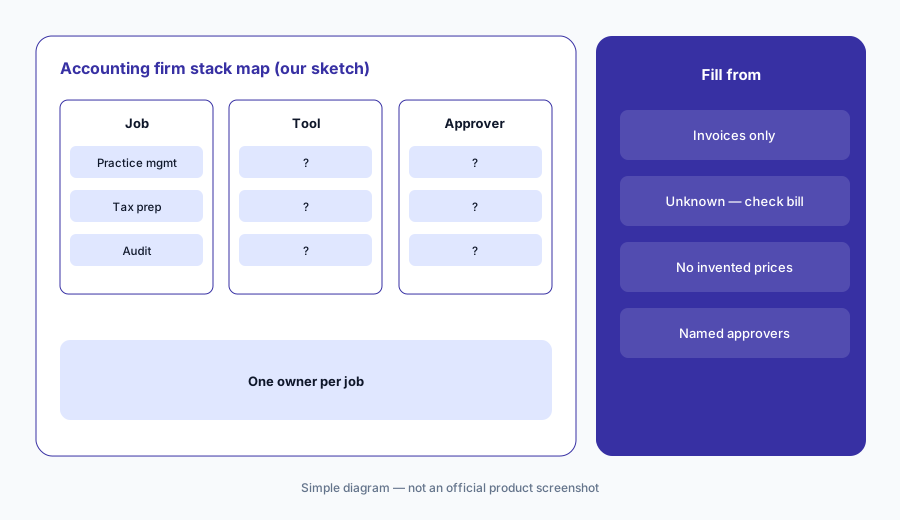
Primary workflow:
List every AI feature your firm pays for today. Have the managing partner write one job and one named approving professional next to each before adding another tool.
2. Fill costs from invoices only
What it is: For each tool, find the contract or the last invoice and write the monthly cost. If you cannot find it, write Unknown — check bill. Accounting software is sold many ways — per user, per seat per year, per client, per return, per connected client, by add-on, or by quote — so convert to a monthly figure from your own invoice rather than a list price. Our reviews of Fieldguide, DataSnipper, MindBridge, Caseware, Suralink, Basis, Soraban, SurePrep, and CCH Axcess Expert AI found no public price at all.
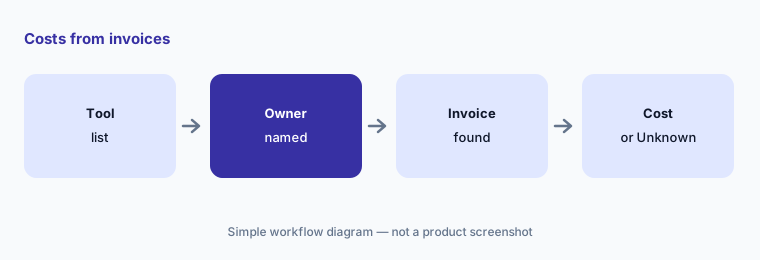
Costs from invoices:
Have the firm administrator fill Cost/mo for every row from the contract or last invoice only, and write Unknown — check bill wherever no invoice is found.
3. Write overlaps in plain sentences
What it is: Write each overlap as a sentence: “Our practice system, our prep tool, and chat seats all draft client document reminders.” “The engagement platform and the Excel add-in both flag exceptions on the same cash tests.” The most common ones in 2026: client emails and reminders (Karbon, Financial Cents, Soraban, chat seats), document requests and checklists (TaxDome, Canopy, Suralink), source-document extraction (Juno, SurePrep, Dext), and audit exceptions (Fieldguide, DataSnipper, MindBridge).
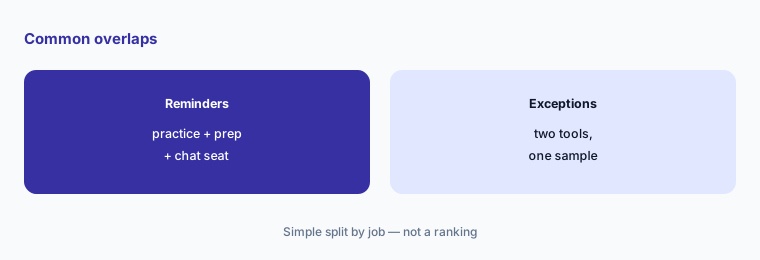
Overlaps as sentences:
Have the operations manager write every overlap as one plain sentence naming the tools, and have the managing partner mark the three that cost the most review time.
4. Name the approving professional per output
What it is: Approvals are per output, not per tool. For each row, write who approves each kind of output: returns and extracted fields — the preparer of record and the reviewing tax manager; cited tax research — the reviewing tax manager (Blue J vs CCH Axcess Expert AI); audit exceptions, workpapers, and conclusions — the audit senior and the engagement partner (Fieldguide vs DataSnipper); agent-posted entries — the bookkeeping manager; client emails, requests, and reminders — the client manager; scope and fees — the engagement partner. Add one line per tool on what client data may go in.
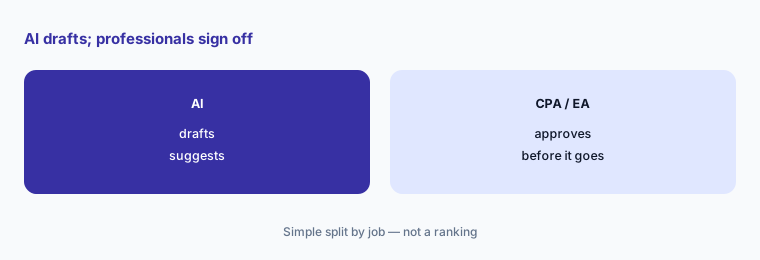
Who signs off, what goes in:
For each tool, have the managing partner write which professional approves returns, research, workpapers, entries, client messages, and fees, and one line on what client data may go in.
5. Write one-sentence decisions
What it is: For each overlap, write one decision: keep both (with a reason), consolidate into one, or pause one for 30 days. Name who owns the follow-up and the renewal date. Start with the three rows where overlap costs the most review time: client reminders, document request lists, and audit exceptions — the places where two outputs for one task reach a client or a workpaper. Compares such as Karbon vs TaxDome and Juno vs SurePrep help when the overlap is two full systems.
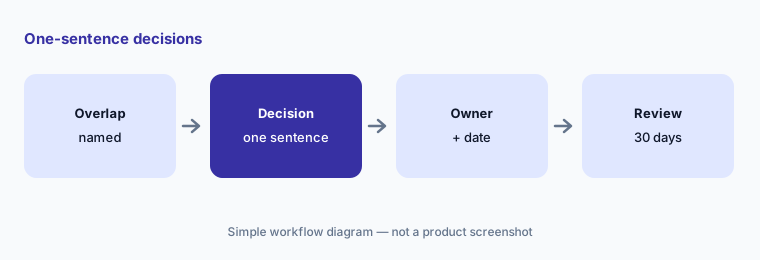
One sentence, one owner:
For the client reminders, request lists, and audit exceptions rows only, have the managing partner write a Decision in one sentence each (keep both, consolidate, or pause), name who owns the follow-up date, and note any renewal date.
6. Run a 30-day check
What it is: After 30 days, check each paused or consolidated tool with three questions: did anyone ask for it back, did any return, workpaper, or client message fall through, and did every output still reach its named approver? Update the table, keep it next to your renewal list, and revisit it after each big vendor release — Karbon's September release and TaxDome's September notes show how much can change in one month.
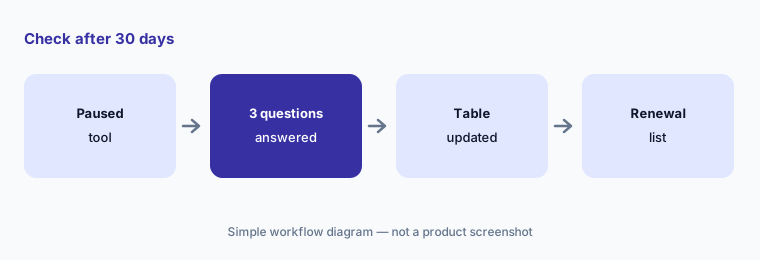
Check after 30 days:
After 30 days, have the firm administrator ask the managing partner three questions for each paused tool: did anyone ask for it back, did any return, workpaper, or client message fall through, and did every output reach its named approver? Update the table.
Pricing context (October 2026)
This how-to does not quote vendor prices. Fill Cost/mo from your contracts and invoices only; use Unknown — check bill when missing. Today's accounting firm reviews (checked 21 Oct 2026) note which vendors are quote-only — many audit and tax-prep vendors are — and which publish list prices.
Our soft offers stay $9 for the toolkit spreadsheet and $19 for the audit — links on /stack and /audit.
Uncertainty: Accounting software is often sold per seat per year, per client, per return, by add-on, or on custom contracts, so a list price would not be your bill even where one exists. This page invents none. Vendor AI features and the actions they can take change with each release — re-check each tool's settings after major updates. Nothing here is tax, audit, or accounting advice; confidentiality duties (including IRS Publication 4557 and your written information security plan) and professional standards depend on your firm and jurisdiction.
When it’s useful (honest take)
Useful when you suspect three tools draft the same client email, build the same request list, or flag the same exception, and nobody is sure which professional signs off.
Less useful when you only need a single-product review — start from Karbon AI or Fieldguide AI instead.
Comparing several AI tools for the same job? The $9 AI toolkit spreadsheet puts each one you pay for on one page with cost, usage, and payback, so overlaps are easy to spot.
Want someone to do it for you? AI toolkit audit — $19
Related options (educational)
| Need | Better home | Why |
|---|---|---|
| Practice management compare | Karbon vs TaxDome | Compare |
| Tax prep compare | Juno vs SurePrep | Compare |
| Tax research compare | Blue J vs CCH Axcess Expert AI | Compare |
| Audit tools compare | Fieldguide vs DataSnipper | Compare |
| Chat assistant roles | Claude for accounting firm ops / Gemini for accounting firm ops | Role |
FAQ
What columns does the table need?
Job, Tool, Owner, Approving professional, Cost/mo, Overlap, and Decision — plus Data rules once you are ready.
What if I cannot find a price?
Write Unknown — check bill. Do not invent amounts from directories, a vendor's sales deck, or a list figure that is not your contract.
Which ten jobs?
Practice management AI, tax research, tax intake and prep, audit engagement platforms, audit testing and analytics, client requests, client bookkeeping and close, proposals and billing, practice system changes to review, and the chat assistant — the inventory order for this page.
Can AI file a return, sign off a workpaper, or email a client on its own in this inventory?
No. The inventory assumes a licensed CPA, EA, or the engagement partner owns any return, workpaper, audit conclusion, client letter, or filing — and owns any automatic setting a tool offers. Nothing here is tax, audit, or accounting advice.
Where do chat assistants fit when client data is involved?
On the chat-assistant row, with a data rule the firm writes down. See Claude for accounting firm ops and Gemini for accounting firm ops for what each vendor says about data use.
Optional next step (if seats overlap)
If your firm pays for practice management AI, a prep tool, a research platform, audit agents, bookkeeping agents, and chat seats that all touch the same clients, finish this inventory before the next renewal. Map the overlap with the $19 AI toolkit audit or the $9 AI toolkit spreadsheet. Email Audit $19 or Toolkit spreadsheet $9.
Checkout is live via Stripe. After you pay, we email delivery (spreadsheet) or intake next steps (audit).