Tool · Accounting firm ops · Basis · Oct 2026
Basis AI review (Oct 2026): AI accounting agents for client bookkeeping, reconciliations, and close at accounting firms
Basis (getbasis.ai) builds AI agents for accounting firms. For client accounting services (CAS), its agents code bank and card activity, reconcile accounts, draft journal entries from source documents, and prepare reporting packages, following each firm's procedures and each client's context; the same platform now takes a first pass on tax returns and audit work. This page is about using it while the bookkeeping manager still reviews every entry before a client's books close. Each section has a Try this.
What this Basis page covers
This page is for a CAS lead, bookkeeping manager, reviewing tax manager, audit senior, or firm administrator at a firm that closes books for many clients. It is not tax, audit, or accounting advice; a licensed CPA, EA, or the engagement partner owns any return, workpaper, audit conclusion, client letter, or filing. Basis itself describes accountants as the reviewers who resolve exceptions and own every conclusion.
Basis sells by demo and prints no prices (its /pricing address returns a not-found page). Its pages describe four practices: CAS and advisory (the month-end close), tax (intake through review-ready workpapers), audit (planning, fieldwork, reporting), and corporate accounting, plus a small-firms version. On 5 August 2026 Basis announced an End-to-End Tax Platform that gathers client information, prepares and reviews the return, and brings accountants in for judgment calls.
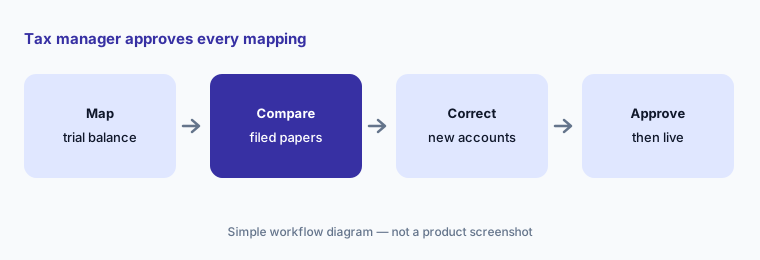
Ground rules before you rely on anything: the bookkeeping manager compares every agent-coded transaction and proposed entry with the closed books before any pilot client goes live; the reviewing tax manager approves every trial-balance mapping and workpaper; the engagement partner owns every audit conclusion. Client names and account numbers stay out of shared examples.
Major features (with how someone uses them)
Examples at a glance: each feature has a concrete example from a real job plus a short Try this you can run this week.
1. CAS close agents: coding, reconciliations, and reporting (primary)
What it is: On the CAS page, Basis agents code bank and credit-card activity with accounting context and an explanation of the treatment, push high-confidence transactions automatically, and flag low-confidence items for review. They compare the ledger with statements and schedules, surface exceptions, and draft reporting packages and variance analysis, keeping source support, calculations, confidence levels, and exceptions in one place for the reviewer.
“Pushed automatically” means a high-confidence item reaches the ledger before a person looks at it. Decide which clients and which accounts are allowed that, and check them anyway in the pilot.
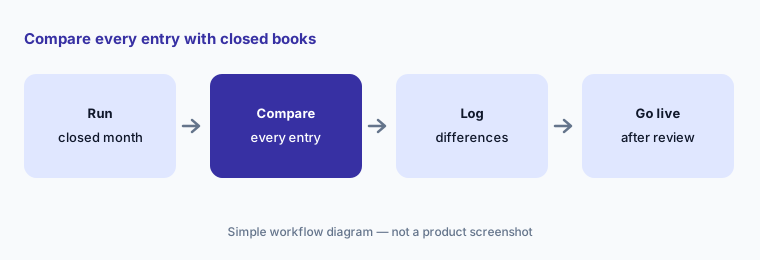
Primary workflow:
Let the agent reconcile one closed month for three clients. Have the bookkeeping manager compare every entry with the books your team actually closed.
2. Procedures: your firm's way, written down for the agents
What it is: Basis agents follow written Procedures. The small-firms page says firms can choose from 350+ pre-built accounting Procedures written by Basis's accountants in residence and create shareable ones that capture review preferences and client quirks; work is organized by client and Basis carries each client's context forward. In Basis's Boyum Barenscheer story (18 Sep 2026), the firm turned recurring work — transaction coding, payroll and sales entries, reconciliations, close checklists — into Procedures and moved from six pilot books in February 2026 to nearly all relevant CAS clients within six weeks; the story reports a payroll entry going from about four hours to 20 minutes — a customer claim.
A Procedure turns one person's habit into everyone's default. If it is wrong, it is wrong for every client it touches.
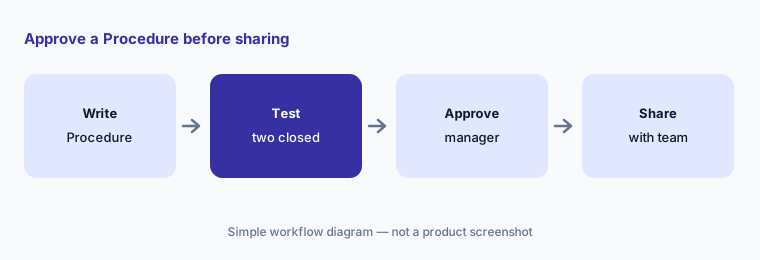
Approve before sharing:
Write one client Procedure and run it on two closed months. Have the bookkeeping manager approve the Procedure only after both entries match what your team posted.
3. Journal entries from source documents, staged for review
What it is: On the small-firms page, you drop in a payroll report, invoice, or bank statement and Basis proposes journal entries with account, memo, and source documents linked, “staged for your review before anything posts”. It also does write-up and general-ledger cleanup, staging every entry, and runs reconciliations that flag unmatched detail and propose fixing entries. Basis's Springline Advisory story (20 Oct 2026) reports payroll entry preparation falling from 4 hours to 30 minutes and 35% more clients per junior accountant — customer claims.
A proposed entry with a linked source looks finished. The account choice and the period are still the reviewer's call.
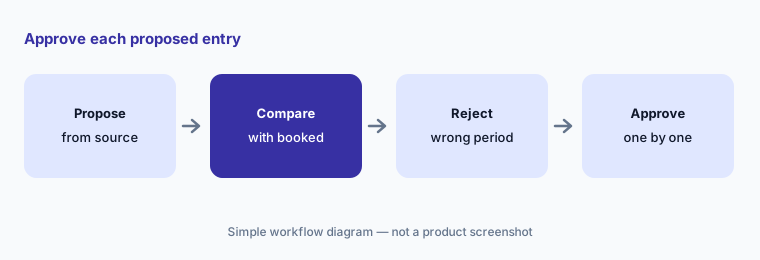
Approve each entry:
Have Basis propose entries from one client's closed-quarter statements. Have the bookkeeping manager compare each proposed entry with what was booked and approve them one by one.
4. Tax first pass: intake, trial-balance mapping, workpapers, and return QC
What it is: Basis's tax page says agents read the prior-year return and client files, organize documents, surface data gaps, and contact clients to resolve them, then build workpapers and run quality-control checklists. The small-firms page lists trial-balance mapping to the firm's chart with return-line references, K-1 aggregation with citations, book-to-tax workpapers for M-1 adjustments, fixed-asset roll-forwards and the tax trial balance, and return QC that ties every number to its source and builds a prior-year variance list. A Boulay partner is quoted on returns with 60 or 70-plus K-1s going from more than 100 prep hours to 15 or 20 — a customer claim.
An agent that contacts clients is speaking for the firm. A mapping with a return-line reference is still a tax position.
Tax manager approves:
Run trial-balance mapping and workpapers for one closed return. Have the reviewing tax manager compare every mapped account and adjustment with the filed workpapers before using Basis on a live return.
5. Audit first pass: planning, fieldwork, and reporting drafts
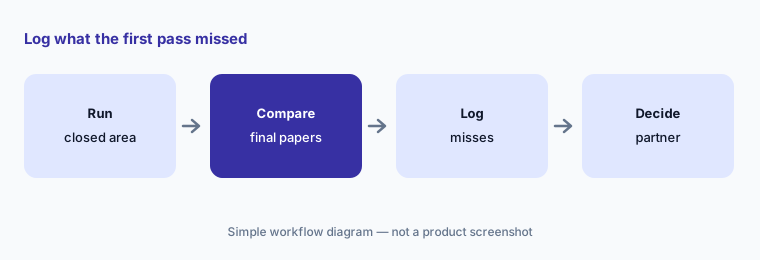
What it is: On the audit page, Basis agents map trial balances, run preliminary analytics, and surface risk indicators by financial-statement assertion; apply firm-defined tests, build workpapers, cite evidence, and surface exceptions (including employee benefit plan engagements); and draft financial statements and footnotes with quality checks. Basis says auditors review the work, judge whether the evidence is sufficient, and own every conclusion, and that it fits alongside a firm's existing binder and portal.
Evidence that is cited is not the same as evidence that is sufficient. That judgment, and the opinion, stay with the engagement team.
Partner owns conclusions:
Run Basis on two audit areas from one closed engagement. Have the audit senior compare every cited item and exception with the final workpapers before the engagement partner allows it on a live engagement.
6. Security, access, and how firms get Basis
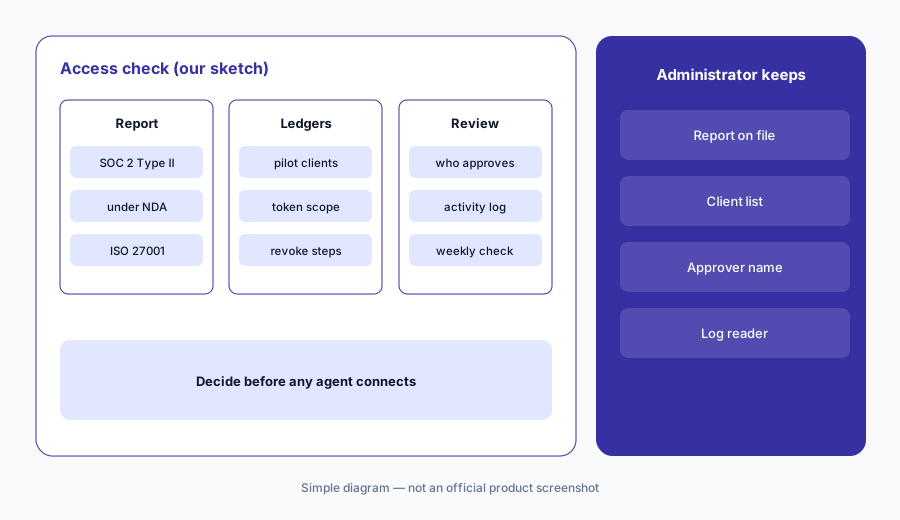
What it is: Basis's security page lists SOC 2 Type II, ISO 27001, and ISO 42001 certification, US-only hosting, no model training on firm or client data, tenant separation, logged and auditable agent actions, revocable tokens instead of stored credentials, and enforced multi-factor authentication; GDPR and CCPA are marked “coming soon”. Access is by demo, and the small-firms page offers a waitlist-style “Get access”. Basis says it works with large firms — its news page lists Baker Tilly (29 April 2026) and Sikich (1 July 2026) collaborations — and it announced a $100M Series B on 24 February 2026.
Agents that can post to a client's ledger act with whatever access the connection grants. A certificate covers the vendor, not how your firm sets up access.
Admin sets access first:
Before any agent connects to a client ledger, have the firm administrator get Basis's SOC 2 Type II report, list which clients are in the pilot, and name who approves postings and reads the activity log.
Pricing context (October 2026)
Basis is quote-only. getbasis.ai has no pricing page (the /pricing address returned a not-found page on 21 Oct 2026); the site offers “Get a demo”, and the small-firms page offers “Get access” through a waitlist form. No per-client, per-seat, or per-return figure is published.
Ask in writing how Basis charges (per client, per entity, per return, or per user), what a pilot costs, which practices (CAS, tax, audit) are included, and whether agent activity is capped.
Hours-saved and capacity figures on Basis's site come from its customer stories and quotes, not our measurements.
Uncertainty: We did not test Basis. Features, dates, and claims come from getbasis.ai solution, security, news, and customer-story pages read on 21 Oct 2026 and can change. Basis publishes no prices. The End-to-End Tax Platform post (5 Aug 2026) does not give a general-availability date or say which tax software it connects to; ask. Ledger connections are described generally (“connect the GL”) rather than as a named list on the pages we read.
When it’s useful (honest take)
Useful when your firm closes books for many CAS clients, has written (or is willing to write) its close procedures, and a named bookkeeping manager will compare every agent-coded transaction and proposed entry with closed months before any client goes live.
Less useful when you want to move clients onto a new AI-native ledger (Digits AI), mainly need receipt and invoice capture (Dext AI), need 1040 scanning and a client portal (Thomson Reuters SurePrep), or want practice management with built-in AI (Karbon AI).
Paying for Basis AI and a few other AI tools? The $9 AI toolkit spreadsheet lists every AI subscription you have, what each one costs, and how fast it pays for itself, so you can see which ones are worth the money.
Want someone to do it for you? AI toolkit audit — $19
Related options (educational)
| Need | Better home | Why |
|---|---|---|
| Agents for CAS close, tax, and audit first passes | Basis AI (this page) | Quote |
| AI-native ledger with agentic close | Digits AI | $65 / $100 per month (business plans) |
| Document capture and AI Assist for firms | Dext AI | Per client; 10-client minimum |
| Practice management with close checks | Karbon AI | $59 / $89 per user/month annual |
| Small-firm practice management with AI file agents | Financial Cents AI | $19 / $49 / $69 per user/month annual |
FAQ
What is Basis used for?
Basis (getbasis.ai) builds AI agents for accounting firms. Its agents code transactions, reconcile accounts, draft journal entries, and prepare reporting for CAS clients, and take a first pass on tax returns and audit work, following each firm's written Procedures.
How much does Basis cost in October 2026?
Basis does not publish prices. Its site offers demos, and the small-firms page offers access through a waitlist form. Ask how it charges and what a pilot costs before you commit.
Does Basis post entries to client books on its own?
Basis says its agents push high-confidence transactions automatically and flag low-confidence ones, and that proposed journal entries are staged for review before anything posts. Decide which clients and accounts may be pushed automatically, and keep it off during a pilot.
Is Basis only for large firms?
Basis names large firms such as Baker Tilly, Sikich, and Wiss, but it also has a small-firms version with pre-built Procedures. Small firms reach it through a waitlist form rather than a self-serve plan.
Who should check Basis's AI output?
The bookkeeping manager for every coded transaction, reconciliation, and proposed entry, the reviewing tax manager for mappings and tax workpapers, the audit senior and engagement partner for audit work, and the firm administrator for ledger access and the activity log.
Optional next step (if seats overlap)
If your firm pays for close agents, a practice system with its own AI, a capture tool, and general chat seats that all touch the same client books, that overlap is worth mapping. Map the overlap with the $19 AI toolkit audit or the $9 AI toolkit spreadsheet. Email Audit $19 or Toolkit spreadsheet $9.
Checkout is live via Stripe. After you pay, we email delivery (spreadsheet) or intake next steps (audit).