Blue J vs CCH Axcess Expert AI (Oct 2026): cited AI tax research and Workflows vs CCH-grounded answers inside Axcess
Blue J and CCH Axcess Expert AI both answer tax questions with citations, but they sit in different places. Blue J is a standalone research assistant whose answers draw on primary authority, Tax Notes, and IBFD, with pre-built Workflows and a published $1,498 per year Individual plan. CCH Axcess Expert AI is Wolters Kluwer's set of AI modules inside the CCH Axcess suite, led by CCH Axcess Intelligence, grounded in CCH content and sold by quote. This page splits them by job, shows how to test both on the same questions, explains why most firms keep one research platform of record, and is not a ranking. Each section has a Try this.
This page is for a tax partner, reviewing tax manager, research lead, or firm administrator deciding whether Blue J, CCH Axcess Expert AI, or both belong in the firm's research budget. It is not tax, audit, or accounting advice; a licensed CPA, EA, or the engagement partner owns any return, workpaper, audit conclusion, client letter, or filing. Nothing here replaces reading the authority.
Facts come from our Blue J and CCH Axcess Expert AI reviews, re-checked on 21 October 2026 against Blue J's pricing page and Wolters Kluwer's CCH Axcess Intelligence page (read through a page reader because it blocks plain scripted requests). We did not test either product. Time-saved and value figures on both sites are vendor claims.
The overlap is the research answer: a cited response to a tax question, sometimes turned into a memo or client email. The difference is where the answer lives and what it is grounded in. Blue J is a separate subscription you can use with any tax software. Expert AI is part of a CCH Axcess relationship and works next to the return, the scan, and the workflow already in Axcess.
Ground rules for either pilot: the reviewing tax manager opens every cited authority before an answer shapes advice; no SSNs, EINs, or unredacted returns go in unless firm policy and the contract allow it; the engagement partner signs every client-facing memo or email; the tax partner decides which platform is the firm's research platform of record. This comparison is not a ranking.
Blue J and CCH Axcess Expert AI side by side (as published, checked 21 October 2026)
Question
Blue J
CCH Axcess Expert AI (Wolters Kluwer)
Built around
A standalone tax research assistant with cited answers
AI modules inside the CCH Axcess suite, led by CCH Axcess Intelligence
Content behind answers
Primary authority, Tax Notes, and IBFD (IBFD live since 25 Mar 2026)
CCH content, built on the conversational research introduced in CCH AnswerConnect
Client documents
Attach returns and agreements; Projects keep threads tied to one client
Intelligence analyzes documents such as K-1s inside CCH Axcess
Drafting and workflows
Memos and client emails; pre-built Workflows for returns, notices, agreements, and state nexus
Memo and client-communication drafts; Advisor (GA 13 May 2026) surfaces advisory opportunities
Where you use it
Blue J's own app; inside Legora in early access (19 Oct 2026)
Inside CCH Axcess, next to the tax return and workflow
Price
Individual $1,498 per year per user; Team “contact for pricing”
Quote-only (“Request a Quote”)
Who signs off
Reviewing tax manager opens every cited authority
Reviewing tax manager reads every cited CCH source
A simple mark we drew for this comparison. The diagrams show workflows, not product screenshots.
Major features (with how someone uses them)
Examples at a glance: each feature has a concrete example from a real job plus a short Try this you can run this week.
1. Same three research questions in both (primary)
What it is: Pick three questions your firm answered last season and already documented — one federal, one state, one involving a client agreement or notice — and ask both tools the same way. Blue J offers a 7-day free trial with no credit card (pricing); CCH Axcess Intelligence demos and quotes go through Wolters Kluwer (Request a Quote). Compare each answer and each citation with the memo your firm actually wrote.
A citation shows where an answer came from, not that the source supports the exact point. Reading the cited section is the test.
Concrete example (reviewing tax manager at a 20-person CPA firm)
She asks both tools about a state's treatment of remote-employee nexus, a passive-activity grouping question, and a partnership-agreement allocation. Both answer all three with citations. On the state question, one cites a superseded ruling and the other cites guidance that does not cover remote employees. She logs both and attaches the log to the renewal discussion.
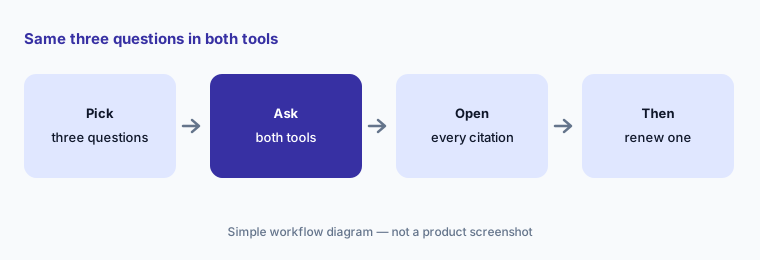
Simple workflow diagram: three documented questions, both tools, every citation opened, then the renewal decision. Simple diagram — not an official product screenshot.
Try this
Primary workflow:
Ask both tools the same three research questions. Have the reviewing tax manager compare every cited authority before renewing either contract.
2. Content behind the answers: Tax Notes and IBFD vs CCH content
What it is: Blue J's how it works page describes answers “powered by primary authoritative content, Tax Notes, and IBFD”; IBFD cross-border content went live on 25 March 2026. Wolters Kluwer's Intelligence page says answers are grounded in authoritative CCH content, and Expert AI launched on 15 October 2025 building on the conversational research introduced in CCH AnswerConnect.
Which publisher's commentary your reviewers trust is a real difference. A firm used to CCH explanations will read Tax Notes analysis differently, and the other way round.
Concrete example (research lead at a 40-person firm with an international practice)
For cross-border questions the research lead finds Blue J's IBFD content useful; for routine federal and state questions, staff already reach for CCH content inside Axcess. She writes down which questions go where, and the tax partner approves the list.
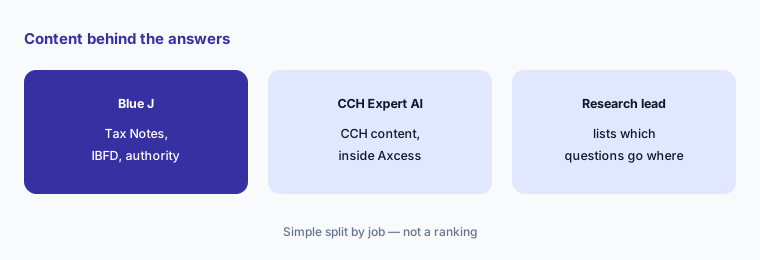
Simple split by job: split diagram: blue j tax notes and ibfd, cch content in axcess, research lead lists which questions go where. Simple diagram — not an official product screenshot.
Try this
Name the content:
Have the research lead list which kinds of questions (federal, state, international) your firm sends to which content set, and the tax partner approve the list.
3. Client documents: Blue J Projects vs Intelligence document analysis
What it is: In Blue J you attach tax returns, operating agreements, and other documents, and Projects keep threads tied to one client or engagement (how it works). CCH Axcess Intelligence analyzes tax documents such as K-1s to extract, summarize, and flag information, and Wolters Kluwer says it runs entirely within the CCH Axcess environment and that client data is never used to train AI models (Intelligence page); Blue J's security page cites SOC 2 Type II.
Uploading a client's agreement to a research tool is a data decision, not a convenience. The firm's written information security plan should say where client documents may go.
Concrete example (firm administrator at a 30-person firm)
Before either pilot, the firm administrator checks both contracts and the firm's security plan. Uploads of client documents are allowed only in the tool the contract covers; the other pilot uses redacted excerpts. The reviewing tax manager signs off each upload in the pilot log.
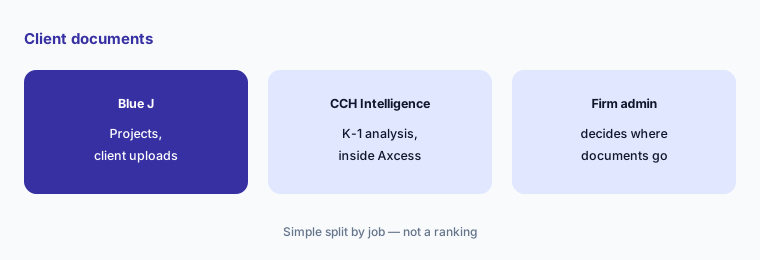
Simple split by job: split diagram: blue j projects with uploads, cch intelligence inside axcess, firm administrator decides where documents go. Simple diagram — not an official product screenshot.
Try this
Decide uploads first:
Before uploading any client document, have the firm administrator confirm in writing which tool your contract and security plan allow it in.
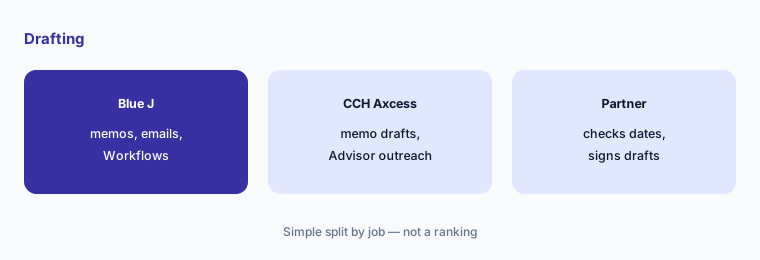
4. Drafting: Blue J Workflows and memos vs Intelligence drafts and Advisor
What it is: Blue J turns research into memos and client emails, and its Workflows page lists pre-built Workflows for return review notes, IRS notice responses, agreement analysis, and state nexus, which it says pause for your input on judgment calls. Wolters Kluwer says Intelligence helps professionals “move quickly toward a clear first draft” (its page also quotes a customer on client-ready memos), and CCH Axcess Advisor (generally available to US firms 13 May 2026) surfaces advisory opportunities from Axcess Tax data and drafts outreach.
A draft client email that sounds certain can carry a position the reviewer would have hedged. Tone is a tax decision too.
Concrete example (engagement partner at a 12-person firm)
She has each tool draft a client email about the same notice. Both are clear; one gives a response deadline that does not match the notice. She fixes the date against the notice itself and signs the email, and adds a rule that every deadline in a draft is checked against the source document.
Simple split by job: split diagram: blue j memos and workflows, cch intelligence drafts and advisor, engagement partner signs every draft. Simple diagram — not an official product screenshot.
Try this
Check every date:
Have each tool draft one client email about a closed notice. Have the engagement partner check every date and position against the notice before anything like it goes to a client.
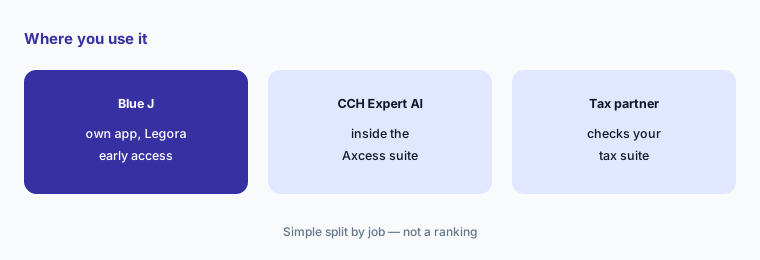
5. Where you use it: standalone app vs inside CCH Axcess
What it is: Blue J works on its own, whatever tax software you file in, and on 19 October 2026 it announced an early-access connection that lets Legora users query Blue J from inside Legora (Blue J). Expert AI sits inside the CCH Axcess suite; Wolters Kluwer's Expert AI page lists modules across Audit, Client Collaboration, Intelligence, Scan, Workflow, and Advisor.
If your firm files in CCH Axcess, research next to the return saves switching windows. If it does not, Expert AI is not a standalone option.
Concrete example (tax partner at a firm on Lacerte)
The partner notes that Expert AI is part of the CCH Axcess suite, which the firm does not use, so the real choice is Blue J or the research product the firm already licenses. She asks Blue J for a Team quote and compares it with the current research renewal.
Simple split by job: split diagram: blue j standalone and in legora, cch expert ai inside axcess, tax partner checks what the firm files in. Simple diagram — not an official product screenshot.
Try this
Start from your suite:
Have the tax partner write down which tax suite and research subscriptions the firm already pays for before pricing either tool.
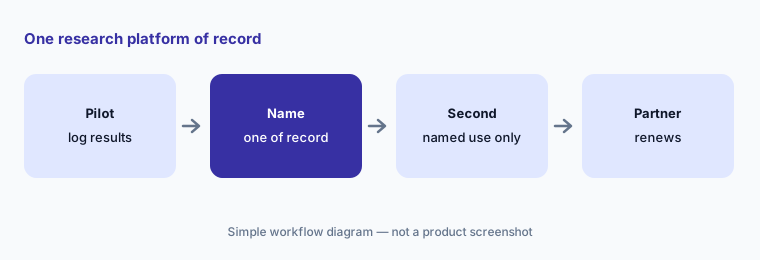
6. Why most firms keep one research platform of record
What it is: Two research tools mean two places a reviewer has to check, two sets of commentary, and two renewal dates. Most firms name one platform of record — the one whose citations go in the file — and treat anything else as a second opinion. Blue J's Team plan and every Expert AI module are quoted, so the comparison that matters is the written quote for your seat count against what you would drop.
A memo that cites two publishers for the same point is harder to review, not safer.
Concrete example (managing partner at an 18-person firm)
After the pilot, the managing partner names CCH content inside Axcess as the platform of record for routine work and keeps one Blue J Individual seat for the international partner. Every memo cites the platform of record; Blue J answers are checked against it before use.
Simple workflow diagram: workflow from pilot log to naming one platform of record to a second-opinion seat to the managing partner's renewal decision. Simple diagram — not an official product screenshot.
Try this
Name one:
After the pilot, have the managing partner name one research platform of record for memos and decide whether any second tool has a named use.
Pricing context (October 2026)
Blue J (pricing page, checked 21 Oct 2026): Individual $1,498 per year per user (“best for sole practitioners”), with full US federal and SALT coverage and unlimited questions, drafting, file uploads, and citations. The Team plan (dedicated support, onboarding, firm-wide usage insights, SSO) is “contact for pricing.” Plans are annual; there is a 7-day free trial with no credit card, and Blue J says there are no add-ons or extra fees.
CCH Axcess Expert AI (Intelligence page, checked 21 Oct 2026): quote-only — “Request a Quote,” no printed price for Intelligence or the other Expert AI modules. Ask in writing which modules your current CCH Axcess contract includes and whether Intelligence needs a separate content subscription.
Wolters Kluwer's figures — up to 90% less time on document review, about 3 hours saved per professional per week, and an estimated $30,000 to $60,000 of annual value per user — and Blue J's time-saved figures are the vendors' own calculations, not our measurements.
Uncertainty: We did not test either product. Features, dates, and prices come from each vendor's pricing and product pages as read on 21 Oct 2026 (the Wolters Kluwer page through a page reader) and can change. Wolters Kluwer publishes no Expert AI prices; Blue J publishes only the Individual price. Blue J inside Legora is early access and needs subscriptions to both products. Value and time-saved figures are vendor claims.
When it’s useful (honest take)
Useful when your firm is renewing research subscriptions, can name three documented questions to test, and has a reviewing tax manager who will open every cited authority in the pilot.
Still choosing between Blue J and CCH Axcess Expert AI? The $19 AI toolkit audit gives you a written plan for which tools to keep using and which to drop across your whole AI stack, including this pair.
What is the main difference between Blue J and CCH Axcess Expert AI?
Blue J is a standalone research assistant grounded in primary authority, Tax Notes, and IBFD, with Workflows and a published Individual price. CCH Axcess Expert AI is a set of AI modules inside the CCH Axcess suite, led by Intelligence and grounded in CCH content, sold by quote. This page is not a ranking.
How much do they cost in October 2026?
Blue J prints $1,498 per year per user for Individual; Team is contact for pricing. Wolters Kluwer prints no price for CCH Axcess Intelligence or other Expert AI modules — request a written quote.
Can we use CCH Axcess Expert AI without CCH Axcess?
Wolters Kluwer describes Expert AI as embedded in the CCH Axcess suite. If your firm files in other software, ask Wolters Kluwer directly; Blue J works whatever tax software you use.
Should we keep both?
Most firms keep one research platform of record whose citations go in the file, and give any second tool a named use, such as international questions. Two platforms for the same questions means more to review, not more safety.
Who approves AI research output?
The reviewing tax manager opens every cited authority, the firm administrator decides where client documents may be uploaded, the engagement partner signs every client-facing memo or email, and the tax partner names the platform of record. Nothing here is tax advice.
Affiliate disclosure: Some outbound product links may be affiliate links.
We may earn a commission if you subscribe. Prices and features change — always verify on the vendor site.
Full policy: disclosure.