How-to · Healthcare ops · Stack inventory · Oct 2026
Stack map for healthcare ops (Oct 2026): which AI tool owns which EHR, ambient, RCM, and patient-access job, and who signs off
How-to inventory — healthcare jobs, tools, owners, approvers, and overlaps. Overlap is the point: in 2026 the EHR's own ambient feature, a specialist scribe, and a chat seat can all draft the same visit note; an EHR coding assistant, an RCM platform, and an autonomous coding vendor can all touch the same claim; and a patient-access agent, a billing agent, and the EHR's patient chat can all answer the same patient. Every output that reaches a chart, a payer, or a patient needs one named person who signs off. Nothing here is medical, coding, billing, or legal advice.
What this how-to covers
Practices and health systems rarely buy one AI tool on purpose. The EHR adds ambient notes, chart summaries, coding help, and patient chat; a specialist ambient vendor is piloted by one department; the RCM platform adds agents that resubmit and appeal; an autonomous coding vendor reads the same charts; intake, reminder, and billing vendors each add their own AI agents; a care-gap platform adds outreach; and every manager already has a chat seat. A year later, three tools can draft the same note or call the same patient, and nobody knows which output the clinician or the billing supervisor relied on. This how-to builds one table — Job | Tool | Owner | Approver | Cost/mo | Overlap | Decision — for the seven jobs where that overlap is most common.
It is an inventory, not a ranking. Fill Cost/mo from your own contracts and invoices, write overlaps in plain sentences, and give each job one owner (the person who can change or cancel the tool) and each output one named approver: the treating clinician for every note, order, and diagnosis; the coding manager for every coding change; the billing supervisor for claims automation touched; the revenue-cycle director for every rule that can submit or appeal; the patient access director for every outbound script; and the practice manager for every patient message. AI drafts and suggests; a named person decides. No patient information goes into a tool unless your organization has a BAA and a policy that allows it — see ChatGPT for healthcare ops and Gemini for healthcare ops.
How to map healthcare-ops AI to jobs and approvers
Examples at a glance: each feature has a concrete example from a real job plus a short Try this you can run this week.
1. List every AI feature by job (primary)
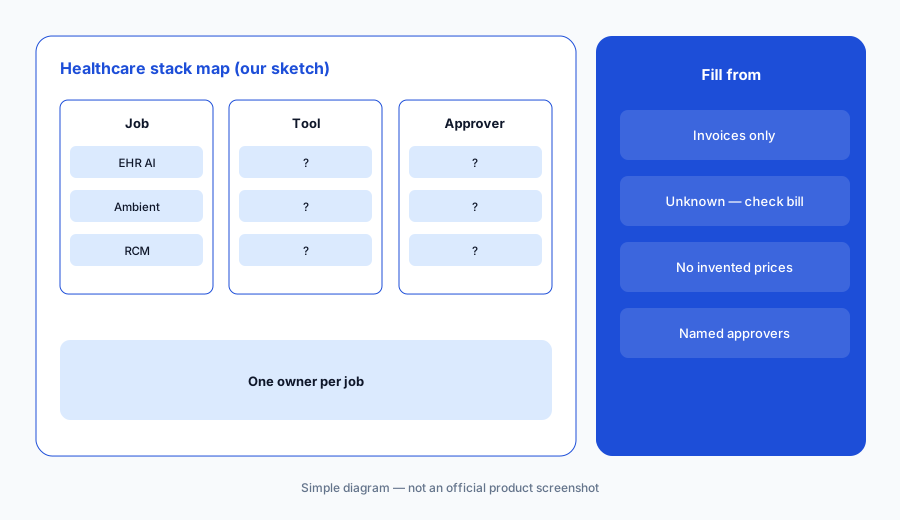
What it is: Start with seven rows and seven columns, and leave cells blank until you have a source: an admin user list, a contract, an invoice, or the person who uses the tool. The seven jobs: ambulatory EHR AI (athenahealth, eClinicalWorks, NextGen, Elation, AdvancedMD), health-system EHR AI (Epic Systems, Oracle Health), ambient documentation (Abridge, Microsoft Dragon Copilot, Suki), revenue-cycle automation (Waystar, Akasa, Notable, R1, Cedar), patient access and engagement (Phreesia, Luma Health), care-gap agents (Innovaccer), and the chat assistant (ChatGPT or Gemini seats — see ChatGPT for healthcare ops and Gemini for healthcare ops).
Primary workflow:
List every AI feature your clinic or RCM team pays for today. Have the practice or RCM manager write one job and one named approver next to each before adding another tool.
2. One owner per job, and Cost/mo from invoices
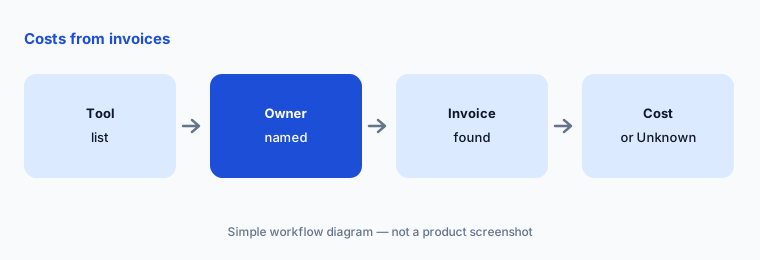
What it is: For each job, write one owner — the person who can change the settings or cancel the tool — and the monthly cost from the contract, invoice, or card statement. If you can't find it, write "Unknown — check bill". Don't fill costs from list prices. Most vendors in today's reviews are quote-only — athenahealth, Epic Systems, Oracle Health, Abridge, Waystar, R1, and Cedar among them. A few publish prices (eClinicalWorks and AdvancedMD), Akasa describes performance-based terms for its prebill suite, and AI is often folded into the EHR contract or priced per provider, per encounter, or as a share of collections — so your bill is the only number that counts.
Costs from invoices only:
For each of the seven jobs, have the practice controller name one owner and fill Cost/mo from contracts and invoices only. If missing, write Unknown — check bill. Do not invent prices, per-encounter fees, or percentages.
3. Mark overlaps in plain language
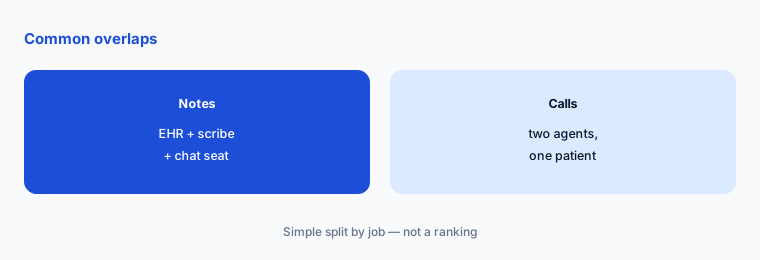
What it is: For each job with two or more tools, write one sentence about what both do — for example, "The EHR's ambient feature and the specialist scribe both draft cardiology visit notes." Common healthcare overlaps: visit notes drafted by the EHR and a specialist scribe (Abridge vs Microsoft Dragon Copilot, athenahealth vs Epic Systems EHR, Oracle Health vs athenahealth); claims and coding touched by an RCM platform, a coding vendor, and the EHR's coding assistant (Waystar vs Akasa, R1 RCM AI, Notable AI); patient calls and texts from intake, reminder, and billing agents (Phreesia AI, Luma Health AI, Cedar AI); and care-gap outreach from both the EHR and a population health platform (Innovaccer AI, What’s new in athenahealth (Sep 2026)).
One sentence per overlap:
Wherever two tools share a job, write what both do in one sentence — for example, both draft cardiology visit notes. Ask each tool's owner to confirm it before anyone suggests dropping a seat.
4. Name an approver for every output
What it is: Fill the Approver column per output, not per tool. Many healthcare tools can now act, not just draft — queue an order, resubmit a claim, send an appeal, call a patient about a balance, or write an allergy to the chart. Name the person who approves each: the treating clinician for every note, order, diagnosis, and chart item; the coding manager for every coding change; the billing supervisor and revenue-cycle director for every automation that submits, resubmits, or appeals; the utilization management lead and physician advisors for patient status; the patient access director for every outbound call or text script; and the practice manager for patient messages and outreach. Write what data may go in, and check the BAA before any patient information does. September changelogs show why this matters — see What’s new in athenahealth (Sep 2026) and What’s new in Epic Systems EHR (Sep 2026).
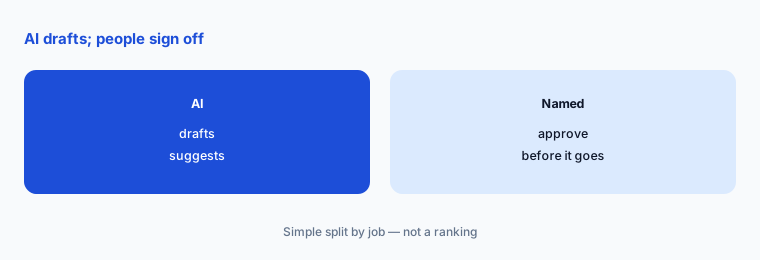
Who signs off, what goes in:
For each tool, have the practice manager write who approves notes, orders, coding changes, claim submissions, appeals, and patient messages, and one line on what data may go in under your BAA.
5. Write one-sentence decisions
What it is: For each overlap, write one decision: keep both (with a reason), consolidate into one, or pause one for 30 days. Name who owns the follow-up and the renewal date. Start with the three rows where overlap costs the most attention: visit notes, claim corrections and appeals, and patient calls — the places where two outputs for one task reach a chart, a payer, or a patient.
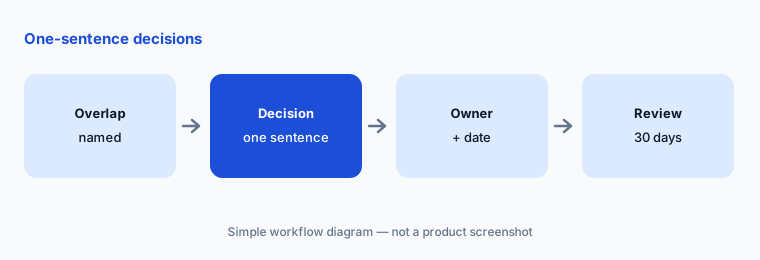
One sentence, one owner:
For the visit notes, claim corrections and appeals, and patient calls rows only, have the practice manager write a Decision in one sentence each (keep both, consolidate, or pause), name who owns the follow-up date, and note any renewal date.
6. Run a 30-day check
What it is: After 30 days, check each paused or consolidated tool with three questions: did anyone ask for it back, did any note, claim, or patient call fall through, and did every output still reach its named approver? Update the table and keep it next to your renewal list. Revisit it after each big vendor release — compares such as athenahealth vs Epic Systems EHR, Abridge vs Microsoft Dragon Copilot, and Waystar vs Akasa show how far the overlap goes.
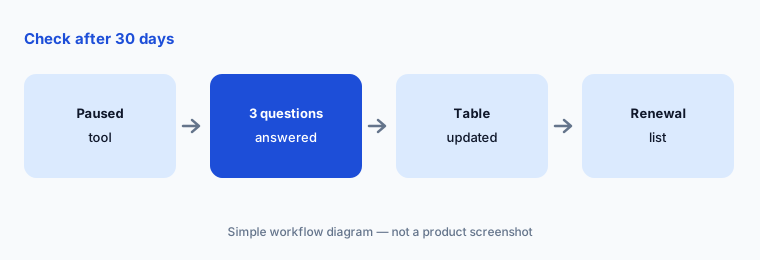
Check after 30 days:
After 30 days, have the practice manager answer three questions for each paused tool: did anyone ask for it back, did any note, claim, or patient call fall through, and did every output reach its named approver? Update the table.
Pricing context (October 2026)
This how-to does not quote vendor prices. Fill Cost/mo from your contracts and invoices only; use Unknown — check bill when missing. Today's healthcare reviews (checked 19 Oct 2026) note which vendors are quote-only — most of them — and which publish prices or performance-based terms.
Our soft offers stay $9 for the toolkit spreadsheet and $19 for the audit — links on /stack and /audit.
Uncertainty: Healthcare software is mostly sold on custom contracts, often with AI folded into the EHR or RCM agreement or priced per provider, per encounter, or as a share of collections, so a list price would not be your bill even where one exists. This page invents none. Vendor AI features and the actions they can take change with each release — re-check each tool's settings after major updates. Nothing here is medical, coding, billing, or legal advice; privacy rules depend on your BAAs and your organization's policies.
When it’s useful (honest take)
Useful when you suspect three tools draft the same note, touch the same claim, or call the same patient, and nobody is sure who signs off.
Less useful when you only need a single-product review — start from athenahealth AI or Epic Systems EHR AI instead.
Comparing several AI tools for the same job? The $9 AI toolkit spreadsheet puts each one you pay for on one page with cost, usage, and payback, so overlaps are easy to spot.
Want someone to do it for you? AI toolkit audit — $19
Related options (educational)
| Need | Better home | Why |
|---|---|---|
| EHR compare | athenahealth vs Epic Systems EHR | Compare |
| Ambient notes compare | Abridge vs Microsoft Dragon Copilot | Compare |
| RCM compare | Waystar vs Akasa | Compare |
| EHR compare (health system vs ambulatory) | Oracle Health vs athenahealth | Compare |
| ChatGPT healthcare role | ChatGPT for healthcare ops | Role |
FAQ
What columns does the table need?
Job, Tool, Owner, Approver, Cost/mo, Overlap, and Decision — plus Data rules once you are ready.
What if I cannot find a price?
Write Unknown — check bill. Do not invent amounts from directories, a vendor's sales deck, or a list figure that is not your contract.
Which seven jobs?
Ambulatory EHR AI, health-system EHR AI, ambient documentation, revenue-cycle automation, patient access and engagement, care-gap agents, and the chat assistant — the inventory order for this page.
Can AI sign a note, submit a claim, or call a patient on its own in this inventory?
No. The inventory assumes a named person approves every note, order, coding change, claim submission, appeal, and patient message — and owns any automatic setting a tool offers. Nothing here is medical, coding, or billing advice.
Where do chat assistants fit when patient data is involved?
On the chat-assistant row, with a data rule. OpenAI says it does not offer a BAA for ChatGPT Business, and Google requires its Workspace BAA before PHI — see ChatGPT for healthcare ops and Gemini for healthcare ops.
Optional next step (if seats overlap)
If your practice or health system pays for an EHR with AI, a specialist scribe, an RCM platform, patient-outreach agents, and chat seats that all touch the same visit, finish this inventory before the next renewal. Map the overlap with the $19 AI toolkit audit or the $9 AI toolkit spreadsheet. Email Audit $19 or Toolkit spreadsheet $9.
Checkout is live via Stripe. After you pay, we email delivery (spreadsheet) or intake next steps (audit).