Compare · Healthcare ops · Oct 2026
Waystar vs Akasa (Oct 2026): end-to-end AltitudeAI RCM agents vs GenAI coding and CDI specialists
Waystar and Akasa both sell AI to hospital revenue-cycle teams, but they start from different ends. Waystar is a payment platform with payer connectivity; its AltitudeAI agents resubmit eligible denied claims, answer analytics questions in plain language, organize CDI evidence, and guide patient payments. Akasa is a mid-cycle specialist; it codes inpatient encounters autonomously within limits you set and reviews charts prebill for coding and documentation gaps. This page splits the two by job and asks when to keep your clearinghouse and add coding AI. It is not a ranking, and each section has a Try this.
What this comparison covers
This page is for a revenue-cycle director, HIM director, coding manager, or CDI lead at a hospital or health system weighing these two vendors — or already using one and being pitched the other. It is not coding, billing, or legal advice.
Facts come from our Waystar AI and Akasa AI reviews, re-checked against vendor pages on 19 October 2026: Waystar’s 26 August 2026 AltitudeAI announcement and 30 April 2026 innovation recap, and Akasa’s home page, autonomous coding page, and Prebill Optimization Suite page.
Where they overlap is the mid-cycle — coding and documentation before the claim goes out. Waystar reaches it from the claim side (prebill anomaly checks, agentic CDI); Akasa reaches it from the chart side (autonomous coding, CDI queries). Where they do not overlap: Waystar’s payer connectivity, denial resubmission, and patient payments; Akasa’s autonomous inpatient coding.
Ground rules for either: the billing supervisor approves every rule that lets an agent resubmit a claim; the coding manager sets every autonomy threshold and audit sample; CDI specialists decide every query to a physician; and vendor outcome figures are their claims, not our measurement. This comparison is not a ranking.
| Question | Waystar (AltitudeAI) | Akasa |
|---|---|---|
| What it is | Healthcare payment platform with payer connectivity; AI across claims, authorizations, and patient payments | GenAI for the mid-cycle: inpatient coding and clinical documentation integrity (CDI) |
| Denials and claims | Autonomous resubmission of eligible rejected and denied claims (26 Aug 2026) | Claim Status and Auth Status checks |
| Coding | Prebill Anomaly Detection flags coding and documentation gaps before submission | Autonomous inpatient coding with chart evidence for every code; Coding Optimizer prebill |
| CDI | Agentic clinical documentation: evidence organized for specialist review | CDI Optimizer: documentation gaps and clinical queries from vitals, labs, notes |
| Questions and analysis | Conversational revenue-cycle analytics | AI Advisor research assistant for revenue-cycle teams |
| Patients | Patient Financial Care; agentic financial concierge in progress | Not a focus on Akasa’s pages |
| Published price | None (quote-only) | No price list; prebill suite sold on performance-based terms |
| Who signs off | Billing supervisor for resubmission rules; CDI lead for documentation | Coding manager for autonomy thresholds; CDI specialists for queries |
Major features (with how someone uses them)
Examples at a glance: each feature has a concrete example from a real job plus a short Try this you can run this week.
1. Split the trial by job: denials and coding (primary)
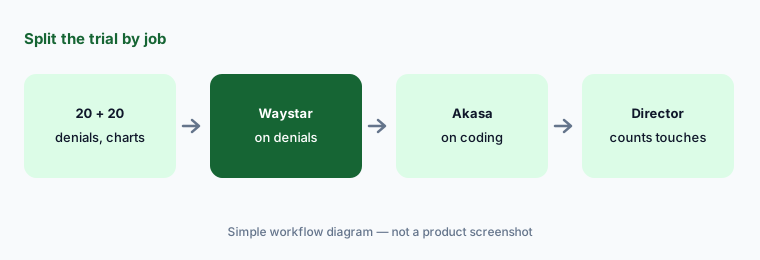
What it is: Because the two vendors aim at different jobs, a head-to-head on one task is unfair to both. A cleaner test gives each the job it is built for — Waystar on denied claims, Akasa on coded inpatient charts — and then asks the same question of both: after the AI touched the file, did a person still have to?
Count touches, not demos. A file that a person reopened, edited, or re-sent counts as touched, even if the AI did most of the work.
Primary workflow:
Pick twenty denied claims and twenty coded inpatient charts. Have the RCM director trial Waystar on denials and Akasa on coding, then compare who still touches each file.
2. Denials: autonomous resubmission vs status checks
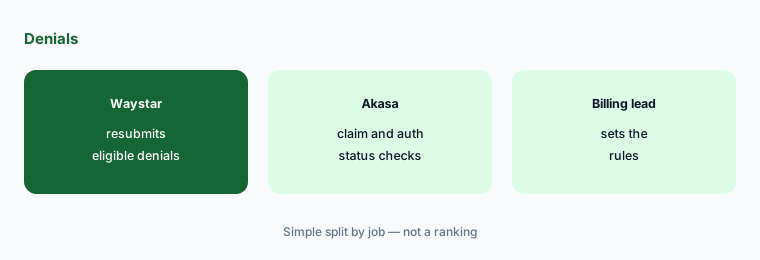
What it is: Waystar says its agents interpret payer responses, apply payer-specific intelligence, choose the next action, and automatically resubmit eligible rejected and denied claims (Waystar, 26 Aug 2026). Akasa’s denial-side tools on its home page are Claim Status and Auth Status, which check status automatically (Akasa).
Resubmitting a claim is an external action with money attached. Decide which denial types the agent may resubmit on its own, and keep the rest in a human queue.
Limit the first rules:
Have the billing supervisor review twenty claims Waystar marks eligible and allow autonomous resubmission for only the denial types that were right every time.
3. Coding: autonomous inpatient coding vs prebill anomaly checks
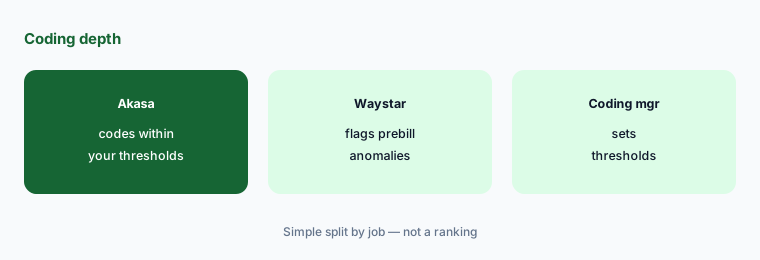
What it is: Akasa says its AI reads the complete chart, codes the inpatient encounter independently, and links every code to the chart language behind it — and that you define thresholds, service-line rules, payer mix, and audit sampling, so it codes only what you approved (Akasa). Waystar’s Prebill Anomaly Detection identifies documentation, coding, and reimbursement opportunities before claims are submitted (Waystar, 30 Apr 2026).
These are different depths. One assigns the code set; the other flags issues in codes someone else assigned. Your coders’ workload changes very differently.
Set thresholds first:
Have the coding manager set Akasa’s autonomy threshold to two service lines with an audit sample, and compare the same charts against Waystar’s prebill flags before widening either.
4. CDI: agentic documentation vs CDI Optimizer
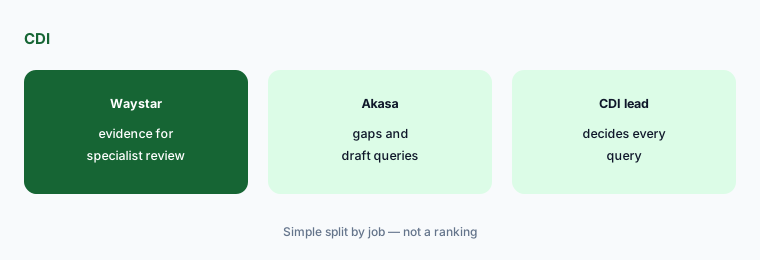
What it is: Waystar says its agents can analyze about 30,000 data points in the medical record in seconds and organize supporting evidence for specialist review, and it expects about 25% less review time — a Waystar projection (Waystar). Akasa’s CDI Optimizer analyzes vitals, labs, flowsheets, medications, and notes to surface documentation gaps and evidence-based clinical queries, inside a suite that reviews every inpatient encounter prebill (Akasa).
Neither should send a query to a physician on its own. A CDI specialist decides whether the clinical evidence supports asking.
Check queries:
Have the CDI lead run ten cases through each tool and decide, for every suggested query, whether she would send it before either tool changes the team’s workflow.
5. Questions: conversational analytics vs AI Advisor
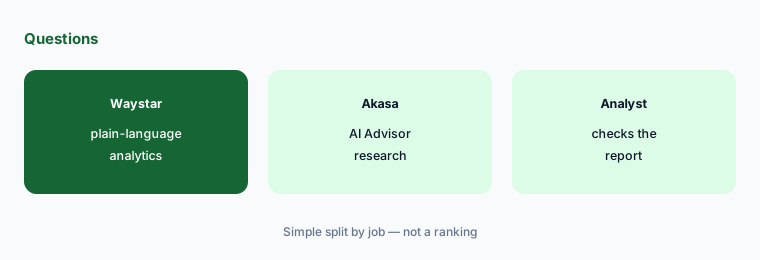
What it is: Waystar is embedding conversational AI in its analytics so users can ask questions in natural language about trends, root causes, and financial impact; early adopters reported up to 75% less time on data analysis, per Waystar (Waystar). Akasa’s AI Advisor is a research assistant for revenue-cycle teams that finds answers, documents, and context (Akasa; see Akasa AI).
A plain-language answer about your numbers still needs a check against the report it came from before it goes to finance.
Check the answer:
Have one analyst ask each tool the same five questions about last month and check every figure against the source report before anyone shares an AI answer upward.
6. Keep the clearinghouse, add coding AI?
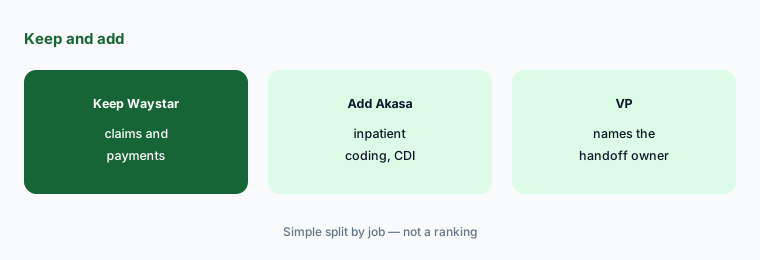
What it is: Waystar is a payment platform; its AI rides on claims and payer connections it already handles (Waystar). Akasa says it works alongside your existing EHR and billing systems (Akasa). So the two can sit side by side: Waystar on claims and payments, Akasa on inpatient coding and CDI.
If you already run Waystar for claims, the question is not which vendor wins. It is whether your coding backlog justifies a second vendor, and who owns the handoff between them.
Name the handoff:
If you keep your clearinghouse and add coding AI, have the VP of revenue cycle name one owner for the coding-to-claim handoff and list what each vendor touches before signing.
Pricing context (October 2026)
Waystar does not publish prices as of 19 Oct 2026 — AltitudeAI features are quote-only through your Waystar agreement. Akasa has no public price list; for its Prebill Optimization Suite it says pricing is performance-based — no upfront fees, invoicing only after measurable financial improvement (Akasa’s wording). Pricing for autonomous coding is not stated, so treat it as quote-only.
Ask Waystar which AltitudeAI agents are in your current contract and which are new modules. Ask Akasa how “measurable financial improvement” is calculated and who audits the baseline.
Uncertainty: We did not test either vendor. Waystar’s patient financial concierge is described as in progress, and its review-time figure is a projection. Akasa’s accuracy and speed figures come from its own pages, including a third-party evaluation as Akasa describes it. Feature availability depends on your contract and EHR. This page is not a ranking.
When it’s useful (honest take)
Useful when a hospital revenue-cycle team is weighing denial automation against coding automation, or already runs one vendor and is being pitched the other.
Less useful when you are an ambulatory practice whose EHR handles coding (athenahealth AI, eClinicalWorks AI), your gap is prior authorization (Notable AI, Innovaccer AI), or patient billing conversations (Cedar AI).
Still choosing between Waystar and Akasa? The $19 AI toolkit audit gives you a written plan for which tools to keep using and which to drop across your whole AI stack, including this pair.
Prefer to do it yourself? Spreadsheet — $9
Related options (educational)
| Need | Better home | Why |
|---|---|---|
| Denial resubmission, analytics, patient payments | Waystar AI | Quote only |
| Autonomous inpatient coding and CDI | Akasa AI | Prebill suite performance-based |
| Prior auth and eligibility agents | Notable AI | Quote only |
| Patient billing conversations | Cedar AI | Quote only |
| Health-system EHR coding AI | Epic Systems EHR AI | Quote only |
FAQ
What is the main difference between Waystar and Akasa?
Waystar is a healthcare payment platform whose AltitudeAI agents work on claims, denials, analytics, CDI evidence, and patient payments. Akasa is a mid-cycle specialist focused on autonomous inpatient coding and CDI. This is not a ranking.
Can we use both?
Yes. Akasa says it works alongside existing EHR and billing systems, so a hospital can keep Waystar for claims and add Akasa for coding. Name one owner for the handoff between them.
Does either one send claims or queries without a person?
Waystar says its agents can resubmit eligible denied claims automatically, and Akasa says it can code encounters autonomously within thresholds you set. Your billing supervisor and coding manager decide those limits; CDI specialists decide every physician query.
How much do Waystar and Akasa cost in October 2026?
Waystar is quote-only. Akasa has no price list; it describes performance-based pricing for its Prebill Optimization Suite, and autonomous coding pricing is not stated.
Who should approve AI output from either vendor?
The billing supervisor for resubmission rules, the coding manager for autonomy thresholds and audit samples, the CDI lead for queries, and the revenue-cycle director for the pilot decision.
Optional next step (if seats overlap)
If your revenue-cycle team pays for a clearinghouse with AI agents, a coding AI, and EHR coding features that all touch the same claim, that overlap is worth mapping. Map the overlap with the $19 AI toolkit audit or the $9 AI toolkit spreadsheet. Email Audit $19 or Toolkit spreadsheet $9.
Checkout is live via Stripe. After you pay, we email delivery (spreadsheet) or intake next steps (audit).