Role guide · Finance · ChatGPT Team
ChatGPT for finance (Sep 2026): close and board-pack patterns on Team
Role guide for teams already on ChatGPT Team / Business — Custom GPT and Projects patterns for close notes and board packs. Soft CTA only if multiple AI seats overlap on the same finance jobs. Differentiates from Claude for finance and the general ChatGPT / Custom GPTs / Memory pages.
Who this guide is for
Finance owners and founder-operators whose company already pays ChatGPT Team / Business and need a repeatable close + board-pack loop — not another generic “AI for CFOs” list. Product deep-dive: chatgpt.html. Claude-shaped version of the same job: claude-for-finance.html.
The finance loop (picture)
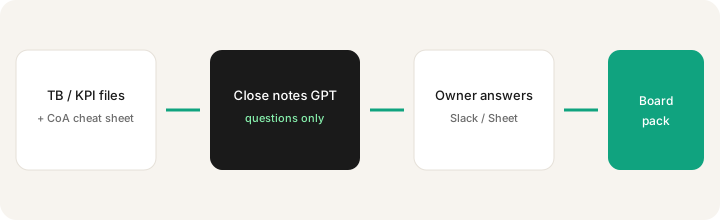
How a finance owner actually runs ChatGPT on Team
Examples at a glance: each pattern has a concrete finance example plus a short Try this.
1. Close notes Custom GPT (primary pattern)
What it is: A shared Custom GPT with a chart-of-accounts cheat sheet and instructions that ban inventing journal entries. The GPT drafts questions for owners from a trial-balance snippet — humans still post entries.
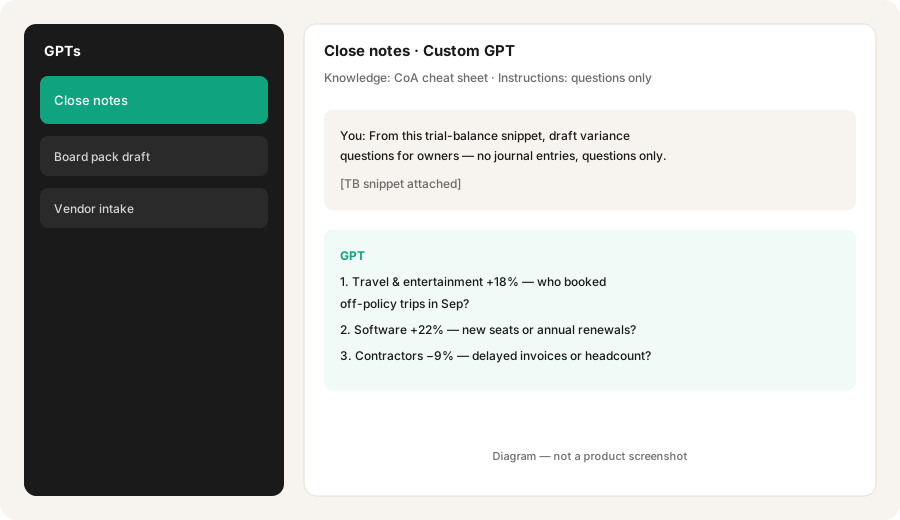
Create Custom GPT “Close notes.” Upload your chart of accounts cheat sheet. Instructions: questions only; never invent journal entries; flag missing owners.
From this trial-balance snippet, draft variance questions for owners — no journal entries, questions only.
2. Board-pack Project
What it is: A ChatGPT Project that holds last month’s board outline, KPI CSV, and standing instructions (“leave owner blanks; do not invent metrics”). Each cycle you upload the new KPI export and ask for a one-page draft the finance lead edits.
In a Project with KPI CSV + last board outline uploaded:
Draft a one-page board pack: KPIs table, 5 variance bullets, 3 risks. Leave owner blanks. Only use Project files. Caption for the finance lead to edit — do not invent metrics.
3. Guardrails that keep finance safe
What it is: Standing instructions + workspace sharing rules. Prefer Business workspace sharing over public GPT Store links. Do not put customer PII or raw bank exports into Memory — use Project files with clear retention habits (see Memory how-to).
Paste this into your Close notes GPT instructions (edit to match policy):
Answer only from uploaded CoA + user paste. Output variance questions or draft narrative. Never invent journal entries, never approve spend, never remember customer names or dollar amounts in Memory. Flag anything not grounded in the paste as Unknown.
4. When ChatGPT Team fits vs Claude for finance
What it is: Same close/board jobs; different home seat. ChatGPT wins when shared Custom GPTs are already how the team encodes SOPs. Claude wins when Projects + Artifacts are the weekly long-doc habit (see Claude for finance). Running both for identical close questions is usually seat overlap.
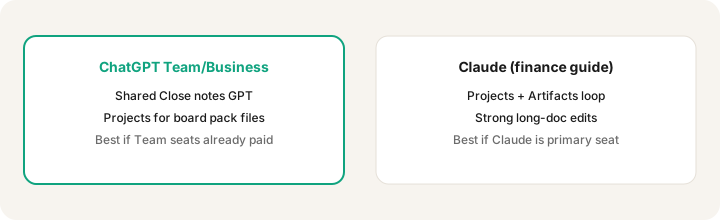
One decision this month:
List our paid AI seats. Circle which one already holds the close SOP. Put Close notes + board pack only there for 30 days. Revisit only if edit quality fails a real pack review.
When seats overlap
If ChatGPT Business, Claude, and Gemini are all drafting the same variance questions, you are paying three times for one habit. Pick the seat that already has the files and shared bots. Soft next step below only if that overlap is real.
Pricing context (September 2026)
Figures summarized from OpenAI’s public Business / ChatGPT pricing and help pages as of September 2026. Plan names and seat types change — confirm live.
- ChatGPT Business (formerly Team): public pages list Standard about $25/user/month monthly or $20/user/month billed annually; Premium about $125/$100. Workspace typically requires at least two paid seats. Confirm on openai.com/business/pricing.
- Included for this guide: Business seats publicly advertise Custom GPTs, Projects, admin controls, and (by default) no training on business data — verify current feature matrix on OpenAI’s pages.
- Plus (individual): often about $20/month — can build GPTs, but shared workspace finance bots fit Business better.
Uncertainty: Team→Business rename, Standard vs Premium usage limits, and seat caps have moved through 2025–2026. Always confirm on Business pricing and chatgpt.com/pricing before you buy.
When ChatGPT for finance is useful (honest take)
It tends to help when the company already pays Team/Business and needs a shared Close notes GPT plus a board-pack Project with strict “questions only / no invented JEs” instructions. It tends not to replace your GL, a controller’s judgment, or Claude when Artifacts/Projects are already the finance home. Paying ChatGPT + Claude + Gemini for the same close questions is stack sprawl.
Paying for ChatGPT and a few other AI tools? The $9 AI toolkit spreadsheet lists every AI subscription you have, what each one costs, and how fast it pays for itself, so you can see which ones are worth the money.
Want someone to do it for you? AI toolkit audit — $19
FAQ
How should finance set up ChatGPT Team or Business?
Shared Close notes GPT (CoA + questions-only instructions) plus a board-pack Project. Share inside the workspace.
Is ChatGPT Team the same as ChatGPT Business?
OpenAI renamed Team to Business; patterns on this page still apply. Confirm live seat names and prices.
When should we use Claude for finance instead?
When Projects + Artifacts are already the weekly loop. See Claude for finance.
Where is the full ChatGPT review?
chatgpt.html · Custom GPTs · Memory. This page is the finance role guide.
Optional next step (if seats overlap)
If ChatGPT Team is one of several AI seats doing the same close/board-pack loop, optional help: $19 AI toolkit audit or $9 AI toolkit spreadsheet — only if you are juggling overlapping seats.
Checkout is live via Stripe. After you pay, we email delivery (spreadsheet) or intake next steps (audit).
Inventory seats by job on the stack map for finance ops.