Tool · Healthcare ops · Cedar · Oct 2026
Cedar AI review (Oct 2026): Kora agentic patient billing, Cedar Intelligence personalization, and voice/text payment concierge
Cedar makes patient billing and payment software for health systems and physician groups. Its AI layer is the Kora Platform, a set of billing agents that answer and place calls and run two-way text conversations about balances, payments, insurance, and Medicaid enrollment, and Cedar Intelligence, which chooses the outreach, timing, and payment options each patient sees. This page is about using them to resolve bills while the patient-access director owns every automated outbound billing call. Each section has a Try this.
What this Cedar page covers
This page is for a patient-access director, revenue-cycle director, patient financial services manager, or call center lead at a health system or physician group using or considering Cedar. It is not billing, collections, or legal advice.
Cedar announced the Kora Platform on 13 August 2026, growing its earlier Kora voice agent into inbound voice, outbound voice, two-way text, and reporting. It added new Cedar Intelligence capabilities on 8 April 2026. Cedar says Kora has handled more than 600,000 patient conversations with a 40% inbound containment rate — its figures, which its site says come from pilots and surveys from 2024 through 2026.
Ground rules: the patient-access director approves every outbound script and listens to samples; the billing supervisor listens to contained inbound calls; insurance is verified before any payment push; financial assistance is offered where it applies; and Cedar’s figures are its claims, not our measurement.
Major features (with how someone uses them)
Examples at a glance: each feature has a concrete example from a real job plus a short Try this you can run this week.
1. Kora Autonomous Outbound Voice for billing calls (primary)
What it is: Cedar says Kora’s Autonomous Outbound Voice “proactively reaches out to patients to capture missing insurance, collect payments, resolve coordination-of-benefits denials, and assist eligible patients enroll in Medicaid.” Cedar reports a 20% pickup rate and a 21% relative increase in payment within 7 days of outreach, and says outbound calling is consent-aware and TCPA-compliant (Kora page) — Cedar’s figures.
A billing call that pushes for payment before coverage is settled can collect money the patient should not owe. Listen for that first.
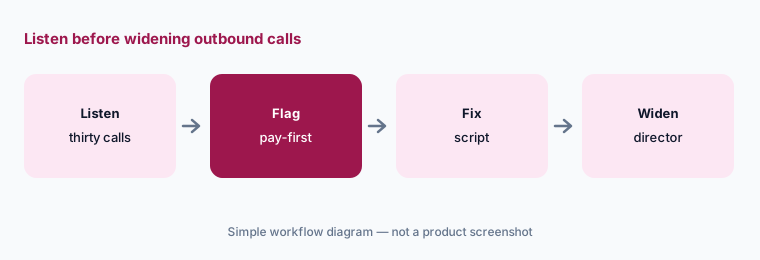
Primary workflow:
Listen to thirty Kora outbound billing conversations. Have the patient-access director scrap any script that pressures payment before insurance is verified.
2. Kora Autonomous Inbound Voice and warm handoffs
What it is: Cedar’s Autonomous Inbound Voice “answers inbound billing calls, verifies the patient, performs real-time eligibility checks, completes payments and resolves routine questions like balance inquiries, bill explanations, insurance capture.” Cedar says anything clinical or out of scope “routes straight to a human,” with full case context passed to live agents (Kora page), and reports 7.4% more patients attempting payment than with live agents — its figure.
Containment counts calls the agent finished, not calls it finished correctly. Sample both contained calls and handoffs.
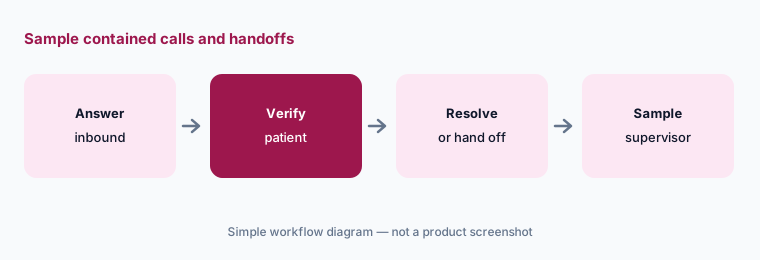
Sample both:
Have the billing supervisor listen to twenty contained Kora calls and ten handoffs each month and log every wrong balance or account.
3. Two-way text with memory across a billing journey
What it is: Kora’s two-way text handles billing and insurance questions, balances, and payments in English and Spanish. Cedar says Kora “remembers past conversations” and stays with a patient across weeks — for example from a denied claim, to updated insurance, to reprocessing, to paying what remains (Kora Platform release).
Memory helps until the facts change. A thread that remembers last month’s balance can quote it after an adjustment.
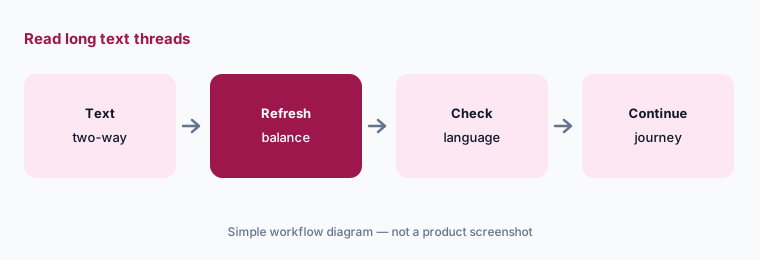
Read long threads:
Have the patient financial services manager read twenty multi-week Kora text threads and flag any message quoting an outdated balance.
4. Cedar Intelligence personalized journeys
What it is: Cedar Intelligence uses more than 80 patient attributes — such as bill size, payment behavior, coverage, prior engagement, and sentiment from support conversations — to choose messaging, channel, timing, and offers. Cedar says Adaptive Patient Experiences can route patients to Express Pay, payment plans, HSA payment, or financial assistance, “unlocking up to 23% collections lift” — Cedar’s figure. Cedar says it designs these features to “minimize the risk of unethical or discriminatory decisioning.”
A system that picks offers by predicted likelihood to pay can quietly steer some groups away from help. Check who sees assistance.
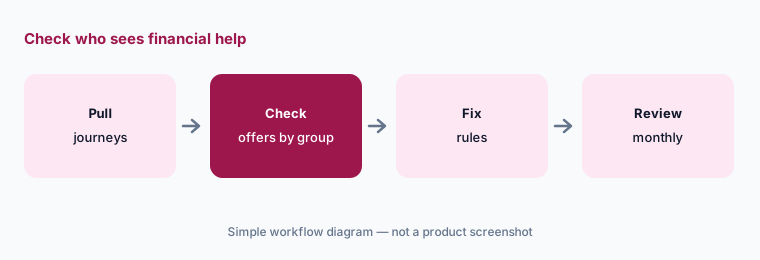
Check who sees help:
Have the revenue-cycle director review one month of Cedar Intelligence journeys by patient group and confirm financial assistance is offered wherever your policy says it should be.
5. Bill Navigator explanations and Agent Copilot for staff
What it is: Bill Navigator uses AI to turn statements into plain-language explanations of charges, coverage, and balance changes inside Cedar’s digital experience, and answers likely questions such as “Why is my bill higher than last time?” Cedar’s page says Agent Copilot “will sit inside the existing agent workflow” to give live staff a summary of billing and payment history and suggested resolution options — written in the future tense, so ask whether it is live for you.
A friendly explanation of the wrong number is worse than no explanation. Check explanations against the statement and the explanation of benefits.
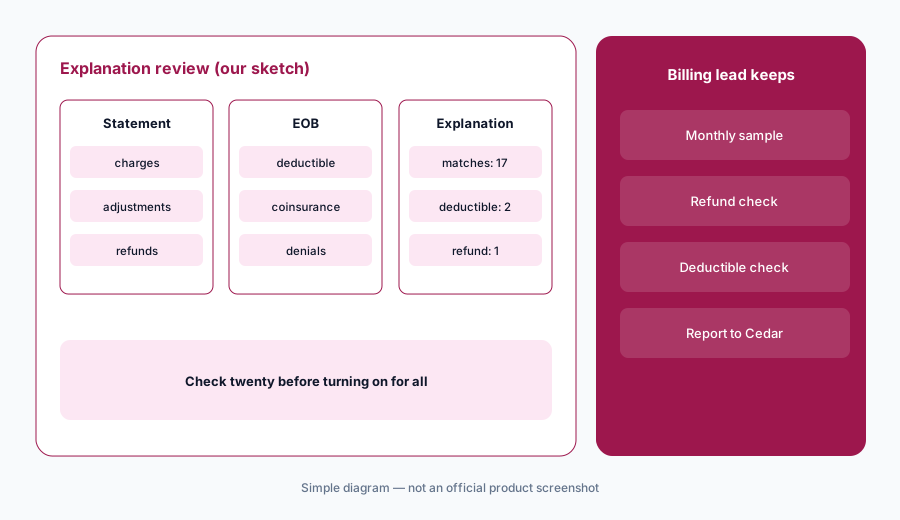
Check explanations:
Have the billing lead compare twenty Bill Navigator explanations with the statement and EOB before turning explanations on for every patient.
6. Cedar Cover for Medicaid enrollment and coverage denials
What it is: Cedar Cover matches patients to Medicaid, ACA Marketplace plans, or other aid; lets them apply or renew from a phone; offers live help from credentialed advocates; and guides patients through coordination-of-benefits, workers’ compensation, and dual-coverage denials, alerting provider teams when coverage details change.
Enrollment help is a service to the patient. Check that matches are right before patients spend time on the wrong program.
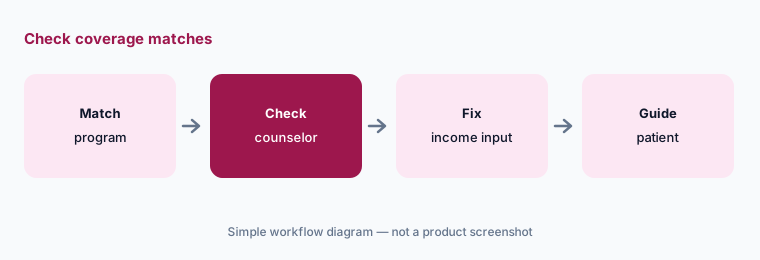
Check matches:
Have a financial counselor review fifteen Cedar Cover program matches against the patient’s answers before matches go out without review.
Pricing context (October 2026)
Cedar publishes no price list for Cedar Pay, Kora Platform, Cedar Intelligence, Cedar Support, or Cedar Cover. When we checked on 19 Oct 2026, cedar.com/pricing returned a not-found page; Cedar asks you to book a demo. Its site notes that “certain functionalities may require third-party integrations or service-specific terms or fees.” Treat it as quote-only.
Ask in writing whether Kora is priced per conversation, per resolved account, or as a percentage of collections; what Cedar Support call-center servicing costs; and whether Cedar Intelligence features are included with Cedar Pay.
Uncertainty: We did not test Cedar. Containment, pickup, payment-lift, and collections-lift figures are Cedar claims, which its site says come from pilots and surveys from 2024 through 2026 and are illustrative. Agent Copilot is described in the future tense. Confirm consent handling for outbound calls and texts, opt-out behavior, and BAA terms with Cedar.
When it’s useful (honest take)
Useful when you are a health system or physician group with high patient-balance volume, a busy billing call center, and many uninsured or underinsured patients, and the patient-access director will own every outbound script.
Less useful when your main job is front-desk intake and copays at check-in (Phreesia AI), claim submission and denials with payers (Waystar AI or Notable AI), or appointment reminders and recalls (Luma Health AI).
Paying for Cedar AI and a few other AI tools? The $9 AI toolkit spreadsheet lists every AI subscription you have, what each one costs, and how fast it pays for itself, so you can see which ones are worth the money.
Want someone to do it for you? AI toolkit audit — $19
Related options (educational)
| Need | Better home | Why |
|---|---|---|
| Patient billing voice, text, and personalization | Cedar AI (this page) | Quote only |
| RCM platform with patient financial concierge agent | Waystar AI | Quote only |
| Copays and payment at intake and check-in | Phreesia AI | Quote only; intake free until spring 2027 per Phreesia |
| Patient billing chat inside MyChart | Epic Systems EHR AI (Emmie) | Quote only |
| Payment reminders alongside scheduling outreach | Luma Health AI | Quote only |
| General chat on sanitized billing FAQs | Claude (sanitized) | No PHI, no billing access |
FAQ
What is Cedar Kora?
Kora is Cedar’s set of AI billing agents. Since 13 August 2026 the Kora Platform includes inbound voice, outbound voice, two-way text in English and Spanish, and reporting, covering balances, payments, insurance capture, coordination-of-benefits denials, and Medicaid enrollment help.
What is Cedar Intelligence?
Cedar Intelligence is Cedar’s AI engine that uses more than 80 patient attributes to choose messages, channels, timing, and payment or assistance options for each patient. Cedar added Adaptive Patient Experiences, Bill Navigator, Agent Copilot, and Kora Outbound in April 2026.
How much does Cedar cost in October 2026?
Cedar publishes no prices; its pricing URL returned a not-found page when we checked on 19 Oct 2026, and its site says some features need extra terms or fees. Ask for a written quote.
Will Kora pressure patients to pay?
Cedar says outbound calling is consent-aware and patients can opt out. Your own scripts decide what Kora asks for. Have the patient-access director listen to outbound calls and remove any script that asks for payment before insurance is verified.
Who should check Cedar AI output?
The patient-access director for outbound scripts; the billing supervisor for contained inbound calls and handoffs; the revenue-cycle director for which patients see assistance; the billing lead for bill explanations; and a financial counselor for Cedar Cover matches.
Optional next step (if seats overlap)
If you pay for Cedar, a separate patient-payment vendor, and an outsourced billing call center that all handle the same balances, that overlap is worth mapping. Map the overlap with the $19 AI toolkit audit or the $9 AI toolkit spreadsheet. Email Audit $19 or Toolkit spreadsheet $9.
Checkout is live via Stripe. After you pay, we email delivery (spreadsheet) or intake next steps (audit).