Compare · Healthcare ops · Oct 2026
Oracle Health vs athenahealth (Oct 2026): Foundation EHR Clinical AI Agent vs athenaOne AI-native ambulatory
Oracle Health and athenahealth both build AI into the EHR, but they start from different care settings. Oracle Health (the former Cerner business) runs Foundation EHR in hospitals and health systems, and its Clinical AI Agent now drafts inpatient and ED notes, creates draft orders, suggests codes, and has a nursing version. athenahealth’s athenaOne is built only for ambulatory practices, with athenaAmbient, Express Coding, and patient messaging AI. This page splits them by setting and job and asks when a multi-site organization might run both. It is not a ranking, and each section has a Try this.
What this comparison covers
This page is for a CMIO, CNO, medical director, or IT leader at a health system, a hospital with affiliated clinics, or a group practice being pitched one of these EHRs’ AI. It is not medical, coding, billing, or legal advice.
Facts come from our Oracle Health AI and athenahealth AI reviews, re-checked against vendor sources on 19 October 2026: Oracle’s Oracle Health AI Agents page and its 2026 announcements (2 Feb, 11 Mar, 19 Aug, 14 Sep), plus athenahealth’s AI-powered healthcare page and its 13 August 2026 availability announcement. Neither vendor publishes EHR prices.
One correction to the usual shorthand: Oracle is not only an inpatient vendor. Its Clinical AI Agent page lists inpatient, outpatient, and emergency settings, its 11 March 2026 release says AtlantiCare used the agent in ambulatory care before expanding it to its emergency departments, and Oracle describes its own “modern, AI-powered ambulatory EHR” (23 Sep 2026). The real difference is that athenaOne has no inpatient product, and Oracle’s nursing agent is inpatient only at launch.
Ground rules for either EHR: the attending reviews every draft note and draft order before signing or placing; nursing leadership owns nursing charting rules; the coding lead or billing supervisor samples coding suggestions before second review stops; and vendor hours-saved figures are their claims, not our measurement. This comparison is not a ranking.
| Question | Oracle Health (Foundation EHR, Clinical AI Agent) | athenahealth (athenaOne) |
|---|---|---|
| Main care setting | Hospitals and health systems (inpatient, ED), plus outpatient clinics and an ambulatory EHR | Ambulatory practices only (“AI-native, built for ambulatory care”) |
| Ambient notes | Note generation for inpatient and ED (11 Mar 2026), after ambulatory use | athenaAmbient (broad availability 13 Aug 2026, “at no additional cost” per athena); Ambient Notes |
| Orders from the conversation | Order creation: draft labs, imaging, meds, follow-ups for review (2 Feb 2026) | athenaAmbient suggests recommended order types |
| Coding | Professional fee coding suggestions for ambulatory workflows (19 Aug 2026) | AI-powered Express Coding; claim follow-up timing; copay prediction |
| Nurses | Clinical AI Agent for nurses, inpatient (14 Sep 2026): voice chart search, acute summaries, voice discrete charting | No nursing agent described on athena’s AI page |
| Published price | None; Oracle pages say pricing may change | None for athenaOne; athenaAmbient described as no additional cost |
| Who signs off | Attending for notes and orders; charge nurse for nursing charting; coding lead for codes | Attending clinician for notes and orders; billing supervisor for coding |
Major features (with how someone uses them)
Examples at a glance: each feature has a concrete example from a real job plus a short Try this you can run this week.
1. Split inpatient and ambulatory documentation jobs first (primary)
What it is: Both vendors announce AI by care setting and role, and availability differs: Oracle’s nursing agent launched for inpatient units only, its coding suggestions launched for ambulatory professional fees, and athena’s AI page still labels athenaAmbient “coming in 2026” even after its August broad-availability release. Mixing settings in one demo makes both look like they do everything.
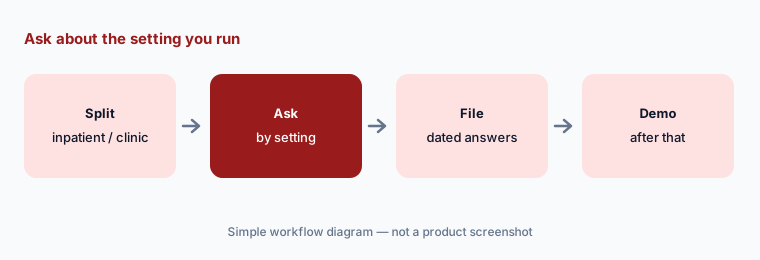
A vendor answer about the ED tells you nothing about your clinics, and the reverse. Ask about the setting you run, in writing.
Primary workflow:
Write down inpatient vs ambulatory documentation jobs separately. Have the CMIO ask each vendor only about the setting you actually run before comparing demos.
2. Ambient notes: Clinical AI Agent note generation vs athenaAmbient
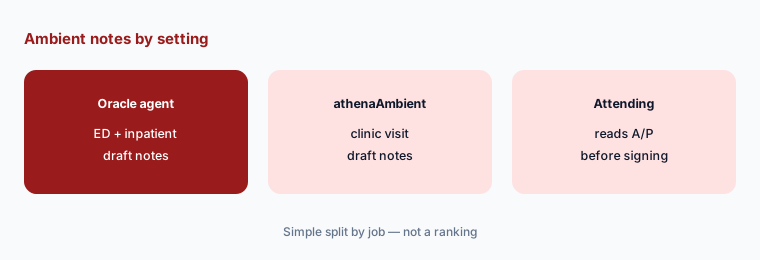
What it is: Oracle says Clinical AI Agent note generation is available in the U.S. for inpatient and emergency department settings, drafting one note that reflects several clinical events using triage notes, re-exams, and discussed labs and imaging; “clinicians can then quickly review, edit, and sign” (Oracle, 11 Mar 2026). athenaAmbient captures the ambulatory visit and drafts the note, potential diagnoses, and recommended order types, included “at no additional cost” per athena (13 Aug 2026).
An ED note pulls from many events over hours; a clinic note from one conversation. Check the parts each is most likely to miss.
Read before signing:
In whichever system you run, have the attending compare ten ambient drafts with the encounter, line by line in Assessment and Plan, before signing.
3. Orders from the conversation: order creation vs recommended order types
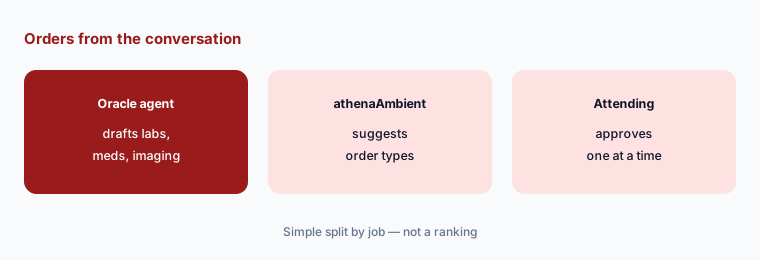
What it is: Oracle’s order creation drafts labs, imaging and diagnostic studies, new and refilled prescriptions, and follow-up appointments from the visit conversation, using order history and favorites, “making it easy for physicians to review and approve” (Oracle, 2 Feb 2026). athenaAmbient suggests recommended order types alongside the draft note (athenahealth AI).
A drafted order sitting in a queue is one click from being real. Nobody should approve drafted orders in bulk.
Approve one by one:
Have the medical director sample twenty AI-drafted or suggested orders against the conversation and the chart before anyone approves drafted orders without opening each.
4. Coding: pro-fee suggestions vs Express Coding
What it is: Oracle’s 19 August 2026 release says the agent now suggests professional fee charge codes for ambulatory workflows within the orders workflow, and that “clinicians review and confirm recommendations before submission” (Oracle). athena describes AI-powered Express Coding for charge capture, plus AI for claim follow-up timing and copay prediction (athenahealth).
Coding suggestions change what you bill. The person who owns coding compliance should own the sample, not the vendor’s figures.
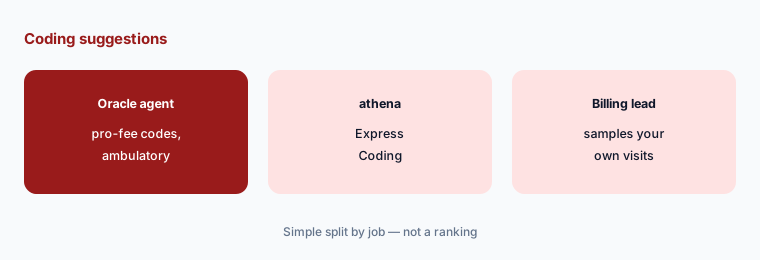
Sample your own visits:
Have the billing supervisor sample fifty AI coding suggestions against final codes, by visit type, before comparing any vendor’s coding claims.
5. Nursing and chart review: Oracle’s nursing agent vs athena summaries
What it is: Oracle’s Clinical AI Agent for nurses is available in the U.S. for inpatient settings in Foundation EHR, with voice chart navigation and search, acute nursing summaries, and voice-enabled discrete charting (Oracle, 14 Sep 2026); its August release added chart review that summarizes history, labs, and medications. athena offers AI patient summaries and a chat-based assistant for chart questions in ambulatory care (athenahealth).
Voice charting writes structured data that other people act on. A misheard value in a flowsheet travels further than a typo in a note.
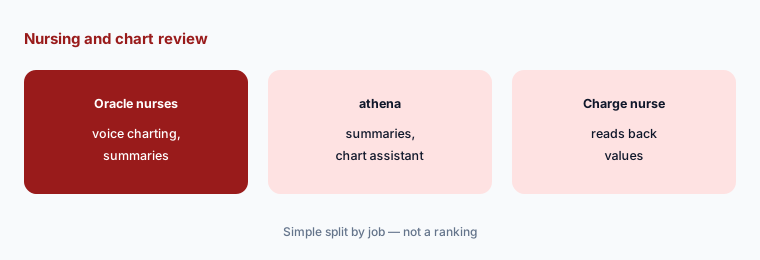
Read back values:
Have the charge nurse review one shift of voice-charted entries against the bedside record before more nurses chart by voice.
6. When a multi-site organization might run both
What it is: A health system on Oracle Foundation EHR may own or partner with independent practices on athenaOne, or a large group on athena may send patients to an Oracle hospital. In that case the question is not which AI wins but which system’s AI owns which setting, and how notes, orders, and results cross between them. Third-party ambient tools such as Abridge AI and Microsoft Dragon Copilot AI are another way to standardize ambient across EHRs.
Two EHRs means two sets of AI rules. Write down who owns each before clinicians move between them.
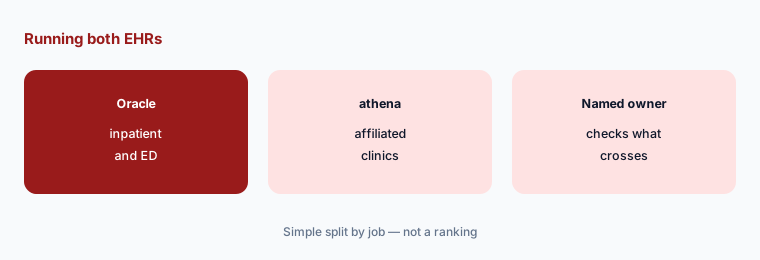
Name owners per setting:
If you run both EHRs, have the IT director write which AI owns each setting and who checks notes that cross between systems before expanding either.
Pricing context (October 2026)
Neither vendor publishes EHR or AI list prices as of 19 Oct 2026. Oracle Health treats Clinical AI Agent and Foundation EHR terms as quote-only, and its pages say the release, timing, and pricing of described features may change. athenahealth states athenaAmbient is built into athenaOne at no additional cost (its claim — confirm on your order form); other athena AI features are quote-only.
Ask each which AI features are included in your current agreement, which are licensed separately (for example physician vs nursing agents), and what build or analyst time each requires on your side.
Uncertainty: Availability differs by setting, role, specialty, and build in both systems; Oracle labels several admin and revenue-cycle agents “planned.” athena’s AI page still says athenaAmbient is “coming in 2026” although its August release announced broad availability. Hours-saved figures (Oracle’s 400,000+ physician hours; AtlantiCare’s 41%) are vendor or customer claims. We did not test either EHR.
When it’s useful (honest take)
Useful when your organization spans hospital and clinic care, you are being pitched one of these EHRs’ AI against the other, or you run both and need to decide which AI owns which setting.
Less useful when you are a single-setting practice choosing between ambulatory EHRs (see NextGen Healthcare AI, Elation Health AI, or eClinicalWorks AI), you are on Epic (athenahealth vs Epic Systems EHR), or you only need an ambient scribe (Suki AI).
Still choosing between Oracle Health and athenahealth? The $19 AI toolkit audit gives you a written plan for which tools to keep using and which to drop across your whole AI stack, including this pair.
Prefer to do it yourself? Spreadsheet — $9
Related options (educational)
| Need | Better home | Why |
|---|---|---|
| Hospital and ED notes, order drafts, nursing agent | Oracle Health AI | Quote only |
| Ambulatory AI-native EHR with athenaAmbient | athenahealth AI | Quote only; Ambient “no additional cost” per athena |
| Health-system EHR AI (Art, Penny, Emmie) | Epic Systems EHR AI | Quote only |
| Ambulatory ambient SOAP notes on NextGen | NextGen Healthcare AI | Quote only |
| Ambient across several EHRs | Abridge AI | Quote only |
FAQ
What is the main difference between Oracle Health and athenahealth AI?
Oracle Health builds its Clinical AI Agent into Foundation EHR for hospitals and health systems, including inpatient, ED, and outpatient care, with a nursing version for inpatient units. athenahealth builds AI into athenaOne for ambulatory practices only. This is not a ranking.
Is Oracle Health only for hospitals?
No. Oracle’s Clinical AI Agent page lists outpatient settings, and Oracle describes an AI-powered ambulatory EHR. athenaOne, by contrast, has no inpatient product.
Does either vendor have a nursing AI agent?
Oracle announced U.S. availability of Clinical AI Agent for nurses in inpatient settings on 14 September 2026. athena’s AI page describes no nursing agent.
How much do Oracle Health and athenahealth AI cost in October 2026?
Neither publishes list prices. athena says athenaAmbient is included at no additional cost; Oracle Clinical AI Agent and other athena AI features are quote-only.
Who should approve AI output in either EHR?
The attending for notes and orders, the charge nurse or nursing leadership for nursing charting, and the coding lead or billing supervisor for coding suggestions.
Optional next step (if seats overlap)
If your organization pays for EHR AI add-ons in two systems plus a third-party ambient scribe that touch the same patients, that overlap is worth mapping. Map the overlap with the $19 AI toolkit audit or the $9 AI toolkit spreadsheet. Email Audit $19 or Toolkit spreadsheet $9.
Checkout is live via Stripe. After you pay, we email delivery (spreadsheet) or intake next steps (audit).