Tool · Insurance ops · Applied Epic · Oct 2026
Applied Epic AI review (Oct 2026): Epic Conductor search, document extraction, quote and policy checks, reconciliation, and remarketing for agencies
Applied Epic is the agency management system many independent insurance agencies and brokerages run on. On 29 September 2026 Applied added Epic Conductor, an AI layer built into Epic that searches records, pulls data out of carrier documents, compares quotes, checks issued policies against what was quoted, matches carrier statements, and moves commercial submissions to carriers. This page is about using those features for the re-keying and checking work while a licensed account manager still owns every coverage question, carrier message, and policy change. Each section has a Try this.
What this Applied Epic page covers
This page is for an account manager, CSR, producer, or agency accountant at an agency that runs Applied Epic, or is weighing it, and wants to know what the new AI actually does. The question it answers: which Epic Conductor features touch which part of the policy lifecycle, where a person stays in the loop, what Applied has and hasn’t said about availability, and who must check the output before it reaches a carrier or a client.
Applied announced Epic Conductor in a 29 September 2026 press release at its Applied Net conference. It groups the AI into three areas: operational automation (search, document extraction, quote comparison, policy checking), financial automation (invoicing, payments, reconciliation), and Connected Trading (submissions, quoting from email, remarketing). Separately, Applied’s carrier business uses Cytora, which Applied bought in 2025, for submissionless renewal quotes that arrive inside Epic before an agency starts remarketing.
Ground rules: a named account manager checks every AI policy check and quote comparison before the client or carrier hears about it; the producer approves every quote that goes to a client; the agency accountant reviews reconciliation exceptions before commissions post; nobody pastes client policy numbers, claims history, or personal data into an outside chat tool; and Applied’s time-saving figures are its claims, not our measurement. This page explains features. It is not coverage advice.
Major features (with how someone uses them)
Examples at a glance: each feature has a concrete example from a real job plus a short Try this you can run this week.
1. Quote comparison and AI policy checking (primary)
What it is: Applied says Epic Conductor compares quotes side by side “in seconds”, and that “every policy is checked by AI against what was quoted, flagging coverage gaps and missing endorsements” (29 Sep 2026 release). In plain terms: when the issued policy comes back from the carrier, the AI lines it up against the quote the client accepted and points out differences, such as a missing additional insured endorsement, a changed deductible, or a lower limit.
A flag is a lead, not a conclusion. Some differences are intentional (the client agreed to a higher deductible on the phone), and some gaps only show up in endorsement wording the AI may summarise loosely. The account manager reads the policy before calling anyone.
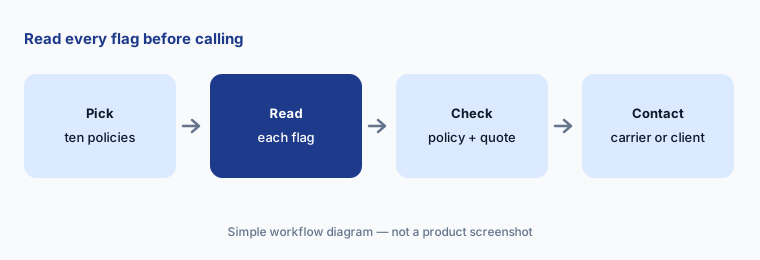
Primary workflow:
Pick ten new commercial policies that Epic Conductor checked against the quote. Have the account manager compare each flagged coverage gap with the policy and the quote before anyone contacts the carrier or the client.
2. Natural-language search across Epic records and attachments
What it is: Applied calls search “Epic’s most common task” and says Epic Conductor makes it work in natural language across both records and attachments (release). A CSR can ask a question the way a client asks it (“when does the Smith Bakery umbrella renew, and who is the carrier?”) instead of clicking through account, policy, and attachment screens.
Search answers are only as current as what is in Epic. If a carrier change was never entered, or the latest dec page was never attached, the answer will be wrong in a confident tone.
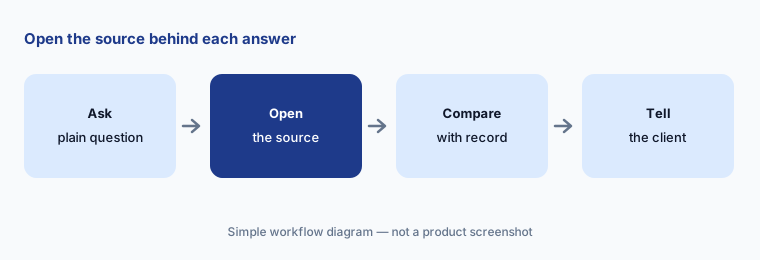
Check the source:
Ask Epic's AI search three questions your CSRs answer every day. Have the CSR open the record or attachment each answer came from and check it before quoting the answer to a client.
3. Document extraction from dec pages, applications, and submissions
What it is: According to Applied, AI “extracts data from carrier documents, including dec pages, applications, submissions, and writes data back into Epic”, logging every action for errors-and-omissions (E&O) purposes. Applied claims this cuts data entry “by more than 50%” immediately. That figure is Applied’s, not ours.
Writing back into the system of record is the step that needs care: a wrong limit or a wrong named insured in Epic flows into renewals, certificates, and invoices. Use the E&O log to see exactly what changed.
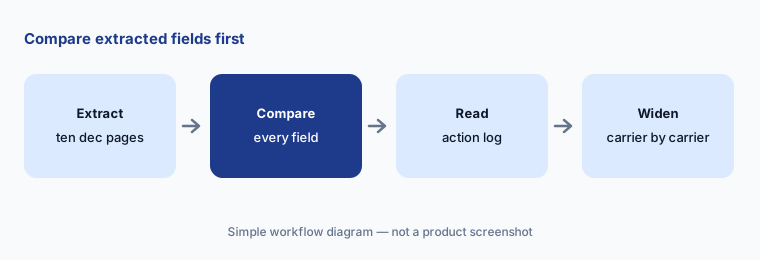
Compare before trusting it:
Run ten carrier dec pages through Epic's extraction. Have the account manager compare every field written into Epic with the dec page, and read the action log, before turning off manual entry for that carrier.
4. Financial automation: invoicing, payment links, and reconciliation
What it is: Epic Conductor’s financial side ties every transaction to a policy in one ledger, from invoicing and accounts-receivable posting through trust accounting and general-ledger close. Applied says the client can be invoiced with a payment link and financing options as soon as the carrier document arrives, and that direct bill, agency bill, and bank statements are “ingested and matched against Epic” to “reconcile automatically with a human in the loop”.
Commission is the agency’s income, so a mismatch that is auto-accepted is real money. Decide in advance which differences a person must review (any commission rate change, any line over a set amount).
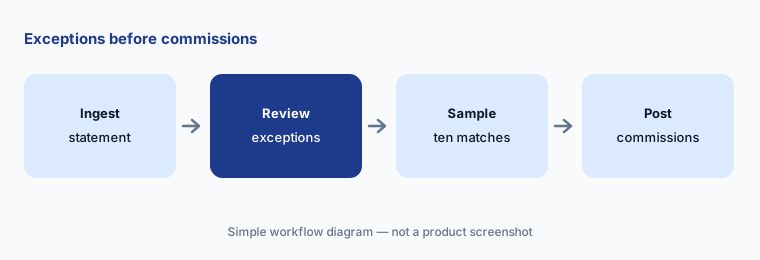
Review exceptions first:
Run one direct bill statement through Epic's reconciliation. Have the agency accountant review every unmatched line and ten matched lines before commissions are posted.
5. Connected Trading: one submission workflow, quoting from email, and remarketing from Epic
What it is: The third part of Epic Conductor is what Applied calls Connected Trading. Every commercial new-business and remarket submission goes through one AI-powered workflow inside Epic, with status visibility, quotes recorded back in Epic, and gaps flagged. Applied says you can quote small commercial risks straight from email or from Epic, with AI reading the request, pulling out the details, and routing them to carriers, and that you can remarket an existing policy by letting AI send the policy data already in Epic to carriers, who quote back inside Epic.
Speed is the selling point, so the risk is a quote that goes out before anyone checked it against what the client asked for. The producer still owns which carriers see the risk and what the client is told.
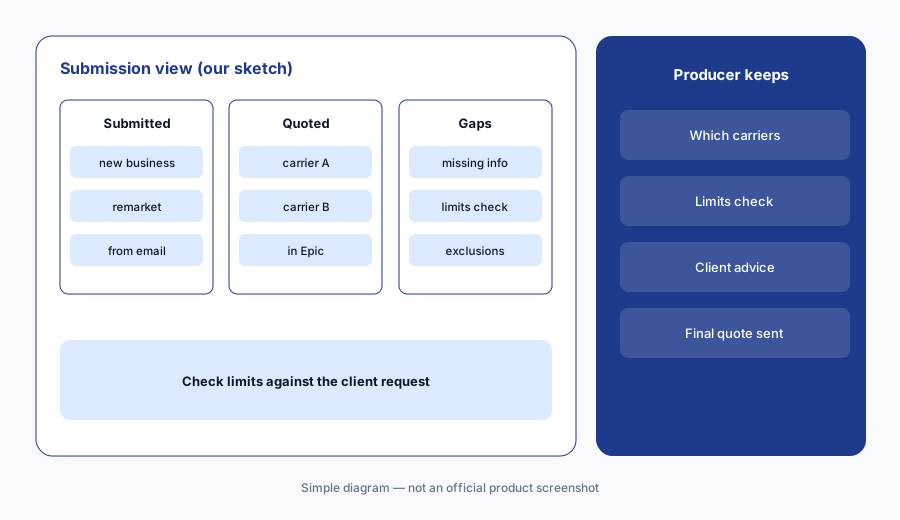
Check before the client sees it:
Send five small-commercial submissions through Epic's email quoting path. Have the producer check each quote's limits, deductibles, and exclusions against the client's request before anything goes to the client.
6. Submissionless renewals and early AI agents
What it is: Two newer pieces sit next to Epic Conductor. On 8 July 2026 Applied announced a submissionless commercial renewal experience with Travelers as the first anchor carrier: Cytora reads risk data already stored in Epic, sends it to participating carriers, and renewal quotes come back inside Epic before the agency starts remarketing. Applied’s CEO also described AI agents that chain several steps, such as reviewing coverage for a certificate request, drafting a carrier request for an endorsement, and preparing the certificate. Per Insurance Innovation Reporter (8 Oct 2026), the agent “stops for approval before communicating with a carrier or completing actions affecting a policy or customer”, Applied is working with a small number of customers on agents today, and it hopes to reach hundreds or thousands of agencies in 2027.
Agents are early. Treat any agent pilot as a test of your approval rules as much as of the software.
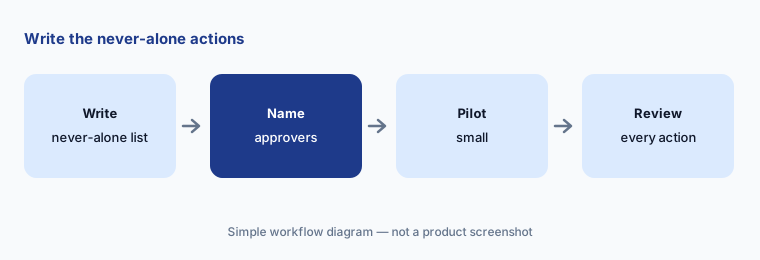
Write the rules first:
Write down the three actions an Applied agent must never take without a person (contacting a carrier, changing a policy, sending to a client). Have the agency principal name an approver for each before you join any agent pilot.
Pricing context (October 2026)
Applied does not publish prices for Applied Epic or Epic Conductor. Its site offers demos and contact forms, and the 29 September 2026 release gives no price, edition list, or rollout date, so pricing is quote-only as of 18 Oct 2026. Ask your Applied representative whether Epic Conductor features are included in your Epic subscription, priced per feature, or limited to certain editions, and when each one is available to your agency.
Submissionless renewal quotes depend on which carriers take part (Travelers was the first anchor carrier; 8 Jul 2026 release). Per trade press, Applied expects it to reach EZLynx around mid-2027. Carrier-side email-to-quote (18 Aug 2026) is sold to carriers, not agencies.
Uncertainty: Applied has not published which Epic Conductor features are generally available today, for which Epic editions or regions, or what they cost; we could not confirm a rollout date. The “more than 50%” data-entry figure is Applied’s own claim, not our measurement. The description of AI agents and the 2027 rollout hope come from the CEO’s comments reported by trade press (Insurance Innovation Reporter, 8 Oct 2026), not from an Applied product page. We did not test Epic Conductor ourselves.
When it’s useful (honest take)
Useful when your agency already runs Applied Epic, account managers spend hours re-keying dec pages and checking issued policies against quotes, your accountant reconciles carrier statements by hand, and someone will write down who approves each AI output before it reaches a carrier or client.
Less useful when your agency runs AMS360 or Sagitta (see Vertafore AI), you are a carrier looking at core-system AI (Guidewire AI), or your main need is drafting emails in Outlook (Microsoft 365 Copilot). A small agency with little commercial business may get less from Connected Trading.
Paying for Applied Epic AI and a few other AI tools? The $9 AI toolkit spreadsheet lists every AI subscription you have, what each one costs, and how fast it pays for itself, so you can see which ones are worth the money.
Want someone to do it for you? AI toolkit audit — $19
Related options (educational)
| Need | Better home | Why |
|---|---|---|
| AI inside Applied Epic for search, extraction, policy checks, and reconciliation | Applied Epic AI (this page) | Quote only |
| AI agents inside AMS360 and Sagitta | Vertafore AI | Quote only |
| Carrier core system with an agent framework | Guidewire AI | Quote only; for carriers |
| Drafting client emails in Outlook | Microsoft 365 Copilot | See its review |
| One-off summary of a sanitized renewal list | Claude (sanitized export) | General chat; no Epic access |
FAQ
What is Applied Epic Conductor?
An AI platform built into Applied Epic, launched 29 September 2026. It covers natural-language search, data extraction from carrier documents, quote comparison and policy checking, financial automation (invoicing, payments, reconciliation), and Connected Trading for commercial submissions.
Is Epic Conductor available to every Epic agency now?
Applied has not published a rollout date or edition list. Ask your Applied representative which features your agency can use today.
How much does Applied Epic AI cost in October 2026?
Applied does not publish prices for Epic or Epic Conductor. Treat it as quote-only and ask whether the AI features are included in your subscription or priced separately.
Can Applied’s AI contact carriers or change policies on its own?
Per Applied’s CEO (Insurance Innovation Reporter, 8 Oct 2026), its AI agents stop for approval before communicating with a carrier or changing a policy, and agents are with a small number of customers today. Keep a named person approving those steps anyway.
Who should check Epic Conductor’s output?
The account manager for policy checks, extraction, and search answers; the producer for quotes going to clients; the agency accountant for reconciliation exceptions; and the agency principal for any agent pilot rules.
Optional next step (if seats overlap)
If you pay for an agency management system with new AI, a separate policy-checking tool, an email assistant, and a chat seat that all read the same dec pages, that overlap is worth mapping. Map the overlap with the $19 AI toolkit audit or the $9 AI toolkit spreadsheet. Email Audit $19 or Toolkit spreadsheet $9.
Checkout is live via Stripe. After you pay, we email delivery (spreadsheet) or intake next steps (audit).