Compare · Healthcare ops · Oct 2026
Abridge vs Microsoft Dragon Copilot (Oct 2026): ambient clinical documentation from a specialist vs the Dragon stack
Abridge and Microsoft Dragon Copilot both listen to a clinical visit and draft the note, but they come from different places. Abridge is a specialist in ambient documentation whose signature feature is Linked Evidence — every note sentence can be traced to the transcript and audio. Dragon Copilot is Microsoft’s clinical assistant that builds on Dragon Medical One dictation and adds ambient capture, coding suggestions, and nurse and radiology experiences. This page splits the two by job and asks when a health system already paying for Dragon dictation should add ambient in place or switch. It is not a ranking, and each section has a Try this.
What this comparison covers
This page is for a CMIO, chief nursing informatics officer, medical director, or clinical informatics lead choosing an ambient documentation tool — or a health system that already pays for Dragon Medical One and is being pitched Abridge. It is not medical, coding, billing, or legal advice.
Facts come from our Abridge AI and Microsoft Dragon Copilot AI reviews, re-checked against vendor pages on 19 October 2026: Abridge’s home page and product page (Abridge Inside Epic; outpatient, emergency, and inpatient settings; multilingual; orders for clinician review), Abridge’s Linked Evidence support article, and Microsoft’s Dragon Copilot page (multi-party ambient capture, cited answers, coding suggestions, nurse and radiology experiences, access embedded in EHRs such as Epic). Neither vendor publishes a price.
Ground rules for either tool: the clinician reads every draft note and every suggested order before signing or placing anything; patients are told when ambient recording is used, following your organization’s consent policy; coding suggestions are leads for the coding team, not final codes; and outcome figures on either site are vendor claims, not our measurement. This comparison is not a ranking.
| Question | Abridge | Microsoft Dragon Copilot |
|---|---|---|
| What it is | Ambient AI for clinical conversations; Abridge says 300+ health systems use it | Microsoft’s AI clinical assistant; builds on Dragon Medical One dictation |
| Capture | Ambient visit capture; outpatient, emergency, and inpatient; multilingual | Ambient multi-party, multilingual capture, on-demand recordings, and dictation |
| Audit trail | Linked Evidence: highlight a note sentence to see the transcript passage and play the audio | Answers drawn from transcripts, notes, and medical references with citations |
| EHR path | Abridge Inside Epic: capture in Haiku, verify drafts in Hyperspace | Web, mobile, desktop, and embedded in supported EHRs such as Epic |
| Beyond the note | Problem capture aligned with billing codes; orders for clinician review | Coding suggestions, referral letters, after-visit summaries, orders |
| Other roles | Nursing, revenue cycle, and payer use cases on Abridge’s site | Nurses (U.S., flowsheets); radiologists (preview, U.S.) |
| Published price | None; enterprise contracts | None; through a Microsoft representative |
| Who signs off | The clinician, after checking Linked Evidence | The clinician, after checking the draft against the visit |
Major features (with how someone uses them)
Examples at a glance: each feature has a concrete example from a real job plus a short Try this you can run this week.
1. Run the same five visits through both (primary)
What it is: Demos use the vendor’s best recordings. The fairest test is your own visits: the same five encounters, captured with each tool by the same clinician, then compared on how much the clinician had to change and how easy it was to trace a sentence back to what was said. Neither vendor lists a self-serve trial on its site, so ask each for a pilot on the same specialty.
Edit distance here just means how much of the draft the clinician rewrote — count changed sentences in the Assessment and Plan. A tool that needs fewer edits but cannot show where a sentence came from may still cost more review time.
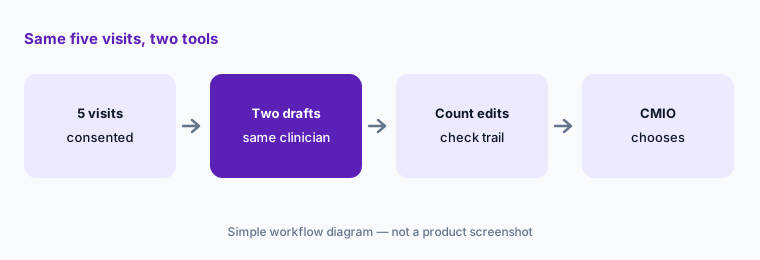
Primary workflow:
Run the same five visits through both trials if available. Have the CMIO compare edit distance and Linked Evidence / audit trails before choosing.
2. Audit trail: Linked Evidence vs cited answers
What it is: Abridge’s support article says Linked Evidence lets you highlight any text in the note and see the matching transcript passage, then play the original audio (Abridge). Microsoft says Dragon Copilot answers questions with responses drawn from transcripts, notes, and trusted medical references, with clear citations (Microsoft).
These are different jobs. Linked Evidence checks a sentence in the note against the visit. Cited answers help a clinician look something up. Ask each vendor how a reviewer traces one Assessment sentence back to the audio.
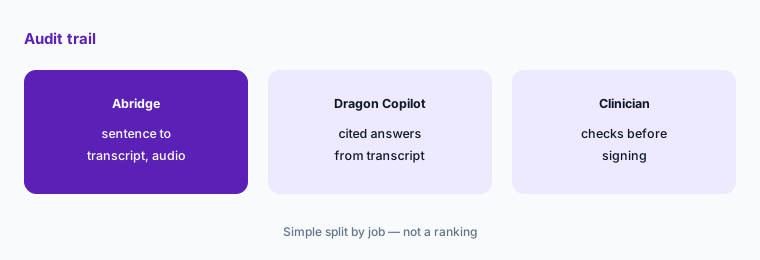
Trace one sentence:
Have one clinician trace ten Assessment sentences back to what was said in each tool and time how long each check takes before deciding which audit trail your reviewers will use.
3. Where the draft lands: Haiku and Hyperspace vs embedded Dragon
What it is: Abridge describes Abridge Inside Epic: capture the conversation in Haiku and verify drafts in Hyperspace with Linked Evidence (Abridge). Microsoft says physicians reach Dragon Copilot through a web browser, mobile app, desktop application, or embedded within supported EHRs such as Epic, and nurses through embedded EHR mobile tools such as Epic Rover (Microsoft).
Both can sit inside Epic. What differs is the version, the specialties your IS team has certified, and which note types each tool writes into.
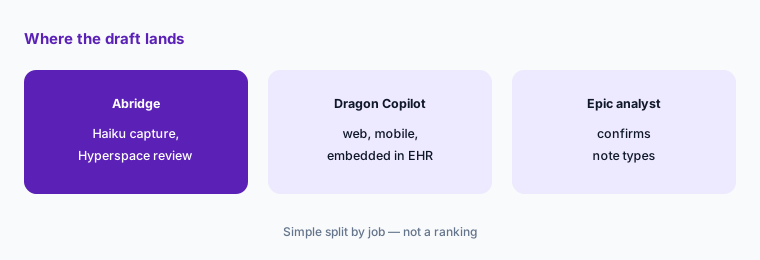
Confirm note types:
Have your Epic analyst confirm which note types and specialties each tool writes into for your version before either pilot expands.
4. Beyond the note: orders, coding, letters
What it is: Abridge says its models capture problems with language aligned to billing codes and capture actionable outputs such as medical orders for clinician review (Abridge). Microsoft lists coding suggestions, clinical evidence summaries, referral letters, and after-visit summaries, plus order capture (Microsoft).
A suggested order is not an order, and a suggested code is not a final code. In either tool, the clinician places orders and the coding team owns codes.
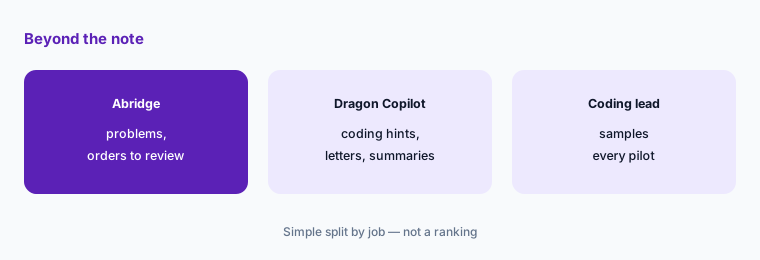
Sample downstream output:
Have the coding lead sample twenty visits from each pilot and compare every code-related suggestion with the final claim before anyone turns off dual review.
5. Roles and settings: who else uses it
What it is: Abridge says it works across outpatient, emergency medicine, and inpatient settings and describes use for clinicians, revenue cycle, nurses, IT, and payers (Abridge). Microsoft lists physician experiences in ten countries, a nurse experience that turns observations into flowsheet documentation for nurse review (United States), and a radiology companion for PowerScribe One that is in preview in the United States (Microsoft).
If nursing or radiology is part of the plan, ask what is generally available in your country and setting today, not what is in preview.
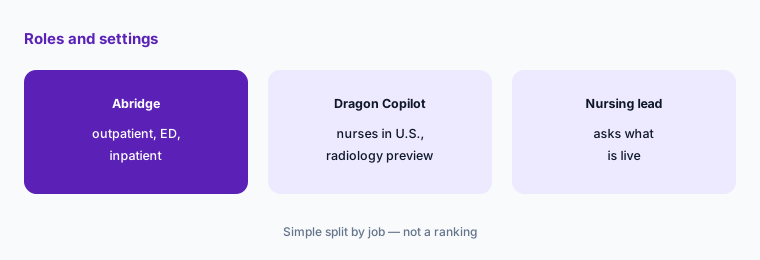
Ask what is live:
Have the nursing informatics lead ask both vendors which nurse features are generally available for your units, and write the answers and dates down before nursing joins any pilot.
6. Already on Dragon Medical One: add ambient or switch?
What it is: Microsoft positions Dragon Copilot as the next step for Dragon Medical One users (Microsoft). For a system whose clinicians already dictate in Dragon, adding ambient there keeps one vendor and one microphone habit. Abridge is a separate vendor, so a switch means a new contract, new training, and running two tools during the change — which can still be worth it if your reviewers prefer its audit trail.
Price both paths with the same inputs: how many clinicians dictate today, how many want ambient, and what the current dictation contract allows.
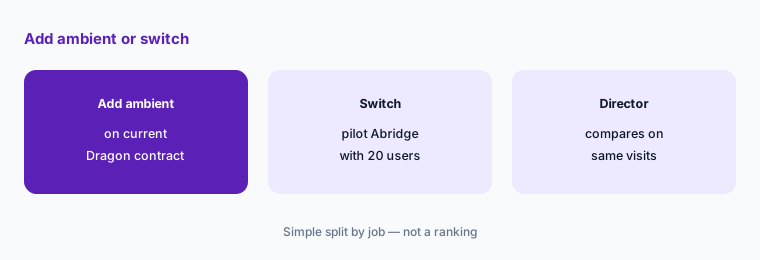
Price both paths:
Before your Dragon renewal, have the informatics director price ambient on the current agreement and a twenty-clinician Abridge pilot, using the same five test visits for both.
Pricing context (October 2026)
Neither vendor publishes prices as of 19 Oct 2026. Abridge sells enterprise contracts (quote-only); Microsoft’s Dragon Copilot page routes buyers to a representative (quote-only). Neither site lists a self-serve trial, so ask each for a pilot on one specialty.
Ask each which features are in the base price (ambient notes, dictation, orders, coding suggestions, nurse or radiology experiences), how Epic integration is priced, and — for Dragon Medical One customers — what happens to the current dictation agreement.
Uncertainty: We did not test either tool. Features roll out by country, setting, and EHR version; Microsoft lists radiology as preview and nursing as U.S.-only. Outcome figures on both sites (for example Abridge’s cognitive-load figures and Microsoft’s time-in-notes figure) are vendor claims, not our measurement. This page is not a ranking.
When it’s useful (honest take)
Useful when you are choosing an ambient documentation tool for a health system, or you already pay for Dragon Medical One and need to decide whether to add ambient there or bring in a specialist.
Less useful when your EHR already includes ambient at no extra cost (see athenahealth AI), you run a small practice looking at Suki AI or eClinicalWorks AI, or your gap is inpatient coding (Akasa AI).
Still choosing between Abridge and Microsoft Dragon Copilot? The $19 AI toolkit audit gives you a written plan for which tools to keep using and which to drop across your whole AI stack, including this pair.
Prefer to do it yourself? Spreadsheet — $9
Related options (educational)
| Need | Better home | Why |
|---|---|---|
| Ambient notes with sentence-level audit trail | Abridge AI | Quote only |
| Ambient plus Dragon dictation in one assistant | Microsoft Dragon Copilot AI | Quote only |
| Ambient scribe for practices across EHRs | Suki AI | Quote only |
| EHR-native ambient for health systems | Epic Systems EHR AI | Quote only |
| Hospital EHR Clinical AI Agent | Oracle Health AI | Quote only |
FAQ
What is the main difference between Abridge and Dragon Copilot?
Abridge is an ambient documentation specialist built around Linked Evidence, which traces each note sentence to the transcript and audio. Dragon Copilot is Microsoft’s clinical assistant that builds on Dragon Medical One dictation and adds ambient capture, coding suggestions, and nurse and radiology experiences. This is not a ranking.
Do both work inside Epic?
Both describe Epic paths. Abridge describes capture in Haiku and review in Hyperspace; Microsoft says Dragon Copilot can be embedded within supported EHRs such as Epic. Your Epic version and certified specialties decide what you get.
Can we trial both?
Neither site lists a self-serve trial. Ask each vendor for a pilot on the same specialty and run the same five consented visits through both.
How much do Abridge and Dragon Copilot cost in October 2026?
Neither publishes prices. Both are quote-only enterprise agreements; ask what is included and how Epic integration is priced.
Who should approve AI drafts in either tool?
The clinician signs every note and places every order; the coding lead samples code-related suggestions; the CMIO owns the pilot decision; and patients are told about ambient recording under your consent policy.
Optional next step (if seats overlap)
If your organization pays for an EHR with ambient features, a dictation contract, and a separate ambient tool that all touch the same visit, that overlap is worth mapping. Map the overlap with the $19 AI toolkit audit or the $9 AI toolkit spreadsheet. Email Audit $19 or Toolkit spreadsheet $9.
Checkout is live via Stripe. After you pay, we email delivery (spreadsheet) or intake next steps (audit).