Tool · Healthcare ops · R1 · Oct 2026
R1 RCM AI review (Oct 2026): enterprise revenue-cycle automation, intelligent automation, and human-in-the-loop billing ops
R1 runs revenue-cycle operations for large health systems and sells the software and services behind them. Its AI is now packaged as Phare OS, which R1 calls a Revenue Operating System: specialist AI agents and people working across Phare Access (front end), Phare Claim (mid-cycle), and Phare Flow (back end), plus Phare UM for utilization management, announced 16 September 2026. This page is about using that automation while the revenue-cycle director owns every rule that can submit, change, or appeal a claim. Each section has a Try this.
What this R1 page covers
This page is for a revenue-cycle director, patient financial services lead, coding manager, utilization management lead, or CFO at a health system using or considering R1 — as an end-to-end partner or for individual modules. It is not medical, billing, coding, or legal advice.
R1 says it partners with 95 of the top 100 U.S. health systems and has more than $77 billion in net patient revenue under management (home page). Its Phare OS page describes a shared foundation — Phare Intelligence (AI agents and models that read medical records for medical necessity, codes, and appeals), Payer Atlas (1,500+ payer connections), and a Data Platform — under the Access, Claim, and Flow modules. Its applied AI lab, R37, works on payer policy monitoring, autonomous coding, contract analysis, denial prevention, and an AI contact center. These are R1’s descriptions and figures.
Ground rules: the revenue-cycle director owns every automation that can submit, correct, or appeal a claim; the billing supervisor samples what automation touched; the coding manager owns coding changes; the utilization management lead and physician advisors decide patient status; and R1’s figures are its claims, not our measurement.
Major features (with how someone uses them)
Examples at a glance: each feature has a concrete example from a real job plus a short Try this you can run this week.
1. Phare Claim fixes and Phare Flow follow-up on claims (primary)
What it is: On the mid-cycle side, Phare Claim says it will “address claim errors automatically where possible” before submission. On the back end, Phare Flow uses agents that triage, orchestrate, and resolve accounts — “check status, appeal denial, reconcile payments, call payer” — and R1 reports about an 80% cut in manual processing time and more than 40% of AR defects resolved without human involvement. R1’s figures.
“Without human involvement” is the number to sample. A claim fixed or resubmitted by automation is still your claim.
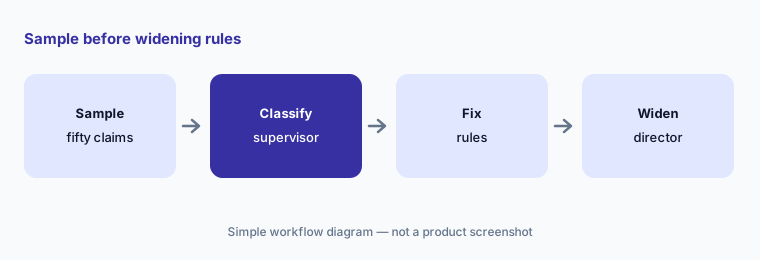
Primary workflow:
Sample fifty claims R1's automation touched last month. Have the billing supervisor classify each as clean, needs edit, or should never have auto-submitted before widening rules.
2. Phare Access eligibility and prior authorization
What it is: Phare Access “blends AI and intuitive patient tools to clear patients early on, automating eligibility and insurance verification, securing prior authorizations, and embedding accurate patient data at intake.” R1 reports 96% of authorizations cleared in one day and up to 45% lower patient-access costs — its figures. R1’s newsroom says its acquisition of Humata Health is meant to strengthen prior authorization within its pre-bill architecture.
An authorization marked “cleared” should match what the payer approved — the service, units, and dates.
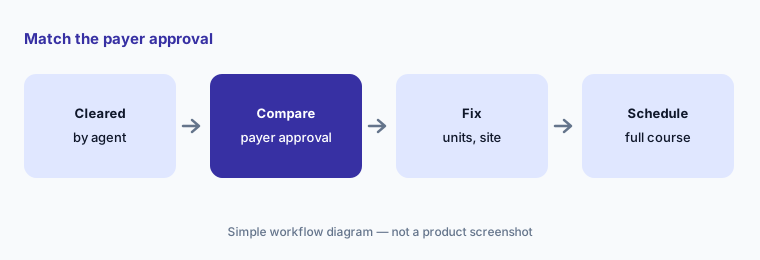
Match the approval:
Have the patient access director compare twenty authorizations marked cleared with the payer’s approval for service, units, and dates before scheduling the full course of care.
3. Phare Claim pre-bill review for coding and documentation
What it is: Phare Claim connects coding, charge capture, clinical documentation integrity, and utilization management, using AI to “surface risks earlier” before claim submission, with “R1 clinical and revenue cycle experts” adding judgment on complex cases. R1 reports 100% AI review across cases, first-level reviews in under four minutes, and a $250 revenue lift per discharge for Phare Audit — R1’s figures. The R37 lab says it is working toward autonomous coding with a “DRG-V safety net”.
A flagged documentation gap is a question for the physician, not a code change. Track which flags led to queries and which were wrong.
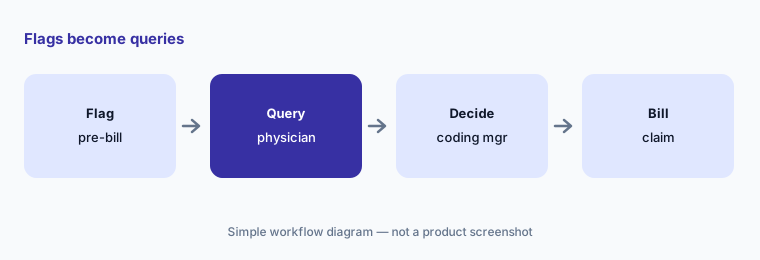
Flags become queries:
Have the coding manager review thirty Phare Claim flags before billing and record which led to a physician query, which were already resolved, and which the documentation did not support.
4. Phare UM for patient status and medical necessity (16 Sep 2026)
What it is: R1 announced Phare UM on 16 September 2026. It says the tool “continuously reviews 100% of cases from admission through discharge,” uses AI agents to assess denial likelihood and payer risk through Payer Atlas, and gives utilization management teams prioritized worklists, “keeping human judgment at the center of every decision.” The Guthrie Clinic is named among the first adopters. In one customer sample assessment R1 says about 65% of observation encounters should have been inpatient — R1’s figure.
Status is a clinical decision made by the physician and the utilization review process, not by a payer-risk model. Use the worklist to prioritize, not to decide.
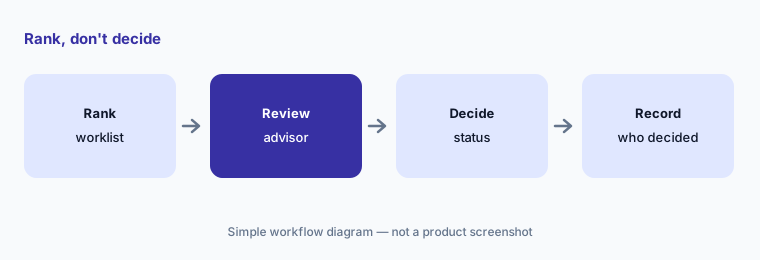
Rank, don’t decide:
Have the utilization management lead and a physician advisor review the twenty highest-risk Phare UM cases each week and record who made every status decision.
5. Command Center and what may run without a person
What it is: Phare OS includes a Command Center with “unified analytics, role-based controls, and real-time visibility into human and AI operations,” which R1 says lets revenue-cycle managers step in and fine-tune the operating model. R1 says Phare is “built on R1’s AI governance framework” with “expert human oversight and supervision” (r1rcm.com).
Visibility is not the same as a rule. Write down which actions may run without a person and who can change that list.
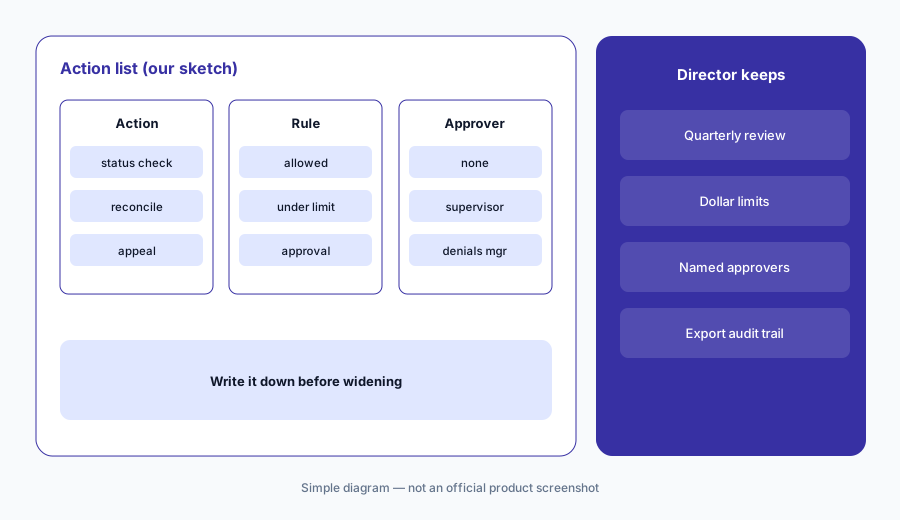
Write the list:
Have the revenue-cycle director write down every action R1’s agents may take without a person, with a dollar limit and a named approver for the rest, and review it each quarter.
6. AI-prepared denial appeals
What it is: R1 says Phare Intelligence agents interpret medical records to produce “airtight appeals” (Phare OS page), Phare Flow can “appeal denial” as one of its actions, and the R37 lab is working to automate the workflow “from denial receipt to appeal submission.” R37 also describes R1-super, a reasoning model built with NVIDIA for claims adjudication. These are R1’s descriptions.
An appeal is a statement to the payer on the hospital’s behalf. Someone at the hospital should be able to defend every sentence.
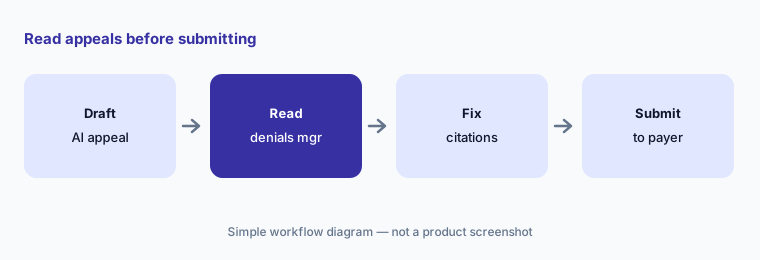
Read before submitting:
Have the denials manager read ten AI-prepared clinical appeals each month before submission and check every cited record and payer policy.
Pricing context (October 2026)
R1 publishes no price list for Phare OS, its modules, or its end-to-end services. When we checked on 19 Oct 2026, r1rcm.com/pricing returned a not-found page; R1 offers enterprise partnerships and individual solutions through its sales team. Treat it as quote-only.
Ask in writing whether each module is priced per transaction, per claim, as a percentage of collections, or as part of a broader operating partnership, and how fees change when automation replaces work R1 staff did before.
Uncertainty: We did not test R1. Authorization, processing-time, AR-defect, revenue-lift, and status figures are R1’s claims. Phare UM was announced on 16 September 2026; ask which modules are generally available for your setting. Confirm BAA terms, which actions agents take without a person by default, and how you can export the audit trail.
When it’s useful (honest take)
Useful when you are a hospital or health system with large claim volumes, considering an end-to-end revenue-cycle partner or module-level automation, and the revenue-cycle director will own every rule that submits or appeals.
Less useful when you are an independent practice that needs PM/EHR software with RCM services (AdvancedMD AI or athenahealth AI), a clearinghouse-led platform (Waystar AI), or autonomous coding alone (Akasa AI).
Paying for R1 RCM AI and a few other AI tools? The $9 AI toolkit spreadsheet lists every AI subscription you have, what each one costs, and how fast it pays for itself, so you can see which ones are worth the money.
Want someone to do it for you? AI toolkit audit — $19
Related options (educational)
| Need | Better home | Why |
|---|---|---|
| End-to-end RCM partner with agentic automation | R1 RCM AI (this page) | Quote only |
| Clearinghouse and RCM platform with AltitudeAI agents | Waystar AI | Quote only |
| Autonomous coding and CDI | Akasa AI | Performance-based prebill terms; coding quote only |
| Prior auth and intake agents | Notable AI | Quote only |
| Patient billing voice and text | Cedar AI | Quote only |
| Health-system EHR coding AI | Epic Systems EHR AI (Penny) | Quote only |
FAQ
What is R1 Phare OS?
Phare OS is R1’s name for its revenue-cycle platform: AI agents and people working across Phare Access (eligibility, authorizations, intake), Phare Claim (coding, documentation, pre-bill review), and Phare Flow (claim follow-up, denials, payments), on a shared foundation of Phare Intelligence, Payer Atlas, and a Data Platform.
What is Phare UM?
A utilization management module R1 announced on 16 September 2026. R1 says it reviews every case from admission through discharge, assesses denial likelihood and payer risk, and gives teams prioritized worklists, with human judgment at the center of each decision.
How much does R1 cost in October 2026?
R1 publishes no prices; its pricing URL returned a not-found page when we checked on 19 Oct 2026. Ask for a written quote and how fees are calculated.
Can R1’s agents resubmit or appeal claims without a person?
R1 describes Phare Flow agents that check status, appeal denials, reconcile payments, and call payers, and reports more than 40% of AR defects resolved without human involvement. Decide which actions may run without a person and sample the results monthly.
Who should check R1 AI output?
The billing supervisor for claims automation touched; the patient access director for authorizations; the coding manager for pre-bill flags; the utilization management lead and physician advisors for status; the denials manager for appeals; and the revenue-cycle director for the list of automatic actions.
Optional next step (if seats overlap)
If you pay for R1 services, a separate clearinghouse, a coding AI, and a patient billing vendor that all touch the same claims, that overlap is worth mapping. Map the overlap with the $19 AI toolkit audit or the $9 AI toolkit spreadsheet. Email Audit $19 or Toolkit spreadsheet $9.
Checkout is live via Stripe. After you pay, we email delivery (spreadsheet) or intake next steps (audit).