What’s new · Healthcare ops · athenahealth · Sep 2026
What's new in athenahealth (Sep 2026): September athenaOne AI and RCM updates to verify before turning them on
athenahealth's press-release page lists four items dated September 2026. Set aside the workplace list on 9 September and three remain: an orthopedic practice's athenaOne results on 1 September, epocrates prescription pricing with ScriptSave on 23 September, and new value-based care AI in athenaOne on 24 September. Most of the 24 September features are in beta or alpha, so for a practice manager the useful question is not “is it good?” but “is it on for us, and who checks it?” This page is not a review — for that, see our athenahealth AI review. Every item links to its source.
What this page covers
This page is for a practice manager, medical director, billing supervisor, or quality lead at an ambulatory practice on athenaOne (or weighing it) who wants September's changes without reading every release — especially anything that changes what AI suggests in the chart, what reaches patients, and what touches the revenue cycle.
We list only entries dated September 2026 on athenahealth's own athenahealth press releases: the 1 September orthopedic practice announcement, the 23 September epocrates and ScriptSave partnership, and the 24 September value-based care release. The 9 September workplace list is recognition, not a product change, so we leave it out. Earlier 2026 items — athenaAmbient at no additional cost and the Spring 2026 Ambient Notes updates — are covered on athenahealth AI.
Practice guardrails stay the same: AI surfaces and drafts, but the treating clinician decides every diagnosis and signs every note, the coding lead owns coding rules, and the practice manager approves every patient message before it goes out. Figures in these releases are athenahealth's, not our measurement. Nothing here is medical, coding, or billing advice.
Major features (with how someone uses them)
Examples at a glance: each feature has a concrete example from a real job plus a short Try this you can run this week.
1. September items to check before turning anything on (primary)
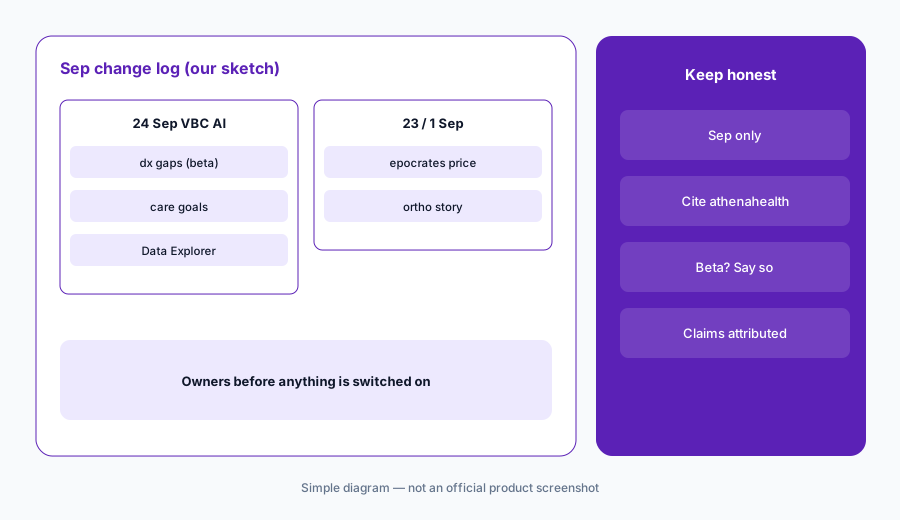
What it is: From athenahealth's dated September announcements, three need an owner: (1) new value-based care AI in athenaOne — Clinically Inferred Diagnosis Gaps (now in beta), AI-suggested care-plan goals and AI care event summaries in Enterprise Care Management (now in alpha), Data Explorer population reporting with AI explanations of quality-measure status (now in beta), Sage for Analytics (now in alpha), and Agentic Care Gap Outreach (coming soon to alpha), all “already in testing with thousands of providers” (athenahealth press release, 24 Sep); (2) prescription pricing and savings information inside epocrates drug content through a multi-year ScriptSave partnership — epocrates is an athenahealth company (athenahealth press release, 23 Sep); and (3) an orthopedic practice's results after moving to athenaOne for Orthopedics, including athenahealth's Authorization Management services for prior authorization (athenahealth press release, 1 Sep).
Primary workflow:
Pick one September athena item your practice might enable. Have the practice manager write who approves its output and which ten charts you'll check first.
2. Clinically Inferred Diagnosis Gaps (beta, 24 Sep)
What it is: The 24 September release says Clinically Inferred Diagnosis Gaps “uses AI to analyze patient chart data and surface undocumented diagnoses that may warrant review and evaluation,” shown alongside supporting clinical evidence. athenahealth says these gaps have a 2x higher closure rate and a 3.5x lower dismissal rate than suspected gaps from other sources — its figures. A quoted chief medical information officer describes the reasoning and links to the result or note being shown, and providers adding the diagnosis from the same screen.
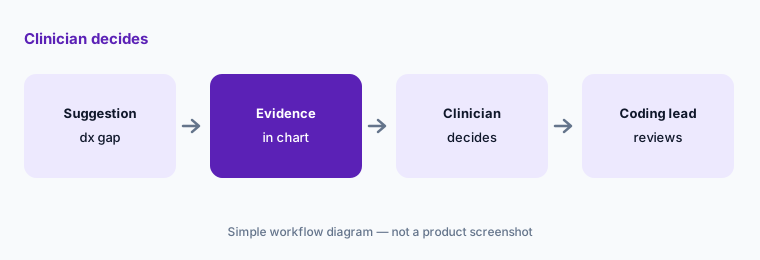
A suggested diagnosis is a prompt to look, not a diagnosis. Ask athenahealth whether beta access is open to your practice, what evidence each suggestion shows, and whether dismissals are logged. The clinician who saw the patient decides; the coding lead checks that what was documented supports what was coded.
Clinician decides:
Pick ten suggested diagnosis gaps. Have the treating clinician check each one against the chart and the visit before anything is documented, and the coding lead review the resulting notes.
3. AI care-plan goals and hospital event summaries (alpha, 24 Sep)
What it is: Per the same release, Enterprise Care Management now in alpha “uses AI to suggest personalized care plan goals that the care team can incorporate directly in the patient chart,” and AI-generated summaries of hospital care events help teams “quickly understand what happened and coordinate timely follow-up.”
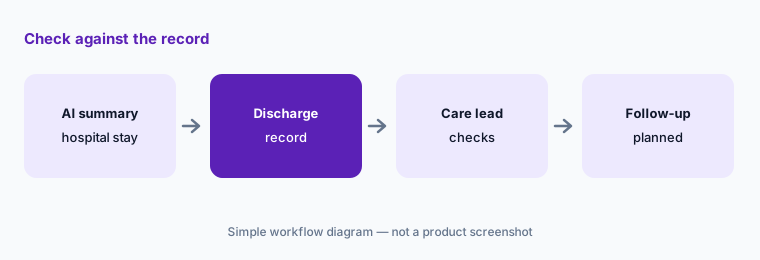
Alpha means early access for a small group. If you are in it, a summary of a hospital stay is only as good as the records behind it — compare it with the discharge summary before anyone acts on it.
Check against the record:
Compare five AI hospital event summaries with the discharge summaries. Have the care management lead list every missing medication change or follow-up before the summaries are used for outreach.
4. Data Explorer, Sage for Analytics, and care gap outreach (24 Sep)
What it is: The 24 September release lists Data Explorer population-level reporting (now in beta), where “embedded AI explains why a patient has or has not met a quality measure”; Sage for Analytics (now in alpha), which lets teams analyze population data in natural language and build visualizations; and Agentic Care Gap Outreach, “coming soon to alpha,” which will identify patients who need outreach and “prepare tailored communications for customer review and approval before they are sent.”
Two checks matter here: does the explanation match the chart, and does a number from Sage match the report it came from? Outreach is not on yet — but decide now who approves each message when it is.
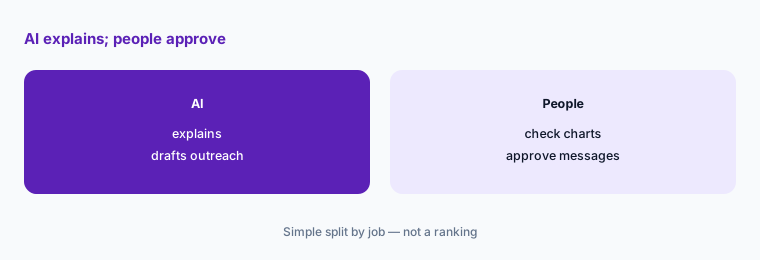
Explanation vs chart:
Check twenty Data Explorer measure explanations against the charts. Have the quality lead record every mismatch, and name the practice manager as approver for any outreach message before Agentic Care Gap Outreach is switched on.
5. epocrates prescription pricing with ScriptSave (23 Sep)
What it is: The 23 September release says epocrates, an athenahealth company, will bring ScriptSave's prescription drug pricing and savings information into epocrates drug content — current cost information, pricing across medication forms, and cost-saving opportunities — so clinicians can talk about cost with patients before a prescription is written. It calls this an “initial rollout”; future releases are to add deeper workflow integrations, faster data refresh cycles, links to patient savings resources, and access to coupons and discount programs.
The release describes epocrates drug content, not a new athenaOne screen. A price shown in a reference tool is an estimate; what the patient pays depends on the pharmacy and their coverage. Prescribing decisions stay with the clinician.
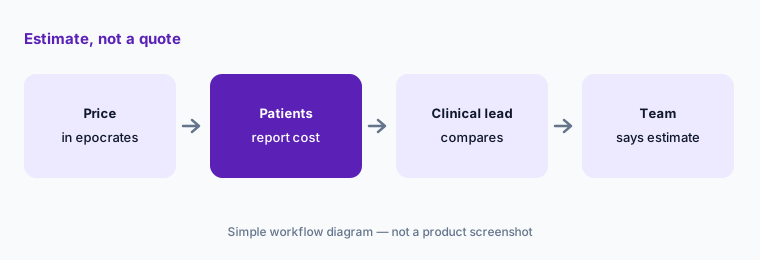
Estimate, not a quote:
Have the clinical lead compare the price epocrates shows for five common prescriptions with what patients report paying, and tell staff to call it an estimate before anyone mentions it to a patient.
6. The 1 Sep orthopedic announcement and what is not a September change
What it is: The 1 September release says Orthopedic + Fracture Specialists, a five-location practice in the Portland, Oregon area, implemented athenaOne for Orthopedics, stabilized operations within three months of go-live, eliminated 15 bolt-on applications (about 75% of its additional systems, per its CEO), and uses athenahealth's Authorization Management services for prior authorization. That is a customer's account — not a feature, and not a reason to switch systems. The 9 September workplace list is recognition. For how athenaOne compares with Epic Systems, see athenahealth vs Epic Systems EHR; for Epic's own September notes, What’s new in Epic Systems EHR (Sep 2026).
Keep the September log clean: customer stories and recognition go under reading, not under changes to test. If prior-authorization services interest you, ask what is software and what is a service team.
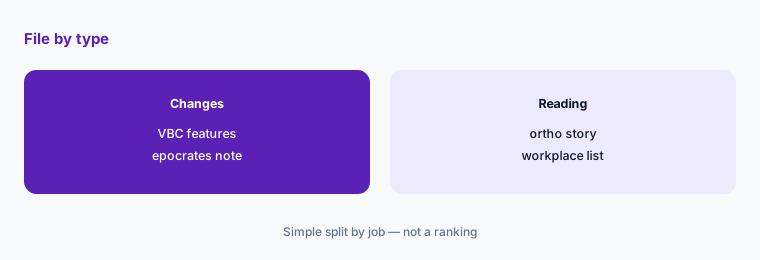
File by type:
Have the practice manager keep the 24 Sep value-based care features and the 23 Sep epocrates note under September changes, and move the orthopedic announcement and the workplace list to a reading list, with a link to each source.
Pricing context (October 2026)
None of the September 2026 items publish prices, and athenahealth has no public price list for athenaOne or its AI features (checked 19 Oct 2026). Treat the value-based care features as quote-only and ask in writing whether beta and alpha access carries a fee and what changes at general availability — see athenahealth AI for what the product pages do and do not show (Oct 2026).
The epocrates release gives no price for clinicians or practices, and Authorization Management is described as a service; ask for terms.
Uncertainty: We list only dated September 2026 items fetched from athenahealth's press-release page on 19 Oct 2026. Most 24 September features are in beta or alpha, and Agentic Care Gap Outreach is “coming soon”, so availability for your practice is a question to ask, not a given. Closure and dismissal-rate figures are athenahealth's; the orthopedic results are the practice's account.
When it’s useful (honest take)
Useful when you run athenaOne (or are shortlisting it) and need September's dated changes with an owner and a check for each.
Less useful when you need the product deep-dive — use athenahealth AI — or you run Epic (What’s new in Epic Systems EHR (Sep 2026)).
Paying for athenahealth and a few other AI tools? The $9 AI toolkit spreadsheet lists every AI subscription you have, what each one costs, and how fast it pays for itself, so you can see which ones are worth the money.
Want someone to do it for you? AI toolkit audit — $19
Related options (educational)
| Need | Better home | Why |
|---|---|---|
| athenahealth product review | athenahealth AI | Tool review |
| athenaOne vs Epic | athenahealth vs Epic Systems EHR | Compare |
| Epic Sep changelog | What’s new in Epic Systems EHR (Sep 2026) | What’s new |
| Care-gap agents outside the EHR | Innovaccer AI | Tool review |
| Healthcare stack inventory | Stack map for healthcare ops | Stack map |
FAQ
Which September 2026 athenahealth items did you fetch?
athenahealth press releases dated 1 Sep (orthopedic practice on athenaOne), 23 Sep (epocrates and ScriptSave prescription pricing), and 24 Sep (value-based care AI in athenaOne), all read 19 October 2026. The 9 Sep workplace list is recognition and is left out.
Are the value-based care features available to every athenaOne practice?
No date is given. The 24 September release says they are in beta or alpha, with Agentic Care Gap Outreach coming soon to alpha, and already in testing with thousands of providers. Ask athenahealth in writing whether your practice can join and write the answer and date down.
Can the AI add a diagnosis to the chart on its own?
The release describes surfacing diagnoses that may warrant review, with evidence, and providers adding them from the same screen. The treating clinician decides; nothing on this page is medical or coding advice.
Does epocrates pricing appear inside athenaOne?
The 23 September release describes pricing inside epocrates drug content and future workflow integrations. Ask athenahealth whether and when it appears in athenaOne for your practice.
Is this a review?
No. It is a dated September changelog. For the product review see athenahealth AI.
Optional next step (if seats overlap)
If September's athenahealth features overlap with a care-gap tool, an analytics product, or chat seats your practice already pays for, map that overlap before you add another seat. Map the overlap with the $19 AI toolkit audit or the $9 AI toolkit spreadsheet. Email Audit $19 or Toolkit spreadsheet $9.
Checkout is live via Stripe. After you pay, we email delivery (spreadsheet) or intake next steps (audit).