What’s new · Logistics ops · Flexport · Sep 2026
What’s new in Flexport (Sep 2026): Flexport MCP, AI agents, Atlas upgrades, and fulfillment in Canada and the UK
Flexport published three dated September 2026 posts we re-fetched on 17 October 2026 — fulfillment in Canada and the UK on 2 September, a new general manager for Singapore and Malaysia on 9 September, and a recap of its first Flexport Forward event in Copenhagen on 18 September — and shipped its Fall Release 2026, which trade press dated 29 September. For an importer's logistics lead, that adds up to a short list of things to test this quarter, each with a named owner and a check before anything reaches a booking, a customs entry, or a customer. This page is not a review — for that, see our Flexport AI review. Every item links to its source.
What this page covers
This page is for a logistics lead, import manager, or customs and compliance lead who ships with Flexport (or is shortlisting it) and wants September's changes without reading every post — especially anything that changes what an AI assistant can do in your account, how bookings and quotes get made, how HTS codes are drafted, and where you can hold inventory.
We list only entries dated September 2026: three Flexport-published posts on the Flexport blog — the 2 September fulfillment release, the 9 September Singapore and Malaysia appointment, and the 18 September Copenhagen recap — plus the Fall Release 2026 page. Flexport's Fall Release page carries no date; FreightWaves reported the launch on Tuesday, 29 September 2026, and Flexport's own newsroom lists Inc coverage of the ChatGPT integration dated 29 September. The blog's market and customs explainers (1, 9, 15, and 21 September) are useful reading but are not Flexport product or company announcements, so they are context only. For the full product, see Flexport AI.
Importer guardrails stay the same: Flexport's AI can quote, book, track, and draft HTS candidates, but a named logistics manager approves every booking rule, and the customs or compliance lead (or a licensed broker) confirms every HTS code before an entry is filed. Lead-time, efficiency, and accuracy figures in these posts are Flexport's, not our measurement.
Major features (with how someone uses them)
Examples at a glance: each feature has a concrete example from a real job plus a short Try this you can run this week.
1. Changes an importer's logistics lead should test this quarter (primary)
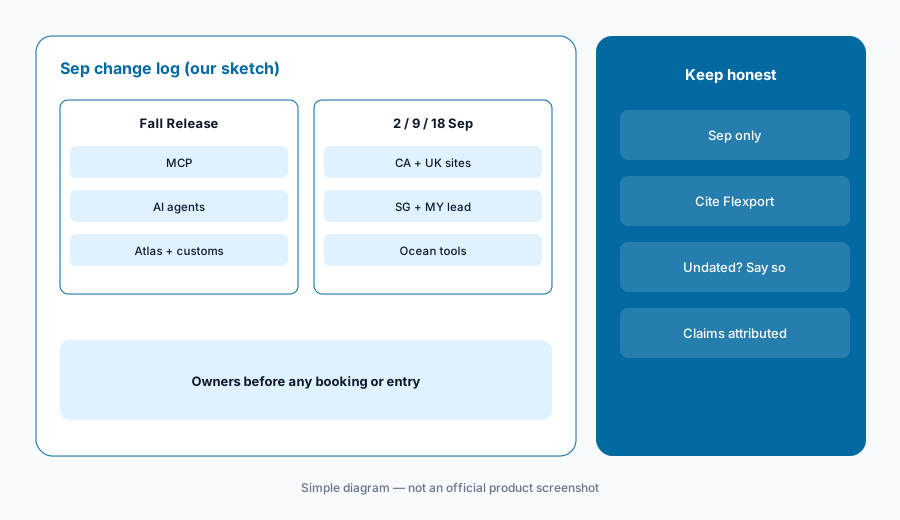
What it is: From Flexport's September announcements, these need a decision: (1) Flexport MCP, which connects Claude, ChatGPT, Copilot, and Muse to your account to track shipments, check customs holds, search rates, and book against your own rates (Fall Release page, reported 29 Sep); (2) the fleet of AI agents that read booking emails and either send back a quote for review or book on the spot, convert rate sheets to your format, and catch vessel changes; (3) Flexport Atlas adding air, rail, and barge routing, disruption alerts, and estimated CO2e per container; (4) AI Customs Classification and the Customs Business Rules Engine; (5) fulfillment in Mississauga, Canada and Manchester, England, where Flexport says it can clear customs directly and orders and returns stay in-country (Flexport blog, 2 Sep); (6) a new General Manager for Singapore and Malaysia, Zoe Chan (Flexport blog, 9 Sep); and (7) the Copenhagen recap's list of ocean tools — automated carrier planning, AI data structuring of news and dwell alerts, Atlas tracking, and in-flight consolidation (Flexport blog, 18 Sep).
Primary workflow:
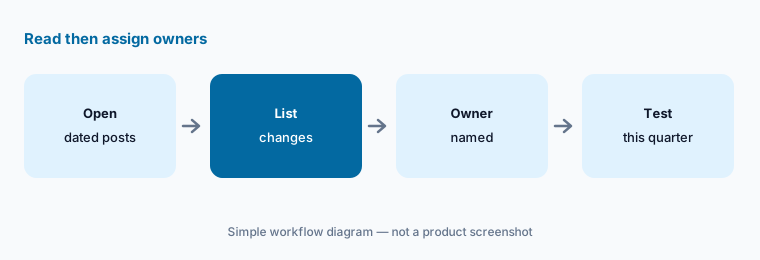
From Flexport's Sep 2026 announcements, list the changes an importer's logistics lead should test this quarter — cite sources.
2. Flexport MCP and the AI agents (Fall Release, reported 29 Sep)
What it is: The Fall Release page says you can connect Flexport to Claude, ChatGPT, Copilot, and Muse and track a shipment, check a customs hold, search rates, or book against your own rate without logging in. Flexport's MCP page (re-read 17 October 2026) says an administrator enables the connection once, each person signs in with their own Flexport login, the assistant can reach only what that person can already reach, and administrators can revoke any user or switch the organization off. It also says historical analysis such as average transit times by lane is not available yet. The release's email agent “either sends back a quote for review or executes the booking on the spot”; FreightWaves reports Flexport saying every exception routes to a human expert.
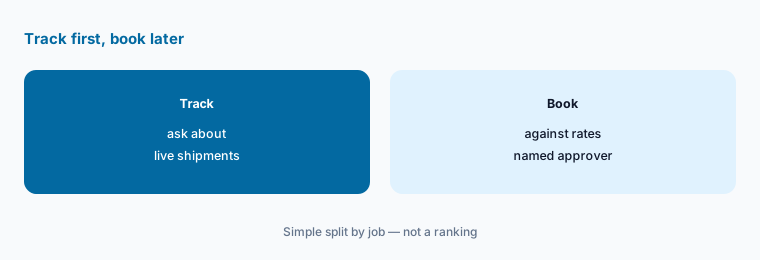
Start with tracking questions. Booking from a chat window is a booking: decide who may do it, against which rates, before anyone connects an assistant with booking access.
Track first, book later:
Connect Flexport MCP for two coordinators and ask about five live shipments. Check every answer against the Flexport shipment page, and write down who may book through an assistant before anyone does.
3. Atlas: multimodal routing, disruption alerts, route emissions
What it is: The Fall Release page describes Flexport Atlas as a map of vessels, ports, and carrier services that now searches routes across ocean, air, rail, and barge, shows which vessels are stalled when a chokepoint closes or a port backs up, and puts estimated CO2e per container next to carrier and transit time. The 18 September recap says Atlas tracking combines AIS data, berthing schedules, and dwell metrics into predictive lead times that, by Flexport's account, outperform carrier schedules by 10 to 15 percentage points — Flexport's figure, not our measurement.
A predicted lead time is still a prediction. Check it against the carrier's own schedule for a few live shipments before you change safety stock or tell a customer a date.
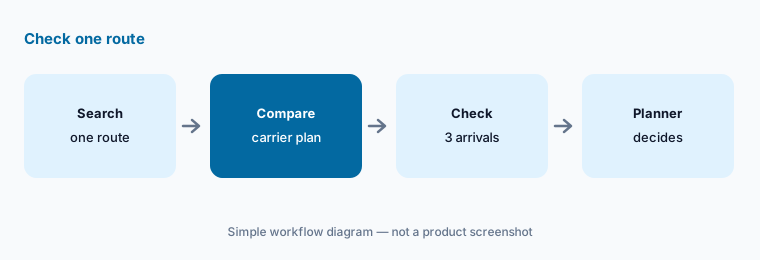
One route, three checks:
Search one of your regular routes in Flexport Atlas. Compare its predicted lead time with the carrier's schedule and your last three actual arrivals before anyone changes safety stock.
4. AI Customs Classification and the Business Rules Engine
What it is: The Fall Release page says you answer a few guided questions and compare candidate HTS classifications side by side, with Customs and Border Protection rulings linked, and that the Customs Business Rules Engine turns your customs procedures into deterministic code that checks every entry against your rules and flags anything that looks wrong before filing — AI writes the code, and it runs once tested and signed off. Flexport's product classification page (re-read 17 October 2026) says its licensed customs brokers confirm every code.
A candidate code is a draft. Your compliance lead or a licensed broker confirms each one, and whoever signs off a rule owns what it checks. This page gives no legal or customs advice.
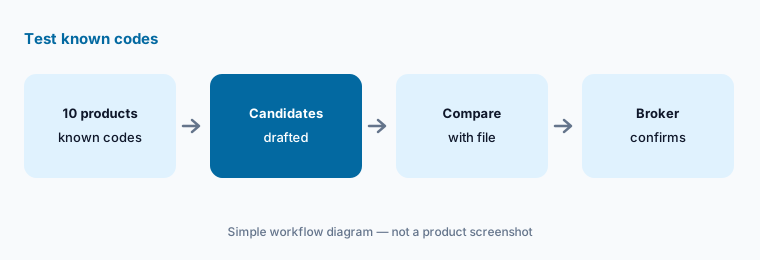
Test on codes you know:
Run ten products you have already classified through AI Customs Classification. Compare each candidate HTS code with the code on file and have the compliance lead or broker review every difference.
5. Fulfillment in Canada and the UK (2 Sep)
What it is: The 2 September release announces Flexport's first international fulfillment services, in Mississauga, Canada and Manchester, England. Flexport says brands can hold inventory in-market with the same platform, account team, and freight and customs relationship; that it can clear customs directly in both countries; and that orders and returns stay in-country. The Canada site, near Toronto Pearson, holds Health Canada certifications for medical products, supplements, and consumer goods, with inbound receiving live in July 2026 and first outbound orders in September. UK fulfillment runs from two partner-run Manchester facilities with AutoStore storage and retrieval. Flexport plans continental Europe for 2027.
Ask in writing what in-country fulfillment would cost and include for your SKUs; the release publishes no prices.
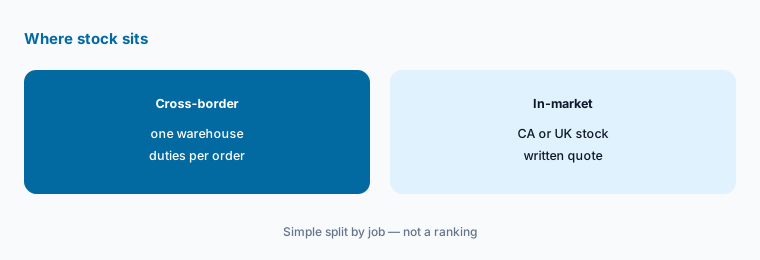
Quote before you move stock:
List last quarter's Canadian and UK orders and returns, check which SKUs need special certification, and ask Flexport in writing what in-country fulfillment would include and cost.
6. Copenhagen recap, the Singapore appointment, and what is not a September item
What it is: The 18 September recap also explains that Flexport ships two product releases a year (it lists February 2025, September 2025, and February 2026) and that it has launched operations in Belgium, France, and Poland. The 9 September post names Zoe Chan as General Manager, Singapore and Malaysia — a people change, not a product feature. The blog's explainers on the typhoon season (1 September), U.S. executive orders affecting Canada (9 September), the Q4 European freight outlook (15 September), and EU customs reform (21 September) are context. For how Flexport compares with visibility platforms, see project44 vs FourKites; for planning suites, Kinaxis vs o9.
Keep the September log clean: explainers and award news go under reading, not under changes to test.
File by type:
In your freight change log, keep the Fall Release and the 2, 9, and 18 September posts under September changes, and move the market and customs explainers to a reading list, with a link to each source.
Pricing context (October 2026)
None of the September 2026 items publish prices. Flexport quotes freight, customs, and fulfillment and has no public software price list (checked 17 October 2026) — see Flexport AI for what the product pages do and do not show (Oct 2026).
The fulfillment release mentions efficiencies and cost savings but gives no amounts; treat them as Flexport's claims and ask for a written quote.
Uncertainty: Flexport's Fall Release page shows no date; we date it from FreightWaves' 29 September 2026 report and the Inc coverage listed in Flexport's newsroom on the same day. MCP historical analysis is “not yet” available per Flexport. The email agent can book “on the spot”, so check which booking rules your account has on. We list only dated September 2026 items fetched 17 Oct 2026; lead-time, efficiency, and customer figures are Flexport's.
When it’s useful (honest take)
Useful when you ship with Flexport (or are shortlisting it) and need September's dated changes with owners and checks.
Less useful when you need the product deep-dive — use Flexport AI — or o9's September notes (What’s new in o9 Solutions).
Paying for Flexport and a few other AI tools? The $9 AI toolkit spreadsheet lists every AI subscription you have, what each one costs, and how fast it pays for itself, so you can see which ones are worth the money.
Want someone to do it for you? AI toolkit audit — $19
Related options (educational)
| Need | Better home | Why |
|---|---|---|
| Flexport AI product review | Flexport AI | Tool review |
| Visibility platforms compared | project44 vs FourKites | Compare |
| o9 Sep changelog | What’s new in o9 Solutions | What’s new |
| Logistics stack inventory | Stack map for logistics ops | How-to |
| Trade compliance mapping | Altana AI | Tool review |
FAQ
Which September 2026 Flexport items did you fetch?
Flexport blog posts dated 2 Sep (fulfillment in Canada and the UK), 9 Sep (General Manager, Singapore and Malaysia), and 18 Sep (Flexport Forward Copenhagen recap), plus the Fall Release 2026 page, which trade press dated 29 Sep — all read 17 October 2026.
Is the Fall Release really a September item?
Flexport's page is undated. FreightWaves reported the launch on Tuesday, 29 September 2026, and Flexport's newsroom lists Inc coverage of the ChatGPT integration on the same date, so we file it under September and say so.
Can Flexport's AI book freight without a person?
Flexport says its email agent can either send back a quote for review or execute the booking on the spot, and that every exception routes to a human expert. Decide which booking rules are on and name the logistics manager who approves them.
Who should own these changes?
IT or the account admin for MCP access, the logistics manager for booking rules and agent tests, the compliance lead or a licensed broker for every HTS code and business rule, and the ecommerce or operations manager for the fulfillment decision.
Is this a review?
No. It is a dated September changelog. For the product review see Flexport AI.
Optional next step (if seats overlap)
If September's Flexport changes overlap with a visibility platform, a TMS assistant, or a chat seat that already answers where your freight is, map that overlap before you add another seat. Map the overlap with the $19 AI toolkit audit or the $9 AI toolkit spreadsheet. Email Audit $19 or Toolkit spreadsheet $9.
Checkout is live via Stripe. After you pay, we email delivery (spreadsheet) or intake next steps (audit).