Tool · Logistics ops · Altana · Oct 2026
Altana AI review (Oct 2026): AI supply chain mapping, product passports, and trade compliance workflows
Altana sells an AI platform for trade: it maps the suppliers behind your products, keeps each product’s classification, origin, and duty record current, and lets you share that record as a Product Passport with brokers and customs. Its AI runs on what Altana calls the Supply Chain Graph, built from shipment records, public and commercial data, and customer data. The parts most teams meet first are AI value-chain mapping, the trade-manager agent, and, for brokers, agentic entry writing. This page covers each and who should sign off. Each section has a Try this.
What this Altana AI page covers
This page is for a trade compliance lead, sourcing manager, or customs broker using Altana or comparing it. It answers: what Altana’s AI suggests and what it leaves to you, how Product Passports work with customs, what the brokerage workflow automates, and what Altana publishes about price.
Altana’s platform page (read 17 October 2026) says its product catalog combines “what you know”, “what AI suggests”, and “what suppliers tell you”, and that its AI suggests likely upstream suppliers “giving you the opportunity to verify”. Its trade and tariffs page puts it plainly: “You stay in control: it suggests, you decide.” Its customs brokerage page says “AI writes and enriches the entry. Your broker signs off on it and files.”
Ground rules: the trade compliance lead confirms every AI-suggested supplier link before it is used in a filing, an audit, or a Passport; a licensed customs broker checks and files every entry; the sourcing manager treats tariff simulations as estimates until finance checks them. Bills of materials should be sanitized before any test, real supplier contracts stay out of outside chat tools, and Altana’s figures are its claims, not our measurement. Nothing on this page is legal or customs advice.
Major features (with how someone uses them)
Examples at a glance: each feature has a concrete example from a real job plus a short Try this you can run this week.
1. AI value-chain mapping from a bill of materials (primary)
What it is: Altana’s platform page says: “Share a bill of materials and supplier data, and Altana’s AI suggests which entities in the Supply Chain Graph are likely in your upstream value chains, completing the picture automatically and giving you the opportunity to verify.” Altana describes the graph as covering “~50% of global trade and 600M+ companies”, with more than half drawn from first-party logistics data. Its Passports page says sourcing teams can add, edit, and delete connections to curate a verified record, and that suppliers can confirm links through requests in the platform.
An AI-suggested supplier is a lead from shipment data, not proof of where your goods come from. Confirm a sample with the suppliers themselves before relying on the map.
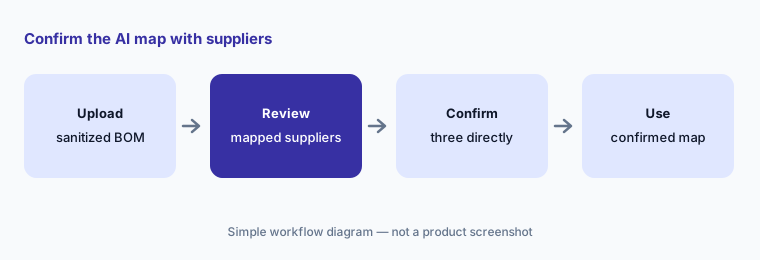
Primary workflow:
Upload one sanitized bill of materials to Altana and review the suppliers it maps. Have the compliance lead confirm three of them with the supplier directly before using the map.
2. Product Passports and customs pre-validation
What it is: Altana’s Product Passports page describes a Passport as a shareable digital record of a product’s journey from raw materials to finished goods, built from a product profile with a name, description, HS code, country of origin, and “more than 200 other attributes”. You choose what each Passport shares for a given purpose. Altana says U.S. Customs and Border Protection selected its Passport technology in May 2025 as the product-level identifier for its Global Business Identifier program, open to CTPAT-certified importers, and that logistics providers add the Passport ID to the customs entry. Its 23 April 2026 release added a passport manager for customs authorities along Maersk’s Gemini Cooperation lanes, where authorities “make their own risk and compliance determinations, with Altana AI suggesting recommendations”.
A Passport is only as good as the links behind it. Share one with customs only after the compliance lead has confirmed what it says.
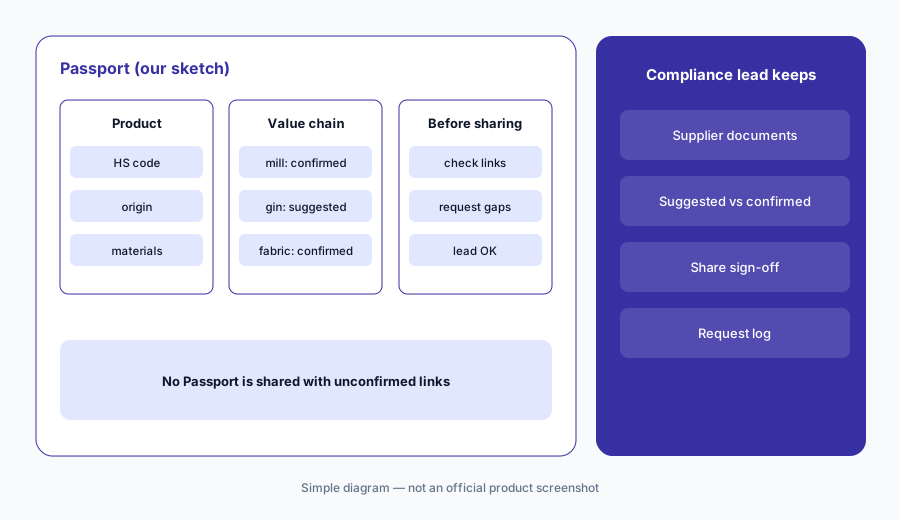
Check before you share:
Open one Product Passport before it is shared with customs. Have the compliance lead check that every supplier link in it is confirmed by a supplier document, not just suggested by AI.
3. Trade-manager agent: classification, origin, FTA, and duty
What it is: Altana’s trade and tariffs page describes a trade-manager agent that organises what a product needs to cross the border: HS classification “to full national tariff depth, backed by rulings and clear reasoning”, country of origin with “audit-ready rationale”, free-trade agreement qualification (including USMCA), Section 232 estimates by material, duty calculation that stacks every program, denied party and forced-labor screening, and partner government agency flags. It also lists post-entry and continuous audits that compare what you filed with what you owed.
Reasoning you can read is still a suggestion. The compliance lead or broker decides each code and origin before anything is filed.
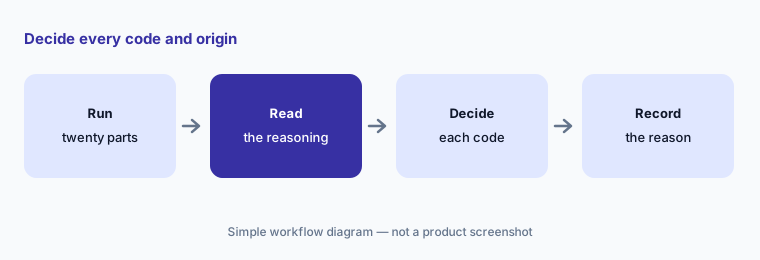
Decide each code:
Run twenty products through Altana's classification and origin suggestions. Have the compliance lead accept or reject each one, with the reason recorded, before any entry uses it.
4. Agentic entry writing for customs brokers
What it is: On its customs brokerage page, Altana says its AI reads the document packet and drafts the import declaration, fills partner government agency, Section 232, and classification fields, applies each importer’s own procedures, and checks every line for forced labor, origin, classification, and valuation risk before submission. The last steps are “Filed by your team” in CargoWise, NetCHB, or another ABI system, and shared with the importer. Altana’s 21 July 2026 release says it acquired Cervo AI, whose entry writer prepares submission-ready entries, and cites 5x as many entries processed; the brokerage page cites 8x faster classification.
A drafted entry is not a filed one. A licensed broker reviews every line before it goes to customs.
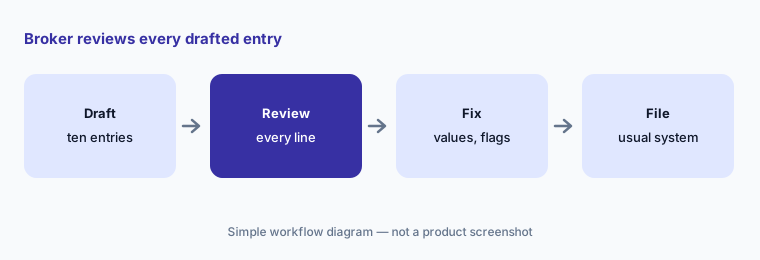
Review before filing:
Have Altana draft ten customs entries from real packets. Have a licensed broker review every line, value, and agency flag before filing them from your usual system.
5. Tariff and disruption simulation for sourcing
What it is: Altana’s sourcing and procurement page describes tariff simulation that models duty exposure “by supplier, component, and country” for landed-cost planning, and scenario simulation for events such as a trading partner going dark, export restrictions on critical materials, or a new sanctions regime. It cites a customer case of 47 detained shipments resolved through a Passport, plus figures such as $50M avoided and 30% supplier price savings — Altana’s claims, not our measurement.
A simulation is only as current as the tariff rules and supplier links behind it. Have finance check the inputs before a sourcing decision moves.
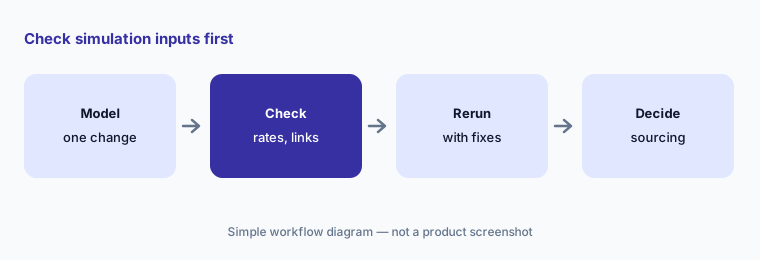
Check the inputs:
Model one tariff change on a single component in Altana. Have finance check the duty rates and supplier links behind it before any sourcing decision changes.
6. Supplier requests and risk screening
What it is: Altana’s platform lists request management (ask suppliers for product information or documents), risk management through “AI-assisted task workflows and supplier collaboration”, and screening of value chains for violations including forced labor. Its suppliers page says suppliers can join, map their own value chains, and answer buyer requests “at no cost”, sharing only what they choose. Altana describes its data model as federated, with participants keeping control of their own data.
A supplier reply closes a gap only if someone checks the document. Review what comes back before marking a link confirmed.
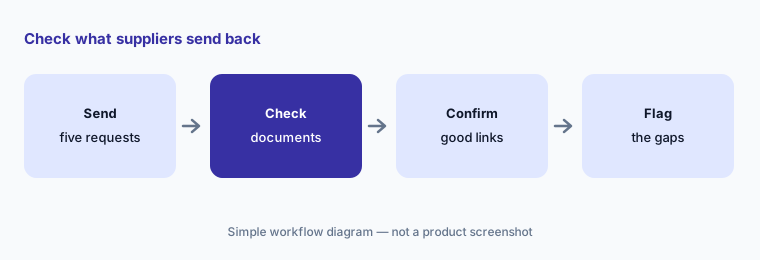
Check the replies:
Send origin requests to five suppliers through Altana. Have the compliance analyst check each returned document before marking that supplier link as confirmed.
Pricing context (October 2026)
Altana does not publish prices for buyers; altana.ai/pricing returns a 404 page and the site offers a demo request. Altana is quote-only for importers, brokers, and logistics providers as of 17 Oct 2026.
Altana’s suppliers page says there is “no cost to join Altana or to respond to your buyer’s request”, and that advanced trade tools for a supplier’s own team are sold separately (checked 17 Oct 2026). Ask whether entry writing, Passports, simulation, and screening are separate modules, how pricing scales with products or entries, and what onboarding of your catalog includes.
Uncertainty: Altana describes its graph as covering “~50% of global trade and 600M+ companies” and elsewhere cites “140 million buyer-supplier connections”; these measure different things and we use neither as our own figure. The same 47-detention case appears as $50M avoided (sourcing page), about $150M in delays, detentions, and legal fees (keynote page), and “$150M avoided in repeat detentions” (enterprise page). Altana’s pages say “it suggests, you decide” and that your broker signs off, while its Cervo release calls the combined product an “autonomous platform”; we follow the sign-off wording. We could not confirm which features are in which package. Figures such as 5x entries, 8x faster classification, $40,000+ per broker, and $300M+ average duty savings are Altana’s claims, not our measurement.
When it’s useful (honest take)
Useful when you import goods with multi-tier supply chains, face forced-labor, origin, or tariff questions, and a named trade compliance lead and licensed broker will confirm what the AI suggests before it reaches customs.
Less useful when you mainly need disruption alerts on suppliers (Everstream AI), denied party screening inside a wider logistics suite (Descartes AI), or a forwarder that also files your entries (Flexport AI).
Paying for Altana AI and a few other AI tools? The $9 AI toolkit spreadsheet lists every AI subscription you have, what each one costs, and how fast it pays for itself, so you can see which ones are worth the money.
Want someone to do it for you? AI toolkit audit — $19
Related options (educational)
| Need | Better home | Why |
|---|---|---|
| Value-chain mapping, Passports, trade workflows | Altana AI (this page) | Quote only; free for suppliers to respond |
| Supplier risk alerts and sub-tier visibility | Everstream AI | Quote only |
| Screening assist and customs document capture | Descartes AI | Screening from a few thousand dollars a year |
| Forwarder with AI customs classification | Flexport AI | Quote only (freight and customs quoted) |
| Planning with supply risk in scenarios | Kinaxis vs o9 | Quote only |
| Drafting a sanitized supplier request | Claude | General chat; not a compliance tool |
FAQ
What does Altana’s AI do?
It suggests likely upstream suppliers from a bill of materials, proposes classifications, origin, FTA, and duty treatment with its reasoning, drafts customs entries for brokers, and flags forced-labor and other risks. Altana says it suggests and you decide.
What is an Altana Product Passport?
A shareable digital record of a product’s journey and attributes that you can share with suppliers, brokers, and customs. Altana says CBP selected the technology in May 2025 for its Global Business Identifier program.
How much does Altana cost in October 2026?
Altana publishes no prices for buyers and offers demos, so it is quote-only. Suppliers can join and answer buyer requests at no cost (checked 17 Oct 2026).
Does Altana file customs entries on its own?
Altana says its AI drafts and enriches the entry and your broker signs off and files it from your usual system, such as CargoWise or NetCHB.
Who should approve what Altana’s AI suggests?
The trade compliance lead confirms every AI-suggested supplier link before it is used in a filing or audit, a licensed broker checks every entry, and finance checks tariff simulations before sourcing changes.
Optional next step (if seats overlap)
If you pay for a trade compliance tool, a screening service, a supplier risk feed, and chat seats your team uses to draft supplier requests, that overlap is worth mapping. Map the overlap with the $19 AI toolkit audit or the $9 AI toolkit spreadsheet. Email Audit $19 or Toolkit spreadsheet $9.
Checkout is live via Stripe. After you pay, we email delivery (spreadsheet) or intake next steps (audit).