Compare · Logistics ops · Oct 2026
Kinaxis vs o9 (Oct 2026): AI agents and supply chain planning platforms compared
Kinaxis and o9 Solutions both sell large supply chain planning platforms, and both now describe AI agents that watch plans and recommend or take actions. The practical differences are in shape: Kinaxis Maestro is built around concurrency — one connected model where a change ripples through every plan — and offers a no-code agent builder, while o9 is built around its Enterprise Knowledge Graph and reaches further into integrated business and merchandise financial planning. This page compares the decisions a planning team makes each month, what each vendor publishes, and who signs off — it is not a ranking, and each section has a Try this.
What this comparison covers
This page is for a planning director, S&OP lead, or supply chain transformation lead choosing between Kinaxis and o9, or running one and curious about the other’s AI. The question it answers: by AI agents, scenario planning, core data model, planning scope, approval steps, and price, how do the two compare.
Facts align with our Kinaxis AI and o9 Solutions AI reviews (read 17 October 2026), with Kinaxis’ AI page, S&OP page, concurrency page, and Planning One page, and o9’s AI innovation page, APEX page, IBP page, and merchandise financial planning page re-read the same afternoon. Neither vendor publishes a price. Kinaxis’ Kinexions EMEA event runs 26–28 October 2026, after this page was written, so it adds no news here.
Ground rules for either platform: a named planner approves every plan, forecast, or purchase-order change an agent proposes; the S&OP or IBP lead owns the consensus plan; IT owns what each agent may write to; nobody pastes customer orders or supplier prices into an outside chat tool; and vendor speed and accuracy figures are their claims, not our measurement. This comparison is not a ranking. If supplier risk is your gap, see Everstream AI.
| Question | Kinaxis | o9 Solutions |
|---|---|---|
| Published price | None; quote only (pricing URL returns page not found) | None; quote only (pricing URL returns page not found) |
| AI agents | Prebuilt Maestro Agents (not named on the AI page) plus Maestro Agent Studio, a no-code builder (5 Feb 2026) | Specialized AI agents “now generally available” since 3 Jun 2025; none named on the site |
| Core model | Concurrency: one connected model where a change in one area updates the rest; Semantic Graph for shared business context | Enterprise Knowledge Graph inside the “Digital Brain”, described as neuro-symbolic AI |
| Scenarios | “Unlimited, instantaneous what-if scenario simulations” | Sense, model, simulate, decide, execute, learn loop |
| Planning scope listed | S&OP, demand, supply, inventory, control tower, orchestration; Planning One for mid-market | Integrated business planning, demand, supply, merchandise financial planning, assortment |
| Approvals (vendor wording) | Agent building blocks include “approvals”; teams “validate recommendations and oversee actions” | “Flexible autonomy: From human-in-the-loop to touchless execution”; APEX: “Humans remain in control” |
| Who signs off | Demand or supply planner for plan changes; S&OP lead for the consensus plan | Planner for plan changes; finance or merchandise lead for financial and merchandise plans |
Major features (with how someone uses them)
Examples at a glance: each feature has a concrete example from a real job plus a short Try this you can run this week.
1. Start from three monthly planning decisions (primary)
What it is: Before comparing agent lists, write down three planning decisions your team makes every month — for example, the consensus demand number for a product family, which plant absorbs a supply shortfall, or how much safety stock to hold for a promotion. For each, note how each platform’s AI would support it (spotting the issue, running scenarios, recommending an action) and which planner signs off.
The useful comparison is not who describes more agents, but whether your three decisions get better support and whether a named planner still makes the call.
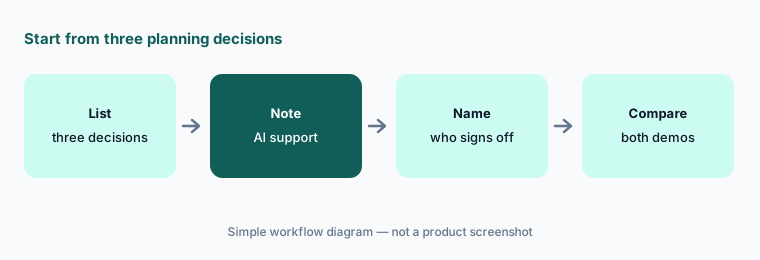
Three decisions:
List three planning decisions you make every month. Note how each platform's AI would support them and which planner signs off.
2. AI agents: Maestro Agents and Agent Studio vs o9’s specialized agents
What it is: Kinaxis’ AI page says Maestro Agents work “both inside Maestro and across enterprise systems” and are assembled from building blocks that include “agents, triggers, automation, tools, and approvals”; its 5 February 2026 release added Maestro Agent Studio, a no-code builder that works with large language models such as OpenAI’s GPT and Google Gemini (Kinaxis AI). o9’s June 2025 release made its specialized AI agents “generally available”, and its AI page says they “continuously sense, analyze, and recommend actions”, are “purpose-built for planning, execution, and learning — not generic copilots”, and support multiple LLMs (o9 Solutions AI). Neither site names its prebuilt agents.
When agents are not named on the website, the contract is where the list lives. Ask each vendor for it in writing.
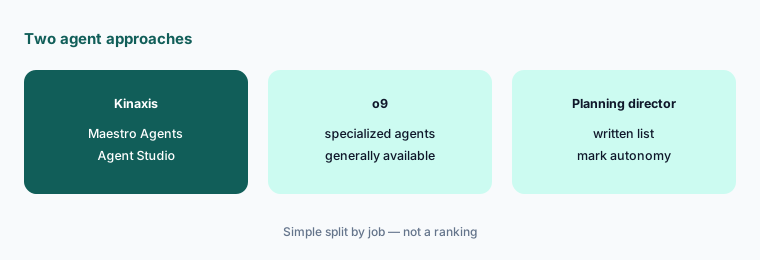
Ask for the list:
Ask Kinaxis and o9 for a written list of the AI agents your licence would include. Mark any agent that can change a plan without a planner's approval.
3. Scenario planning: concurrency vs the Digital Brain loop
What it is: Kinaxis’ S&OP page promises “unlimited, instantaneous what-if scenario simulations” and “simultaneous planning across all functions”, so a change can be tested even in the middle of an S&OP meeting. o9’s Digital Brain page describes a loop of sense, model, simulate, decide, execute, and learn on its knowledge graph, and its APEX page (26 March 2026 launch) describes agent-assisted planning that “automates execution-horizon decisions within defined governance guardrails”.
Speed claims are easiest to test with your own data. Bring one real disruption from last quarter and time how long each takes to show its effect.
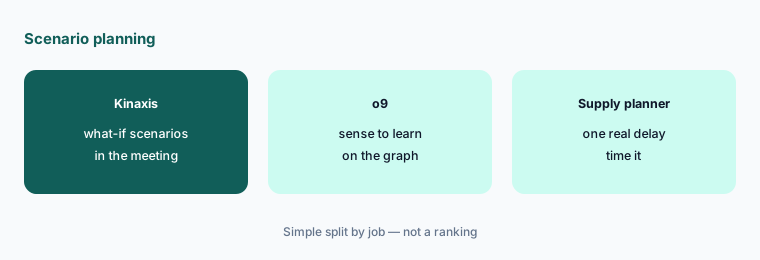
Test one real disruption:
Bring one real supply disruption from last quarter to both demos. Note how long each platform takes to show its effect and whether its recommendation matches what your team did.
4. Core model: concurrent planning vs the Enterprise Knowledge Graph
What it is: Kinaxis’ concurrency page describes “a model that takes into view the whole supply chain network and aligns data and people so that a change in one area triggers corresponding changes and communications in the rest of the chain, in real-time”; its Semantic Graph and AI page add “semantic intelligence” so people and AI share business context. o9’s AI page builds on an Enterprise Knowledge Graph that links data across planning, with AI models and LLMs on top and what o9 calls neuro-symbolic AI, and frames the agents around questions such as “What happened and why?”.
Both models depend on clean master data. Ask each vendor which systems feed the model and who fixes a wrong lead time or bill of materials when the AI trips over it.
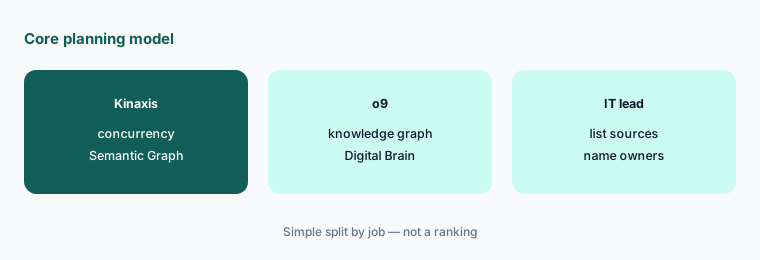
Name the data owners:
List the systems that would feed each platform's model. Name the person who fixes bad master data in each before any pilot starts.
5. Planning scope: S&OP, IBP, and merchandise financial planning
What it is: Kinaxis’ solutions list covers sales and operations planning, demand, supply, inventory, control tower, supply chain orchestration, order management, and more, plus Planning One for mid-market teams, which starts with “guided assistance” and can expand to “agent-led workflows”. Its list shows no merchandise financial planning product. o9 lists integrated business planning that connects finance, marketing, sales, and supply chain data, and merchandise financial planning and assortment planning for retailers, on the same knowledge graph.
Scope matters most where plans hand off: a merchandise plan that drives a supply plan, or a financial target that sets an inventory policy. Each hand-off needs an owner.
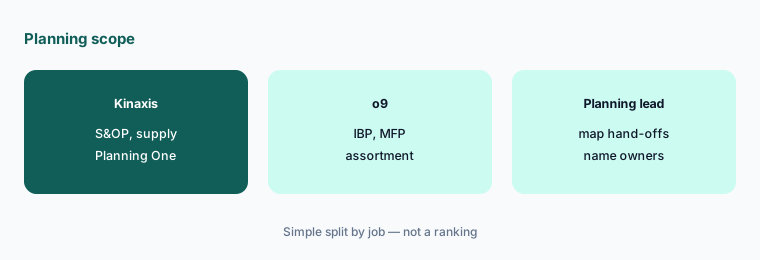
Map the scope:
List the planning processes you need (S&OP, IBP, merchandise financial planning). Mark which each platform covers and who owns each hand-off between plans.
6. Approval steps and price transparency
What it is: Kinaxis lists “approvals” among its agent building blocks and says its governed, explainable AI helps teams “validate recommendations and oversee actions”; Agent Studio was announced with “human-in-the-loop oversight”. o9 offers “Flexible autonomy: From human-in-the-loop to touchless execution”, while its APEX page says “Humans remain in control of strategy, intent, and judgment”. Neither vendor publishes prices: both pricing URLs return page not found, so both are quote-only as of 17 Oct 2026.
“Touchless” and “human-in-the-loop” are both settings, not policies. Write where autonomy stops for each decision and ask to see the approval step in a trial.
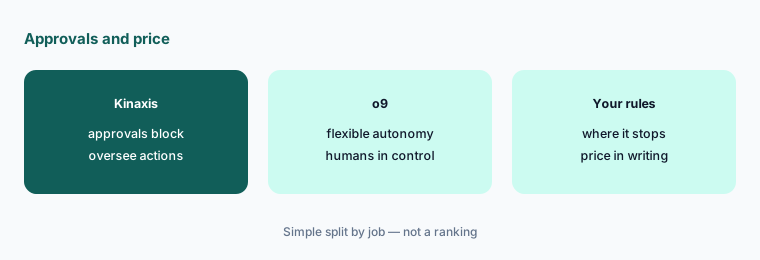
Write where autonomy stops:
Write which plan changes need a named planner's approval. Ask each vendor to show that approval step and the action log in a trial, and to put pricing in writing.
Pricing context (October 2026)
Neither vendor publishes prices. Kinaxis’ pricing URL and o9’s pricing URL both return “page not found”, and both sites offer demos or platform tours. Both are quote-only as of 17 Oct 2026.
Ask each which agents and planning modules your licence includes, whether Agent Studio builds (Kinaxis) or agent configuration (o9) cost extra, whether large-language-model usage is metered, and what implementation services and Forward Deployed Engineering (Kinaxis) add.
Uncertainty: Neither vendor names its prebuilt AI agents on its website, so we describe them only in each vendor’s general terms. Kinaxis said in February 2026 it planned orchestrator agents and outside-agent connections “later in 2026”; we could not confirm they have shipped, and its Kinexions EMEA event (26–28 October 2026) is after this page. Kinaxis’ scenario planning URL (kinaxis.com/en/scenario-planning) returned page not found when we checked, so we link its S&OP and concurrency pages instead. o9 frames its agents’ questions three ways (“3Ws”, four questions, and a “4W” engine), and offers autonomy “to touchless execution” while APEX says humans remain in control. Speed figures (Kinaxis’ up to 12X with NVIDIA; o9’s over 10x with NVIDIA cuOpt) are the vendors’ own tests, not our measurement. Analyst rankings on both sites are not used.
When it’s useful (honest take)
Useful when you are replacing spreadsheet or legacy planning, choosing between these two platforms, and a named planner and S&OP or IBP lead will approve agent recommendations in a trial.
Less useful when your gap is warehouse and transport execution (Blue Yonder vs Manhattan), supplier risk alerts (Everstream AI), or proving product origin for customs (Altana AI).
Still choosing between Kinaxis and o9? The $19 AI toolkit audit gives you a written plan for which tools to keep using and which to drop across your whole AI stack, including this pair.
Prefer to do it yourself? Spreadsheet — $9
Related options (educational)
| Need | Better home | Why |
|---|---|---|
| Concurrent planning with Maestro Agents and Agent Studio | Kinaxis AI | Quote only |
| Knowledge-graph planning with specialized agents | o9 Solutions AI | Quote only |
| Planning and execution agents with one orchestrator | Blue Yonder AI | Quote only |
| Supplier risk alerts that feed planning | Everstream AI | Quote only |
| Supply chain mapping and trade compliance | Altana AI | Quote only; free for suppliers |
| Drafting a sanitized S&OP agenda | Claude | General chat; not a planning tool |
FAQ
What is the main difference between Kinaxis and o9?
Kinaxis Maestro is built around concurrency, one connected model where a change updates every plan, and offers a no-code agent builder; o9 is built around its Enterprise Knowledge Graph and lists integrated business and merchandise financial planning. This is not a ranking.
Do Kinaxis and o9 both have AI agents?
Yes. Kinaxis has prebuilt Maestro Agents and Maestro Agent Studio (February 2026); o9 made specialized AI agents generally available in June 2025. Neither names its prebuilt agents on its website.
How much do Kinaxis and o9 cost in October 2026?
Neither publishes prices; both pricing URLs return page not found. Both are quote-only (checked 17 Oct 2026).
Which covers merchandise financial planning?
o9 lists merchandise financial planning and assortment planning. Kinaxis’ solutions list covers S&OP, demand, supply, inventory, and more, but shows no merchandise financial planning product.
Who should approve AI recommendations in either platform?
A named planner approves plan, forecast, and purchase-order changes, the S&OP or IBP lead owns the consensus plan, and IT controls what each agent may write to.
Optional next step (if seats overlap)
If you pay for a planning suite, a risk feed, a BI tool, and chat seats your planners use to summarize S&OP decks, that overlap is worth mapping. Map the overlap with the $19 AI toolkit audit or the $9 AI toolkit spreadsheet. Email Audit $19 or Toolkit spreadsheet $9.
Checkout is live via Stripe. After you pay, we email delivery (spreadsheet) or intake next steps (audit).