Compare · Logistics ops · Oct 2026
Blue Yonder vs Manhattan (Oct 2026): AI agents for warehouse, transportation, and supply chain execution compared
Blue Yonder and Manhattan Associates both sell large warehouse and transportation suites, and both now lead with AI agents that watch operations and act in your systems of record. The clearest practical difference is shape: Blue Yonder describes a few broad domain agents with one orchestrator across planning and execution, while Manhattan lists 26 narrower ready-to-use agents inside its execution suite plus Agent Foundry for building your own. This page compares the work a warehouse or transport team does every day, what each vendor publishes, and who approves — it is not a ranking, and each section has a Try this.
What this comparison covers
This page is for a warehouse director, transportation manager, or supply chain lead choosing between Blue Yonder and Manhattan, or running one and curious about the other’s agents. The question it answers: by agent line-up, building your own, planning and execution reach, how agents act and who approves, cloud and update model, and price, how do the two compare.
Facts align with our Blue Yonder AI and Manhattan Active AI reviews (read 17 October 2026), with Blue Yonder’s AI agents page, AI and machine learning page, current release page, and Responsible AI page, and Manhattan’s AI agents page, ready-to-use agents page, Agent Foundry page, and ActivePlatform page re-read the same morning. Neither vendor publishes a price.
Ground rules for either suite: a named warehouse or operations manager approves agent actions that change orders, waves, loads, or appointments; a planner approves plan and purchase-order changes; IT owns what each agent may write to; nobody pastes customer orders or contract rates into an outside chat tool; and vendor productivity figures are their claims, not our measurement. This comparison is not a ranking. If planning is your main gap, see Kinaxis AI and o9 Solutions AI.
| Question | Blue Yonder | Manhattan |
|---|---|---|
| Published price | None; quote only (pricing URL returns page not found) | None; quote only (pricing URL goes to the home page); Essentials, Enterprise, and Enterprise Premier editions with no amounts |
| Agent line-up | “5 Domain Agents. One Orchestrator.” — three named on the page (Network or Network Ops, Warehouse, Shelf Ops) | 26 named ready-to-use agents, from Wave Coordinator and Shipment Tracking to Contact Center and Store Associate |
| Building your own | No separate agent builder named on the pages we read; agents share one data foundation and talk to each other | Agent Foundry: build from AI, a template, or scratch; MCP and A2A; publish to an agent marketplace |
| Reach | Planning (demand, supply, network) and execution (warehouse, transportation, shelf) on the Blue Yonder Platform | Execution: warehouse, transportation, order management, store, and contact centre on Manhattan Active |
| How agents act (vendor wording) | “Without human-in-the-loop latency”; “governed actions, logged and reversible” | Interactive agents assist people; autonomous agents “automatically remedy” issues; Foundry can “require human approvals where necessary” |
| Cloud and updates | Named releases (“2026.2”, current release) on Blue Yonder Platform and Data Cloud, with Snowflake and Microsoft Azure | “Evergreen”: updates every 90 days with zero downtime, on Google Cloud |
| Who signs off | Planner for plan and order changes; warehouse and transport leads for execution actions | Warehouse or ops manager for orders, waves, and loads; contact centre lead for customer refunds |

Major features (with how someone uses them)
Examples at a glance: each feature has a concrete example from a real job plus a short Try this you can run this week.
1. Start from your three most manual tasks (primary)
What it is: Before comparing agent lists, write down the three warehouse or transport tasks that take your team the most hands-on time — for example re-planning waves after a short pick, rebooking dock appointments when a truck runs late, or chasing missing proofs of delivery. For each, note which agent in each suite covers it, whether that agent suggests or acts, and the named person who approves its action.
The useful comparison is not how many agents each vendor lists, but whether your three tasks are covered and whether a person can approve the steps that change orders, loads, or appointments.
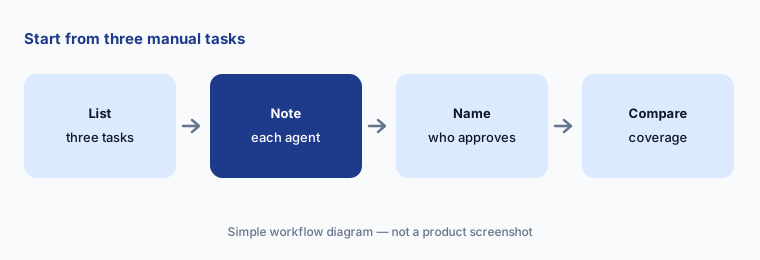
Three tasks:
Write down your three most manual warehouse or transport tasks. Note which suite's AI agent covers each and who approves its actions.
2. Agent line-ups: five domain agents vs 26 named agents
What it is: Blue Yonder’s AI agents page says “5 Domain Agents. One Orchestrator.”: broad agents with persistent memory that run a see–analyze–decide–act loop and act against WMS, TMS, OMS, and planning systems. The page names the Network (or Network Ops) Agent, the Warehouse Agent, and the Shelf Ops Agent, not all five. Manhattan’s ready-to-use agents page names 26 narrower agents across Manhattan Active, including Wave Coordinator, Warehouse Labor, Create and Verify ASN, Freight Payment, Shipment Tracking, Transportation Planner, Appointment Management, Rate Management, Proof of Delivery, Contact Center, and Store Associate (Manhattan Active AI).
A few broad agents and many narrow ones can cover the same work. Ask each vendor for the written list your contract includes rather than comparing counts.
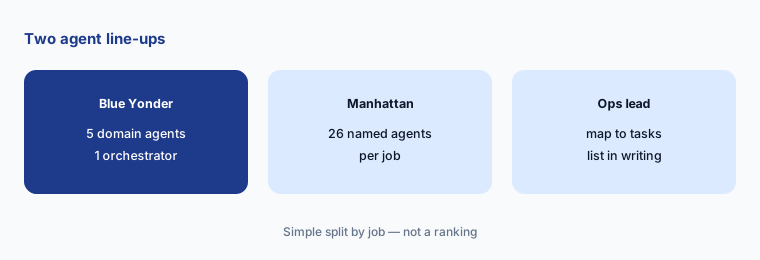
Map, then ask in writing:
Map each suite's named agents to your three most manual tasks. Ask each vendor for a written list of which agents your edition or subscription includes.
3. Building your own: Agent Foundry vs connected domain agents
What it is: Manhattan’s Agent Foundry lets you build agents from an AI prompt, a template, or from scratch, add procedural guardrails that “require human approvals where necessary”, connect over MCP and agent-to-agent (A2A) protocols, and publish to an agent marketplace; Manhattan says Foundry is included with its Active solutions. Blue Yonder’s pages we read name no separate agent builder; they stress that its agents share one Snowflake-based data foundation, so “the Network Agent talks to the Warehouse Agent instantly”, and its current release page describes agent-to-agent collaboration (Blue Yonder AI).
A builder helps when your hardest task is unusual. If it is common, a vendor’s own agent may already do it. Either way, the approval step should be visible before it goes live.
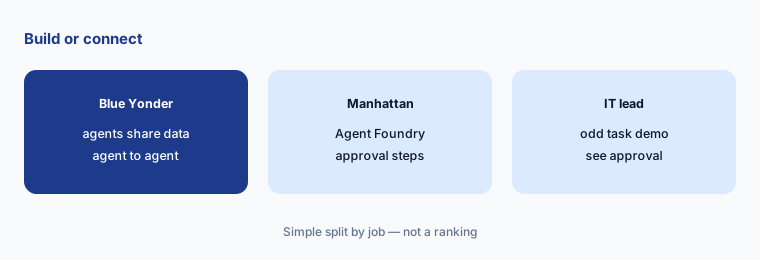
Show the odd one:
Pick one task neither suite's base agents cover. Ask Manhattan to show it built in Agent Foundry and Blue Yonder to show how its agents would handle it, with the approval step visible.
4. Planning vs execution reach
What it is: Blue Yonder’s AI page and agents page span planning (demand and supply planning, multi-enterprise collaboration, network) and execution (warehouse decisioning, transportation, space and shelf), with agents acting against WMS, TMS, OMS, and planning systems. Manhattan’s agents sit in its execution suite — Manhattan Active Warehouse, Transportation, Order Management, Store, and contact centre — and its pages describe no planning-suite agents. Both say their agents connect to outside systems.
Reach matters where an agent’s action crosses systems: a planning change that moves a warehouse wave, or a transport delay that changes an order promise. Those hand-offs need owners.
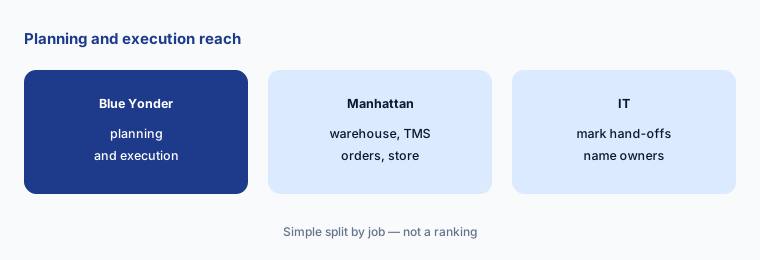
Mark the hand-offs:
List which of your planning and execution systems each suite would replace or connect to. Have IT mark every hand-off where an agent's action crosses between systems.
5. How agents act and who approves
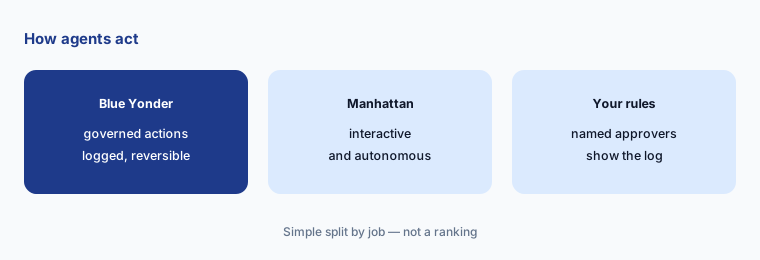
What it is: Blue Yonder’s agents page says its agents resolve disruptions “without human-in-the-loop latency” and trigger “governed actions, logged and reversible”, while its Responsible AI page says oversight should match risk. Manhattan’s 8 January 2026 release splits interactive agents, which help people work, from autonomous agents, which “identify operational issues and automatically remedy them”; Agent Foundry adds approval steps “where necessary”. Our Manhattan Active AI and Blue Yonder AI reviews give agent-by-agent examples.
Neither default is your policy. Write which actions need a named approver and ask each vendor to show both the approval step and the log entry it leaves.
Write the approval rules:
Write which agent actions need a named approver (orders, waves, tenders, plan changes). Ask each vendor to show that approval step and the log entry in a trial.
6. Cloud, updates, and price transparency
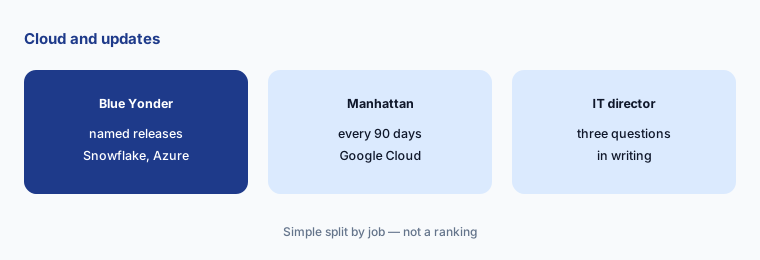
What it is: Manhattan’s ActivePlatform page describes an “evergreen” cloud-native platform with updates “every 90 days” and zero downtime, running on Google Cloud; its Editions page lists Essentials, Enterprise, and Enterprise Premier with no amounts. Blue Yonder ships named releases — its current release page is “2026.2”, with no date — on its Platform and Data Cloud, built with Snowflake and Microsoft Azure. Neither publishes prices: Blue Yonder’s pricing URL returns page not found and Manhattan’s goes to the home page, so both are quote-only as of 17 Oct 2026.
How agent features reach you affects testing: a 90-day cadence means regular change on a fixed rhythm; named releases mean planned upgrade moments. Ask how new agent skills are switched on in each.
Get it in writing:
Ask both vendors how new agent features reach you and what your edition or subscription includes. Get both answers in writing before comparing quotes.
Pricing context (October 2026)
Neither vendor publishes prices. Blue Yonder’s pricing URL returns “page not found”; Manhattan’s sends you to the home page, and its Editions page names three editions with no amounts. Both are quote-only as of 17 Oct 2026.
Ask each which agents your contract includes, whether implementation services are extra (Blue Yonder says its agents go live in 6–12 weeks), whether Agent Foundry builds or Orchestrator features add cost, and how cloud data costs (Snowflake, Azure, Google Cloud) are handled.
Uncertainty: Blue Yonder says five domain agents but names three, and calls one both the Network Agent and the Network Ops Agent, so we list no five. It promises action “without human-in-the-loop latency” while its Responsible AI page stresses oversight matched to risk. Its 2026.2 release page carries no date. Manhattan’s naming varies (ActiveAgents vs Manhattan Active Agents; Google Agentspace vs Gemini Enterprise), and its “up to 60 percent” productivity figure is its own claim. We could not confirm which agents come with which Manhattan edition or Blue Yonder subscription, or which act on their own by default. Analyst rankings on both sites are not used. All vendor figures are claims, not our measurement.
When it’s useful (honest take)
Useful when you are replacing or extending a WMS or TMS, you are choosing between these two suites, and a named warehouse, transport, and planning owner will approve agent actions in a trial.
Less useful when your gap is tracking freight across many carriers (project44 vs FourKites), you want execution agents without replacing your TMS (Loadsmart AI, Shipwell AI), or planning is the main job (Kinaxis AI).
Still choosing between Blue Yonder and Manhattan? The $19 AI toolkit audit gives you a written plan for which tools to keep using and which to drop across your whole AI stack, including this pair.
Prefer to do it yourself? Spreadsheet — $9
Related options (educational)
| Need | Better home | Why |
|---|---|---|
| Planning and execution agents with one orchestrator | Blue Yonder AI | Quote only |
| Execution agents plus Agent Foundry | Manhattan Active AI | Quote only |
| Scenario planning and Maestro agents | Kinaxis AI | Quote only |
| Integrated planning with AI agents | o9 Solutions AI | Quote only |
| Shipper execution agents on top of your TMS | Loadsmart AI | Free PoC, then quote |
| Shipper TMS with assistant and document AI | Shipwell AI | Quote only |
FAQ
What is the main difference between Blue Yonder and Manhattan AI agents?
Blue Yonder describes five broad domain agents with one orchestrator across planning and execution; Manhattan lists 26 narrower ready-to-use agents in its execution suite plus Agent Foundry for building your own. This is not a ranking.
Can you build your own agents in either suite?
Manhattan offers Agent Foundry (from AI, a template, or scratch, with approval steps, MCP, and A2A). The Blue Yonder pages we read name no separate builder and stress agents that share one data foundation.
How much do Blue Yonder and Manhattan cost in October 2026?
Neither publishes prices. Blue Yonder’s pricing URL returns page not found; Manhattan’s goes to the home page and its editions page lists Essentials, Enterprise, and Enterprise Premier without amounts. Both are quote-only.
Do their agents act without a person?
Yes, in places. Blue Yonder says its agents act “without human-in-the-loop latency” with governed, logged, reversible actions; Manhattan’s autonomous agents “automatically remedy” issues. Write which actions need a named approver and test it.
Who should approve agent actions in either suite?
A named warehouse or operations manager for orders, waves, loads, and appointments, a planner for plan and purchase-order changes, the transportation manager for tenders, and IT for what each agent may write to.
Optional next step (if seats overlap)
If you pay for a WMS, a TMS, a planning suite, a visibility platform, and separate agent tools on top, that overlap is worth mapping. Map the overlap with the $19 AI toolkit audit or the $9 AI toolkit spreadsheet. Email Audit $19 or Toolkit spreadsheet $9.
Checkout is live via Stripe. After you pay, we email delivery (spreadsheet) or intake next steps (audit).