Tool · Logistics ops · Uber Freight · Oct 2026
Uber Freight AI review (Oct 2026): Insights AI and AI tools for shippers' transportation management
Uber Freight is a freight broker, a managed transportation provider, and a TMS vendor for shippers. Its AI for shippers centres on Insights AI, an assistant that answers questions about your freight data, ranks KPI insights, and suggests actions, plus 30+ AI agents that Uber Freight says handle scheduling, tracking, documents, and payments across the shipment lifecycle. This page is about using Insights AI to find expensive lanes and service problems faster while a named transportation manager still checks every number before it reaches a carrier. Each section has a Try this.
What this Uber Freight AI page covers
This page is for a transportation manager, logistics analyst, or freight procurement lead at a shipper that uses Uber Freight’s TMS or managed transportation, or is weighing them. It answers: what Insights AI and the agents actually do, which parts Uber Freight says are live versus planned, and who checks an AI answer before it changes a routing guide, an award, or a carrier conversation.
Uber Freight’s Insights AI page (read 17 October 2026; the old /insights-ai address now redirects there) promises rapid analysis “from over 45 sources and more than 20 million delivered shipments”, with enhanced chat, an AI-generated KPI dashboard, and proactive recommendations. Its 21 May 2025 release describes a logistics-specific large language model embedded in the TMS and “more than 30 AI agents” across procurement, execution, tracking, payments, and analytics. We found no 2026-dated AI product release on Uber Freight’s site; the latest are from May, July, and September 2025.
Ground rules: a named transportation manager checks every lane cost and carrier figure against invoices before a carrier review, the procurement lead decides every award, and nobody treats an AI recommendation as a routing-guide change until a person has approved it. No contract rates, driver details, or customer names go into an outside chat tool, and Uber Freight’s savings and accuracy figures are its claims, not our measurement.
Major features (with how someone uses them)
Examples at a glance: each feature has a concrete example from a real job plus a short Try this you can run this week.
1. Insights AI chat: ask about your lanes and spend (primary)
What it is: Insights AI is Uber Freight’s generative AI assistant for shippers. You ask in plain language and get an answer from your freight data; Uber Freight says the enhanced chat handles “far more complex, industry-specific questions”, such as comparing your mode mix and length of haul with industry peers (September 2024 post). Design partners’ teams asked more than 2,000 questions in early access, including monthly spend against the market, spot versus contract use, and live versus drop mix. Uber Freight first announced Insights AI at its Deliver 2023 conference.
Cost per mile depends on which miles and which charges are counted. Check whether accessorials and fuel are included before you compare lanes.
Primary workflow:
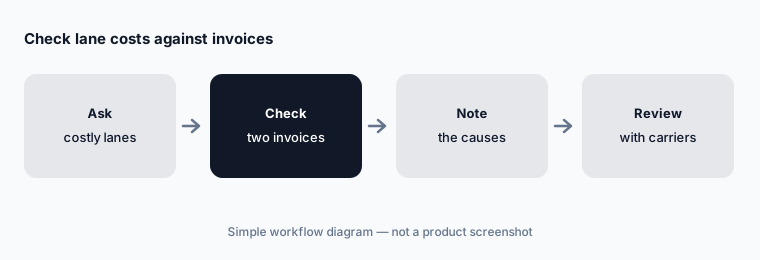
Ask Insights AI for last quarter's five most expensive lanes per mile. Have the transportation manager check two of them against invoices before the next carrier review.
2. AI-generated KPI dashboard with ranked insights
What it is: The Insights AI page describes an AI-generated KPI dashboard that keeps core metrics in a regularly updated format and ranks insights, “guiding you to the most impactful items with the highest ROI”. Uber Freight’s July 2025 release notes say design partner Colgate-Palmolive set its dashboard around KPIs such as on-time performance, carrier utilization, lane volatility, and cost per mile.
A ranked list reflects someone’s idea of impact. Ask how the ranking is calculated before your team works only from the top of it.
Check the ranking:
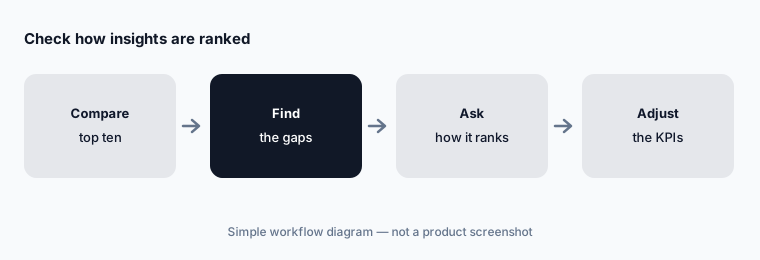
Compare the top ten Insights AI dashboard items with your own monthly review. Have the logistics analyst list what is missing and ask Uber Freight how the ranking is calculated.
3. Proactive recommendations: suggested actions, your decision
What it is: Uber Freight said proactive recommendations would come to Insights AI in 2025 (September 2024 post), and its July 2025 release notes list them among the first-half 2025 rollouts. They suggest actions based on practices Uber Freight developed managing transportation for large shippers. At Deliver 2025 Uber Freight said it envisions recommendations about underperforming lanes, targeted mini-bids, and carrier selection for annual bids — “envision” is future wording, so ask which are live in your account.
A recommendation from your broker’s platform may also suggest more freight for your broker. Check each one against your own lane data and your other carriers’ rates.
Decide per lane:
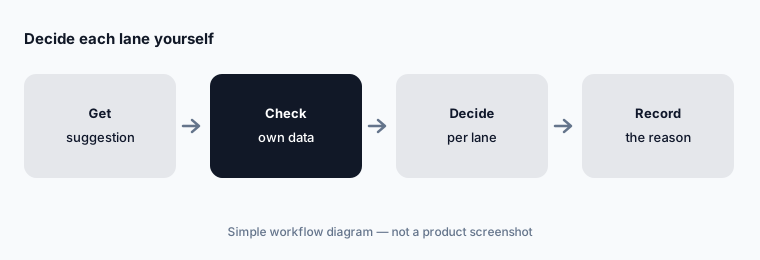
Take the next Insights AI recommendation for a mini-bid. Have the procurement lead check each lane against your own on-time and cost data before inviting any carrier.
4. 30+ AI agents across scheduling, tracking, documents, and payments
What it is: Uber Freight says “more than 30 AI agents” automate tasks across the shipment lifecycle (May 2025 release). Its July 2025 release notes group them by input: image agents process documents and detect fraud, “triggering manual review when necessary”; voice agents handle inbound and outbound calls to track shipments, find capacity, and handle reschedules; text agents answer carrier emails and automate scheduling. At Deliver 2025 it reported scheduling times cut by up to 38%, reschedules reduced by a third, overdue load statuses down 15% from arrival times captured in carrier emails, and automatic correction of LTL PRO number errors in shipper systems — all Uber Freight’s figures.
Agents that write corrected data back into your systems should be sampled. Pick one data type, such as PRO numbers, and check a batch each month.
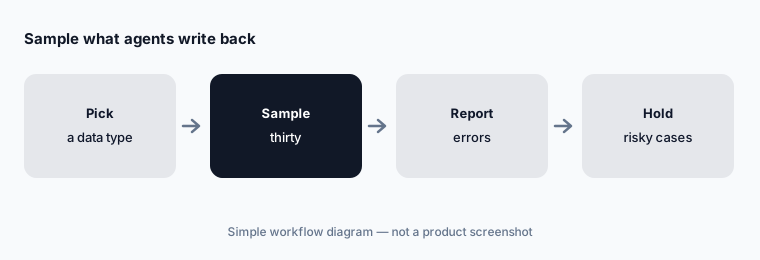
Sample what agents write:
Pick one kind of data an Uber Freight agent corrects or captures, such as PRO numbers or arrival times. Have the logistics coordinator check thirty against the carrier's records each month.
5. TMS, contract procurement scenarios, and freight finance
What it is: Insights AI sits alongside Uber Freight’s transportation management system, which covers procurement, execution, visibility, payments, and insights: predictive pricing for spot load estimates, spot auctions and instant quotes from multiple carriers, and contract rates and routing guides loaded from Uber Freight Exchange. At its Deliver 2025 event (16 September 2025) Uber Freight added scenario analysis to Uber Freight Exchange, its contract procurement platform, for side-by-side comparisons of cost, service, and carrier mix before awarding, and TMS Financials for tracking order-to-cash inside the TMS, which it says cuts dispute resolution time by up to 20%. A September 2026 post describes the TMS and an Optimization Engine surfacing alternatives such as moving truckload freight to intermodal.
A scenario that looks cheapest on paper may lean on carriers you have never used on that lane. The transportation manager decides the award, not the model.
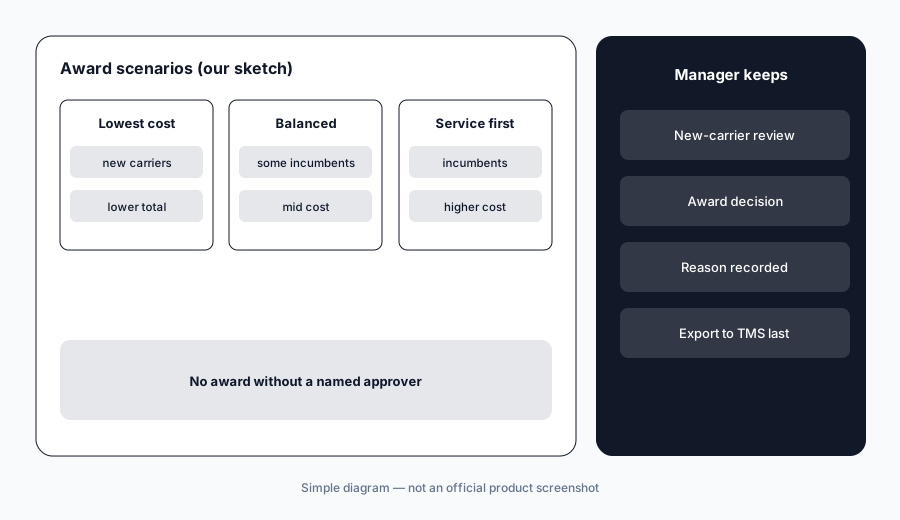
Before you award:
Run two Uber Freight Exchange award scenarios for your next mini-bid. Have the transportation manager review every lane that moves to a carrier with no history on it before awarding.
6. Managed transportation and the people behind the AI
What it is: Uber Freight’s July 2025 release notes describe a human-in-the-loop approach: its own transportation management teams use and shape the AI products daily, and recommendations are “always supported by logistics experts”. Its managed transportation page offers to take over daily freight operations, carrier management, performance tracking, and cost governance, under the heading “Expert-led AI execution”. The May 2025 release says Insights AI recommendations help “shippers using the TMS”, and said Uber Freight would fully integrate Insights AI and its agents into the TMS by the end of 2025; we could not confirm on its site that this has happened, or whether Insights AI is offered without the TMS or managed transportation.
When your provider runs the network and the AI that grades it, agree up front which numbers come from your own systems and who on your side signs off on changes.
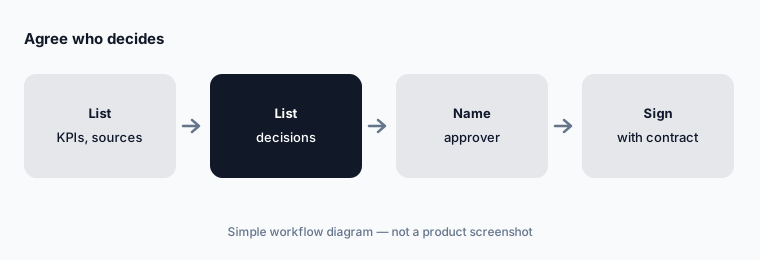
Agree who decides:
Before signing or renewing with Uber Freight, write down which KPIs come from your own systems and which decisions need your transportation manager's sign-off, and attach the list to the contract.
Pricing context (October 2026)
Uber Freight does not publish software prices; uberfreight.com/en-US/pricing returns “page not found” and the TMS and Insights AI pages offer demo requests. The “Instant freight quote” on its site prices individual loads, not the software. Pricing is quote-only as of 17 Oct 2026.
Ask whether Insights AI and the agents are included in your TMS or managed transportation contract, whether Insights AI is available on its own, and how freight bought through Uber Freight’s brokerage is reported in the same dashboard as freight moved by your other carriers.
Uncertainty: The address /insights-ai now redirects to a general Uber Freight AI page titled “Insights AI”. Uber Freight’s figures differ between pages: over 45 data sources on the AI page versus more than 100 in its July 2025 release notes, and nearly $20 billion in freight under management in May 2025 versus $17B+ on its managed transportation page. Its plan to fully integrate Insights AI and the agents into the TMS by the end of 2025 is not confirmed on any 2026 page, and its procurement recommendations were described as a vision in September 2025. We found no 2026-dated AI product release. The 38%, one-third, 15%, ~80%, and up to 20% figures, and the claim of being the first logistics-specific LLM, are Uber Freight’s own, not our measurement.
When it’s useful (honest take)
Useful when you run your freight on Uber Freight’s TMS or managed transportation, your team spends days pulling lane and spend reports, and a named transportation manager will check AI answers against invoices before they reach a carrier.
Less useful when you want a visibility platform that sits across all your carriers and brokers (project44 vs FourKites), you broker freight yourself and need carrier-sales automation (HappyRobot AI), or your main gap is ocean forwarding and customs (Flexport AI).
Paying for Uber Freight AI and a few other AI tools? The $9 AI toolkit spreadsheet lists every AI subscription you have, what each one costs, and how fast it pays for itself, so you can see which ones are worth the money.
Want someone to do it for you? AI toolkit audit — $19
Related options (educational)
| Need | Better home | Why |
|---|---|---|
| TMS and managed transportation with a shipper analytics assistant | Uber Freight AI (this page) | Quote only |
| Visibility platform with an AI analyst and booking agents | project44 AI | Quote only |
| Visibility platform with a named Digital Workforce | FourKites AI | Quote only |
| Voice agents for freight brokers and logistics teams | HappyRobot AI | Quote only |
| Planning platform with AI agents | o9 Solutions AI | Quote only |
| One-off analysis of a sanitized lane export | Claude (sanitized export) | General chat; no carrier actions |
FAQ
What is Uber Freight Insights AI?
Uber Freight’s generative AI assistant for shippers, first announced at Deliver 2023. It answers plain-language questions about your freight data, builds a ranked KPI dashboard, and offers proactive recommendations, drawing on Uber Freight’s logistics data.
How many AI agents does Uber Freight have?
Uber Freight says more than 30 AI agents automate tasks across procurement, execution, tracking, payments, and analytics, using image, voice, and text. Ask which ones work on your freight and what they can change.
How much does Uber Freight cost in October 2026?
Uber Freight does not publish software prices; its pricing URL returns page not found. The instant freight quote prices loads, not software. Treat the TMS, Insights AI, and managed transportation as quote-only.
Do you need Uber Freight’s TMS to use Insights AI?
Uber Freight’s May 2025 release describes Insights AI helping shippers using its TMS, and its site does not say it is sold separately. Ask Uber Freight in writing.
Who should check Insights AI answers?
A named transportation manager checks lane costs and carrier figures against invoices before a carrier review, the procurement lead decides awards and mini-bids, and the logistics coordinator samples data the agents correct.
Optional next step (if seats overlap)
If you pay for a TMS with an AI assistant, a visibility platform with its own analyst, a BI tool for lane reports, and chat seats that all answer “which lanes cost the most”, that overlap is worth mapping. Map the overlap with the $19 AI toolkit audit or the $9 AI toolkit spreadsheet. Email Audit $19 or Toolkit spreadsheet $9.
Checkout is live via Stripe. After you pay, we email delivery (spreadsheet) or intake next steps (audit).