Compare · Logistics ops · Oct 2026
project44 vs FourKites (Oct 2026): AI agents and supply chain visibility platforms compared
project44 and FourKites both started by tracking shipments for shippers, and both now lead with AI agents that call carriers, chase missing milestones, collect documents, and answer questions about your freight. The clearest practical difference is how the agents are organised: project44 sells a catalogue of agents by job plus an analyst called Mo, while FourKites sells a named “Digital Workforce” (Tracy, Sam, Alan, Cassie, Polly) built on its Loft platform. This page compares the jobs a logistics team runs every week, what each vendor publishes, and who signs off — it is not a ranking, and each section has a Try this.
What this comparison covers
This page is for a transportation manager, logistics coordinator, or supply chain lead at a shipper choosing between project44 and FourKites, or running one and curious about the other’s AI. The question it answers: by AI analyst, agent catalogue, workflow builder, human checkpoints, theft and disruption tools, and pricing, how do the two compare.
Facts align with our project44 AI and FourKites AI reviews (read 17 October 2026), with project44’s AI agent page, Mo page, Agentic Workflow Manager page, and Theft Prevention page, and FourKites’ FourSight AI page, Loft page, AOP page, and cargo theft page re-read the same morning. Neither vendor publishes a price.
Ground rules for either platform: a named transportation manager writes every booking limit and routing-guide change; a logistics coordinator checks statuses and ETAs before customers are told; the process owner reads every agent workflow before it goes live; nobody pastes driver phone numbers, contract rates, or customer details into an outside chat tool; and vendor savings and resolution figures are their claims, not our measurement. This comparison is not a ranking. If your gap is forwarding and customs rather than visibility, see Flexport AI.
| Question | project44 | FourKites |
|---|---|---|
| Published price | None; quote only (pricing URL returns page not found) | None; quote only (pricing URL returns page not found); Outcome-as-a-Service engagements (14 Oct 2026) |
| AI analyst | Mo, in beta for all customers (12 Aug 2026); truckload, LTL, and ocean data at launch; shows its work and flags low confidence | FourSight AI Ask, plus role-based generated views and scheduled reports |
| Agents | A catalogue by job: exceptions, network operations, documents, disruptions, appointments, carrier onboarding, procurement, execution recovery (“57 agents and counting”) | Named Digital Workforce: Tracy, Sam, Alan, Cassie, Polly, plus Sophie the developer agent |
| Building workflows | Agentic Workflow Manager: signal, trigger (carrier, lane, origin, destination, reference key, reason code), action | Loft: Sophie turns a written procedure into an Agent Operating Procedure, tested on 10–20 past exceptions |
| Human checkpoints (vendor wording) | “Full audit trails and human checkpoints built in”; agents also update shipments “without a human touch” | “Human oversight where it matters”; Sam works “without a human in the loop”; launch release says FourKites engineers review Sophie’s work |
| Agents that touch money | Freight procurement and execution recovery agents book “within the guardrails your team defines” | No freight-buying or rate agent named on the pages we read; Alan books and moves dock appointments |
| Theft | Theft Prevention: zones, route deviation, idle detection, AI carrier outreach | Cargo theft outcome led by Tracy: risk signals from route, time, commodity, and carrier patterns, automated escalation |
| Who signs off | Transportation manager for booking limits and routing-guide changes | Logistics coordinator for customer-facing statuses; process owner for every procedure |
Major features (with how someone uses them)
Examples at a glance: each feature has a concrete example from a real job plus a short Try this you can run this week.
1. Start from your five most common exceptions (primary)
What it is: Before comparing demos, list the five shipment exceptions your team handles most — for example a missing pickup milestone, a late delivery with no reason code, a delivered load with no proof of delivery, a dock appointment that has to move, and a customer asking where an order is. For each, note which agent in each platform handles it, what it does on its own (calls the carrier, updates the shipment, tells the customer), and the named person who signs off before a carrier or customer hears from it.
The useful comparison is not how many agents each vendor lists, but whether your five exceptions are covered and whether you can put a person in front of the steps that reach carriers and customers.
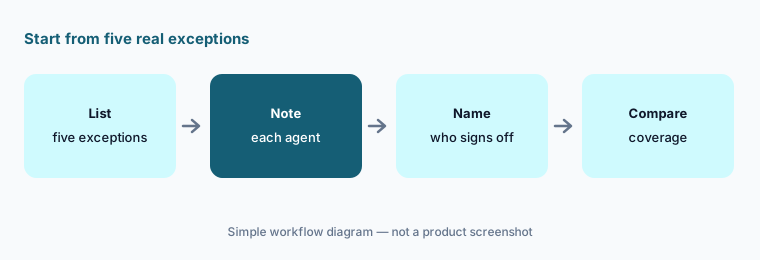
Five exceptions:
List your five most common shipment exceptions. Note which platform's agents handle each and who signs off before a carrier or customer hears from it.
2. AI analysts: Mo vs FourSight Ask
What it is: project44’s Mo answers plain-language questions from your own shipment history and business rules, shows which shipments, time window, and on-time definition it used, flags low confidence, and runs a data quality check first; project44’s 12 August 2026 release says Mo is in beta for all customers, with truckload, LTL, and ocean data at launch (project44 AI). FourKites’ FourSight AI pairs Ask — plain-language questions answered with data, charts, and root-cause breakdowns — with role-based generated views and scheduled reports such as carrier performance reports (FourKites AI).
Ask both the same question about the same month and compare how each defines “on time”. A different definition will give a different list of bad lanes.
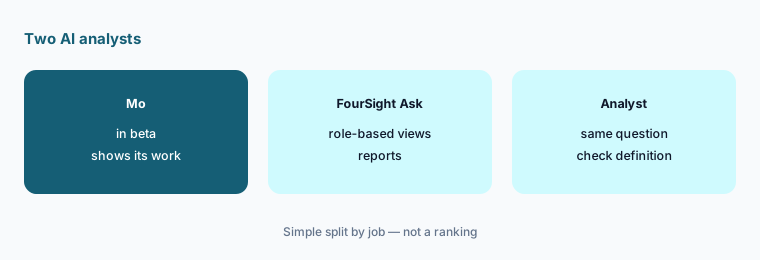
Same question, same month:
Ask Mo and FourSight the same question about last month's on-time performance. Have the logistics analyst compare which on-time definition each used before trusting either list.
3. Agent catalogue vs named Digital Workforce
What it is: project44’s AI agent page lists agents by job — exception management, network operations, documents (PODs), disruption mapping, dock appointments, carrier onboarding, freight procurement, and execution recovery — and says it is “powered by 57 agents and counting”, while its August release says more than 54. FourKites names its agents: Tracy chases carriers by email, SMS, WhatsApp, voice, EDI, or API; Sam turns supplier documents into shipments linked to purchase orders; Alan books and moves dock appointments; Cassie answers “where is my order” questions; Polly collects proofs of delivery.
A long agent list and a short named one can cover the same work. Map agents to your five exceptions rather than counting them.
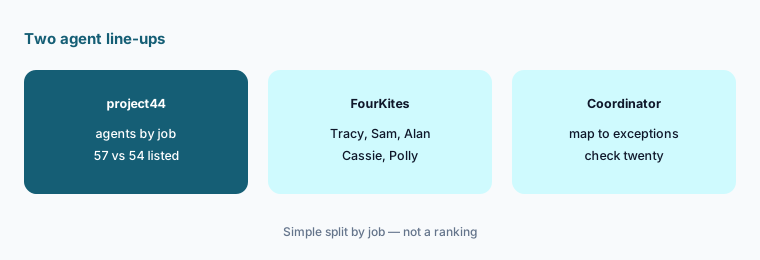
Map, don’t count:
Map each platform's agents to your five most common exceptions. Have the logistics coordinator check twenty results from each trial against the load record before comparing.
4. Building workflows: Agentic Workflow Manager vs Loft and Sophie
What it is: project44’s Agentic Workflow Manager is a no-code builder: a signal from shipment data, a trigger you filter by carrier, lane, origin, destination, reference key, or reason code, and an action an agent takes; workflows start from templates and you publish when ready. FourKites’ Loft works differently: you describe a procedure in plain language and Sophie, an AI developer agent, turns it into an Agent Operating Procedure with triggers, steps, decision logic, and escalation rules, tested against 10–20 of your historical exceptions before it goes live; the launch release says FourKites engineers review Sophie’s work.
Either way, your written procedure becomes the agent’s rulebook. Start with one narrow workflow and read every carrier conversation before widening it.
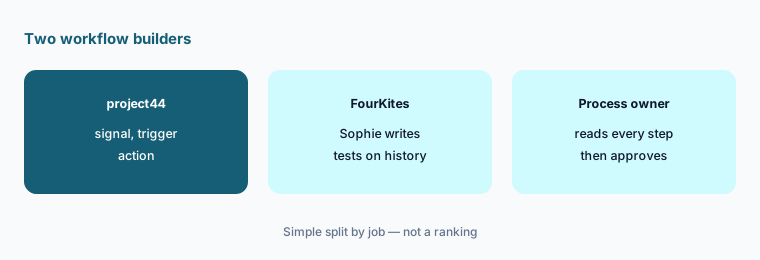
Same rule, both builders:
Build one narrow exception rule in each platform's workflow tool. Have the process owner read every step and the first two weeks of carrier conversations before widening it.
5. Human checkpoints: what runs without a person
What it is: Both vendors describe oversight and autonomy on the same pages. project44 says the Agentic Workflow Manager has “full audit trails and human checkpoints built in”, and also that agents update shipments “without a human touch”; its procurement and recovery agents book freight “within the guardrails your team defines” (project44 AI). FourKites’ Loft page promises “human oversight where it matters”, describes Tracy detecting a delay, Alan rescheduling, and Cassie notifying the customer with “no human coordination required”, and says Sam works “without a human in the loop” (FourKites AI).
Neither default is your policy. Write down which actions need a named approver — bookings, rate changes, customer messages, dock moves — and ask each vendor to show where that approval sits.
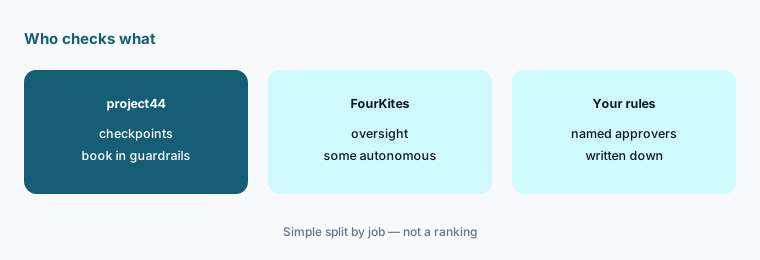
Write the approval rules:
Write down which actions need a named approver (bookings, rates, customer messages, dock moves). Ask each vendor to show where that approval step sits in a trial.
6. Theft and disruption tools
What it is: project44 Theft Prevention lets you define safe and risky zones, compares truck movement with a baseline route, detects unscheduled idle stops, and has an AI agent contact the carrier and escalate; its disruption agent maps events across more than 120 risk categories to in-transit inventory (project44 AI). FourKites’ cargo theft page names Tracy as the primary agent and describes theft-risk signals by commodity, route, time, and carrier, behavioural baselines, cross-customer pattern analysis, and automated escalation; FourKites also sends disruption alerts through FourSight.
A theft or disruption alert is a prediction. Write the night-shift escalation path, and check the shipments an alert names before expediting or calling the police.
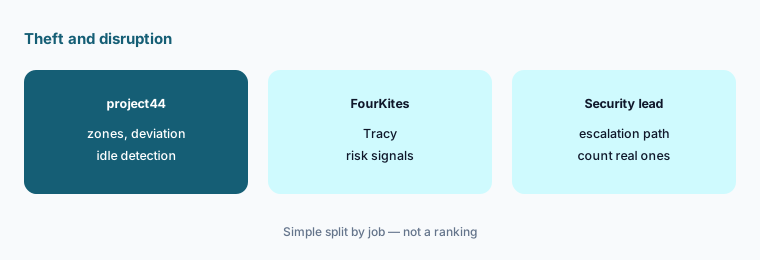
Escalation path first:
Before the first live theft alert in either platform, write down who the night shift calls and what they check. Count how many escalations were real after a month.
Pricing context (October 2026)
project44 (re-checked 17 Oct 2026 via project44 AI): no published prices; project44.com/pricing returns page not found and the site offers demos and a contact-sales form. Quote only. Ask whether Mo, the agents, the Agentic Workflow Manager, and Theft Prevention are included in your visibility or Intelligent TMS contract.
FourKites (re-checked 17 Oct 2026 via FourKites AI): no published prices; fourkites.ai/pricing returns page not found and the site routes buyers to an Outcome Advisor. Quote only. Its 14 October 2026 release describes Outcome-as-a-Service engagements built around a business number such as on-time-in-full, but does not say how fees are set.
Uncertainty: Neither vendor gives a price on 17 Oct 2026, so any cost comparison depends on written quotes. project44’s agent count differs between its AI page (57) and its August 2026 release (more than 54), and Mo is still in beta. FourKites’ pages render template codes instead of agent and outcome counts, and the network size on its theft page (882 shippers, 10,164 carriers) differs from its 14 October release (1,600+ brands, 500,000+ carriers), so we use no counts. Both vendors describe human checkpoints and fully autonomous steps on the same pages. Vendor savings, resolution, and theft figures are their claims, not our measurement. This page is not a ranking — decide from your five exceptions, two trials, and named approvers.
When it’s useful (honest take)
project44 is useful when you want an analyst that shows its work, agents organised by job including ones that book freight inside guardrails you write, and a trigger-based builder your transportation manager configures directly.
FourKites is useful when you want named agents for carriers, suppliers, docks, and customers, prefer describing procedures in plain language and having them tested on past exceptions, and are open to an outcome-based engagement.
Less useful when (either one) you mainly run your own trucks (Samsara AI), you need forwarding and customs (Flexport AI), you broker freight and want voice agents for carrier sales (HappyRobot AI), or nobody will own approvals.
Still choosing between project44 and FourKites? The $19 AI toolkit audit gives you a written plan for which tools to keep using and which to drop across your whole AI stack, including this pair.
Prefer to do it yourself? Spreadsheet — $9
Related options (educational)
| Need | Better home | Why |
|---|---|---|
| project44 on its own | project44 AI | Quote only |
| FourKites on its own | FourKites AI | Quote only; outcome-based engagements |
| Managed transportation with a shipper analytics assistant | Uber Freight AI | Quote only |
| Forwarding and customs with MCP and booking agents | Flexport AI | Freight and customs quoted |
| Own-fleet telematics and safety | Samsara AI | See its review |
FAQ
Is project44 or FourKites better?
Neither is ranked here. project44 pairs an analyst (Mo) with agents organised by job and a trigger-based builder; FourKites names its agents and has Sophie write procedures from plain language. Test your five most common exceptions in both.
Do project44 and FourKites publish prices?
No (checked 17 Oct 2026). Both pricing URLs return page not found and both are quote only. FourKites also offers Outcome-as-a-Service engagements built around a business number.
What is the difference between Mo and FourSight Ask?
Both answer plain-language questions about your freight. Mo (in beta for all project44 customers) shows which shipments and definitions it used and flags low confidence; FourSight Ask adds role-based views and scheduled reports. Compare their on-time definitions.
Can their agents act without a person?
Yes, in places. project44 agents update shipments “without a human touch” and book within your guardrails; FourKites says Sam works without a human in the loop. Write which actions need a named approver and ask each vendor to show the step.
Who should approve agent actions in either platform?
A named transportation manager for bookings and routing-guide changes, a logistics coordinator for statuses customers see, the process owner for every workflow, the warehouse manager for dock moves, and the security lead for theft escalations.
Optional next step (if seats overlap)
If you pay for a visibility platform with agents, a TMS with its own assistant, a customer-service tool that answers “where is my order”, and chat seats on top, that overlap is worth mapping. Map the overlap with the $19 AI toolkit audit or the $9 AI toolkit spreadsheet. Email Audit $19 or Toolkit spreadsheet $9.
Checkout is live via Stripe. After you pay, we email delivery (spreadsheet) or intake next steps (audit).