Tool · Logistics ops · FourKites · Oct 2026
FourKites AI review (Oct 2026): Tracy and the Digital Workforce, Loft with Sophie, and FourSight AI for supply chain visibility
FourKites started as a real-time shipment tracking company and now leads with AI agents it calls the Digital Workforce: Tracy chases carriers, Sam processes supplier documents, Alan books dock appointments, Cassie answers “where is my order” questions, and Polly collects proofs of delivery. They run on Loft, where an AI developer agent called Sophie turns your procedures into workflows, and FourSight AI lets people ask questions of the data. This page is about using those agents for the follow-up work while a logistics coordinator still checks what customers are told. Each section has a Try this.
What this FourKites page covers
This page is for a logistics coordinator, transportation manager, or supply chain lead at a shipper that uses FourKites or is comparing visibility platforms. The question it answers: what each FourKites agent does, where FourKites says a person is involved and where it says none is, how Loft and Sophie build new workflows, and who should check an agent’s work before it reaches a carrier, supplier, or customer.
FourKites’ FourSight AI page and Loft page (read 17 October 2026) describe six named agents, Loft as the operating environment, and FourSight as the interface for asking questions and receiving reports. On 14 October 2026 FourKites announced Outcome-as-a-Service, a sales model that starts from the business number a customer is accountable for, such as on-time-in-full.
Ground rules: a named logistics coordinator checks every status and ETA that reaches a customer; the process owner approves every AOP before it runs; the buyer or planner checks supplier shipments Sam creates; nobody pastes driver phone numbers or customer details into an outside chat tool; and FourKites’ performance figures are its claims, not our measurement.
Major features (with how someone uses them)
Examples at a glance: each feature has a concrete example from a real job plus a short Try this you can run this week.
1. Tracy: carrier follow-up and ETAs around the clock (primary)
What it is: Tracy follows up on late or at-risk shipments. FourKites describes the flow: a digital twin of the shipment spots an ETA slip or missed milestone; Tracy weighs it against the carrier’s history on that lane; contacts the carrier by email, SMS, WhatsApp, voice, EDI, or API depending on the carrier’s preference; parses the reply and updates the shipment; and, if the carrier doesn’t answer within the window you set, tries another channel or flags the case for human review. It then notifies your team, the consignee, or customer service, and the full decision trace is recorded.
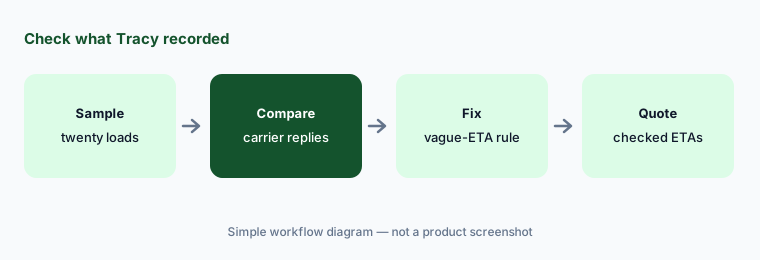
A carrier’s reply is a claim too. Check a sample of what Tracy recorded before customer service quotes those ETAs to customers.
Primary workflow:
Pick twenty late loads Tracy followed up on last week. Have the logistics coordinator check each status and ETA she recorded against the carrier's reply before customers are told.
2. Sam: supplier documents turned into shipments
What it is: Sam reads supplier emails and documents (packing lists, booking confirmations, PDFs in many formats), creates shipments, and links them back to purchase orders. FourKites says Sam does this “without a human in the loop” and flags exceptions when supplier data is incomplete. The Loft page adds that supplier documents are validated against the order record and suppliers are screened against sanctions watchlists before a shipment is created automatically.
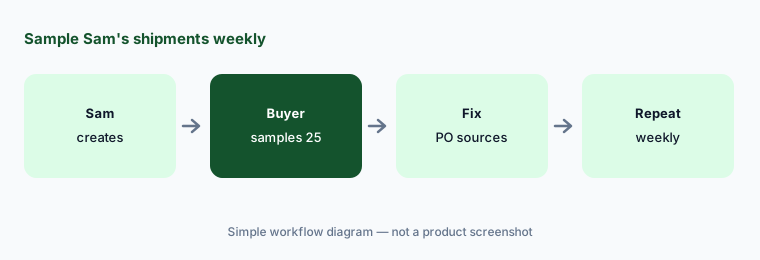
“No human in the loop” means a wrong PO link flows straight into your inventory plan. Have a buyer review a sample of Sam’s shipments each week until the error rate is known.
Sample every week:
Have a buyer review 25 shipments Sam created from supplier documents. Check each PO link and quantity before those shipments feed the inventory plan.
3. Alan, Cassie, and Polly: appointments, WISMO, and PODs
What it is: Three more agents cover facilities and customers. Alan creates and reschedules dock appointments from live ETAs and connects to carrier and yard systems. Cassie answers “where is my order” emails and chats from the shipment record and escalates when a person is needed. Polly chases carriers for missing proofs of delivery and delivery documents, then validates and files them. FourKites lists case studies for each; their figures are FourKites’ claims.
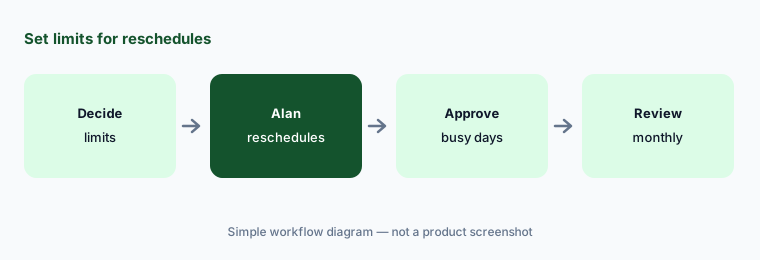
Rescheduling a dock and answering a customer are both promises. Decide which reschedules need the warehouse’s OK and which customer accounts always get a person.
Set the limits:
Let Alan reschedule late inbound appointments on your quietest days only. Have the warehouse manager approve every move on the busiest day for the first month.
4. Loft and Sophie: turning your procedure into an agent workflow
What it is: Loft is the platform FourKites’ agents run on, launched on 9 February 2026. Its centrepiece is Sophie, an AI developer agent: you describe an operating procedure in plain language, and Sophie turns it into an Agent Operating Procedure (AOP) with trigger conditions, data-gathering steps, decision logic, escalation rules, and outcome recording. FourKites says each AOP is tested against 10–20 historical exceptions from your own shipment data before it goes live, and the launch release says FourKites engineers review Sophie’s work before it runs. Loft records how each decision was made and who approved it.
Your written procedure becomes the agent’s rulebook, including its gaps. Have the person who owns the process read the generated AOP and the historical test results before it goes live.
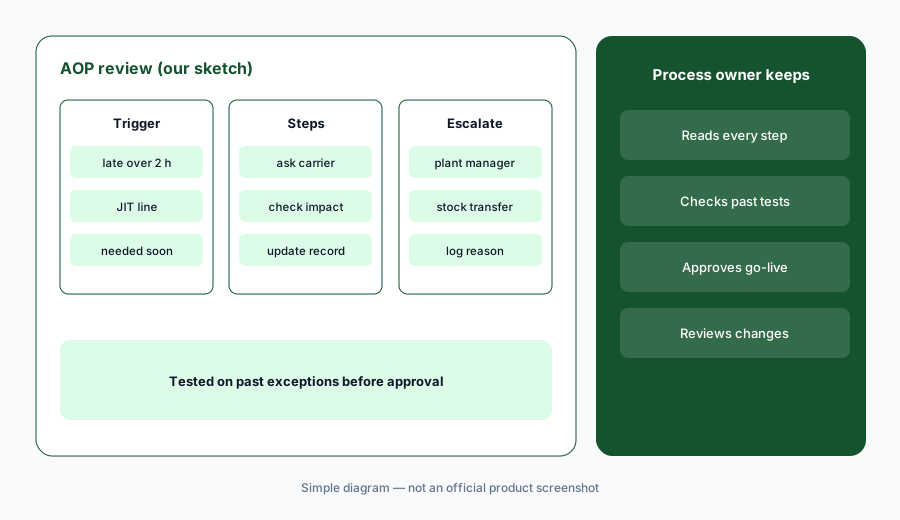
Read before it runs:
Describe one exception procedure for Sophie to turn into an AOP. Have the process owner read every step and the historical test results before approving it.
5. FourSight AI: ask questions and get role-based views
What it is: FourSight AI is FourKites’ interface layer. Ask answers plain-language questions with data, charts, root-cause breakdowns, and a link to set up a monitoring workflow. Gen UI builds a different view for each role — revenue at risk for a VP, today’s exceptions for a coordinator, the next four hours for a dock supervisor. Intelligence delivery sends carrier performance reports, supplier reports, disruption alerts, and data connectors to the tools you already use.
Two people looking at different generated views can come to a meeting with different numbers. Agree which report is the reference for each number your team quotes.
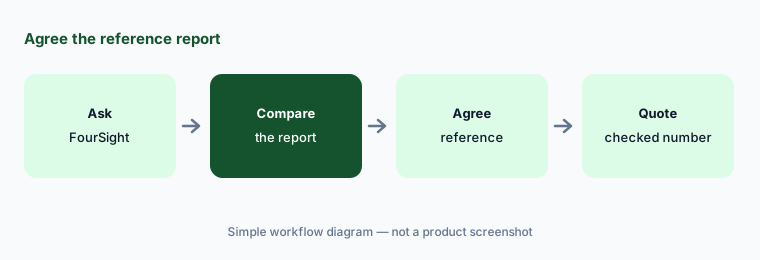
Agree the reference:
Ask FourSight which five carriers caused the most late deliveries last quarter. Have the transportation manager compare the answer with the carrier performance report before the carrier review.
6. Outcome-as-a-Service: buying by result
What it is: On 14 October 2026 FourKites announced Outcome-as-a-Service for Supply Chain. Each engagement starts from a number the customer is accountable for — on-time-in-full, expedited freight spend, or cost to serve — and FourKites works backward to the agents, workflows, and data needed to move it. Its website now has a page for each of 70+ outcomes, and an agent called Owen, an “Outcome Advisor”, opens conversations with buyers.
An outcome promise is only as good as how the outcome is measured. Agree the baseline, the data source, and who calculates the number before signing.
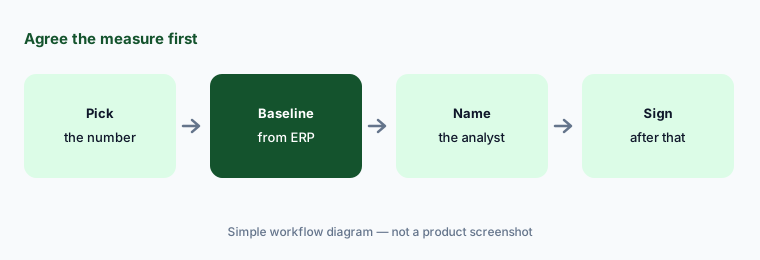
Agree the measure first:
Before any FourKites outcome-based deal, write down your baseline for the target number, its data source, and the analyst who will calculate it each month.
Pricing context (October 2026)
FourKites does not publish prices. Its site routes buyers to an Outcome Advisor (Owen) or a sales conversation, so pricing is quote-only as of 17 Oct 2026; we have no plan names or amounts to give.
The 14 October 2026 release describes engagements built around a customer’s business outcome rather than a product list, but does not say how fees are set. Ask whether each agent (Tracy, Sam, Alan, Cassie, Polly) and Sophie-built workflows are priced per outcome, per agent, or included in a visibility contract.
Uncertainty: FourKites’ pages did not show a number of named agents on 17 October 2026 (the count did not render in the page text), so we count the six agents listed. The Loft page says buyers don’t interact with Loft directly, while the launch release says customers describe requirements that Sophie turns into workflows, reviewed by FourKites engineers — ask who writes and approves your AOPs. Figures such as 75% autonomous resolution, 4,000+ calls eliminated a month, and customer results are FourKites’ claims, not our measurement. Sam is described as running without a human in the loop; we recommend sampled review anyway.
When it’s useful (honest take)
Useful when your team spends hours a day emailing and calling carriers and suppliers, you already track most freight in FourKites, and you have a coordinator who will sample agent work and a process owner who will read every AOP before it runs.
Less useful when you mainly need consumer delivery messaging after checkout (Narvar AI, AfterShip AI), forwarding and customs (Flexport AI), or want to compare another shipper visibility platform first (project44 AI).
Paying for FourKites AI and a few other AI tools? The $9 AI toolkit spreadsheet lists every AI subscription you have, what each one costs, and how fast it pays for itself, so you can see which ones are worth the money.
Want someone to do it for you? AI toolkit audit — $19
Related options (educational)
| Need | Better home | Why |
|---|---|---|
| Named agents for carriers, suppliers, docks, and customers | FourKites AI (this page) | Quote only |
| Visibility with an AI analyst and booking agents | project44 AI | Quote only |
| Forwarder platform with MCP and booking agents | Flexport AI | Freight and customs quoted |
| Consumer post-purchase tracking and returns | Narvar AI | Quote only — see review |
| Drafting a carrier email from a sanitized SOP | Claude | General chat; no carrier contact |
FAQ
What is FourKites Tracy?
An AI agent that follows up on late or at-risk shipments by email, SMS, WhatsApp, voice, EDI, or API, updates the shipment from the carrier’s reply, and escalates or flags for human review when a carrier doesn’t respond in the window you set.
What is FourKites Loft?
The platform FourKites’ agents run on, launched 9 February 2026. Its AI developer agent, Sophie, turns a plain-language procedure into an Agent Operating Procedure that is tested on 10–20 past exceptions before it goes live.
How much does FourKites cost in October 2026?
FourKites does not publish prices. Treat it as quote-only; its Outcome-as-a-Service model (announced 14 October 2026) starts from the business result you want to move.
Does a person check what FourKites agents do?
It depends on the agent. Tracy can flag cases for human review; Sophie-built workflows are reviewed by FourKites engineers before they run; Sam is described as working without a human in the loop. We recommend sampled human review for all of them.
Who should approve FourKites agent work?
A named logistics coordinator for statuses customers see, the process owner for every AOP, a buyer for shipments Sam creates, and the warehouse manager for dock reschedules on busy days.
Optional next step (if seats overlap)
If you pay for a visibility platform with its own agents, a customer-service tool that also answers “where is my order”, and a chat seat on top, that overlap is worth mapping. Map the overlap with the $19 AI toolkit audit or the $9 AI toolkit spreadsheet. Email Audit $19 or Toolkit spreadsheet $9.
Checkout is live via Stripe. After you pay, we email delivery (spreadsheet) or intake next steps (audit).