Compare · Logistics ops · Oct 2026
HappyRobot vs Parade (Oct 2026): AI agents for freight brokerage carrier sales compared
HappyRobot and Parade both sell AI that takes repeated carrier sales work off a broker’s desk: answering carrier calls and emails, matching trucks to loads, and negotiating rates. They come at it from different sides. HappyRobot is a general AI agent platform — voice first, across many channels and industries — that you or its engineers configure into broker workflows. Parade is capacity management software built for brokerages, with CoDriver agents on carrier email, phone, and trucklists. This page compares the tasks a carrier sales team repeats every day, what each vendor publishes, and who sets the limits — it is not a ranking, and each section has a Try this.
What this comparison covers
This page is for a carrier sales lead, brokerage operations manager, or broker technology lead choosing between HappyRobot and Parade, or running one and curious about the other. The question it answers: by channels, load matching, rate guardrails, integrations, testing and governance, and price, how do the two compare.
Facts align with our HappyRobot AI and Parade AI reviews (read 17 October 2026), with HappyRobot’s agents overview, logistics page, and integrations page, and Parade’s CoDriver page, Capacity page, Voice 2.0 post, and Auto-Accept Under Max help article re-read the same afternoon. Neither vendor publishes a price.
Ground rules for either tool: the carrier sales lead sets the rate ceiling for every load or lane an agent may offer or accept, and decides which loads may book without a rep; carrier compliance checks stay on before any booking; nobody pastes full rate files, driver phone numbers, or shipper contracts into an outside chat tool; and vendor productivity figures are their claims, not our measurement. This comparison is not a ranking. For shipper-side agents, see Loadsmart AI.
| Question | HappyRobot | Parade |
|---|---|---|
| Published price | None; quote only (pricing URL returns page not found) | None; quote only (pricing URL returns page not found) |
| What it is | A general AI agent platform sold across several industries, with logistics workflows for brokers and carriers | Capacity management software for freight brokerages, with CoDriver AI agents |
| Main channels | Voice, SMS, email, WhatsApp, web chat, Teams, Slack; 30+ languages | Carrier email in and out (including trucklists) and inbound phone (CoDriver Voice 2.0) |
| Load matching | Captures inbound loads, triages tenders, re-engages carriers; matching logic set in your workflow | Machine-learning carrier-to-load matching, lane-interest signals, Cascade and AutoAssign for recurring lanes |
| Rates (vendor wording) | “Counter offers with live market data and log every offered and accepted rate” | Max Rate per load; Auto-Accept Under Max books email offers below it without a rep when switched on |
| Testing and governance | Northstars, adversarial test agents, audits and regression tests, separate test and production versions | Voice 2.0 modes: Qualify only, Full automation, Strict compliance; opt-in auto-booking |
| Who signs off | Carrier sales lead sets rate ceilings and approval steps in each workflow | Carrier sales lead sets Max Rates and decides whether Auto-Accept is on |

Major features (with how someone uses them)
Examples at a glance: each feature has a concrete example from a real job plus a short Try this you can run this week.
1. Start from your five most repeated carrier sales tasks (primary)
What it is: Before comparing demos, write down the five carrier sales tasks your reps repeat most — for example, answering “is this load still available?” calls, replying to load-board emails, reading trucklists, qualifying a new carrier, and countering a rate. For each, note which tool’s AI would handle it, whether it suggests or acts, and who sets the rate limits it works within.
The useful comparison is not which tool sounds more human on a call, but which of your five tasks each covers and whether the rate limit is written down before anything books.
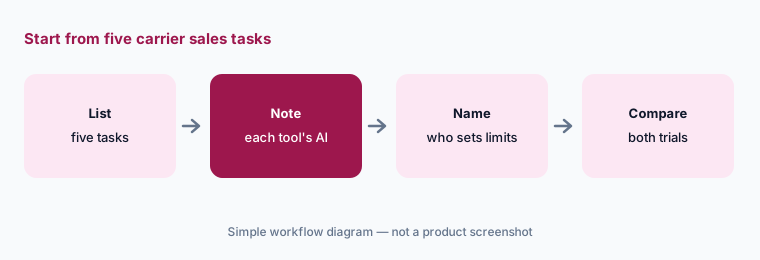
Five tasks:
Write down your five most repeated carrier sales tasks. Note which tool's AI handles each and who sets the rate limits.
2. Voice agents vs email and capacity AI
What it is: HappyRobot’s agents overview describes “autonomous AI workers” on voice, SMS, email, WhatsApp, web chat, Teams, and Slack, with handoff to a person in Teams or Slack; its voice page describes a multi-model voice stack (turn-taking, interruption handling, transcription failover, numeric accuracy) in 30+ languages. Parade’s CoDriver page covers inbound load emails and outbound replies including trucklists, inbound phone, and trucklist extraction, and says brokers “receive 3x more quotes by email than phone”; its Voice 2.0 post (5 March 2026) says calls transfer only with confirmed, qualified carriers (Parade AI).
Channel mix decides a lot. Count last week’s carrier calls and emails before you weigh voice quality against email coverage.
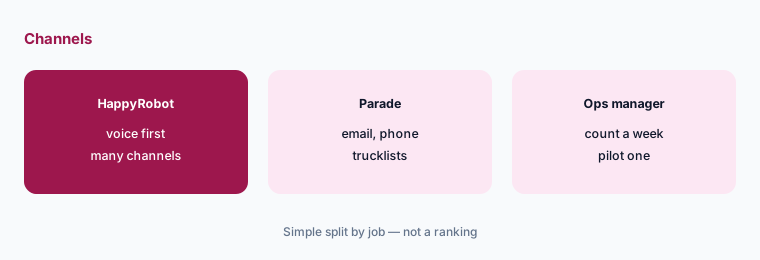
Count the channels:
Count one week of carrier calls and emails. Ask each vendor to handle a sanitized sample of your bigger channel, and review ten results from each.
3. Load matching and carrier capacity
What it is: Parade’s Capacity page describes machine-learning matching of carriers to loads, automated outreach to load boards and email, digital quoting and booking, and, on its home page, Cascade and AutoAssign for recurring lanes; CoDriver Capacity turns lane interest from incomplete conversations into signals. HappyRobot’s logistics page describes agents that capture inbound loads, triage tenders, screen for fraud, re-engage dormant carriers, and keep the contact database clean; matching rules live in the workflow you configure (HappyRobot AI).
A match is a suggestion until a rep or a written rule accepts it. Decide which lanes can follow the tool’s pick and which need a rep.
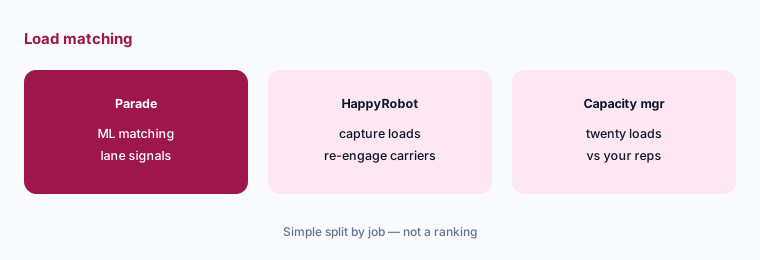
Check the matches:
Give both tools the same twenty open loads. Compare their suggested carriers with the ones your reps would call before any load books.
4. Rate guardrails and auto-booking
What it is: HappyRobot’s logistics page says its agents “counter offers with live market data and log every offered and accepted rate”, recording rate offered, rate accepted, and lane for each call. Parade’s 13 August 2026 help article says that with Auto-Accept Under Max on, CoDriver accepts and books an emailed carrier offer below the load’s Max Rate “without a rep stepping in”, makes one auto-book attempt per load, and passes any carrier question to a rep; its Estimated Carrier Bid (22 July 2026) shows a live carrier asking rate per lane, and Parade says “Your team controls the weighting, margin logic, and final shipper price”.
Both tools can move money on their own once configured. Write the ceiling per lane and the on/off switch for auto-booking before any agent talks rates.
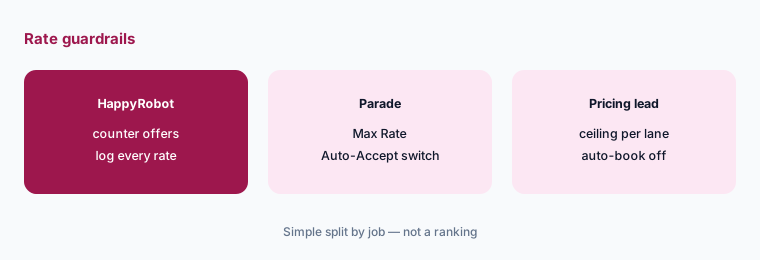
Write the ceilings:
Write a rate ceiling for each lane in the trial and who may change it. Keep auto-booking off until the carrier sales lead has reviewed two weeks of logged rates.
5. Integrations with your TMS and carrier tools
What it is: HappyRobot’s integrations page says it connects to “200+ enterprise systems”, exposes each integration to agents as “a specific scoped action within a workflow”, keeps credentials per deployment, and uses browser agents for systems without an API. Parade’s integrations page groups partners into TMS, carrier onboarding, visibility, rate benchmarks, and load boards (partner names did not load in our capture), and its Voice 2.0 strict compliance mode checks carriers against Highway, RMIS, and MyCarrierPortal.
The write-back matters more than the logo list. Ask which fields each tool writes to your TMS and who can undo a wrong write.
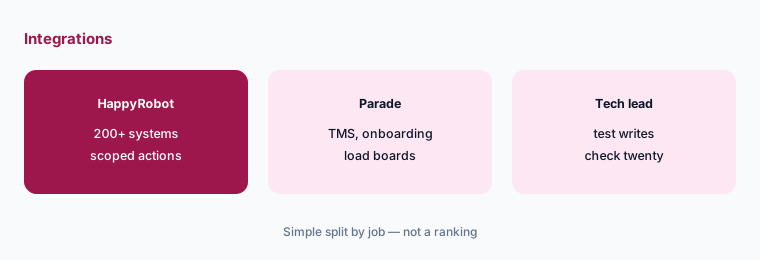
Check the write-backs:
List the TMS fields each tool would write. Give write access in a test environment first and check twenty records before production.
6. Testing, governance, and price transparency
What it is: HappyRobot describes northstars (rules such as “Always confirm the waybill number before disclosing any shipment status”), adversarial test agents that try prompt injection and data extraction in a sandbox, and audits and tests with expected responses, regression tests, and sampled reviews, plus separate test and production versions. Parade’s Voice 2.0 post lists three modes — Qualify only, Full automation, and Strict compliance — and Auto-Accept is switched on per account. Neither publishes prices: both pricing URLs return page not found, so both are quote-only as of 17 Oct 2026.
Testing tools help only if someone reads the results. Name the person who reviews sampled calls and emails each week.
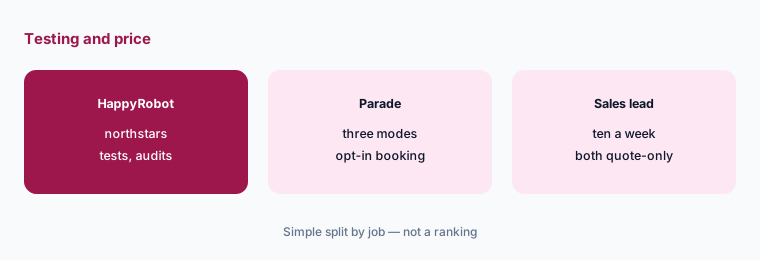
Start narrow:
Start each tool in its most limited mode. Have the carrier sales lead review ten conversations a week and widen scope only after two clean weeks.
Pricing context (October 2026)
Neither vendor publishes prices. HappyRobot’s and Parade’s pricing URLs both return “page not found”, and both sites offer demos. Both are quote-only as of 17 Oct 2026.
Ask each how pricing scales (per call, per load, per seat, or per workflow), whether voice minutes, email volume, or integrations cost extra, whether HappyRobot’s forward deployed engineers are included in setup, and whether Parade’s CoDriver features such as Voice 2.0 and Auto-Accept are part of the base subscription.
Uncertainty: HappyRobot’s logistics page describes agents that counter rates and adjust dock appointments “before a human notices the gap”, and Parade’s Auto-Accept Under Max books offers below Max Rate without a rep when it is on; both pages describe defaults you can limit, and we follow the limit-first approach. Parade’s integration partner names did not load in our capture, and HappyRobot’s integrations page gives a count, not a list of broker systems, so ask each for your TMS by name. Parade’s Voice 2.0 post describes its rollout in a garbled sentence. HappyRobot now sells to several industries beyond logistics. Figures such as WWEX’s 50,000 tasks in a month (HappyRobot) and 4X rep bandwidth, 27% more quotes, and 12M+ AI conversations a year (Parade) are vendor or customer claims, not our measurement.
When it’s useful (honest take)
Useful when you run a freight brokerage with heavy carrier call and email volume, you are choosing between these two, and a named carrier sales lead will write rate ceilings and review sampled conversations in a trial.
Less useful when you are a shipper wanting agents on your own freight (Loadsmart AI), you need a TMS with AI built in (Shipwell AI), or you want a digital freight broker to move the loads for you (Uber Freight AI).
Still choosing between HappyRobot and Parade? The $19 AI toolkit audit gives you a written plan for which tools to keep using and which to drop across your whole AI stack, including this pair.
Prefer to do it yourself? Spreadsheet — $9
Related options (educational)
| Need | Better home | Why |
|---|---|---|
| Voice-first agent platform with logistics workflows | HappyRobot AI | Quote only |
| Capacity management with CoDriver agents | Parade AI | Quote only |
| Shipper-side execution agents | Loadsmart AI | Free PoC, then quote |
| TMS with assistant and document AI | Shipwell AI | Quote only |
| Digital freight brokerage with AI insights | Uber Freight AI | Quote only for software |
| Drafting a sanitized carrier email template | Claude | General chat; not a broker tool |
FAQ
What is the main difference between HappyRobot and Parade?
HappyRobot is a general, voice-first AI agent platform configured into broker workflows across many channels; Parade is capacity management software for brokerages with CoDriver agents on carrier email, phone, and trucklists. This is not a ranking.
Can either tool book a load without a rep?
Yes, if configured. Parade’s Auto-Accept Under Max books emailed offers below the Max Rate without a rep when it is on; HappyRobot’s agents can counter offers within a workflow. Set ceilings and keep auto-booking off until you have reviewed results.
How much do HappyRobot and Parade cost in October 2026?
Neither publishes prices; both pricing URLs return page not found. Both are quote-only (checked 17 Oct 2026).
Do they connect to my TMS?
HappyRobot says it connects to 200+ enterprise systems with scoped actions and browser agents; Parade lists TMS, carrier onboarding, visibility, rate benchmark, and load board integrations. Ask each for your TMS by name.
Who should set the limits for carrier sales AI?
The carrier sales lead sets rate ceilings per lane, decides which loads may book without a rep, and reviews sampled conversations each week; carrier compliance checks stay on before any booking.
Optional next step (if seats overlap)
If you pay for a capacity tool, a voice agent platform, load boards, a rate benchmark, and chat seats your reps use to write carrier emails, that overlap is worth mapping. Map the overlap with the $19 AI toolkit audit or the $9 AI toolkit spreadsheet. Email Audit $19 or Toolkit spreadsheet $9.
Checkout is live via Stripe. After you pay, we email delivery (spreadsheet) or intake next steps (audit).