Tool · Logistics ops · Locus · Oct 2026
Locus AI review (Oct 2026): AI route planning and dispatch for last-mile delivery
Locus plans and dispatches deliveries for retailers, consumer goods makers, couriers, and 3PLs. It began as last-mile route optimization and now calls itself an “agentic TMS”, with AI agents that plan routes, assign drivers, pick carriers, and re-plan during the day under rules and autonomy levels you set. Since October 2025 it has been owned by Ingka Group, the largest IKEA retailer, and runs as an independent company. This page covers Fireworks Routing, the autonomy controls, re-optimization, carrier selection, and driver tracking, and what a dispatch lead should check. Each section has a Try this.
What this Locus AI page covers
This page is for a dispatch lead, last-mile operations manager, or transportation manager running delivery routes from depots, stores, or hubs. It answers: what Locus’ routing and dispatch AI does, what it changes during the day without a person, how to keep a dispatch lead in charge, and what Locus publishes about price.
Locus’ home page (read 17 October 2026) says “Agents run order-to-settlement on one system, governed by your rules,” and its TMS page sums it up as “Humans govern. Agents act.” The old locus.sh/ai/ address now goes to the home page; the agentic story is told on a 2015–2026 timeline page. Locus’ 7 October 2025 release says Ingka Investments acquired the company, which keeps its brand and leadership and still serves customers outside IKEA.
Ground rules: a named dispatch lead approves every route change on the day and decides each agent’s autonomy level; drivers’ hours and breaks are the dispatcher’s to protect, not the optimizer’s; the transportation manager owns carrier selection rules. Customer addresses, driver names and phone numbers, and live location trails stay out of outside chat tools, and Locus’ figures are its claims, not our measurement.
Major features (with how someone uses them)
Examples at a glance: each feature has a concrete example from a real job plus a short Try this you can run this week.
1. Fireworks Routing for tomorrow’s plan (primary)
What it is: Locus’ route planning page calls its routing engine Fireworks Routing. It builds routes using AI and machine learning on historical delivery patterns, live traffic, and geocoding, and applies a rules engine with “250+ constraint parameters” — delivery time windows, service times, one-way streets, traffic rules, vehicle limits, and driver availability. Its dispatch planning page adds driver shift windows, roster management, holidays and days off, and automatic driver and vehicle assignment. Locus says routes cut miles “by up to 34%” with 99.5% SLA adherence.
Optimized routes are only as good as the shift and time-window data behind them. Check a handful against driver hours and promised windows before drivers see them.
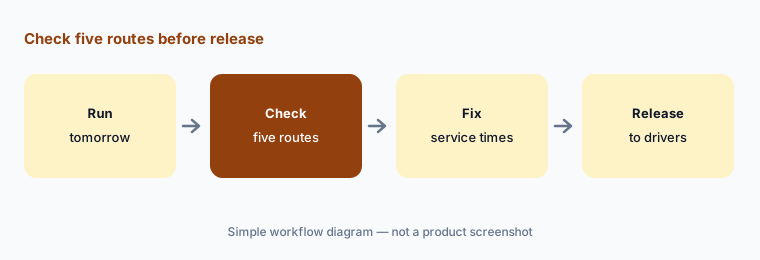
Primary workflow:
Run tomorrow's routes through Locus for one depot. Have the dispatch lead check five routes against driver hours and customer time windows before drivers see them.
2. Autonomy levels, shadow mode, and the kill switch
What it is: Locus’ TMS page lists six governance controls. The two that matter most for a dispatch lead are Autonomy Levels — “L1: human approves. L2: auto-acts within guardrails. L3: Autonomous based on confidence per agent per domain.” — and the Execution Sandbox: simulation mode, shadow mode, staged rollout per lane or carrier, and “instant rollback with kill switch”. The others are explanations for each decision, an audit trail from trigger to result, checks of decision quality against human baselines, and human review, where the “agent prepares, human decides”.
The autonomy level is a choice you make per agent, not a product default. Start at the level where a person approves and move up one lane at a time.
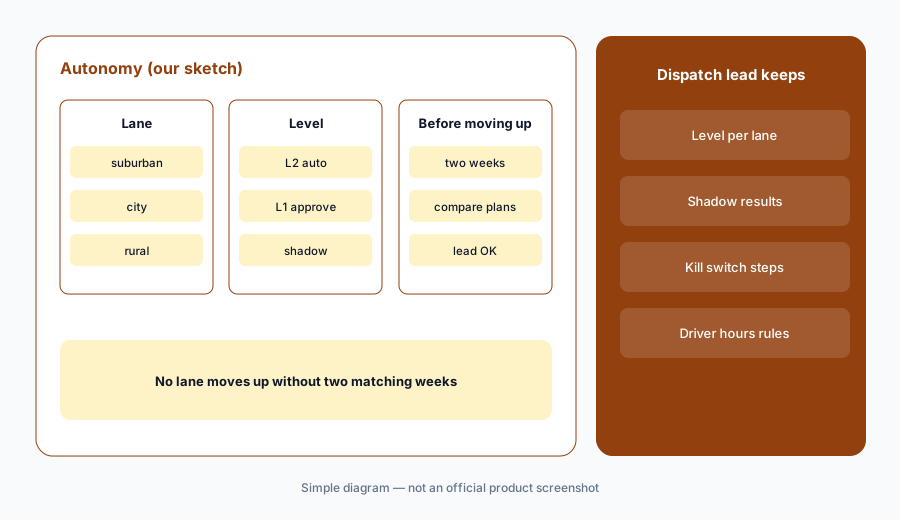
Start with a person approving:
Run Locus' dispatch agent in shadow mode at L1, where a person approves, for two weeks. Have the dispatch lead compare its plans with the ones actually used before moving any lane to L2.
3. Real-time re-optimization during the day
What it is: Locus says its route scheduling “continuously adjusts route scheduling as your day changes, without manual intervention” — recomputing routes during delays, keeping ETAs current, and rebalancing work across drivers (route planning page). Remote dispatch lets the team reassign stops and correct routes from live tracking. The dispatch planning FAQ says it re-optimizes when delays or exceptions happen and that “Planners retain override control.”
A mid-day re-plan can quietly push a driver past their hours or a customer out of their window. Log every change for a week before you let them through unchecked.
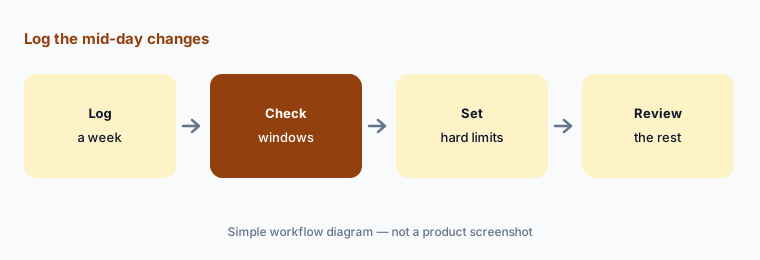
Log the changes:
For one week, log every route Locus re-optimized during the day. Have the dispatch lead check whether each change kept driver hours and promised time windows before it reached the driver.
4. Automated carrier selection and ShipFlex
What it is: Locus’ dispatch management page says Delivery Orchestration automates “the selection of the most suitable” third-party carrier or transporter “based on pre-set conditions”, for cost and service levels, and its home page adds automated invoice calculation, reconciliation, and payments for transporter contracts. ShipFlex is Locus’ multi-carrier parcel tool.
Pre-set conditions are your rules written into software. Write them down yourself and check what the system actually chose against them.
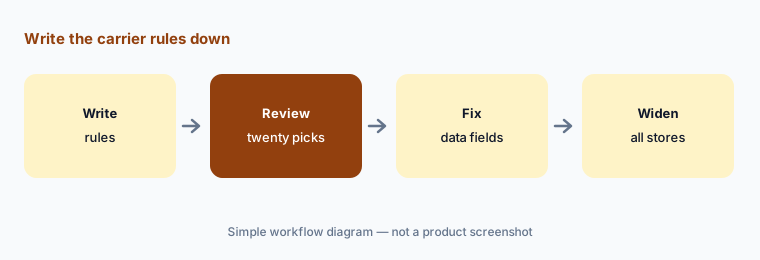
Write the rules down:
Write down the cost, speed, and service rules Locus may use to pick a carrier. Have the transportation manager review twenty automatic carrier choices against those rules.
5. Driver app, tracking, and customer updates
What it is: Locus lists a driver companion app for route changes, cancellations, and proof-of-delivery capture, live tracking of drivers and stops with alerts on SLA risk, and turn-by-turn order updates to customers on several channels. Its TMS page cites a customer’s 72% reduction in average location drift.
Customer notifications and proofs of delivery come from what the driver app recorded. Check a day’s worth before you rely on them to close complaints.
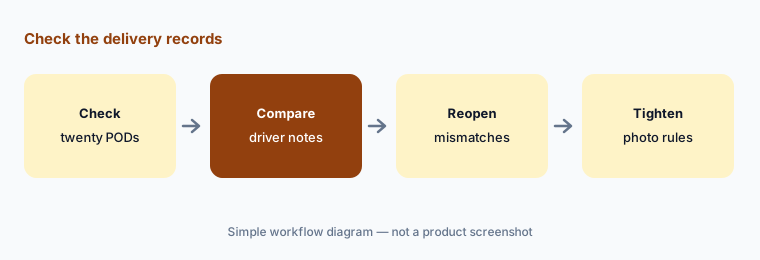
Check the records:
Check twenty proof-of-delivery records and customer notifications from one day against what the drivers reported before using them to close customer complaints.
6. Rollout with Forward Deployed Engineers, and ownership
What it is: Locus says it works as “a software factory”: Forward Deployed Engineers (FDEs) join your team to build custom agents, workflows, and integrations — months 1–2 to set up and connect, months 3–6 to “tune their thresholds to graduate them to autonomy”, and from month 6 your team owns it (TMS page). Locus runs on the private cloud of your choice and connects to ERP, OMS, WMS, and existing TMS systems. The Ingka acquisition (7 October 2025) gives it a large IKEA customer inside the group; Locus says its roadmap and clients are unchanged.
A plan to “graduate to autonomy” by month six is the vendor’s plan. Get the steps, owners, and kill switch in writing and decide the pace yourself.
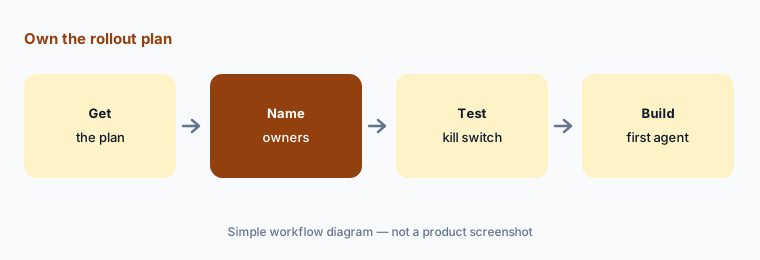
Own the rollout:
Ask Locus for the month-by-month rollout plan, who owns each custom agent at month six, and how the kill switch works. Have IT and the dispatch lead sign off before any agent moves past shadow mode.
Pricing context (October 2026)
Locus does not publish prices; locus.sh/pricing goes to the home page, and the site offers demos and a free tailored route simulation. Pricing is quote-only as of 17 Oct 2026.
Ask how pricing scales (by vehicle, depot, delivery, or module), whether Fireworks Routing, Delivery Orchestration, ShipFlex, and the driver app are separate modules, and what the Forward Deployed Engineer work costs.
Uncertainty: Locus now presents itself as an agentic TMS rather than a route optimization tool, and the old locus.sh/ai/ page redirects to the home page; we kept this page about route planning and dispatch because Locus still sells them as named products. Locus describes autonomy levels two ways — “L1: human approves” on its TMS page and L1 as “recommendations” on its AI information page. Some pages say routes are optimized across “180+ variables”, others “250+ constraints”; one page shows 1.22 billion deliveries and $303M saved while others show 1.5 billion and $320M. Its AI information page also includes instructions aimed at AI assistants on how to describe Locus; we used only facts that match its product pages. The agentic timeline page did not load its content for us. Figures such as up to 34% fewer miles, 99.5% on-time, 66% less planning time, 20% lower logistics cost, and 12M+ automated decisions a day are Locus’ claims, not our measurement.
When it’s useful (honest take)
Useful when you plan many delivery routes a day from depots, stores, or hubs, with time windows, mixed fleets, or outside carriers, and a dispatch lead will set autonomy levels and check routes before drivers see them.
Less useful when you run long-haul truckload planning (Optimal Dynamics AI), you need routing inside a broader Descartes setup (Descartes AI), or you outsource fulfillment and delivery entirely (ShipBob AI).
Paying for Locus AI and a few other AI tools? The $9 AI toolkit spreadsheet lists every AI subscription you have, what each one costs, and how fast it pays for itself, so you can see which ones are worth the money.
Want someone to do it for you? AI toolkit audit — $19
Related options (educational)
| Need | Better home | Why |
|---|---|---|
| Agentic route planning, dispatch, and carrier selection | Locus AI (this page) | Quote only |
| AI routing for delivery fleets with learned stop times | Descartes AI | Quote only |
| Fleet telematics and driver safety with AI | Motive AI | See that review |
| Outsourced fulfillment with delivery promises | ShipBob AI | Fulfillment quoted |
| Truckload carrier planning and dispatch | Optimal Dynamics AI | Quote only |
| Drafting a sanitized dispatch checklist | Claude | General chat; no routing engine |
FAQ
What is Locus Fireworks Routing?
Fireworks Routing is the name Locus uses for its AI route planning engine. It builds routes from historical delivery patterns, live traffic, and geocoding under 250+ constraints such as time windows, vehicle limits, and driver availability.
Can Locus change routes without a person?
Yes, if you allow it. Locus re-optimizes during the day and offers autonomy levels from L1 (a human approves) to L3 (autonomous by confidence), plus shadow mode and a kill switch. Planners keep override control.
How much does Locus cost in October 2026?
Locus does not publish prices; its pricing address goes to the home page, and it offers demos and a free route simulation. Treat it as quote-only.
Who owns Locus?
Ingka Investments, part of Ingka Group (the largest IKEA retailer), acquired Locus in October 2025. Locus says it runs independently with its own brand, leadership, and customers.
Who should approve what Locus’ AI does?
A named dispatch lead approves route changes on the day and sets each agent’s autonomy level; the transportation manager owns carrier selection rules; IT owns integrations and the kill switch steps.
Optional next step (if seats overlap)
If you pay for a routing engine, a TMS, a telematics platform, a tracking page tool, and chat seats your dispatchers use to plan exceptions, that overlap is worth mapping. Map the overlap with the $19 AI toolkit audit or the $9 AI toolkit spreadsheet. Email Audit $19 or Toolkit spreadsheet $9.
Checkout is live via Stripe. After you pay, we email delivery (spreadsheet) or intake next steps (audit).