How-to · Last-mile delivery · Locus · Oct 21, 2026
Run Locus routing in shadow mode first, and have the dispatch lead approve every same-day route change
Locus plans and dispatches deliveries with Fireworks Routing and re-optimizes routes during the day. Its TMS page lists autonomy levels — “L1: human approves. L2: auto-acts within guardrails. L3: Autonomous based on confidence per agent per domain.” — and an execution sandbox with shadow mode and a kill switch. A mid-day re-plan can quietly push a driver past their hours. This page shows how to run shadow mode first, then keep the dispatch lead approving every same-day route change.
Who this is for
Dispatch leads, last-mile operations managers, and transportation managers running delivery routes from depots, stores, or hubs. The job here is same-day route changes. For writing one Optimal Dynamics load auto-accept rule at a truckload carrier — a different job in carrier planning — see Optimal Dynamics auto-accept rule.
How to do it
This is a how-to, not a ranking of routing software. Per the Locus AI review, Fireworks Routing builds routes with a rules engine of “250+ constraint parameters”; Locus says route scheduling adjusts during the day “without manual intervention” and that “planners retain override control”; Delivery Orchestration selects carriers on pre-set conditions; and a driver app captures route changes and proof of delivery. Locus has been owned by Ingka Group, the largest IKEA retailer, since October 2025 and runs as an independent company. Locus’ figures are its claims. The ground rule: the dispatch lead approves every same-day route change and decides each agent’s autonomy level; drivers’ hours and breaks are the dispatcher’s to protect.
1. Run shadow mode for two weeks
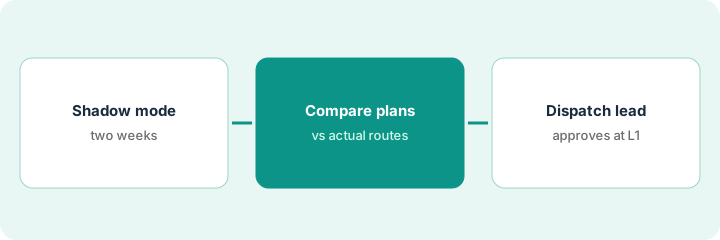
What it is: Turn on the dispatch agent in shadow mode for one depot, so it plans alongside your team without changing anything drivers see.
- Pick one depot.
- Check driver shift windows, breaks, and customer time windows are loaded correctly.
- Run the agent in shadow mode at L1 for two weeks.
- Log every same-day re-plan the agent would have made.
- Ask Locus how the kill switch and rollback work, and write the steps down.
Before shadow mode starts, the dispatch lead finds two drivers’ break rules missing from the roster and fixes them. She runs shadow mode for two weeks and writes down the kill-switch steps from Locus.
Check shift, break, and time-window data for one depot, then run shadow mode at L1 for two weeks with the kill-switch steps written down.
2. Compare the agent’s plans with the routes you actually ran
What it is: Each day, compare the agent’s shadow plans and re-plans with what drivers actually did, focusing on hours and promised windows.
- Compare five planned routes a day with actual routes.
- Check each shadow re-plan against driver hours and breaks.
- Check each against customer time windows.
- Note re-plans that would have saved miles without breaking a rule.
- Note re-plans that would have broken one.
Over two weeks, most shadow re-plans would have saved miles within the rules. Four would have pushed a driver past a break, and two would have moved a customer outside a promised window. She sends all six to Locus with the constraint that was missed.
Each day of shadow mode, compare five plans with actual routes and log every re-plan that would have broken a driver’s hours or a customer window.
3. Pick an autonomy level; the dispatch lead approves every same-day change
What it is: Go live at the level where a person approves, and keep every same-day route change on the dispatch lead’s approval.
- Go live at L1, where a human approves.
- Have the dispatch lead approve every same-day route change before it reaches drivers.
- Keep the log of approved and rejected changes.
- Move one lane at a time to L2 only after a clean month, and only with the dispatch lead’s written decision.
- Have IT and the dispatch lead sign off before any agent moves past shadow mode.
The fleet goes live at L1. In the first week the dispatch lead approves most same-day changes and rejects three that would have cut into breaks. After a clean month she moves one suburban lane to L2 and keeps the rest at L1.
Go live at L1 with the dispatch lead approving every same-day route change, and move a lane to L2 only after a clean month and a written decision.
Pricing context (October 2026)
This how-to isn’t a price sheet. Per the Locus AI review, Locus does not publish prices. When we checked on Oct 21, 2026, locus.sh/pricing sent us to the home page, which lists no prices. Treat it as quote-only and ask how pricing scales by vehicle, depot, delivery, or module. Dated October 2026.
Checked Oct 21, 2026 on the vendor’s own site: Locus publishes no prices; locus.sh/pricing sent us to Locus’ home page, which lists no prices. This page quotes no Locus dollar figure; ask Locus for a written quote and see our review for what is known.
Uncertainty: The only prices this site sells here are the optional $9 AI toolkit spreadsheet and $19 AI toolkit audit.
When this helps (honest take)
Useful when you run delivery routes from depots or stores, same-day changes are frequent, and the dispatch lead will approve every change while autonomy is low.
Not useful when shift and break data are incomplete, nobody will compare shadow plans with actual routes, or you want L3 autonomy from day one.
Related options (educational)
| Need | Where to look | Why |
|---|---|---|
| Fireworks Routing, autonomy levels, shadow mode | Locus AI | Primary path; quote only |
| Truckload load acceptance rules | Optimal Dynamics auto-accept rule | A different job |
| Carrier choices and freight analytics | Uber Freight Insights AI KPI check | A different job |
| Where freight tools fit | Stack map: logistics ops | Broader map |
FAQ
What are Locus autonomy levels?
Per our review, L1 (a human approves), L2 (auto-acts within guardrails), and L3 (autonomous based on confidence per agent per domain), plus shadow mode and a kill switch.
Who owns Locus?
Per our review, Ingka Investments, part of Ingka Group, acquired Locus in October 2025; Locus says it runs independently.
How much does Locus cost?
Locus publishes no prices. Treat it as quote-only (checked Oct 21, 2026).
Optional next step
If you want a one-page toolkit map for the tools you already pay for, use the optional $9 AI toolkit spreadsheet. If you want a short review of seat waste and unused tools, use the optional $19 AI toolkit audit. Neither is required to follow this how-to.