How-to · Compliance ops · Stack inventory · Oct 2026
Stack map for compliance ops (Oct 2026): inventory AI seats across GRC, questionnaires, vendor risk, and security automation
How-to inventory — compliance and security jobs, tools, owners, and overlaps. Overlap is the point: most teams find three tools drafting the same questionnaire answers, two trust centers, and vendor reviews run in both a GRC platform and a vendor risk tool. Pair with Stack map for IT ops.
What this how-to covers
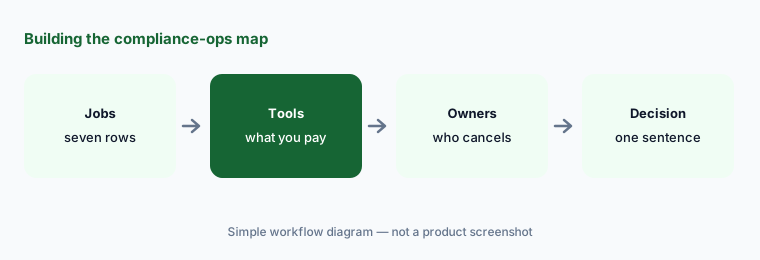
Security and compliance teams add AI one surface at a time: the GRC platform adds questionnaire agents and AI policy drafts, the trust center adds an AI answer box, the questionnaire or RFP tool rebuilds around an agentic engine, the vendor risk tool reads SOC 2 reports, a discovery tool flags shadow AI apps, the security automation platform adds AI agents, and everyone already has a chat assistant. A year later, three tools draft the same answer from three copies of your library. This how-to builds one table — Job | Tool | Owner | Cost/mo | Overlap | Decision — for seven jobs where overlap is common: GRC platform, trust center, questionnaires, vendor risk, SaaS discovery, security automation, and the chat assistant.
It is an inventory, not a ranking. Fill Cost/mo from your own invoices, write overlaps in plain sentences, and add who approves: every questionnaire answer that leaves the company, every vendor decision, every control status change, every Trust Center document, and every automated account or containment action. AI drafts and suggests; a named person approves. No tool makes a company compliant — auditors attest — and no secrets or customer data go into a general chat tool.
How to inventory compliance-ops AI seats
Examples at a glance: each feature has a concrete example from a real job plus a short Try this you can run this week.
1. Build the blank table (primary)
What it is: Start with seven rows and six columns. Leave cells blank until you have a source: an admin console seat list, an invoice, or the person who uses the tool. The seven jobs: GRC platform (Vanta, Drata, Secureframe, Sprinto, Hyperproof, or an enterprise platform such as AuditBoard or OneTrust), trust center (often inside the GRC platform or the questionnaire tool), questionnaires and RFPs (Conveyor, Loopio, Responsive), vendor risk (Whistic, UpGuard), SaaS discovery (Nudge Security, Zluri), security automation (Tines, Torq), and the chat assistant (Claude, ChatGPT, or Gemini seats used for questionnaires and policies — see ChatGPT for security ops, Claude for security ops, and Gemini for security ops).
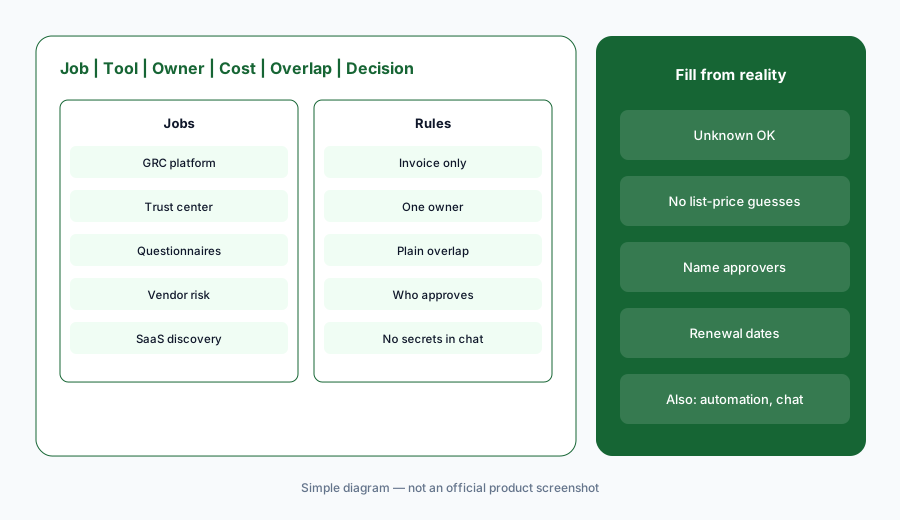
Primary workflow:
Build Job | Tool | Owner | Cost/mo | Overlap | Decision blank for: GRC platform, trust center, questionnaires, vendor risk, SaaS discovery, security automation, chat assistant.
2. Owners and Cost/mo from invoices
What it is: For each tool, write one owner — the person who can cancel it — and the monthly cost from the invoice, PO, or card statement. If you can’t find it, write "Unknown — check bill". Don’t fill costs from list prices: most tools in this stack publish no prices at all and quote every deal, some list only a free tier or a starting price, and pricing units vary — frameworks, employees, questionnaires, usage credits, vendors monitored, workflows, or seats. Our dated reviews note what each vendor published on 10 October 2026 — Drata, Secureframe, Conveyor, Whistic, Nudge Security, Tines, Torq — but contract prices differ from list prices.
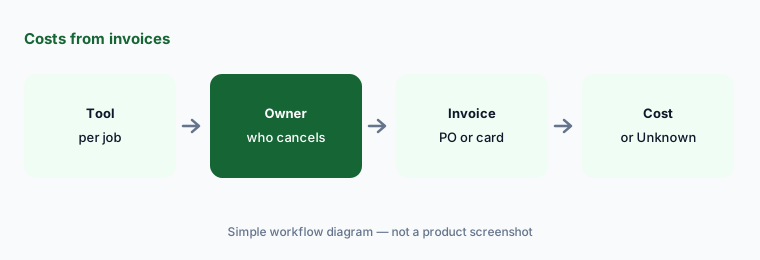
Costs from invoices only:
For each of the seven jobs, name the owner and Cost/mo from invoices only. If missing, write Unknown — check bill. Do not invent prices, framework counts, or seat numbers.
3. Mark overlaps in plain language
What it is: For each row with two or more tools, write one sentence about what both do — for example, "The GRC platform’s questionnaire AI and our questionnaire tool both draft security answers from separate libraries." Common overlaps: two trust centers; questionnaire drafting in the GRC platform, the questionnaire tool, and a chat assistant; vendor reviews in both the GRC platform’s third-party risk module and a vendor risk tool; shadow-AI discovery in both a SaaS discovery tool and the identity or GRC platform; and alert summaries written by both the security automation platform and a chat assistant.
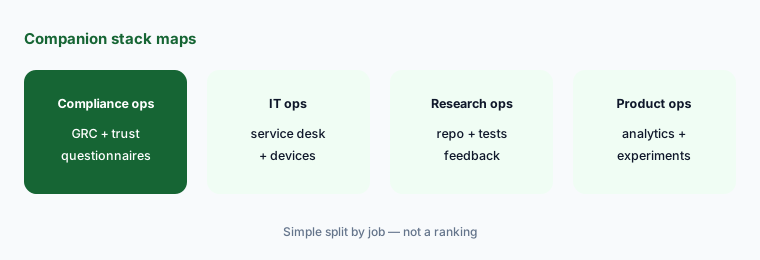
One sentence per overlap:
For each row with two or more tools, write one plain sentence about what both do on that job. No labels or rankings. Flag any job with no paid AI as blank.
4. Add who approves answers, vendors, and actions
What it is: Add two short columns for tools that can act: Who approves (questionnaire answers that leave the company, Trust Center documents and access, vendor decisions, control status changes, policy publishing, and automated account or containment actions) and Data rules (no secrets, customer data, or NDA audit reports in general chat; which MCP connections or API keys can write; where downloaded evidence may go). If a tool can send, publish, approve, or act on its own, write whether that setting is on, its scope, and who approved it.
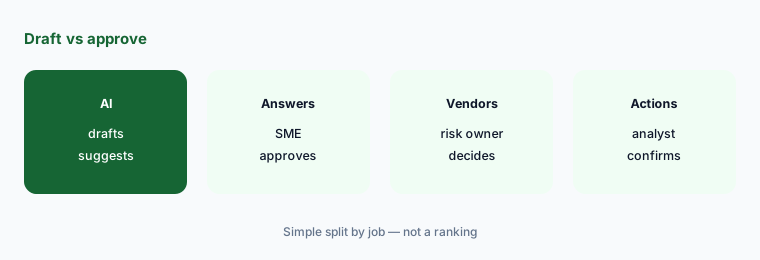
Name who approves:
For every tool that can send an answer, publish a document, decide on a vendor, change a control, or act on an account, add Who approves and Data rules columns. Write whether any automatic action is on.
5. Write a Decision in one sentence
What it is: For each overlap row, write a Decision in one sentence: keep both (and why they do different jobs), consolidate onto one tool, or pause one for 30 days. Name who owns the follow-up and the date. Don’t use labels or rankings. If a contract is annual, write the renewal date so the decision happens before it renews — compliance contracts often renew right after an audit, when nobody is looking.
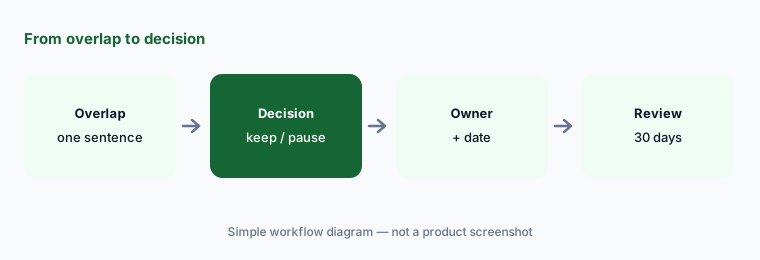
One sentence, one owner:
For the questionnaires and chat assistant rows only, write a Decision in one sentence each (keep both, consolidate, or pause). Name who owns the follow-up date and note any renewal date.
6. Run a 30-day check
What it is: After 30 days, check each paused or consolidated tool: did anyone ask for it back, did any compliance or security job stop getting done, and did approvals still happen where they should? Update the table and keep it next to your audit calendar. For September vendor changes, see What’s new in Tines (Sep 2026) and What’s new in Conveyor (Sep 2026).
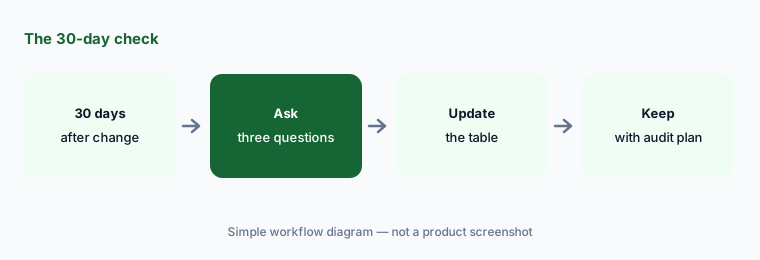
Check after 30 days:
Thirty days after a pause or consolidation, ask the owners three questions: did anyone ask for the tool back, did any compliance or security job stop getting done, and did approvals still happen. Update the table.
Pricing context (October 2026)
This how-to is dated 10 October 2026 and is not a price sheet. Compliance and security tools price by framework, employee count, usage, vendors monitored, workflows, or quote, and most publish no prices at all. Our dated reviews record what each vendor listed when we checked in October 2026: Vanta, Drata, Secureframe, Sprinto, Conveyor, Loopio, Whistic, UpGuard, Nudge Security, Tines, and Torq. Fill Cost/mo from your invoices.
Optional structured help: $9 toolkit spreadsheet or $19 toolkit audit.
Uncertainty: Plan names, AI add-ons, usage credits, and bundled pricing change often, and most vendors in this stack quote every deal. Which features count as AI, and which are on by default, differs by vendor and contract. Always verify on the vendor's live page and your bill before budgeting. This is product education, not legal, audit, or security advice for your environment.
When it’s useful (honest take)
Useful when security, compliance, or sales engineering pays for more than one AI surface and you suspect several tools draft the same answers or review the same vendors.
Useful when you need to show an auditor or your leadership who approves every AI-drafted answer, vendor decision, and automated action.
Less useful when you have one GRC platform, one questionnaire flow, and one chat habit with clear jobs. Soft $19/$9 only if overlaps are real.
Comparing several AI tools for the same job? The $9 AI toolkit spreadsheet puts each one you pay for on one page with cost, usage, and payback, so overlaps are easy to spot.
Want someone to do it for you? AI toolkit audit — $19
Related options (educational)
| Need | Better home | Why |
|---|---|---|
| Inventory seats by compliance-ops job | This stack map | Jobs · tools · owners · overlaps · decision |
| IT inventory | Stack map for IT ops | Same table pattern, different jobs |
| September vendor notes | Tines · Conveyor | Dated changes |
| GRC platforms side by side | Vanta vs Drata · Secureframe vs Sprinto | Not a ranking |
| Questionnaire tools and security automation | Loopio vs Responsive · Tines vs Torq | Library model; builder style |
FAQ
What is a compliance-ops stack map?
One table that lists each compliance and security job (GRC platform, trust center, questionnaires, vendor risk, SaaS discovery, security automation, chat assistant), the tool that does it, its owner, its monthly cost from your invoices, overlaps with other tools, and a one-sentence decision.
Which jobs should we inventory first?
Questionnaires and the chat assistant, then the trust center. They overlap most often, because GRC platforms, questionnaire tools, and chat assistants can all draft the same answers from different copies of your library.
Should we use list prices for Cost/mo?
No. Use invoices, POs, or card statements. Most compliance and security tools are quote-only or bundle AI into a platform deal, and contract prices differ. Write Unknown — check bill when you can’t find it.
Why add who approves?
Because several tools can now send answers, approve Trust Center access, publish documents, or act on accounts. A named person should approve those actions, and tools collect evidence — auditors, not tools, attest.
When do the $9 / $19 toolkit offers help?
Only when overlaps are real and you want a structured sheet ($9 spreadsheet) or a second pair of eyes on the table ($19 audit).
Optional next step (if seats overlap)
If security and compliance already pay for overlapping AI across the GRC platform, trust center, questionnaire tool, vendor risk, and chat, map that before you buy another assistant. Map the overlap with the $19 AI toolkit audit or the $9 AI toolkit spreadsheet. Email Audit $19 or Toolkit spreadsheet $9.
Checkout is live via Stripe. After you pay, we email delivery (spreadsheet) or intake next steps (audit).