Compare · Insurance ops · Oct 2026
Tractable vs CCC (Oct 2026): AI photo estimating for auto claims from a specialist vs the claims network incumbent
Tractable and CCC both turn photos of a damaged car into a repair estimate. Tractable is a specialist whose AI plugs into the claims and estimating systems an insurer already uses. CCC runs the claims and repair network many US auto insurers and body shops already work in, and builds its AI estimating into it. In both, the claims supervisor owns the rules for anything that goes straight through. This page splits them by job and sign-off. It is not a ranking, and each section has a Try this.
What this comparison covers
This page is for auto physical damage claims leaders, appraisal managers, and claims supervisors at insurers weighing photo-based estimating, and for those already on CCC wondering what a specialist adds. The question it answers: what each one does with damage photos, what can go straight through without an appraiser, and who owns those rules.
Facts come from our Tractable AI and CCC AI reviews, both checked against the vendors’ own pages on 18 October 2026: Tractable’s insurer page, home page, LumaScanner site and June 2026 launch event page; and CCC’s claims estimating and claims management pages, its help-site guide to Estimate – STP settings, its AI page, and its 15 October 2026 acquisition announcement. Neither publishes prices.
The structural difference matters more than any one feature. CCC’s estimating sits inside the network its insurer and repairer customers already use to send and approve estimates. Tractable sells AI that connects to whatever estimating and claims systems you run, which can include CCC’s. Many insurers will compare a specialist’s accuracy with the convenience of staying inside one network.
Ground rules for either: a staff appraiser checks AI estimates against final repair bills before any go live; the claims supervisor owns every straight-through and automatic-settlement rule; the total-loss team lead approves early total-loss routing; and a subrogation specialist approves every contention or demand response. Vendor figures are their claims, not our measurement. This comparison is not a ranking, and it is not coverage, claims, or legal advice.
| Question | Tractable (specialist) | CCC Intelligent Solutions (claims network) |
|---|---|---|
| Published price | None on pages read; quote only | None; quote only (pricing URL returns page not found) |
| Photo estimates | AI-verified estimates and estimate pre-fill, by desktop or API into your systems | CCC Intelligent Estimating: line-level estimates “in seconds” inside the CCC network |
| Straight-through settings | Certainty level per estimate; Claim Review (70% of claims reviewed without human involvement, vendor figure) | Estimate – STP: eligible states, post-check bands, part thresholds 70–99%, change log |
| FNOL triage | Instant Claim Classification: total loss, repairable, or cash settlement | CCC First Look: repairable vs total loss, point of impact, routing by your rules |
| Repair side | LumaScanner drive-through scans; Instant Quote for UK repairers (June 2026) | Mobile Jumpstart 2.0 for shops on CCC ONE; repairers set their own thresholds |
| Ownership news | None found on pages read | Agreement to be acquired by a GTCR-led group (15 Oct 2026); close expected Q1 2027 |
| Who signs off | Staff appraiser for estimates; claims supervisor for any automatic settlement rule | Claims supervisor for every Estimate – STP rule; appraiser for preliminary estimates |
Major features (with how someone uses them)
Examples at a glance: each feature has a concrete example from a real job plus a short Try this you can run this week.
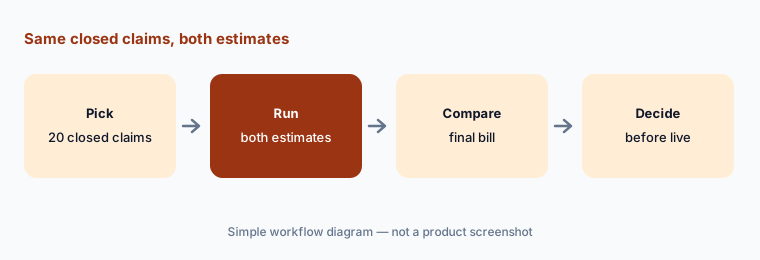
1. Send the same twenty closed claims through both (primary)
What it is: The fairest test uses claims where you already know the answer. Tractable pre-fills repair estimates from photos with what it calls AI-verified accuracy (Tractable AI); CCC Intelligent Estimating produces line-level estimates from photos under your rules, either for an appraiser to complete or ready for automatic approval (CCC AI). Closed claims come with a final repair bill, which is the only number that settles which estimate was closer.
A demo on the vendor’s photos proves little. Twenty of your own closed claims, with hidden damage, supplements, and a final bill, show where each AI lands and what it misses.
Primary workflow:
Send the same twenty closed claims through both estimates. Have a staff appraiser compare each against the final repair bill before either touches a live claim.
2. Photo estimates: specialist AI vs estimating inside the network
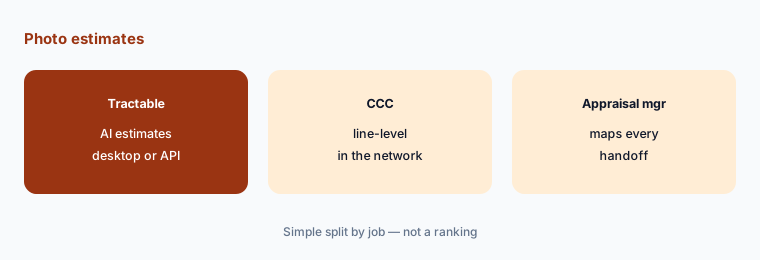
What it is: Tractable’s insurer page describes AI-verified estimates and pre-filled repair cost estimates delivered by desktop tools or API, and cites a 50% cut in estimate writing time. CCC’s claims estimating page describes line-level estimates “in seconds” on qualified repairable vehicles, predicting repair or replace, labour, and blend under the insurer’s rules, with “up to 80% or more” of estimate lines aligned to them (its figure).
Where the estimate lands matters as much as how good it is. A CCC estimate is already in the network the shop uses; a Tractable estimate has to reach your estimating system, which may itself be CCC.
Map the handoff:
Have the appraisal manager draw how an AI estimate reaches the repair shop with each vendor. Ask both to demo every handoff and who can edit at each step.
3. Straight-through rules: who decides what skips an appraiser
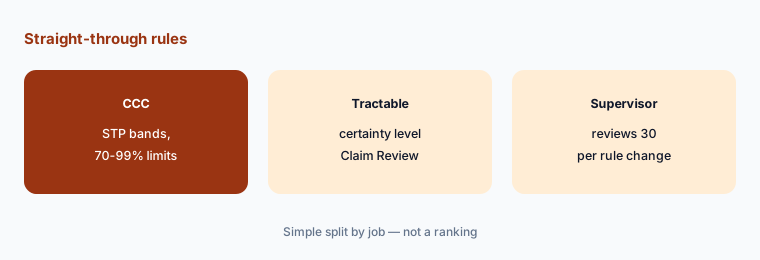
What it is: CCC’s help-site guide shows the settings behind automatic approval (it calls them Estimate – STP): eligible states, post-check bands that send estimates to auto-release, manual review, or exclusion, part-level AI damage thresholds set between 70% and 99%, and a change log of who changed what. Tractable gives each estimate a certainty level based on visibility, image quality, and damage severity (home page), and says its Claim Review product reviews 70% of claims without human involvement (its figure).
Each setting is a decision to pay without an appraiser looking. Whoever owns the rule should see a sample of what it would have released before it changes.
Supervisor owns the rule:
Before changing any straight-through setting in either tool, have the claims supervisor review thirty estimates it would have released. Change the rule only after a staff appraiser has checked them.
4. FNOL triage: total loss, repairable, or cash settlement
What it is: Tractable’s Instant Claim Classification sorts a claim at first notice of loss into total loss, repairable, or cash settlement from customer photos, and it cites an 8-day cut in cycle time with FNOL Triage (insurer page). CCC First Look brings photos in from a camera roll, app, tow or salvage provider, or repair facility, predicts repairable vs total loss and the primary point of impact, and routes by the insurer’s rules; CCC cites a ~40% lift in total-loss identifications when early tow photos arrive (claims management).
An early total-loss call moves a car to salvage and a customer into a settlement conversation. A wrong call either way is costly and hard to undo.
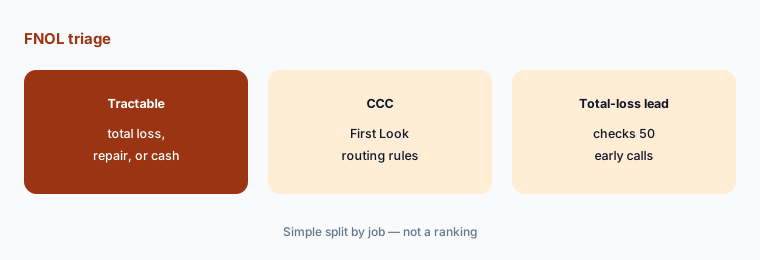
Check early calls:
Have the total-loss team lead run fifty past claims through each trial’s FNOL triage. Compare every early total-loss call with the final outcome before routing changes.
5. The repair side: drive-through scans vs Mobile Jumpstart
What it is: Tractable launched LumaScanner, a drive-through arch that captures every panel and prices damage, at a Birmingham event on 2–3 June 2026, alongside an Instant Quote tool for UK repairers (its UK page calls it AI Instant Estimate). CCC’s Mobile Jumpstart 2.0 guides a shop’s photo capture and starts the estimate in CCC ONE; in its 13 August 2026 release CCC said it captures on average 84% of the final repair bill in 70 seconds, and its AI page says repairers set their own confidence thresholds and human estimators approve final estimates.
These tools mostly serve shops and dealers, not insurers directly. They matter to a carrier because the shop’s first estimate shapes what the insurer is asked to pay.
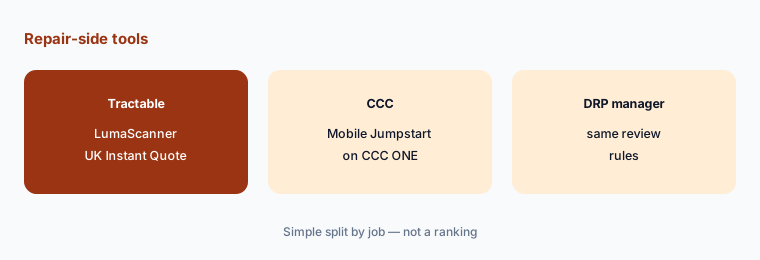
Same rules for every start:
Have the direct repair program manager ask partner shops which AI tool started each estimate. Keep the same review rules whichever tool they used.
6. Subrogation, roadmaps, and CCC’s pending sale
What it is: Both automate subrogation work: Tractable reviews inbound subrogation packets and cites a 50% cut in the time to write a contention report (insurer page); CCC’s subrogation tools review inbound demands with configurable audit rules and look for outbound recovery opportunities. On 15 October 2026 CCC agreed to be acquired by a GTCR-led group including Elliott at an enterprise value of about $6.1 billion, expected to close in the first quarter of 2027, and says it stays public and independent until then.
A pending sale rarely changes a product overnight, but it can affect renewal terms and roadmaps. A contention report goes to another insurer, so a specialist should stand behind every disputed line either way.
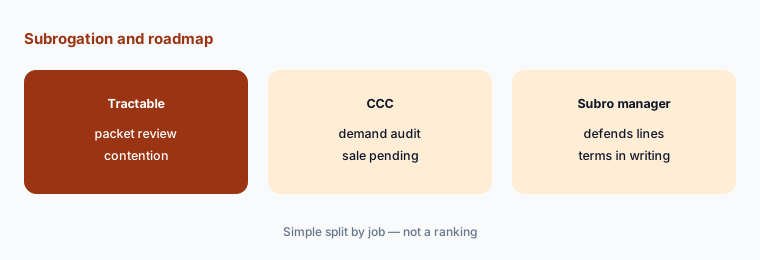
Defend every line:
Have a subrogation specialist review ten contention reports from each tool before any is sent. Ask CCC for written renewal commitments given its pending sale.
Pricing context (October 2026)
Neither vendor publishes prices. Tractable shows no prices on the pages we read (its UK repairer product uses an order form), and CCC’s pricing URL returns “page not found”. Both are quote-only as of 18 Oct 2026.
Ask each whether AI estimating is priced per estimate, per claim, or within an existing subscription; whether straight-through processing, FNOL triage, and subrogation are separate; what integration with your estimating system costs (for Tractable); and, for CCC, how the pending sale may affect renewal terms.
Uncertainty: We read both vendors’ own pages; Tractable’s site sometimes blocks simple downloads, so earlier reads used a page reader. The name Estimate – STP appears on CCC’s help site rather than its current marketing page. Tractable’s LumaScanner install times differ across its pages, and its repairer product has two names. CCC’s acquisition is pending and may not close as planned. Vendor figures are their claims. We did not test either tool ourselves.
When it’s useful (honest take)
Useful when you handle enough auto physical damage claims for photo estimating to matter, you can test both on closed claims with final bills, and a named claims supervisor will own every straight-through rule.
Less useful when your gap is policyholder messaging during the claim (see Hi Marley AI), fraud signals across claims (see FRISS AI), or a full claims system with AI built in (see Five Sigma AI).
Still choosing between Tractable and CCC? The $19 AI toolkit audit gives you a written plan for which tools to keep using and which to drop across your whole AI stack, including this pair.
Prefer to do it yourself? Spreadsheet — $9
Related options (educational)
| Need | Better home | Why |
|---|---|---|
| Specialist photo estimating, triage, and claim review | Tractable AI | Quote only |
| Estimating, First Look, and STP inside the CCC network | CCC AI | Quote only; acquisition pending |
| Policyholder texting during the claim, with CCC as a Unite partner | Hi Marley AI | Quote only |
| Fraud and risk signals across claims | FRISS AI | Quote only |
| Voice FNOL inside the core claims system | Guidewire AI or Duck Creek AI | Quote only; early or restricted access |
FAQ
What is the main difference between Tractable and CCC?
Tractable is a specialist whose photo estimating connects to the systems an insurer already uses. CCC builds AI estimating into the claims and repair network many insurers and shops already work in. This is not a ranking.
Can either approve an estimate without an appraiser?
Both support automatic paths if the insurer allows them: CCC through Estimate – STP settings, Tractable through its certainty levels and Claim Review. The claims supervisor should own every rule and review samples before changes.
Which handles total-loss calls at FNOL?
Both. Tractable’s Instant Claim Classification and CCC First Look each predict total loss or repairable from early photos. Test both on past claims with known outcomes.
How much do Tractable and CCC cost in October 2026?
Neither publishes prices. Both are quote-only (checked 18 Oct 2026).
Does CCC’s pending sale matter?
CCC agreed on 15 October 2026 to be acquired by a GTCR-led group, expected to close in the first quarter of 2027. It says it stays independent until then. Ask for renewal commitments in writing.
Optional next step (if seats overlap)
If your claims team pays for an estimating network, a specialist AI add-on, a texting platform, and chat seats that all touch the same auto claims, that overlap is worth mapping. Map the overlap with the $19 AI toolkit audit or the $9 AI toolkit spreadsheet. Email Audit $19 or Toolkit spreadsheet $9.
Checkout is live via Stripe. After you pay, we email delivery (spreadsheet) or intake next steps (audit).