Tool · Insurance ops · Federato · Oct 2026
Federato AI review (Oct 2026): RiskOps underwriting workbench, appetite and portfolio guardrails, and Control Tower for P&C carriers
Federato started as what it called a RiskOps platform: an underwriting workspace that sorts incoming submissions by appetite, portfolio strategy, and how likely they are to be won. It has since grown into what its site now calls an “AI-native core” for carriers and MGAs, with policy administration, billing, and claims (since August 2026). This page covers the underwriting side most teams buy it for: triage, Control Tower guardrails, drafted quotes, and building your own AI workflows, plus who must check each one. Each section has a Try this.
What this Federato page covers
This page is for chief underwriting officers, underwriting managers, underwriters, and underwriting operations leads at commercial P&C carriers and MGAs. Agencies don’t buy Federato; they see it in how quickly a carrier answers a submission. The question this page answers: what Federato’s AI does with a submission, where portfolio strategy enters each decision, what the newer core-system pieces add, and which person signs off.
Sources are Federato’s own pages, read on 18 October 2026: its platform overview, the Control Tower page and launch post (13 October 2025), the Submission Triage and Orchestrate post (29 April 2025), the policy administration page, the Product Studio page, and the Federato Claims post (4 August 2026). Federato has no public newsroom or pricing page; its dated posts sit under its articles section.
A note on what Federato is now. The “RiskOps underwriting workbench” label fits how it began and how many carriers still use it. Today its site leads with being a full core system, the “only AI-native core” in its words, so a buyer may be pitched a policy administration replacement, not only an underwriting layer. Decide which one you are shopping for before the first demo.
Ground rules: the underwriting manager approves every objective and control before it can clear, refer, or decline anything; an underwriter approves every drafted quote before it reaches a broker; nobody pastes broker submissions into an outside chat tool; and Federato’s results figures are its customers’ and its own claims, not our measurement. This page explains features. It is not coverage, underwriting, or legal advice.

Major features (with how someone uses them)
Examples at a glance: each feature has a concrete example from a real job plus a short Try this you can run this week.
1. Submission triage and the prioritised workbench (primary)
What it is: Federato made Submission Triage generally available on 29 April 2025. It uses a series of AI agents that read the whole submission (the email, SOVs, loss runs, and other documents together, not one file at a time) and put the most in-appetite, winnable deals in front of underwriters within seconds of arrival. Its Control Tower page says each submission is ranked by fit, goals, winnability, and urgency, so the queue is no longer first in, first out. Federato quotes early customers at 89% less time to quote, 2.8 times as many high-appetite submissions quoted, and 3.7 times as much high-appetite business bound — vendor figures, not ours.
A ranked queue decides what gets worked and what waits. If the ranking leans on an old appetite or misreads a class, good submissions sit at the bottom and brokers notice the silence.
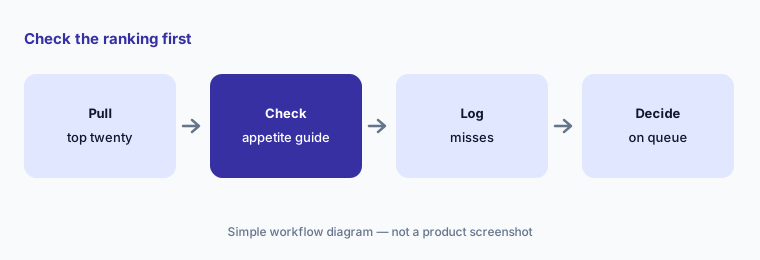
Primary workflow:
Pick twenty submissions Federato ranked highest last month. Have the underwriting manager check each against your written appetite guide before the ranking changes who works what.
2. Control Tower: objectives, controls, and insights
What it is: Federato launched Control Tower on 13 October 2025 as an upgrade to its platform. It has three parts. Objectives put portfolio goals into the system (Federato’s example is “a 6% average rate increase across a business line”) and show each submission’s likely effect on them. Controls are submission-level guardrails: Federato says they clear in-appetite risks, flag referrals, and decline out-of-appetite submissions as they arrive. Insights show how the team and its AI agents are tracking against objectives and can produce reports for auditors, reinsurers, and capital partners. Federato says you can upload existing guidance and strategy documents to generate first-draft objectives and controls.
An automatic decline is the carrier saying no to a broker. A control generated from an old strategy document will turn away business the team now wants, so every control needs a named owner and a test before it goes live.
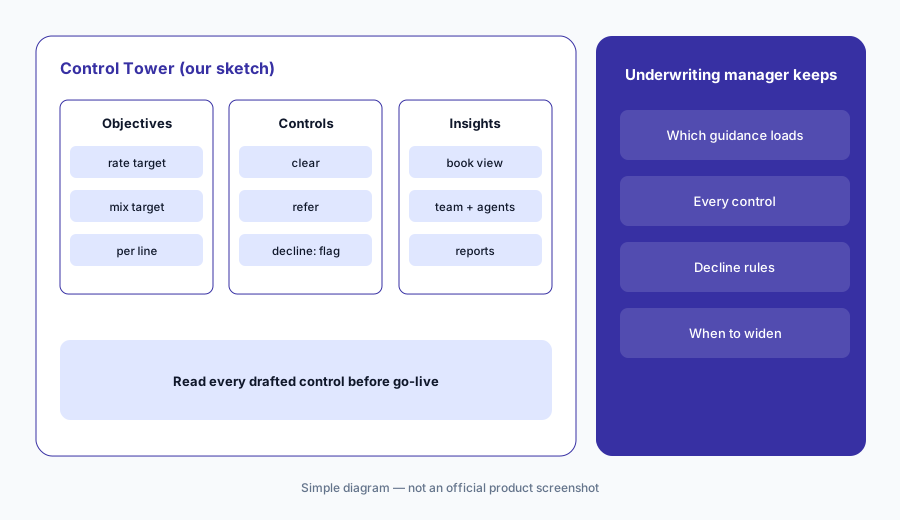
Own every control:
Have the underwriting manager read every control Control Tower drafted from your guidance. Set automatic declines to flag-only for one month and review each flagged submission before allowing any automatic decline.
3. Drafted quotes for underwriter approval
What it is: Federato’s policy administration page says its AI ingests and triages submissions against eligibility, appetite, and pricing criteria, then “produces a first-draft quote within minutes for the best-fit deals”. The Control Tower post describes a multi-agent system that can “prepare entire quotes for underwriter approval”, and Federato’s 9 October 2025 post says every quote includes an explanation of its reasoning.
A complete-looking quote is easy to approve without reading. The underwriter is still the one putting the carrier’s name on the terms, so the reasoning has to be checked, not skimmed.
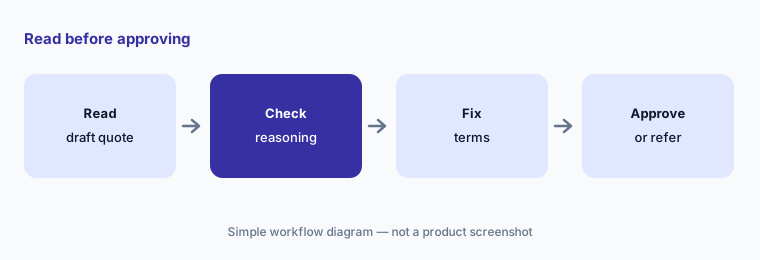
Read the reasoning:
Have a senior underwriter review ten Federato draft quotes line by line, including the stated reasoning. Record every change made before approving any drafted quote without a full read.
4. Orchestrate: building your own AI workflows
What it is: Orchestrate (generally available 29 April 2025) lets an insurer’s IT team describe a workflow in plain language and have it assembled from small AI sub-agents for jobs like document classification, extraction, and summarising. Federato says early users built workflows that draft notices and emails to brokers, find submissions that need extra attention under the guidelines, and summarise recent news about an insured. It runs in Federato’s single-tenant setup, with logging and control over which models see which data.
A workflow built in an afternoon can send broker emails by evening. Each new workflow needs an owner, a test set, and a rule for what it may send without a person.
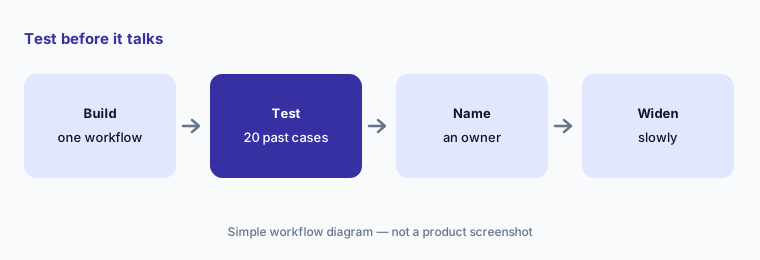
Test before it talks to brokers:
Build one Orchestrate workflow and run it on twenty past cases. Have the underwriting operations lead check every output and name an owner before anything it drafts reaches a broker.
5. The AI-native core: policy administration, billing, and Product Studio
What it is: Beyond underwriting, Federato’s platform now covers policy administration (from submission and quoting through servicing and renewals on one policy record, with out-of-sequence endorsements reconciled and premium recalculated), billing and payments, Product Studio (pricing, forms, and eligibility defined together with versioned rules), and partner portals. On 29 September 2026 Federato signed an agreement with Verisk to bring Verisk’s ISO electronic content (loss costs, rules, and forms logic) into the platform. Its FAQ says a first implementation “typically takes 12-16 weeks”, with about 8 weeks for each further line.
Replacing a policy system is a much bigger decision than adding a triage tool. The AI is the same; the project, the data migration, and the risk are not.
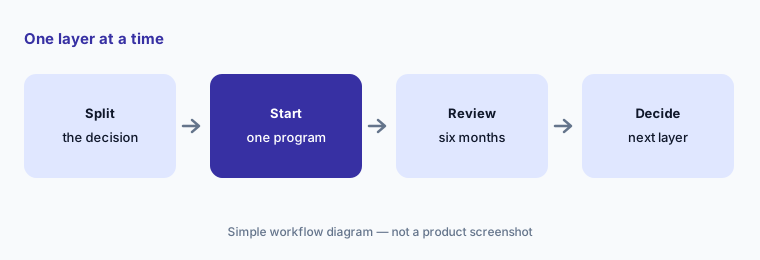
Decide one layer at a time:
List which Federato modules you are being pitched. Have the operations lead decide whether you need the underwriting layer, the full core, or both, and get each priced separately in writing.
6. Federato Claims and the loop back to underwriting
What it is: Federato Claims (introduced 4 August 2026) runs claims on the same platform as underwriting, policy administration, and billing. Federato says that when an adjuster makes a coverage call, the system records the specific policy clause and the reasoning, structures reserve changes with their context, and feeds claims data back into pricing and appetite while a claim is still open.
A coverage position is a licensed adjuster’s decision, whatever the system records. Feeding claim signals back into appetite is useful, but an underwriting manager should decide when a pattern becomes a rule.
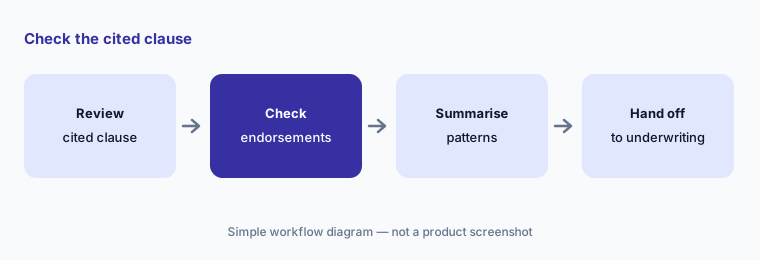
Check the cited clause:
Pick twenty coverage decisions recorded in Federato Claims. Have the claims supervisor check each cited clause against the full policy, including endorsements, before any claim pattern feeds appetite.
Pricing context (October 2026)
Federato does not publish prices; its pricing address sends you to the home page. Pricing is quote-only as of 18 Oct 2026. Ask whether you are buying the underwriting layer, the full core, or modules, how users or premium are counted, whether Orchestrate workflows and AI model use cost extra, and what the 12–16 week first implementation includes.
Federato’s site cites customer results such as a 50% higher hit ratio, 5.5 times more high-appetite bound business, and 90% of referrals automated. These are vendor figures, not our measurement. Federato raised a $100 million Series D in November 2025.
Uncertainty: We read Federato’s own pages only; it has no public newsroom or pricing page. Its positioning moved from a RiskOps underwriting platform to an AI-native core system, so what a sales team proposes may be larger than this page’s underwriting focus. Control Tower is described in a 2025 launch post; we found no separate availability label for it or for Federato Claims (August 2026). Results figures are vendor and customer claims. We could not confirm prices, and we did not test Federato ourselves.
When it’s useful (honest take)
Useful when you are a P&C carrier or MGA with heavy submission volume, a written appetite guide and portfolio targets that are kept current, an underwriting manager who will own every control, and the appetite for either an underwriting layer or a larger core-system project.
Less useful when you are an agency (see Applied Epic AI or Vertafore AI), you only want recommendations on top of your current workbench (see Sixfold AI or Kalepa AI), or your core vendor’s own agents already cover intake (see Guidewire AI or Duck Creek AI).
Paying for Federato AI and a few other AI tools? The $9 AI toolkit spreadsheet lists every AI subscription you have, what each one costs, and how fast it pays for itself, so you can see which ones are worth the money.
Want someone to do it for you? AI toolkit audit — $19
Related options (educational)
| Need | Better home | Why |
|---|---|---|
| Triage, portfolio guardrails, drafted quotes, optional full core | Federato AI (this page) | Quote only |
| Recommendations with rationale and citations per submission | Sixfold AI | Quote only |
| Intake, clearance, research, and quote support | Kalepa AI | Quote only |
| Pricing models built and governed by actuaries | hyperexponential AI | Quote only |
| Agents inside an existing carrier core suite | Guidewire AI or Duck Creek AI | Quote only; several items early or restricted access |
FAQ
What is Federato?
An AI platform for P&C carriers and MGAs. It began as a RiskOps underwriting platform that triages submissions against appetite and portfolio strategy, and now also offers policy administration, billing, Product Studio, and claims as what it calls an AI-native core.
What is Federato Control Tower?
A set of portfolio controls launched 13 October 2025: Objectives for portfolio goals, Controls that clear, refer, or decline submissions, and Insights that track performance and produce reports. It can draft objectives and controls from uploaded guidance.
Does Federato write quotes on its own?
It prepares first-draft quotes with stated reasoning for underwriter approval. An underwriter should read each draft and its reasoning before it goes to a broker.
How much does Federato cost in October 2026?
Federato does not publish prices. Treat it as quote-only and ask for the underwriting layer and any core-system modules to be priced separately.
Who should approve Federato output?
The underwriting manager for every objective and control, an underwriter for every drafted quote and decline, the operations lead for each Orchestrate workflow, and a licensed adjuster or claims supervisor for every coverage decision.
Optional next step (if seats overlap)
If your underwriting team pays for a triage tool, a workbench, a policy system, and chat seats that all touch the same submissions, that overlap is worth mapping. Map the overlap with the $19 AI toolkit audit or the $9 AI toolkit spreadsheet. Email Audit $19 or Toolkit spreadsheet $9.
Checkout is live via Stripe. After you pay, we email delivery (spreadsheet) or intake next steps (audit).