Tool · Insurance ops · Kalepa · Oct 2026
Kalepa AI review (Oct 2026): Copilot submission intake, triage, risk research, and quote-to-bind support for commercial underwriters
Kalepa is an underwriting AI company founded in 2018 that sells to commercial P&C carriers, MGAs, and mutuals. Its earlier posts called the product Copilot; its site now calls it a “Professional Grade AI” platform with seven parts, from submission intake and clearance through triage, risk research, pricing, and quote and bind to portfolio management. This page is about what each part does to a submission and which underwriter must check it. Each section has a Try this.
What this Kalepa page covers
This page is for underwriting leaders, underwriters, and underwriting assistants at commercial carriers and MGAs, especially in E&S and specialty lines where submissions pile up. The question it answers: what Kalepa does between a broker’s email and a bound policy, what it researches on its own, and which person signs off at each step.
Sources are Kalepa’s own pages, read on 18 October 2026: its home page; platform pages for submission ingestion, clearance, triage, risk analysis, quote and bind, and portfolio management; and its newsroom and blog. On naming: the current site never says “Copilot”, but Kalepa’s own older announcements do (for example Bowhead Specialty’s), so treat Copilot as the product’s earlier name.
Customers named in 2026: James River selected Kalepa (10 February 2026) and said it plans to use the platform across E&S underwriting, and Church Mutual selected Kalepa (3 September 2026) for CM Vantage, its E&S carrier. Both releases describe a selection, not a finished rollout, so ask Kalepa for live references in your line. Paragon’s case study (March 2026) reports results after a year of use.
Ground rules: an underwriter approves every quote, bind, and decline; the underwriting manager owns clearance rules, priority targets, and automation limits; nobody pastes broker submissions into an outside chat tool; and Kalepa’s results figures are its customers’ and its own claims, not our measurement. This page explains features. It is not coverage, underwriting, or legal advice.
Major features (with how someone uses them)
Examples at a glance: each feature has a concrete example from a real job plus a short Try this you can run this week.
1. Clearance and risk research on each submission (primary)
What it is: Kalepa’s clearance matches each new submission to existing accounts and policies, flags broker conflicts and the broker of record, runs sanctions screening, and routes it by line, geography, broker, and capacity. Its risk analysis then builds one risk profile from the submission, internal data, and outside sources (Paragon’s team mentions news articles, legal filings, third-party data, and public records) and flags inconsistencies, missing information, adverse media, and regulatory issues. Kalepa says every insight links back to its source.
Research found online can describe the wrong business: a similar name, an old address, a parent company. A fact the underwriter didn’t check can end up shaping the price or a decline.
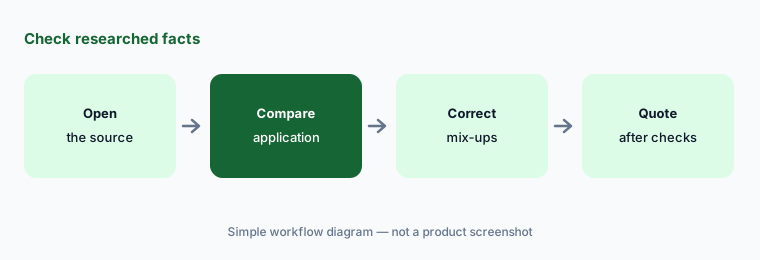
Primary workflow:
Pick ten submissions Copilot cleared and researched last week. Have the underwriter check every business-description fact it found against the application before quoting.
2. Submission ingestion with judging agents and confidence checks
What it is: Kalepa’s submission ingestion takes submissions by email forwarding, portal, or API, classifies the documents (ACORD forms, SOVs, loss runs, supplemental applications, even handwritten notes), and extracts the data “without the need for up-front model training”. Kalepa says each output is checked with document-linked evidence, cross-document consistency checks, and confidence controls. A 4 February 2026 engineering post explains that separate “judging” agents check the extraction agents’ work to set confidence levels.
A confidence level is the system grading its own work. Low-confidence fields should go to a person, and someone should sample the high-confidence ones too.
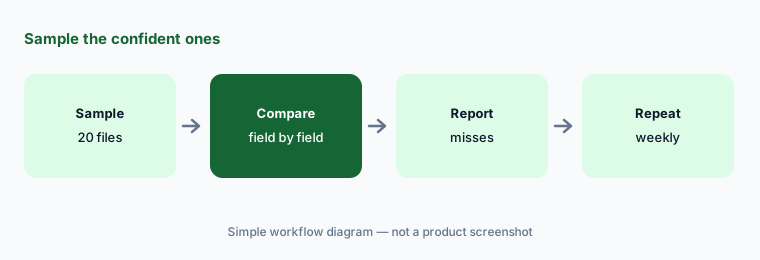
Sample the confident ones:
Have an underwriting assistant compare twenty Kalepa extractions field by field with the source documents, including ten marked high confidence. Log every miss before reducing manual review.
3. Triage: winnability and appetite priority
What it is: Kalepa’s triage uses a reinforcement-learning model trained on historical outcomes and live workflow signals to find the submissions most likely to bind and be profitable. It weighs appetite alignment, guideline compliance, profitability potential, and win probability together and gives each submission one priority. Kalepa says every prioritisation is explainable and auditable, showing which factors drove a submission’s place in the queue, and that portfolio targets (geography, industry, exposure) feed in before a submission reaches a desk.
A model trained on past binds learns past habits, including the brokers and classes the team happened to favour. The underwriting manager should read the factors, not just the order.
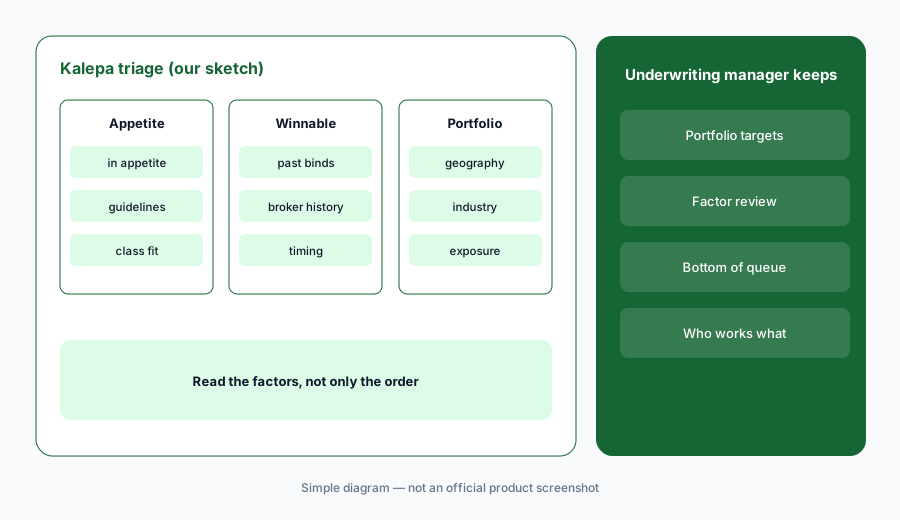
Read the bottom of the queue:
Have the underwriting manager read the factor breakdown for the thirty lowest-priority Kalepa submissions in one week. Fix any portfolio target the model is missing before the queue decides who works what.
4. Pricing and quote-to-bind support
What it is: Kalepa’s pricing step auto-fills inputs from the submission and lets carriers embed their Excel models, connect external engines, or price inside the platform, with version control for different quote scenarios. Its quote and bind page says that once a submission clears triage and analysis, Kalepa can generate a fully populated quote that the underwriter can “review, edit, or send”, apply the right forms and endorsements by coverage, jurisdiction, and risk, and fill binder documents.
“Send” is one click away from “review”. The quote and the binder are the carrier’s commitment, so the underwriter should read the premium inputs and the forms list every time, not only the total.
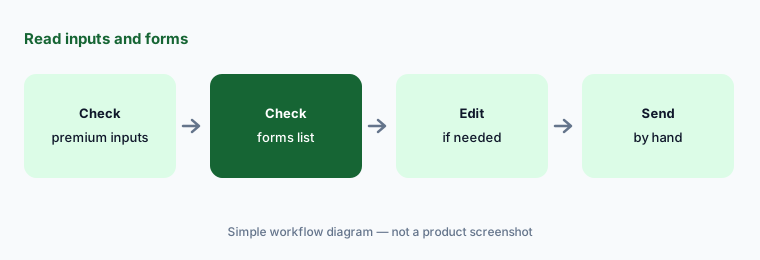
Read inputs and forms:
Have a senior underwriter review ten Kalepa-populated quotes, checking every premium input and the forms list against the submission. Approve each by hand before any quote is sent without a full read.
5. Portfolio management: targets fed into every decision
What it is: Kalepa’s portfolio management gives a live view of the book by geography, industry, peril, and premium, updated as submissions and renewals move. Appetite changes, growth targets, and risk tolerances feed straight into clearance, routing, and triage, and Kalepa says the platform recommends where to expand or tighten appetite and how to adjust distribution.
A recommendation to widen appetite is a portfolio decision with reinsurance and capital consequences. It belongs to underwriting leadership, not to a dashboard.
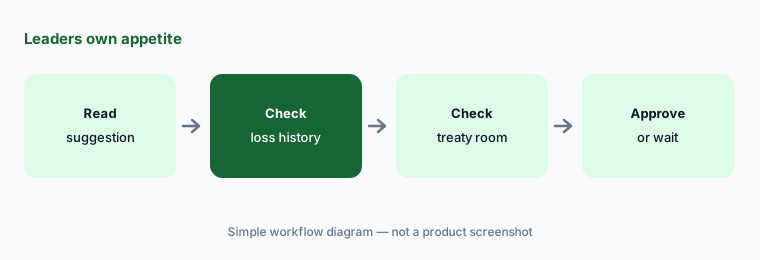
Leaders own appetite:
List every appetite or growth recommendation Kalepa made this quarter. Have the chief underwriting officer check each against loss experience and treaty limits before any target changes.
6. Deciding how much Kalepa does on its own
What it is: Kalepa’s Q3 2026 briefing (1 October 2026) frames AI autonomy as an authority question: agents can gather information, check appetite and duplicates, request missing materials, and draft a quote before a person gets involved, but responsibility for the outcome stays with the insurer. Kalepa’s Church Mutual release describes the same split: AI for intake and back-office work, underwriters for judgment. Clearance rules, routing, and thresholds are configurable.
Without written limits, automation tends to spread one setting at a time. Decide in writing which steps Kalepa may finish alone and which always stop for an underwriter.
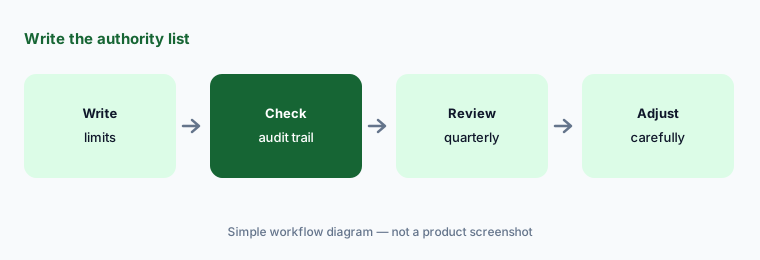
Write the authority list:
Have the underwriting operations lead write which steps Kalepa may complete without a person. Make every decline, quote, and bind require an underwriter, and check the audit trail against the list monthly.
Pricing context (October 2026)
Kalepa does not publish prices; its /pricing address returns “not found”. Pricing is quote-only as of 18 Oct 2026. Ask how it is priced (by underwriter, by submission volume, or by module), which of the seven modules you need, whether outside data sources cost extra, and what it costs to connect your policy system and pricing models.
Kalepa cites results such as a 960 basis-point combined ratio improvement, 30%+ more premium per underwriter, and 58% less quote time. Paragon’s case study quotes its CTO saying extraction is “somewhere around 98 to 99% accurate” and says its quote-to-bind ratio doubled within a year. These are vendor and customer claims, not our measurement.
Uncertainty: We read Kalepa’s own pages only. Its site no longer uses the name Copilot, which appears on older Kalepa posts. James River and Church Mutual announced that they selected Kalepa; neither release says the platform is live in production. Results figures (960 bp, 30%+, 58%, Paragon’s 98–99% and doubled quote-to-bind) are vendor and customer claims. We could not confirm prices, and we did not test Kalepa ourselves.
When it’s useful (honest take)
Useful when you are a commercial carrier or MGA buried in submissions, your appetite and guidelines are written down, you want one platform from intake to bind that works next to your existing policy system, and underwriters will check its research and quotes before trusting it.
Less useful when you mainly need actuarial pricing models (see hyperexponential AI), you want a recommendation engine on top of your current workbench (see Sixfold AI), you are replacing your whole core system (see Federato AI or Guidewire AI), or you are an agency (see Applied vs Vertafore).
Paying for Kalepa AI and a few other AI tools? The $9 AI toolkit spreadsheet lists every AI subscription you have, what each one costs, and how fast it pays for itself, so you can see which ones are worth the money.
Want someone to do it for you? AI toolkit audit — $19
Related options (educational)
| Need | Better home | Why |
|---|---|---|
| Intake, clearance, research, pricing, and quote-to-bind support | Kalepa AI (this page) | Quote only |
| Recommendations with rationale and citations per submission | Sixfold AI | Quote only |
| Triage plus portfolio guardrails, or a full AI-native core | Federato AI | Quote only |
| Actuarial pricing models and governed price changes | hyperexponential AI | Quote only |
| Intake and triage inside a carrier core suite | Duck Creek AI or Guidewire AI | Quote only; several items early or restricted access |
FAQ
What is Kalepa?
An underwriting AI platform for commercial P&C carriers and MGAs, founded in 2018. It covers submission intake, clearance, triage, risk research, pricing, quote and bind, and portfolio management. Its earlier posts called the product Copilot.
Does Kalepa research submissions on its own?
Yes. It adds outside data and public information (news, legal filings, third-party data) to each submission and flags inconsistencies, missing information, and adverse media, with a link to each source. An underwriter should check those facts against the application.
Which insurers use Kalepa?
Kalepa’s own pages name customers including Paragon, Bowhead Specialty, Munich Re Specialty North America, and Canopius. In 2026 James River and Church Mutual (for CM Vantage) announced they selected Kalepa.
How much does Kalepa cost in October 2026?
Kalepa does not publish prices. Treat it as quote-only and ask which modules you need and how volume is counted.
Who should approve Kalepa output?
An underwriter for every quote, bind, and decline and for researched facts; the underwriting manager for clearance rules and priority targets; and the chief underwriting officer for appetite changes.
Optional next step (if seats overlap)
If your underwriting team pays for an intake tool, a workbench, outside data feeds, and chat seats that all read the same submissions, that overlap is worth mapping. Map the overlap with the $19 AI toolkit audit or the $9 AI toolkit spreadsheet. Email Audit $19 or Toolkit spreadsheet $9.
Checkout is live via Stripe. After you pay, we email delivery (spreadsheet) or intake next steps (audit).