Compare · Insurance ops · Oct 2026
Applied vs Vertafore (Oct 2026): Epic Conductor vs Velocity AI agents for independent agencies
Applied and Vertafore make two of the agency management systems many US independent agencies run on, and in 2026 both added AI that does the same back-office jobs: checking issued policies, matching carrier statements, and pulling policy documents into the system. The difference is in shape and timing: Applied built one AI layer, Epic Conductor, into Epic and announced it on 29 September 2026 without a rollout date, while Vertafore ships separate, dated Velocity AI agents inside AMS360 and Sagitta. This page compares those jobs and who signs off — it is not a ranking, and each section has a Try this.
What this comparison covers
This page is for an agency principal, operations manager, account manager, or agency accountant running Applied Epic or Vertafore AMS360 or Sagitta, or choosing between them. The question it answers: for the jobs both vendors now automate, what each one does, how firmly it is available, and which licensed person approves the output.
Facts come from our Applied Epic AI and Vertafore AI reviews, both checked against the vendors’ own releases on 18 October 2026: Applied’s Epic Conductor release (29 September 2026) and submissionless renewals release (8 July 2026), plus the CEO’s 8 October 2026 interview on AI agents; and Vertafore’s Velocity AI release (14 April 2026), Email and Reconciliation release (30 June 2026), Agentic Agency release (23 September 2026), and Policy Intake and Policy Check release (15 October 2026). Neither publishes prices.
Ground rules for either system: the account manager approves every policy correction and carrier request, the agency accountant approves reconciled commissions, the producer approves every quote that reaches a client, nobody pastes client data into an outside chat tool, and vendor time-saved and accuracy figures are their claims, not our measurement. This comparison is not a ranking, and it is not coverage advice. Switching agency management systems is a large project that touches every client record; AI features alone are rarely a reason to do it.
| Question | Applied (Epic + Epic Conductor) | Vertafore (AMS360 / Sagitta + Velocity AI) |
|---|---|---|
| Published price | None; quote only (no edition list or price in the release) | None; quote only (pricing URL returns page not found) |
| How the AI is packaged | Epic Conductor, one AI layer inside Epic (29 Sep 2026), in three areas: operational, financial, Connected Trading | Separate named agents on the Velocity AI Platform (14 Apr 2026) |
| Policy checking | Every policy checked by AI against what was quoted; gaps and missing endorsements flagged | Policy Check Agent: issued policy vs AMS data and source documents; available now in AMS360 (15 Oct 2026) |
| Reconciliation | Direct bill, agency bill, and bank statements matched “with a human in the loop” | Reconciliation Agent: direct bill statements in supported formats, exceptions to a person (30 Jun 2026) |
| Getting documents in | Extraction from dec pages, applications, submissions, written back with an E&O log | Policy Intake Agent: new / changed / missing / conflicting fields for approval; AMS360 now, Sagitta early access |
| Carrier-facing work | One submission workflow, quoting small commercial from email, remarketing from Epic; submissionless renewals via Cytora | Submission Processing and Portal Launcher in Surefyre (14 Apr 2026 plan) |
| Availability stated | No rollout date or edition list; agents with a small customer group (CEO, Oct 2026) | Dated per agent; Coach “early fall”, Document Intelligence “scheduled for September 2026” |
| Who signs off | Account manager for policy checks and changes; agency accountant for reconciliation; producer for quotes | Same roles; the vendor says the user approves each proposed update |
Major features (with how someone uses them)
Examples at a glance: each feature has a concrete example from a real job plus a short Try this you can run this week.
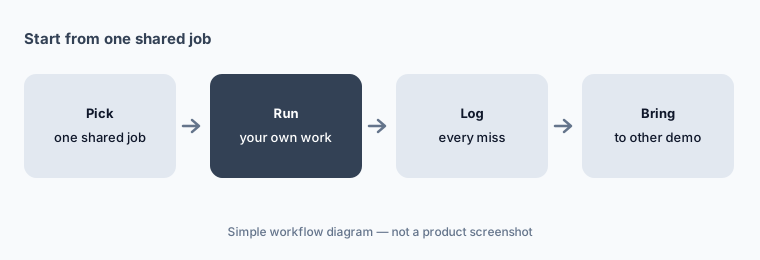
1. Start from one job both offer (primary)
What it is: Before comparing feature lists, pick one job both vendors now automate — policy checking or direct bill reconciliation are the clearest — and run it on your own work in the system you already have. Write down every miss: a flag that wasn’t real, a gap it didn’t catch, a line it matched wrongly. That list is far more useful in the other vendor’s demo than a slide of features.
Both vendors describe a person approving the result. The test is how many corrections that person has to make, on your carriers and your lines.
One job, real work:
Pick one job both offer — policy checking or direct bill reconciliation. Have the agency operations manager run the same ten policies or one statement through whichever system you have, write down every miss, and bring that list to the other vendor's demo.
2. Policy checking: Epic’s AI check vs the Policy Check Agent
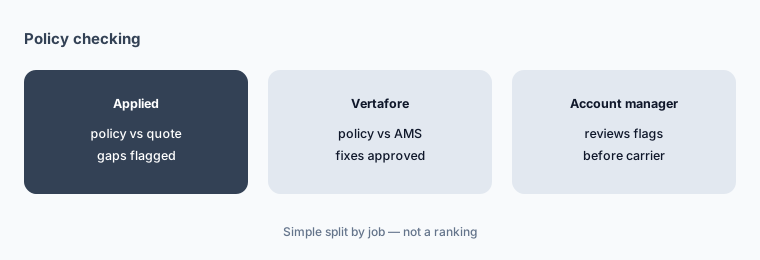
What it is: Applied says Epic Conductor checks “every policy” against what was quoted and flags coverage gaps and missing endorsements (Applied Epic AI). Vertafore’s Policy Check Agent compares the issued policy with AMS360 data and source documents, recommends corrections for the user to approve, then applies approved fixes and records the review; it is available now in AMS360 (Vertafore AI, 15 October 2026). Vertafore cites up to 90% less checking time per line in early testing.
The two check against different things: Applied against the quote the client accepted, Vertafore against what is in the AMS and the source documents. Ask each which comparison it makes on your lines.
Ask what it compares against:
Ask Applied and Vertafore what their policy check compares the issued policy against. Have the account manager review every flag in a ten-policy trial before anyone contacts a carrier.
3. Carrier statements: Epic financial automation vs the Reconciliation Agent
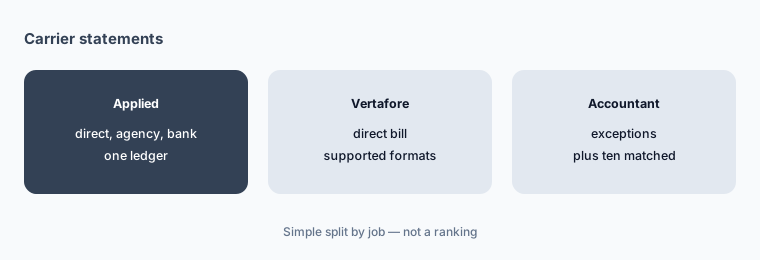
What it is: Applied’s Epic Conductor ingests direct bill, agency bill, and bank statements and matches them against Epic “with a human in the loop”, inside one ledger that runs from invoicing to general-ledger close (Applied Epic AI). Vertafore’s Reconciliation Agent (30 June 2026) matches direct bill carrier statements in supported formats against AMS360 and sends exceptions to a person; its AMS360 page cites 90% time saved, 94% accuracy, and 200+ carriers (Vertafore AI).
Commission is the agency’s income. Either tool’s matched lines should be sampled, not only its exceptions.
List your carriers:
List your ten largest carriers' statement formats. Ask each vendor which are supported today, and have the agency accountant check ten matched lines on every reconciled statement.
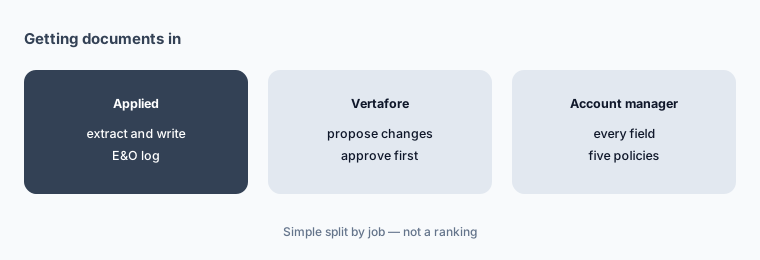
4. Getting documents in: Epic extraction vs the Policy Intake Agent
What it is: Applied says Epic Conductor extracts data from dec pages, applications, and submissions and writes it into Epic, logging every action for E&O and cutting data entry “by more than 50%” — Applied’s figure (Applied Epic AI). Vertafore’s Policy Intake Agent reads policy documents, maps them to AMS fields, shows what is new, changed, missing, or conflicting, and updates the system only after the user approves; it is available now in AgencyOne with AMS360 and in early access for Sagitta (Vertafore AI). Vertafore’s releases say up to 87% time saved; its AMS360 page says 86%.
Writing into the system of record is the risky step. Applied describes a log you can read after the fact; Vertafore describes an approval screen before the write. Ask each to show you that step live.
Watch the write step:
Run five non-download policies through your system's AI intake. Have the account manager check every field written or proposed against the policy, and ask the other vendor to show its approval step on the same five.
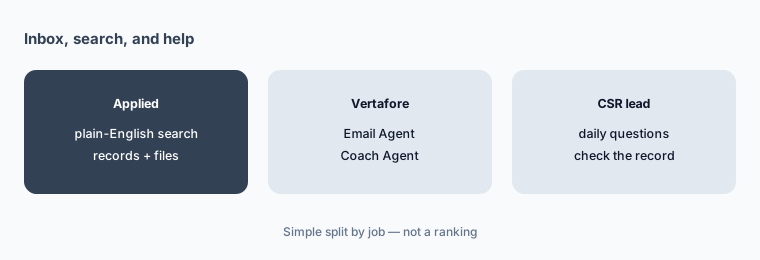
5. Inbox, search, and help: Epic search vs the Email and Coach agents
What it is: Applied’s Epic Conductor adds natural-language search across Epic records and attachments (Applied Epic AI). Vertafore’s Email Agent turns Outlook messages into AMS360 activities and suspenses that the user approves (up to 80% less processing time, up to 98% accuracy, per Vertafore), and its Coach Agent answers product and procedure questions in AMS360 and Sagitta from the agency’s own SOPs, with general availability described as “early fall” (Vertafore AI).
These help CSRs move faster, but every answer depends on what is in the system and how current the SOPs are.
Test daily questions:
Write five questions your CSRs answer every day and five common inbound emails. Have the CSR team lead check each AI answer or proposed activity against the record before new hires rely on it.
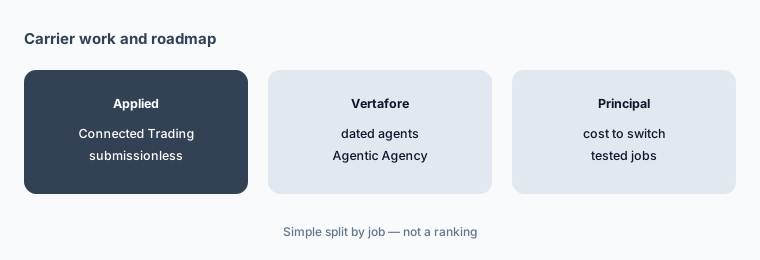
6. Carrier-facing work, the roadmap, and when not to switch
What it is: Applied’s Connected Trading puts every commercial submission through one AI workflow, quotes small commercial straight from email, and remarkets from Epic, and its Cytora unit brings submissionless renewal quotes into Epic (Travelers first, 8 July 2026). Its CEO said in October 2026 that AI agents are with a small number of customers, stop for approval before contacting a carrier, and should reach many more agencies in 2027. Vertafore set out its Agentic Agency plan on 23 September 2026, with dates per agent and submission tools in Surefyre.
Roadmaps are not features. If your current system covers the job you tested in section 1, the cost and risk of moving every client record usually outweigh any AI gap between the two.
Price the switch:
Before switching agency systems for AI, have the agency principal list which tested jobs the current system already covers and what a conversion would cost in staff time, then decide.
Pricing context (October 2026)
Neither vendor publishes prices. Applied’s Epic Conductor release gives no editions, rollout date, or price, and Vertafore’s pricing URL returns “page not found”. Both are quote-only as of 18 Oct 2026.
Ask each whether the AI is included in your current subscription or billed separately, whether it is priced per user, per agency, or per transaction, which carriers’ statement formats are supported, and when each feature is available on your edition or system (Epic, AMS360, or Sagitta).
Uncertainty: Applied has not published a rollout date or edition list for Epic Conductor; its AI agents are with a small customer group per its CEO (trade-press interview, October 2026). Vertafore dates each agent, but Coach (“early fall”) and Document Intelligence (“scheduled for September 2026”) had no confirmed general-availability date we could find, and its Policy Intake figure appears as 87% in releases and 86% on its AMS360 page. Time-saved and accuracy figures are vendor claims. We did not test either system ourselves.
When it’s useful (honest take)
Useful when you already run one of these systems and want to know what the other’s AI does, or you are choosing an agency management system for other reasons and want the AI picture side by side.
Less useful when you are a carrier or MGA (see Guidewire AI, Duck Creek AI, or Federato AI), your gap is agency growth and renewals outreach (see Zywave AI), or you are thinking of switching systems for AI alone.
Still choosing between Applied and Vertafore? The $19 AI toolkit audit gives you a written plan for which tools to keep using and which to drop across your whole AI stack, including this pair.
Prefer to do it yourself? Spreadsheet — $9
Related options (educational)
| Need | Better home | Why |
|---|---|---|
| AI built into Applied Epic: search, extraction, checks, reconciliation, trading | Applied Epic AI | Quote only |
| Separate dated agents in AMS360 and Sagitta | Vertafore AI | Quote only |
| Agency growth: prospecting, renewals, outreach | Zywave AI | Quote only; Advisor Agent early access |
| Outlook drafting for any agency system | Microsoft 365 Copilot | See its review |
| Signatures on applications and proposals | DocuSign AI | See its review |
FAQ
What is the main difference between Applied and Vertafore AI?
Applied built one AI layer, Epic Conductor, into Epic (announced 29 September 2026, no rollout date). Vertafore ships separate, dated Velocity AI agents in AMS360 and Sagitta, such as Policy Check and Reconciliation. This is not a ranking.
Do both check issued policies?
Yes. Applied says Epic Conductor checks every policy against what was quoted; Vertafore’s Policy Check Agent compares the issued policy with AMS data and source documents and is available now in AMS360. An account manager should review every flag.
Which is available now?
Vertafore lists dates per agent; Policy Intake and Policy Check were announced as available in AMS360 on 15 October 2026. Applied has not published a rollout date or edition list for Epic Conductor, so ask Applied for your agency.
How much do Applied and Vertafore AI cost in October 2026?
Neither publishes prices. Both are quote-only (checked 18 Oct 2026).
Should we switch agency systems for the AI?
Usually not. Test one shared job in the system you have first; if it covers that job, the cost and risk of converting every client record tend to outweigh the AI difference.
Optional next step (if seats overlap)
If your agency pays for an agency management system, a comparative rater, an email add-in, and chat seats that all touch the same client files, that overlap is worth mapping. Map the overlap with the $19 AI toolkit audit or the $9 AI toolkit spreadsheet. Email Audit $19 or Toolkit spreadsheet $9.
Checkout is live via Stripe. After you pay, we email delivery (spreadsheet) or intake next steps (audit).