Tool · Insurance ops · Duck Creek · Oct 2026
Duck Creek AI review (Oct 2026): Agentic AI Platform, Agentic Underwriting Workbench, Agentic FNOL, and Agentic Product Configurator for carriers
Duck Creek sells core systems to property and casualty (P&C) insurers: policy administration, a rate engine, billing, and claims, plus portals and the Clarity data platform. In 2026 it launched an Agentic AI Platform (April) and a set of agent applications on top of it: Agentic Underwriting Workbench, Agentic Product Configurator, and Agentic FNOL, which opened to early access customers on 28 September. It also bought the underwriting platform Send in July. This page is about what each piece does, how available it is, and who must check its work. Each section has a Try this.
What this Duck Creek page covers
This page is for claims leaders, underwriting managers, product owners, and IT leads at a P&C carrier that runs Duck Creek, or is choosing a core system. Agencies and brokers don’t buy Duck Creek; they meet it through carrier portals. The question this page answers: what Duck Creek’s agents do in claims intake, underwriting, product setup, and document work, how available each one is, and who approves what they produce.
Sources are Duck Creek’s own press releases (28 April 2026, 29 April 2026, 7 July 2026, 28 September 2026) and its product pages, read on 18 October 2026. Where two Duck Creek pages disagree on availability, we say so.
Ground rules: a named claims supervisor approves FNOL routing and every anomaly referral (a flag is a reason to look, never a finding of fraud); an underwriter owns every quote and decline the workbench helps prepare; a product owner approves every generated configuration before any filing or release; and Duck Creek’s percentage figures are its own claims, not our measurement. This page explains features. It is not coverage, claims, or legal advice.
Major features (with how someone uses them)
Examples at a glance: each feature has a concrete example from a real job plus a short Try this you can run this week.
1. Agentic FNOL in early access (primary)
What it is: Agentic First Notice of Loss lets a claimant report a loss in their own words across digital, voice-to-text, and mobile channels, then turns that into a structured claim file. In its 28 September 2026 release Duck Creek says it verifies coverage, assesses injury and legal severity, and looks for anomaly signals by cross-checking the story, photos, policy data, and claim record. “Each AI-driven determination is clearly logged, with exceptions flagged for human review.” It was built with Google Cloud and runs on Gemini models. Availability: “now available for early access customers”.
Coverage matching and anomaly flags are where a wrong call costs most. A claim tied to the wrong policy or coverage part, or a flag on an honest claimant, starts the file badly. Test on losses you already know the answer to before any live claim is routed.
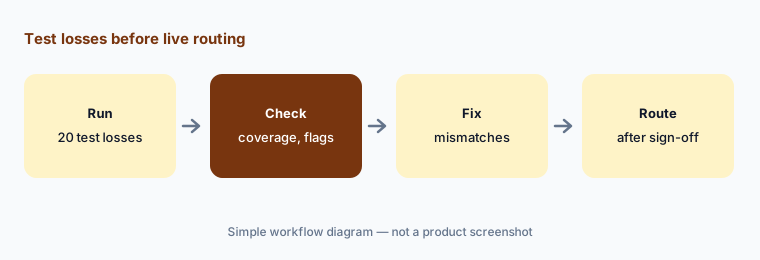
Primary workflow:
Run twenty test losses through Agentic FNOL in early access. Have a claims supervisor check each coverage match and every anomaly it flags against the policy before any claim is routed.
2. Agentic AI Platform: orchestration, human-in-the-loop steps, and AI Assurance
What it is: The Agentic AI Platform (28 Apr 2026) is the layer the other Duck Creek agents run on. Duck Creek describes four parts: Agentic Intelligence (an insurance-native Model Context Repository, MCR, grounded in carrier rules and knowledge graphs), Agentic Orchestration (designing and coordinating agents, “combining automation with autonomous and human-in-the-loop execution”), AI Assurance (decision traceability, auditability, observability, and compliance controls), and an AI Gateway (covered next). Its product page says AI actions are written to an “immutable decision ledger” with inputs, outputs, and model version.
Orchestration decides which steps run on their own and which stop for a person. That split is a business decision, so claims and underwriting owners should write it down before IT configures it.
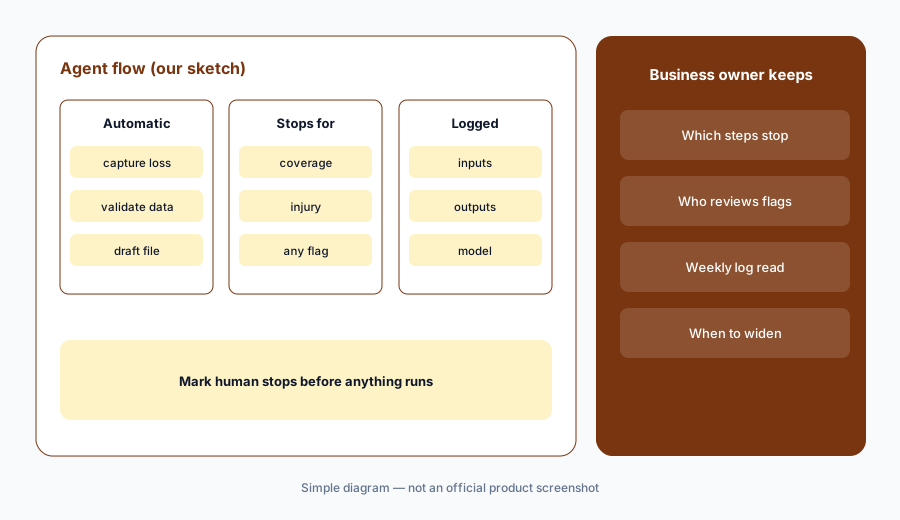
Mark the human stops:
List every step in one agent flow you plan to run on the Agentic AI Platform. Have the claims or underwriting owner mark which steps must stop for a named person, and read a week of the decision log to confirm they did.
3. AI Gateway: MCP, A2A, and your choice of model
What it is: The AI Gateway is Duck Creek’s open layer for connecting its own, partner, and customer-built agents, with a marketplace, a registry, and support for the Model Context Protocol (MCP) and Agent2Agent (A2A) protocol (28 Apr 2026 release). The product FAQ says the platform is model-agnostic (OpenAI, Gemini, Claude, Llama, Mistral, or your own model) and can run embedded in Duck Creek screens or headless behind your own apps.
Open protocols make it easy to plug in an outside agent. Each new connection is also a new path to policy and claims data, so someone has to own the list of what is connected and what it may touch.
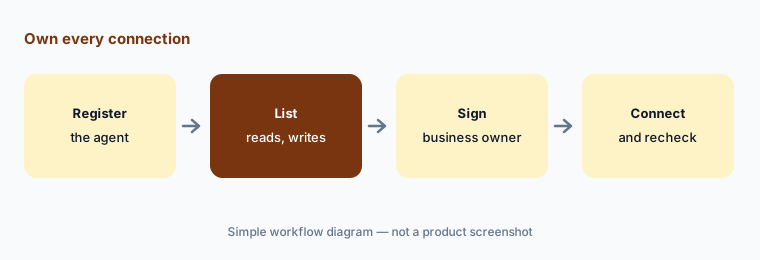
Own the connection list:
Before connecting any outside agent through the AI Gateway, have the IT lead write what it reads, what it may change, and which model it uses. Have the business owner sign that note first.
4. Agentic Underwriting Workbench (and Send)
What it is: The Agentic Underwriting Workbench applies AI agents to the submission-to-quote steps: intake, triage, and enrichment, so underwriters get decision-ready submissions with the data already gathered. In July Duck Creek acquired Send, an underwriting orchestration platform for commercial, specialty, and London Market business; Send stays available on its own, and Duck Creek says its customers can license Send products today. Send’s own figures (“up to 7x faster time-to-quote”) are vendor claims. We found no availability label for the workbench itself.
Triage decides which submissions an underwriter sees first. If the workbench’s order drifts from your written appetite, good business waits while poor fits get worked.
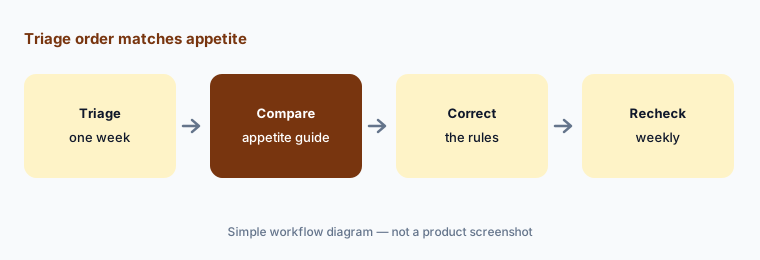
Check the order:
Take one week of submissions the workbench triaged. Have the underwriting manager compare its top twenty with your written appetite guide before the order decides who works what.
5. Agentic Product Configurator: from filings to draft configuration
What it is: The Agentic Product Configurator (29 Apr 2026) reads carrier documents such as underwriting manuals, rate guides, forms, and filings and produces structured requirements and draft Duck Creek Policy configuration (manuscripts). Duck Creek reports early results of “up to a 50% reduction in requirement and manuscript generation effort”, which is its claim. Availability is worded differently in two places: the press release says “available today”, while the product page FAQ says initial capabilities are in Controlled Availability through Duck Creek Professional Services as a statement-of-work engagement.
A generated configuration that looks right can still carry the wrong form edition or a state exception. The product owner has to compare it with the filing before anything goes into a release.
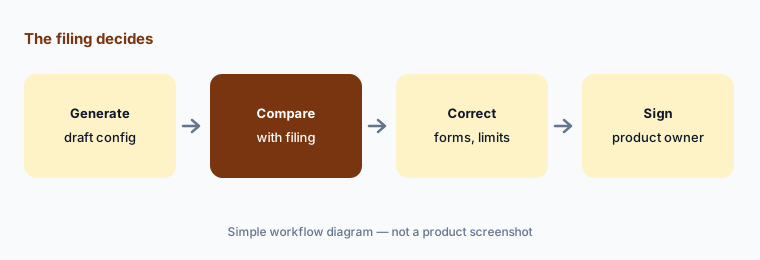
Compare with the filing:
Have the product owner compare one configurator draft line by line with the approved filing. Note every form edition, limit, and state rule it got wrong before any configuration goes into a release.
6. Document Intelligence: summaries, cited search, and sorting
What it is: Duck Creek’s Document Intelligence summarises long claim and underwriting files, searches across documents with citations back to the source, and classifies incoming documents so they route to the right queue. Duck Creek says outputs include “transparent citations and traceable sources”. We found no launch date or availability label for it.
Summaries and sorting save reading time, but a missed medical bill or a misfiled attorney letter changes a claim. Spot-check the summaries and the sorting before people stop opening the originals.
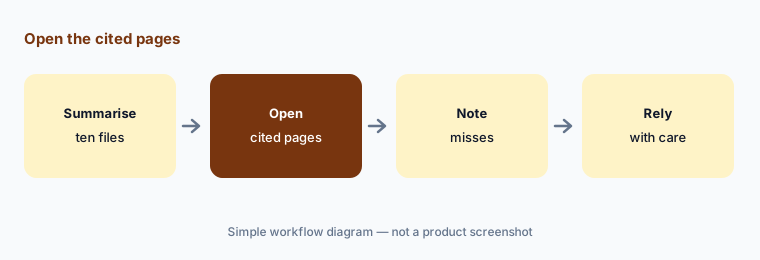
Open the citations:
Pick ten long claim files and have Document Intelligence summarise each. Have the claims team lead open every cited page and note what each summary missed before adjusters lean on them.
Pricing context (October 2026)
We found no published prices for Duck Creek’s core systems, the Agentic AI Platform, or its agent applications on duckcreek.com (its /pricing address returns “not found”). Pricing is quote-only as of 18 Oct 2026. Ask which agents are included in your Duck Creek OnDemand subscription, which are separate licences or Professional Services engagements (the Product Configurator starts as one), and how model usage is charged if you bring your own model.
Availability matters as much as price: Agentic FNOL is in early access (28 Sep 2026), the Product Configurator is described as Controlled Availability through Professional Services on its product page, and we found no availability label for the Underwriting Workbench or Document Intelligence.
Uncertainty: Two Duck Creek pages disagree in places: the Product Configurator press release says “available today” while its product FAQ says Controlled Availability through Professional Services, and the platform press release describes “fine-tuned and carrier-trained” models while the platform FAQ says it “does not include pre-trained models”. The “up to 50%” and Send’s “up to 7x” figures are Duck Creek’s own claims, not our measurement. We could not confirm prices, which agents are generally available, or when early access ends. We did not test Duck Creek ourselves.
When it’s useful (honest take)
Useful when you are a P&C carrier already on Duck Creek, claims intake is slow or incomplete at first notice, you want agents that read your existing policy and claims configuration rather than a separate copy, and your claims and underwriting owners will decide which steps stop for a person before anything runs on live claims.
Less useful when you are an agency or broker (see Applied Epic AI or Vertafore AI), you are not on Duck Creek and do not plan a core-system change, or the agent you need is still early access or Controlled Availability and you cannot join that group yet.
Paying for Duck Creek AI and a few other AI tools? The $9 AI toolkit spreadsheet lists every AI subscription you have, what each one costs, and how fast it pays for itself, so you can see which ones are worth the money.
Want someone to do it for you? AI toolkit audit — $19
Related options (educational)
| Need | Better home | Why |
|---|---|---|
| Carrier core system with an agent platform and agent apps | Duck Creek AI (this page) | Quote only |
| The other big P&C core system with its own agent framework | Guidewire AI | Quote only; Qusar agents are EA or RA |
| AI inside an agency management system | Applied Epic AI or Vertafore AI | Quote only; for agencies |
| Underwriting recommendations on a separate AI tool | Sixfold AI | Quote only; works standalone or beside a core system |
| Reviewing policy wording or contracts in a general tool | Claude for legal ops | See its guide; sanitized text only |
FAQ
What is the Duck Creek Agentic AI Platform?
Duck Creek’s layer for building, running, and governing AI agents on its insurance core, launched 28 April 2026. It combines an insurance-native Model Context Repository, agent orchestration with human-in-the-loop steps, AI Assurance governance, and an AI Gateway that supports MCP and A2A.
Is Duck Creek Agentic FNOL generally available?
No. On 28 September 2026 Duck Creek said Agentic FNOL is “now available for early access customers”. Ask Duck Creek whether your carrier can join and what changes before general availability.
What does the Agentic Product Configurator do?
It turns carrier documents such as manuals, rate guides, forms, and filings into structured requirements and draft Duck Creek Policy configuration. Its product page says initial access is Controlled Availability through Professional Services. A product owner should approve every draft.
How much does Duck Creek AI cost in October 2026?
Duck Creek does not publish prices. Treat it as quote-only and ask which agents your subscription includes, which need Professional Services, and how model usage is charged.
Who should approve Duck Creek AI output?
A claims supervisor for FNOL routing and any anomaly referral, an underwriter for quotes and declines, a product owner for generated configurations, and the business owner for any agent connected through the AI Gateway.
Optional next step (if seats overlap)
If your claims or underwriting team pays for a core-system agent suite, a separate intake or document tool, and chat seats that all read the same claim files, that overlap is worth mapping. Map the overlap with the $19 AI toolkit audit or the $9 AI toolkit spreadsheet. Email Audit $19 or Toolkit spreadsheet $9.
Checkout is live via Stripe. After you pay, we email delivery (spreadsheet) or intake next steps (audit).