Tool · Insurance ops · Tractable · Oct 2026
Tractable AI review (Oct 2026): photo-based damage appraisal, LumaScanner vehicle scans, and Instant Quote for auto claims
Tractable is a computer-vision company that turns photos of a damaged vehicle into an assessment: repairable, total loss, or cash settlement, a pre-filled repair estimate, and checks on estimates already written. Insurers use it in auto claims; repairers, dealerships, recyclers, and fleets use it for intake. In June 2026 it launched LumaScanner, a drive-through 360° scanner, and Instant Quote for UK repairers. This page explains each part and which appraiser or supervisor must check it. Each section has a Try this.
What this Tractable page covers
This page is for auto claims leaders, desk and field appraisers, total-loss teams, and subrogation staff at insurers, plus repairers weighing Tractable’s shop tools. The question it answers: what Tractable reads from a photo, where its output enters the claim, and who checks it before money moves.
Sources are Tractable’s own pages, read on 18 October 2026: its home page, its insurer solutions page, its press page, the LumaScanner site and technology page, the Birmingham launch page for LUMA Scanner and Instant Quote (2–3 June 2026), and the UK Instant Quote page.
Insurers named in 2026: France’s Covéa (MAAF, MMA, GMF) renewed its partnership for three years on 1 April 2026, after working with Tractable since 2018; Covéa said more than 160,000 claims have been finalised since the start. Luxembourg’s Foyer announced a partnership on 6 May 2026 for low-severity motor claims (listed on Tractable’s press page). Ask Tractable for references in your market and line.
Ground rules: a staff appraiser approves every estimate and every total-loss call; the claims supervisor owns any setting that lets a claim skip human review; the SIU lead, not the model, decides whether anything is fraud; and Tractable’s results figures are its claims, not our measurement. This page explains features. It is not coverage, claims, or legal advice.

Major features (with how someone uses them)
Examples at a glance: each feature has a concrete example from a real job plus a short Try this you can run this week.
1. AI estimates from damage photos (primary)
What it is: Tractable’s insurer tools pre-fill repair cost estimates from photos with what it calls AI-verified accuracy, through desktop tools or APIs that connect to FNOL, estimating, and claim review systems. It cites a “50%” cut in estimate writing time with Estimatics Pre-Population. Tractable says its AI evaluates collision damage from minor scratches to total loss.
A photo can’t show hidden damage behind a bumper. The useful test is how far the AI estimate lands from what the repair really cost, line by line, on your own closed claims.
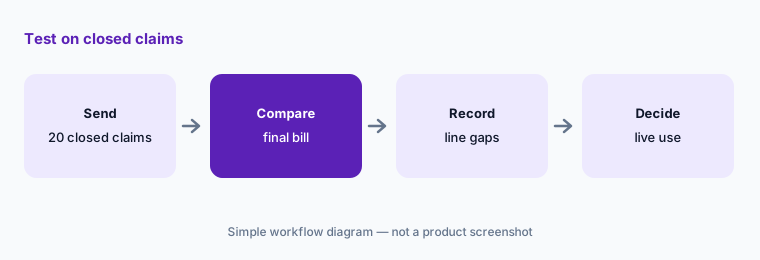
Primary workflow:
Send twenty closed claims' photos through Tractable's estimate. Have a staff appraiser compare each AI estimate line by line with the final repair bill before it is used on a live claim.
2. Instant claim classification at FNOL
What it is: At first notice of loss, Tractable classifies a claim from the customer’s photos as total loss, repairable, or cash settlement, and can offer an AI-verified cash settlement for a faster close. Tractable cites an “8 days” cut in cycle time with FNOL Triage.
An early total-loss call moves a car to salvage and a customer to a settlement conversation. A wrong call either way is expensive and hard to reverse.
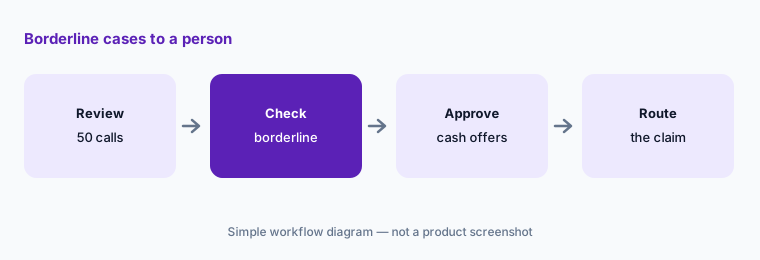
Borderline cases go to a person:
Have the total-loss team lead compare fifty Tractable FNOL classifications with the appraiser’s final decision. Keep a person on every claim near your total-loss threshold before any cash settlement is offered.
3. Claim review: consistency, errors, and possible fraud
What it is: Tractable’s insurer page describes AI claim review that checks estimates and claims for consistency, accuracy, potential errors, and potential fraud. It cites “70%” of claims reviewed without human involvement in its Claim Review product. Each Tractable estimate also carries a certainty level that, per its home page, accounts for visibility, image quality, and damage severity.
“Reviewed without human involvement” is the setting that needs the most care. A claim the AI passes is never looked at again unless someone samples it, and a possible-fraud flag is a reason to look, not a finding.
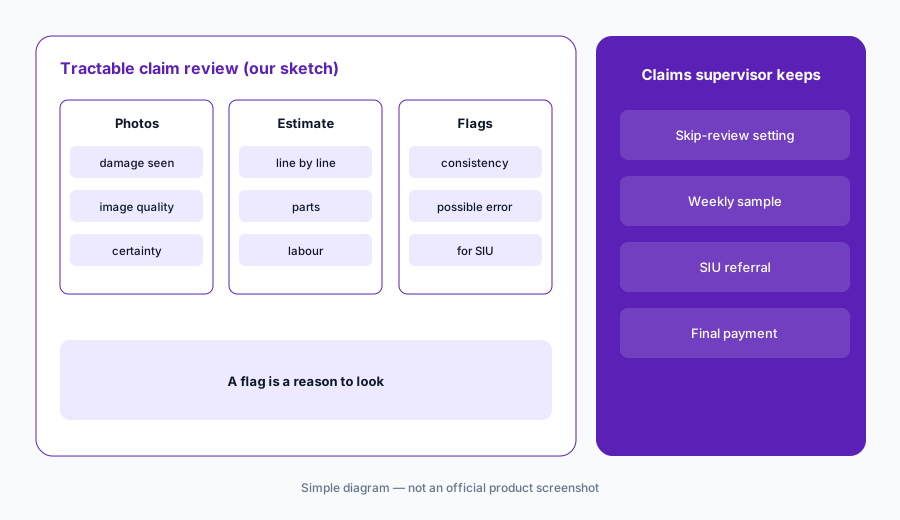
Sample what it passed:
Have the claims supervisor sample twenty-five claims Tractable passed without human review last week. Check each line against the photos before widening what skips review, and send any concern to the SIU lead rather than labelling it fraud.
4. Subrogation: inbound packet review and contention reports
What it is: Tractable says it automates review of inbound subrogation packets and speeds up writing contention reports, citing a “50%” cut in the time to create one. Its pitch is that photo-backed, line-level comparisons give the recovery team a clearer basis for disputing another carrier’s demand.
A contention report goes to another insurer and may end up in arbitration. Every disputed line should be one a subrogation specialist would defend.
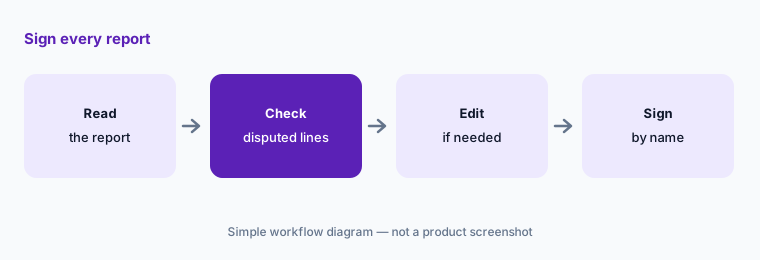
Sign every report:
Have a subrogation specialist read ten Tractable contention reports before they are sent. Check every disputed line against the photos and local labour rates, and sign each report by name.
5. LumaScanner: 360° drive-through vehicle scans
What it is: LumaScanner is a drive-through arch with high-resolution cameras that captures every panel and, per its site, delivers “complete vehicle intelligence in 90 seconds”: dents, scratches, hail, panel misalignment, tyres, wheels, underbody, and body damage, priced into an instant estimate with configurable pricing and a timestamped, photo-backed condition report. Tractable launched it at a Birmingham event on 2–3 June 2026. It is aimed first at dealerships and repairers; insurers and fleets are listed too.
A scan is only as useful as the agreement about what it means. An insurer relying on a dealer’s or shop’s scan should decide in advance whether that report counts as evidence of pre-existing damage.
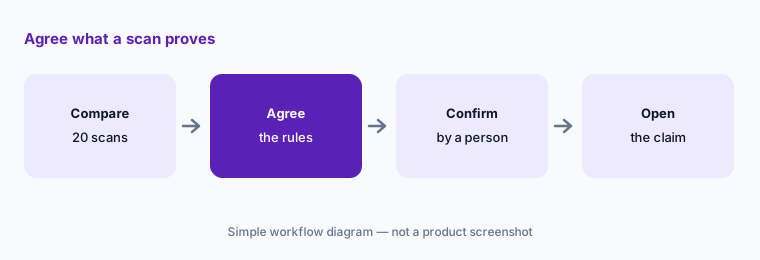
Agree what a scan proves:
If a partner uses LumaScanner, have your claims manager compare twenty scan reports with manual inspections. Agree in writing which findings a person must confirm before a claim or damage charge is opened.
6. Instant Quote for UK repairers
What it is: Tractable’s launch page calls it Tractable Instant Quote; its UK page calls it AI Instant Estimate. Either way, it lets a UK bodyshop’s customers send photos by QR code, website link, or social media form and get an initial, part-level estimate (repair or replace, labour hours, pricing from UK data providers) in under a minute, editable by the shop. It flags jobs where repair cost may approach the vehicle’s value. Tractable says early adopters saw up to 10% higher lead-to-job conversion and a four-day cut in cycle time.
This is a repairer tool, not an insurer’s claims decision. An initial estimate shown to a customer can shape what they expect a claim to pay, so the shop’s estimator should own what is said.
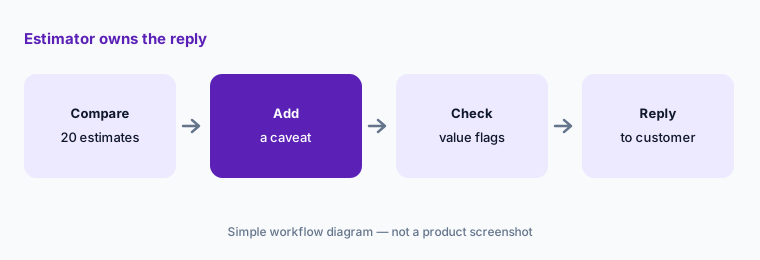
Estimator owns the reply:
Have the shop estimator compare twenty Instant Quote estimates with the full estimate written on arrival. Add a first-estimate caveat to every customer reply before it goes out.
Pricing context (October 2026)
Tractable does not publish prices on the pages we read; the insurer tools are sold through its sales team, and the UK Instant Quote page uses an order form without a price. Pricing is quote-only as of 18 Oct 2026. Ask whether insurer tools are priced per claim, per estimate, or per year; what a LumaScanner unit costs to buy or lease and to run; and what the integration with your claims and estimating systems costs.
Tractable cites an 8-day cycle-time cut (FNOL Triage), 50% less estimate writing time, 70% of claims reviewed without human involvement (Claim Review), 50% less time per contention report, and, for LumaScanner, more than $7B in repairs behind its models. Its pages give different LumaScanner install times: “under a day”, “under 2 hours”, and “about 90 minutes”. These are vendor claims, not our measurement.
Uncertainty: We read Tractable’s own pages with a page reader, because its site blocks simple downloads. The repairer product launched in June 2026 is called Tractable Instant Quote on its launch page and AI Instant Estimate on its UK page. LumaScanner install times differ across Tractable’s pages. The Foyer partnership is listed on Tractable’s press page; the full text we read is Foyer’s. Results figures are vendor claims. We could not confirm prices, and we did not test Tractable ourselves.
When it’s useful (honest take)
Useful when you handle enough auto physical damage claims that photo-based triage and estimating save real appraiser time, your appraisers will compare AI estimates with final bills, and you want a specialist that plugs into the estimating and claims systems you already use.
Less useful when your estimating already runs inside a claims and repair network with its own photo AI (see CCC AI), your main gap is workers’ comp or health claims (see Gradient AI), or you need a claims core system (see Guidewire vs Duck Creek).
Paying for Tractable AI and a few other AI tools? The $9 AI toolkit spreadsheet lists every AI subscription you have, what each one costs, and how fast it pays for itself, so you can see which ones are worth the money.
Want someone to do it for you? AI toolkit audit — $19
Related options (educational)
| Need | Better home | Why |
|---|---|---|
| Photo estimating, FNOL classification, claim review, scans | Tractable AI (this page) | Quote only |
| Estimating, FNOL photo AI, and repair coordination inside a claims network | CCC AI | Quote only |
| FNOL intake and claim summaries inside a carrier core | Guidewire AI or Duck Creek AI | Quote only; several items early or restricted access |
| Severity prediction for injury claims | Gradient AI | Quote only |
| Drafting customer letters from a claim file | Microsoft 365 Copilot | See its review |
FAQ
What does Tractable do?
It uses computer vision on photos of vehicle damage to classify claims (total loss, repairable, cash settlement), pre-fill repair estimates, review claims for consistency and possible errors or fraud, and support subrogation. It also sells LumaScanner and Instant Quote to repairers and dealerships.
What is LumaScanner?
A 360° drive-through vehicle scanner from Tractable, launched in June 2026, that captures every panel in about 90 seconds and produces an instant estimate and a photo-backed condition report.
Is Instant Quote for insurers?
No. Tractable presents it as a tool for UK repairers and dealerships: customers send photos and get an initial estimate in under a minute, which the shop can edit. Its UK page calls it AI Instant Estimate.
How much does Tractable cost in October 2026?
Tractable does not publish prices. Treat it as quote-only and ask how claims or estimates are counted.
Who should approve Tractable output?
A staff appraiser for every estimate and total-loss call, the claims supervisor for any setting that lets claims skip human review, the SIU lead for any fraud concern, and a subrogation specialist for every contention report.
Optional next step (if seats overlap)
If your claims team pays for a photo-estimating tool, an estimating platform, a fraud tool, and chat seats that all read the same claim, that overlap is worth mapping. Map the overlap with the $19 AI toolkit audit or the $9 AI toolkit spreadsheet. Email Audit $19 or Toolkit spreadsheet $9.
Checkout is live via Stripe. After you pay, we email delivery (spreadsheet) or intake next steps (audit).