Tool · Insurance ops · CCC · Oct 2026
CCC AI review (Oct 2026): AI estimating, Estimate – STP, Mobile Jumpstart, and AI-assisted appraisal for auto claims and repairers
CCC Intelligent Solutions runs much of the US auto claims and repair network: insurers write and review estimates in it, collision shops estimate and order parts in CCC ONE, and photos, estimates, and payments move between them. Its AI sits inside that flow — CCC Intelligent Estimating writes line-level estimates from photos, Estimate – STP settings decide which can be approved without a person, First Look predicts total losses at first notice of loss, and Mobile Jumpstart starts a shop’s estimate from guided photos. This page explains each part and who owns its rules. Each section has a Try this.
What this CCC page covers
This page is for auto physical damage claims leaders, desk and field appraisers, total-loss and subrogation teams at insurers, and collision repair shop managers on CCC ONE. The question it answers: where CCC’s AI writes or approves something, which settings control it, and who must own those settings.
Sources are CCC’s own pages, read on 18 October 2026: its AI page, claims estimating, claims management (First Look), and subrogation pages; its help-site guide to Estimate-STP configuration; its Crash Champions release (13 August 2026); its acquisition agreement release (15 October 2026); and its second-quarter 2026 prepared remarks. CCC says more than 100 auto insurers and more than 4,000 collision repairers use its AI.
On naming: CCC’s marketing page now calls the insurer product CCC Intelligent Estimating; its help site documents Estimate – STP (straight-through processing) as the configuration that decides which AI estimates are approved automatically. This page treats Estimate – STP as those settings. On 15 October 2026 CCC agreed to be acquired by a GTCR-led group including Elliott, expected to close in early 2027 (see section 6).
Ground rules: an appraiser or claims supervisor owns every straight-through rule and every auto-approval threshold; a staff appraiser reviews any estimate a rule didn’t approve; shop estimators approve every repair estimate; and CCC’s results figures are its claims, not our measurement. This page explains features. It is not coverage, claims, or legal advice.

Major features (with how someone uses them)
Examples at a glance: each feature has a concrete example from a real job plus a short Try this you can run this week.
1. Estimate – STP: the rules that let an estimate go straight through (primary)
What it is: CCC’s help-site guide shows what an insurer configures before AI estimates can be approved without a person: which states are eligible; post-check bands where estimates in the high band follow auto-release rules, the middle band goes to manual review, and the low band is excluded; part-level AI damage thresholds (set between 70% and 99%); and auto-release rules by state and preliminary repair total. Changes take effect only once they are deployed in the portal, and a change log records who changed what and when.
Each rule is a decision to pay without an appraiser looking. Widening one threshold can move thousands of claims a month, so the person who owns the rule should see a sample first.
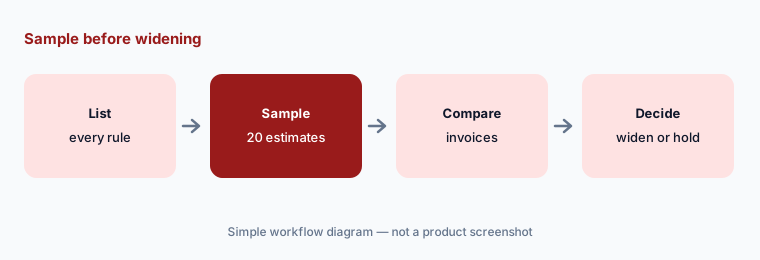
Primary workflow:
Ask the claims supervisor to list every rule that lets an estimate go straight through. Have her sample twenty straight-through estimates against the repair invoice before any rule is widened.
2. CCC Intelligent Estimating: line-level estimates for appraiser review
What it is: CCC Intelligent Estimating (claims estimating) generates line-level estimates “in seconds” on qualified repairable vehicles from damage photos, predicting repair or replace, remove and install, labour hours, and blend procedures under the insurer’s own rules and parts-sourcing preferences. The insurer chooses whether each result is a preliminary estimate for an appraiser to complete or, where its settings allow, an estimate ready for automatic approval. CCC says the AI can write “up to 80% or more” of estimate lines, and cites a 30% efficiency gain at a national insurer.
A preliminary estimate saves time only if the appraiser actually reviews it. The risk is an appraiser who accepts lines because the AI wrote them.
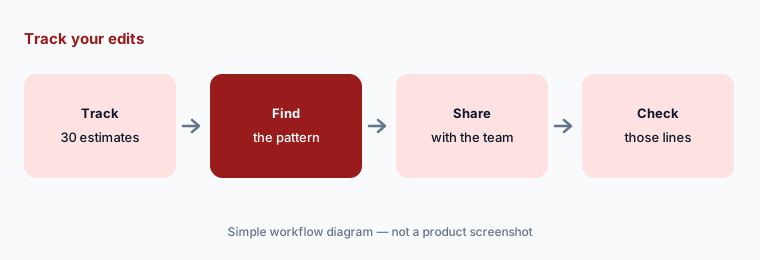
Track your edits:
Have a desk appraiser log every edit she makes to thirty CCC preliminary estimates. Share the most common fixes with the team so every appraiser checks those lines before completing one.
3. CCC First Look: photo predictions right after first notice of loss
What it is: CCC First Look (claims management) brings vehicle photos into an auto physical damage claim from a camera roll, a guided app, a tow or salvage provider, or a repair facility, checks the quality of unguided photos, and gives early predictions such as repairable vs total loss and the primary point of impact. CCC’s AI can then route the claim to the next step under the insurer’s own rules. CCC cites a “~40% lift” in total-loss identifications when early tow photos come through First Look.
An early total-loss prediction can send a car to salvage before an appraiser sees it. The routing rule, not the model, decides what happens next, and a person should own that rule.
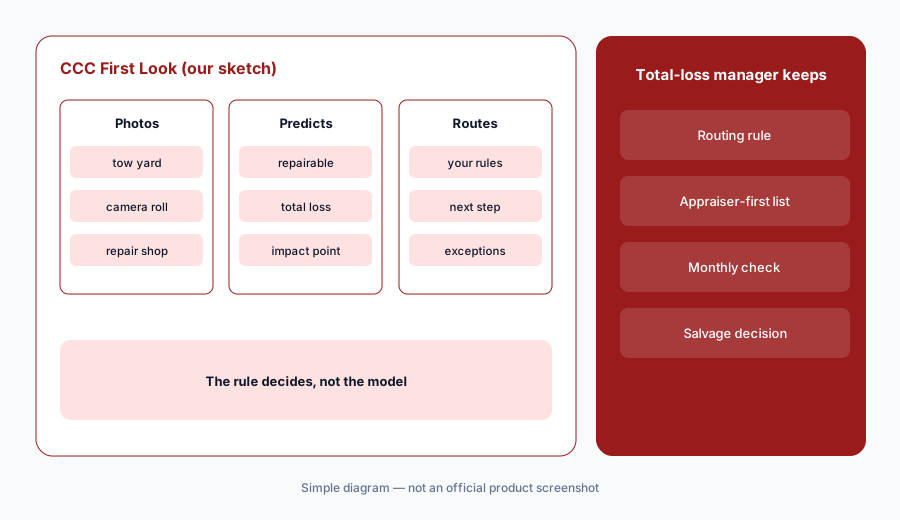
Own the routing rule:
Have the total-loss manager compare forty First Look predictions with the appraiser’s final decision. Set which vehicles always see an appraiser before any routing rule sends a car to salvage.
4. Mobile Jumpstart 2.0: AI-started estimates for repair shops
What it is: Mobile Jumpstart 2.0 uses AI and computer vision to guide a shop’s photo capture and label images in real time, then starts the estimate in CCC ONE. In its 13 August 2026 release, CCC said Crash Champions renewed and expanded its use, and that Mobile Jumpstart captures on average 84% of the final repair bill in 70 seconds, against 15 to 30 minutes by hand. CCC’s AI page says repairers set their own confidence thresholds and human estimators make the final estimate approval.
A fast first estimate is a starting point. The 16% it doesn’t capture is often hidden damage, which is where supplements and disputes with insurers come from.
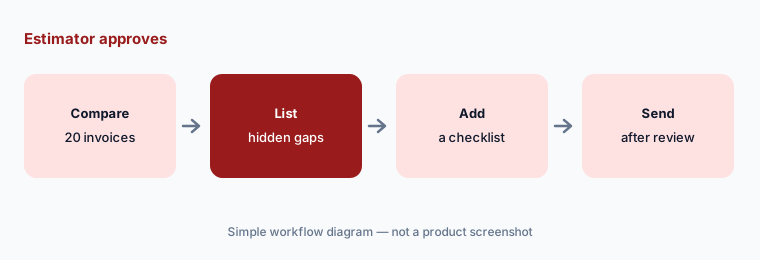
Estimator approves:
Have a shop estimator compare twenty Mobile Jumpstart estimates with final invoices. Add a teardown checklist for the gaps before any Jumpstart estimate goes to an insurer.
5. AI for estimate change requests, subrogation, and parts
What it is: In its second-quarter 2026 remarks, CCC described insurers configuring its AI to handle routine requests from repair shops to change an approved estimate under their own rules, routing exceptions to a person, and said it is embedding AI across parts procurement. Its subrogation tools review inbound demand packages with configurable audit rules and use detection models to find outbound recovery opportunities across auto, property, and workers’ comp claims. CCC’s chief executive said on 15 October 2026 that the company will “accelerate the AI and agentic capabilities our customers want”.
Auto-approving a shop’s change request is paying more money without a person deciding. Start with the smallest, most routine requests and widen only with evidence.
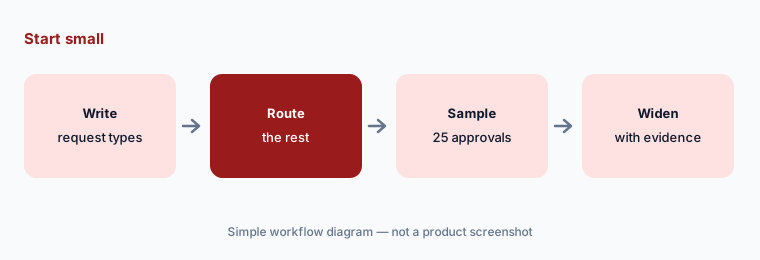
Start small:
Have the appraisal manager write which shop change requests CCC may approve automatically. Route every other request to an appraiser, and sample twenty-five auto-approved ones before adding any type.
6. The pending sale: what to ask before a multi-year renewal
What it is: On 15 October 2026, CCC announced a definitive agreement to be acquired by a GTCR-led group including Elliott, in an all-cash deal with an enterprise value of about $6.1 billion. CCC said it expects to close in the first quarter of 2027, subject to regulatory and stockholder approvals, and that it remains publicly traded and operates independently until then. Both CCC and GTCR said they plan continued investment in AI.
A change of owner rarely changes a product overnight, but it can change pricing, roadmaps, and contract terms at renewal. Buyers should get commitments in writing rather than rely on announcements.
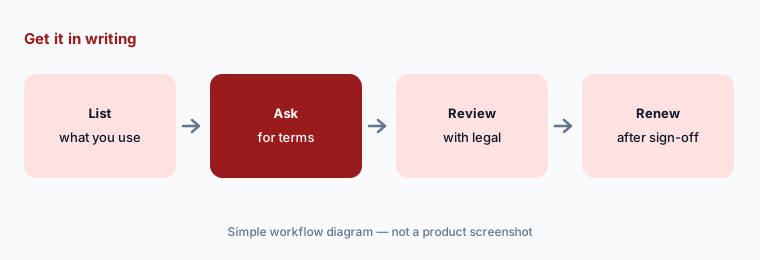
Get it in writing:
Have the vendor management lead list every CCC feature your claims team relies on. Ask CCC to put price-change, data-access, and notice terms in the contract, and have legal review them before renewal.
Pricing context (October 2026)
CCC does not publish prices; its /pricing address returns “not found”, and its product pages ask buyers to request product information. Pricing is quote-only as of 18 Oct 2026. Ask how AI estimating and straight-through processing are priced (per estimate, per claim, or within an existing CCC subscription), whether First Look and subrogation tools are separate, and how the pending sale may affect renewal terms.
CCC cites a ~40% lift in total-loss identifications with early tow photos, up to 80% or more of estimate lines written by AI, a 30% efficiency gain at a national insurer, and 84% of the final repair bill captured in 70 seconds with Mobile Jumpstart. These are vendor and customer claims, not our measurement.
Uncertainty: We read CCC’s own pages, its help site, and its investor materials. The name Estimate – STP appears on CCC’s help site, not on its current marketing page, which describes the same automatic-approval option under CCC Intelligent Estimating. CCC’s description of AI handling estimate change requests comes from its second-quarter 2026 remarks, not a product page. The acquisition is pending and may not close as planned. Results figures are vendor and customer claims. We could not confirm prices, and we did not test CCC ourselves.
When it’s useful (honest take)
Useful when your claims or repair operation already runs on CCC, you want AI inside the estimating, total-loss, and subrogation work you already do there, and a named claims supervisor will own every straight-through rule.
Less useful when you want a photo-estimating specialist that plugs into several systems (see Tractable AI), your gap is workers’ comp or health claims severity (see Gradient AI), or you need a claims core system (see Guidewire vs Duck Creek).
Paying for CCC AI and a few other AI tools? The $9 AI toolkit spreadsheet lists every AI subscription you have, what each one costs, and how fast it pays for itself, so you can see which ones are worth the money.
Want someone to do it for you? AI toolkit audit — $19
Related options (educational)
| Need | Better home | Why |
|---|---|---|
| Estimating, straight-through rules, FNOL photo AI, shop estimating, subrogation | CCC AI (this page) | Quote only |
| Photo estimating and claim review from a specialist | Tractable AI | Quote only |
| Agentic FNOL and claim summaries inside a carrier core | Guidewire AI or Duck Creek AI | Quote only; several items early or restricted access |
| Severity prediction for injury and workers’ comp claims | Gradient AI | Quote only |
| Signatures on settlement and release documents | DocuSign AI | See its review |
FAQ
What is Estimate – STP?
The straight-through processing settings, documented on CCC’s help site, that decide which AI-written estimates are approved without a person: eligible states, post-check bands, AI damage thresholds, and auto-release rules. CCC’s marketing page describes the same option under CCC Intelligent Estimating.
What is Mobile Jumpstart 2.0?
CCC’s AI tool for collision repairers that guides photo capture, labels images, and starts the estimate in CCC ONE. CCC says it captures 84% of the final repair bill in 70 seconds on average.
Is CCC being sold?
CCC announced on 15 October 2026 an agreement to be acquired by a GTCR-led group including Elliott, expected to close in the first quarter of 2027 subject to approvals. Until then it remains public and independent.
How much does CCC cost in October 2026?
CCC does not publish prices. Treat it as quote-only and ask how estimates or claims are counted.
Who should approve CCC AI output?
The claims supervisor for every straight-through rule, a staff appraiser for every estimate a rule didn’t approve, the total-loss manager for routing rules, and the shop estimator for every repair estimate.
Optional next step (if seats overlap)
If your claims team pays for an estimating platform, a photo-AI add-on, a subrogation tool, and chat seats that all touch the same claim, that overlap is worth mapping. Map the overlap with the $19 AI toolkit audit or the $9 AI toolkit spreadsheet. Email Audit $19 or Toolkit spreadsheet $9.
Checkout is live via Stripe. After you pay, we email delivery (spreadsheet) or intake next steps (audit).