Compare · Insurance ops · Oct 2026
Guidewire vs Duck Creek (Oct 2026): Qusar Agentic Framework vs the Duck Creek Agentic AI Platform for P&C core systems
Guidewire and Duck Creek sell the core systems many P&C carriers run policy, billing, and claims on, and in 2026 both shipped a framework for AI agents on top: Guidewire’s Agentic Framework in its Qusar release (3 August 2026) and the Duck Creek Agentic AI Platform (28 April 2026). Both now have an “Agentic FNOL”, an underwriting assistant, and AI for product configuration — mostly in early or restricted access. This page compares those jobs, how firmly each is available, and who signs off. It is not a ranking, and each section has a Try this.
What this comparison covers
This page is for claims, underwriting, product, and IT leaders at P&C carriers that run Guidewire or Duck Creek, or are weighing one of them. The question it answers: for the AI jobs both vendors now describe, what each one offers, which availability label it carries today, and which licensed person approves the output.
Facts come from our Guidewire AI and Duck Creek AI reviews, both checked against the vendors’ own pages on 18 October 2026: Guidewire’s ProNavigator release (16 April 2026), Qusar release (3 August 2026), and Qusar blog; and Duck Creek’s Agentic AI Platform release (28 April 2026), Product Configurator release (29 April 2026), Agentic FNOL release (28 September 2026), and Send acquisition (7 July 2026). Neither publishes prices.
Availability labels matter more than feature names here. Guidewire marks Qusar items as Early Access or Restricted Availability and says some features may not be available in all regions; Duck Creek describes Agentic FNOL as available to early access customers, and its Product Configurator release and product page use different labels. Treat anything not generally available as a roadmap item until your account team confirms otherwise in writing.
Ground rules for either system: the claims supervisor approves any AI summary used for a reserve or coverage decision and every FNOL routing rule; the underwriter approves every policy change and quote; the product owner approves every generated configuration before filing; and vendor time-saved figures are their claims, not our measurement. This comparison is not a ranking, and it is not coverage, claims, or legal advice. Replacing a core system is a multi-year project; AI features alone are rarely a reason to do it.
| Question | Guidewire (Guidewire Cloud, Qusar release) | Duck Creek (Agentic AI Platform) |
|---|---|---|
| Published price | None found; quote only | None; quote only (pricing URL returns page not found) |
| Agent framework | Agentic Framework (3 Aug 2026): pick a model per task, real-time policy, claims, and billing data; MCP | Agentic AI Platform (28 Apr 2026): Model Context Repository, orchestration with human-in-the-loop steps, AI Assurance, AI Gateway (MCP and A2A) |
| FNOL | Agentic FNOL: conversational voice into ClaimCenter; Restricted Availability | Agentic FNOL: digital, voice-to-text, and mobile; early access (28 Sep 2026) |
| Claims help | ProNavigator answers with citations (16 Apr 2026); Claim Summarization, Restricted Availability (ClaimCenter), Early Access (InsuranceNow) | Document Intelligence: summaries, cited search, classification (no availability label found) |
| Underwriting | Policy Change for ProNavigator; Early Access | Agentic Underwriting Workbench: intake, triage, enrichment (no label found); Send acquired 7 Jul 2026 |
| Product configuration | Product Design Assistant for Advanced Product Designer; Early Access | Agentic Product Configurator: “available today” in the release, “Controlled Availability” via Professional Services in the product FAQ |
| Who signs off | Claims supervisor for summaries used in reserve or coverage calls; underwriter for policy changes | Claims supervisor for FNOL routing and anomaly referrals; product owner for generated configurations |
Major features (with how someone uses them)
Examples at a glance: each feature has a concrete example from a real job plus a short Try this you can run this week.
1. Start from availability, not feature names (primary)
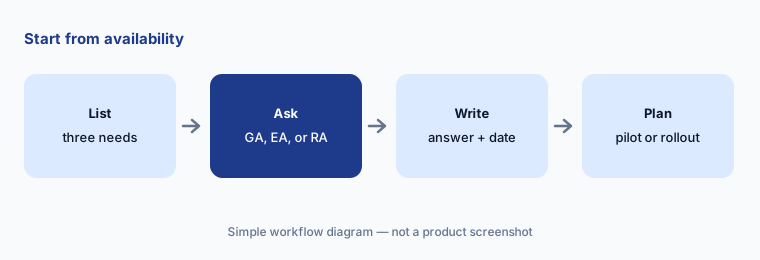
What it is: Both vendors use similar names — each has an “Agentic FNOL”, an agent framework, and AI for underwriting and product setup — but most of these items carry an early or restricted label. Before comparing features, list the AI jobs you actually need this year and ask each vendor which are generally available on your version, which are early access, and which are restricted.
A roadmap slide can look like a product. Writing down each answer with a date gives you something to hold the account team to.
Ask for the label:
List the three AI features you actually need this year. Have the claims and underwriting leads ask both vendors which are generally available, early access, or restricted, and write the answers down before any roadmap promise counts.
2. Agent frameworks: Guidewire Agentic Framework vs the Duck Creek Agentic AI Platform
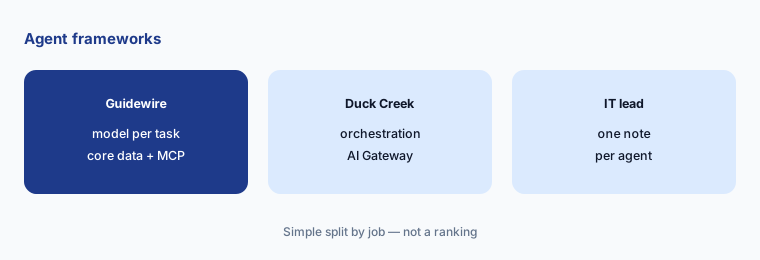
What it is: Guidewire’s Agentic Framework (Qusar, 3 August 2026) lets carriers choose a model per task and gives agents real-time access to policy, claims, and billing data on Guidewire Cloud, with MCP support for outside tools (Guidewire AI). Duck Creek’s Agentic AI Platform (28 April 2026) combines an insurance-native Model Context Repository, orchestration with autonomous and human-in-the-loop steps, AI Assurance for traceability and audit, and an AI Gateway with a marketplace, a registry, MCP, and A2A (Duck Creek AI).
Both let outside agents reach core data. The question for either is who decides what an agent may read and change, and where that decision is logged.
One note per agent:
Before connecting any AI agent to Guidewire or Duck Creek, have the IT architecture lead write what it reads, what it may change, and which model it uses. Have the business owner sign that note first.
3. FNOL: two “Agentic FNOL” products with different channels and labels
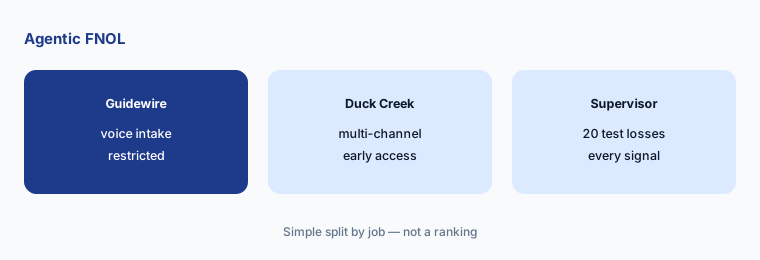
What it is: Guidewire’s Agentic FNOL guides claimants through first notice of loss with conversational AI voice and captures claim details into ClaimCenter; it is in Restricted Availability (Guidewire AI). Duck Creek’s Agentic FNOL, available to early access customers since 28 September 2026, takes digital, voice-to-text, and mobile reports, verifies coverage, assesses injury and legal severity, raises anomaly signals, logs each AI-driven determination, and flags exceptions for a person (Duck Creek AI).
Duck Creek’s version makes more determinations at intake. Each one — a coverage match, a severity level, an anomaly — needs a claims supervisor’s rule for what happens next.
Test with twenty losses:
Run twenty test losses through either vendor’s Agentic FNOL pilot. Have a claims supervisor check every coverage match and anomaly signal against the policy before any claim is routed.
4. Claims help: ProNavigator and Claim Summarization vs Document Intelligence
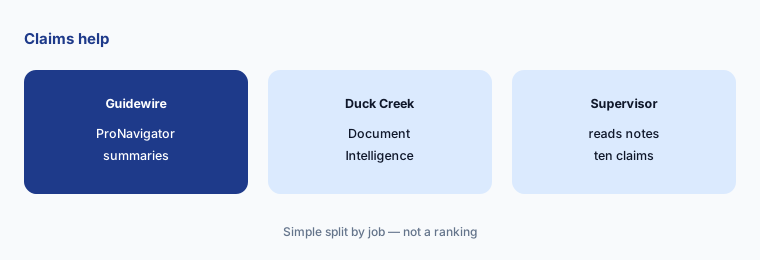
What it is: Guidewire’s ProNavigator (16 April 2026) gives role-specific answers grounded in the insurer’s own sources, with citations, role-based access, and audit trails, and Claim Summarization for ProNavigator writes claim summaries for adjusters (Restricted Availability in ClaimCenter, Early Access in InsuranceNow) (Guidewire AI). Duck Creek’s Document Intelligence summarises, classifies, and searches documents with citations; we found no availability label (Duck Creek AI).
A claim summary is a shortcut through the file. If an adjuster relies on it for a reserve or coverage call, the supervisor should know which facts it left out.
Read against the notes:
Have ten open claims summarised by whichever tool you can trial. Have the claims supervisor read each summary against the claim notes before any adjuster uses one for a reserve or coverage decision.
5. Underwriting: Policy Change for ProNavigator vs the Agentic Underwriting Workbench
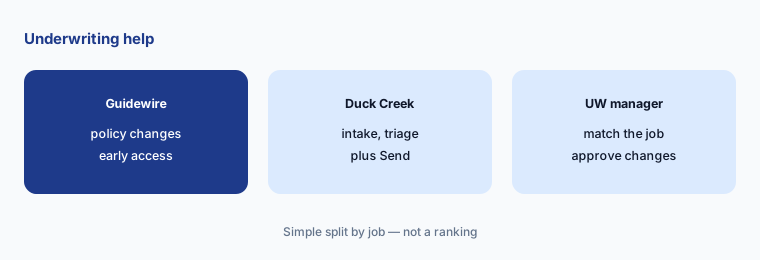
What it is: Guidewire’s Policy Change for ProNavigator is an embedded assistant that helps underwriters and service staff complete policy changes; it is Early Access (Guidewire AI). Duck Creek’s Agentic Underwriting Workbench uses AI agents for submission intake, triage, and enrichment, with no availability label we could find, and Duck Creek acquired the underwriting orchestration company Send on 7 July 2026, which stays available as a standalone product (Duck Creek AI).
These do different jobs: Guidewire’s helps change policies already written, Duck Creek’s helps with new submissions. Compare them against the job your underwriters spend most time on.
Match the job:
Have the underwriting manager count which job takes most underwriter time — new submissions or policy changes. Ask both vendors to demo that job, and have an underwriter approve every proposed change.
6. Product configuration, the roadmap, and when not to replatform
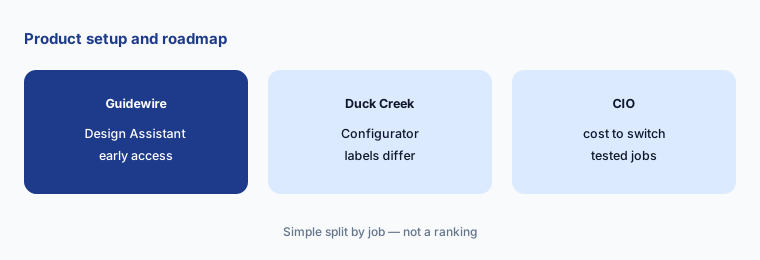
What it is: Guidewire’s Product Design Assistant for Advanced Product Designer helps automate insurance product configuration and is Early Access (Guidewire AI). Duck Creek’s Agentic Product Configurator generates requirements and manuscripts; its 29 April 2026 release says “available today” and cites “up to 50%” less effort, while its product page says Controlled Availability through Professional Services (Duck Creek AI). Guidewire’s next release, Revelstoke, is described as coming “this winter”.
Roadmaps are not features. If your current core covers the jobs you tested in sections 3 to 5, the cost and risk of moving policy, billing, and claims usually outweigh any AI gap between the two.
Price the switch:
Before replatforming for AI, have the CIO list which tested jobs the current core already covers and what a conversion would cost in staff time and risk, then decide.
Pricing context (October 2026)
Neither vendor publishes prices. We found no Guidewire price list, and Duck Creek’s pricing URL returns “page not found”. Both are quote-only as of 18 Oct 2026.
Ask each whether agent features are included in your cloud subscription or billed separately (per agent, per transaction, or by usage), whether model costs are passed through, which features are generally available on your version and in your region, and what Professional Services work is needed to turn each one on.
Uncertainty: Most AI items on both sides carry an Early Access, Restricted Availability, or early access label, and Guidewire notes that some features may not be available in all regions. Duck Creek’s Product Configurator is “available today” in its release but Controlled Availability on its product page, and we found no availability label for its Agentic Underwriting Workbench or Document Intelligence. Guidewire’s “more than 40% faster” is its internal benchmark for developer tools; Duck Creek’s “up to 50%” is an early result it reports. We did not test either system ourselves.
When it’s useful (honest take)
Useful when you already run Guidewire or Duck Creek and want to know what the other’s AI does, or you are choosing a core system for other reasons and want the AI picture side by side.
Less useful when you are an agency (see Applied vs Vertafore), your gap is underwriting recommendations on top of your current core (see Sixfold AI or Kalepa AI), you need auto claims estimating (see Tractable AI or CCC AI), or you are thinking of replatforming for AI alone.
Still choosing between Guidewire and Duck Creek? The $19 AI toolkit audit gives you a written plan for which tools to keep using and which to drop across your whole AI stack, including this pair.
Prefer to do it yourself? Spreadsheet — $9
Related options (educational)
| Need | Better home | Why |
|---|---|---|
| Agent framework, ProNavigator, and FNOL on Guidewire Cloud | Guidewire AI | Quote only; several items EA or RA |
| Agentic AI Platform, AI Gateway, and FNOL on Duck Creek | Duck Creek AI | Quote only; several items early or controlled access |
| Underwriting workbench or AI-native core from a newer vendor | Federato AI | Quote only |
| Pricing models alongside either core | hyperexponential AI | Quote only |
| Workers’ comp severity flags inside ClaimCenter | Gradient AI | Quote only; ClaimVoyant for ClaimCenter announced for later 2026 |
FAQ
What is the main difference between Guidewire and Duck Creek AI?
Both launched agent frameworks in 2026: Guidewire’s Agentic Framework in its Qusar release (3 August 2026) and Duck Creek’s Agentic AI Platform (28 April 2026). Duck Creek emphasises orchestration, governance, and an AI Gateway with MCP and A2A; Guidewire emphasises model choice and real-time core data access. This is not a ranking.
Do both have an Agentic FNOL?
Yes. Guidewire’s takes claims by conversational voice into ClaimCenter and is in Restricted Availability. Duck Creek’s takes digital, voice-to-text, and mobile reports and has been in early access since 28 September 2026.
Which features are generally available?
Both frameworks were announced as launched, but most of the named agents on top of them (FNOL, claim summaries, policy change, product design and configuration) carried an early, restricted, or controlled access label on the pages we read. Ask each vendor for the current label on your version and region, in writing.
How much do Guidewire and Duck Creek AI cost in October 2026?
Neither publishes prices. Both are quote-only (checked 18 Oct 2026).
Should we replatform for the AI?
Usually not. Test the jobs you need on the core you have first; if those are coming there too, the cost and risk of converting policy, billing, and claims tend to outweigh the AI difference.
Optional next step (if seats overlap)
If your carrier pays for a core suite, an AI add-on, a document tool, and chat seats that all touch the same claims and policies, that overlap is worth mapping. Map the overlap with the $19 AI toolkit audit or the $9 AI toolkit spreadsheet. Email Audit $19 or Toolkit spreadsheet $9.
Checkout is live via Stripe. After you pay, we email delivery (spreadsheet) or intake next steps (audit).