Tool · Insurance ops · Bevaya · Oct 2026
Bevaya AI review (Oct 2026): Roots Automation's insurance AI agents, InsurGPT document models, and human review queues
Bevaya is the new name and platform of Roots Automation, a company founded in 2018 by two former AIG executives. On 28 May 2026 it launched Bevaya, an AI agent platform for insurance, as both its new platform and its brand. Its agents read and sort insurance documents across claims, underwriting, and policy servicing, powered by its InsurGPT models, and send uncertain items to human review queues. This page explains the agents, the review design, and its published price. Each section has a Try this.
What this Bevaya page covers
This page is for claims operations, underwriting operations, and policy servicing leads at insurers, brokers, and third-party administrators who handle large volumes of documents. The question it answers: what Bevaya’s agents do with each document, when a person sees the work, and who approves an agent before it runs on its own.
Sources are Bevaya’s own pages, read on 18 October 2026: its home page, pricing page, human-in-the-loop and governed automation pages, its Claim Indexing agent page, and releases on its launch (28 May 2026), its Guidewire-validated indexing accelerator (7 January 2026), and its loss-run benchmark (23 September 2026). The launch release says Bevaya replaces the company’s previous platform and that Roots Automation, Inc. remains the legal entity.
Bevaya says its agents run on InsurGPT, an ensemble of models trained on more than 300 million insurance documents, and that it has more than 120 production deployments, including at three of the top five US P&C carriers. Its May launch release gives 115+ deployments in one place and 120+ in another; its current pages say 120+.
Ground rules: the operations lead approves every agent’s go-live, the review queue owner decides every confidence threshold and every low-confidence item, the claims operations lead checks indexing before it runs unattended, and an account manager checks every certificate and endorsement before it reaches a client. Bevaya’s results figures are its claims, not our measurement. This page explains features. It is not coverage, claims, or legal advice.
Major features (with how someone uses them)
Examples at a glance: each feature has a concrete example from a real job plus a short Try this you can run this week.
1. Claim Indexing agent: sorting incoming claim documents (primary)
What it is: Bevaya’s Claim Indexing agent reads documents arriving by email, mailroom scans, broker portals, and file drops, classifies each page, captures claim-tying fields such as type, claimant, and claim and policy numbers, and routes the file to the right adjuster. On 7 January 2026 Bevaya said its Document Indexing Accelerator was validated by Guidewire and available to ClaimCenter users on Guidewire Cloud through the Guidewire Marketplace, classifying more than 70 document types with 98%+ accuracy (its figure).
Indexing errors are quiet: a legal demand filed under the wrong claim can miss a deadline. Before the agent runs unattended, someone should check a real sample against the claim files.
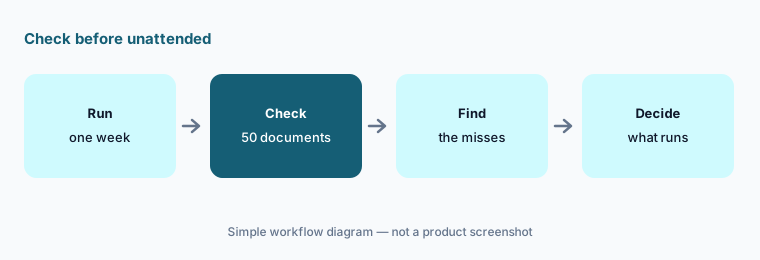
Primary workflow:
Run one week of incoming claim documents through a Bevaya indexing agent. Have the claims operations lead check fifty indexed documents against the claim file before the agent runs unattended.
2. Human review queues and Highlight Mode
What it is: Bevaya’s human-in-the-loop design sends work straight through only when each extracted field clears its confidence threshold and the flow’s business rules; anything else (low confidence, missing documents, appetite hits, duplicates) goes to a review queue, assigned by line of business, document type, or reviewer expertise. Highlight Mode shows the exact spot on the source page behind each field, corrections feed back into the models, and an audit trail records the original output, reviewer, correction, and time.
The thresholds decide how much work a person never sees. The review queue owner should set them per field, watch override rates, and raise them only with evidence.
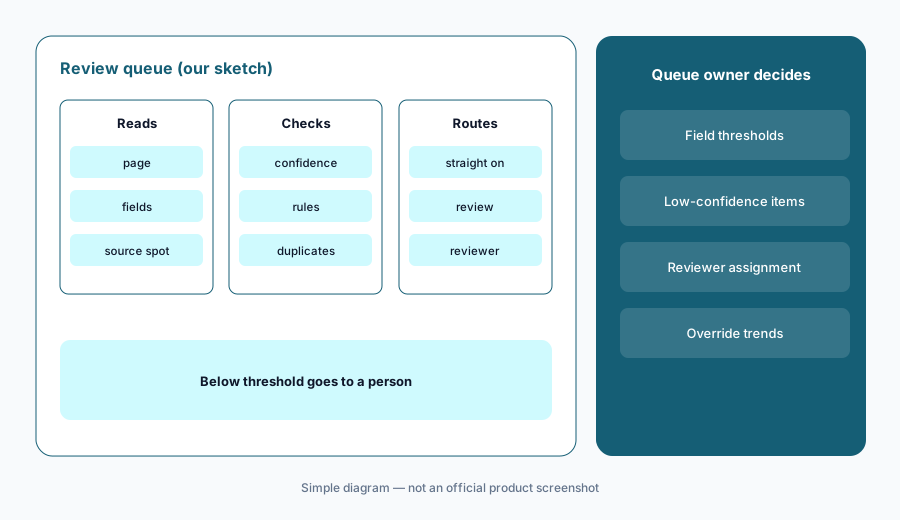
Owner sets thresholds:
Have the review queue owner track how often reviewers change each field for one month. Lower a confidence threshold only on fields reviewers almost never change.
3. Underwriting agents: submissions, loss runs, and schedules
What it is: Bevaya lists underwriting agents that watch broker inboxes, classify submissions, extract ACORD and supplemental data into underwriting systems, normalize loss runs across carriers, read statements of values and property schedules, assemble renewal packages, and compare expiring and renewal policy terms for underwriter review. In its 23 September 2026 benchmark, Bevaya says its loss-run model reached 93.1% field accuracy against 85.3% for the strongest general-purpose model it tested, and that a second checking model plus human review brings production accuracy to 98%+.
A loss run with one wrong total can change a price. The benchmark is the vendor’s own test, so the underwriting operations lead should check a sample of your own carriers’ loss runs.
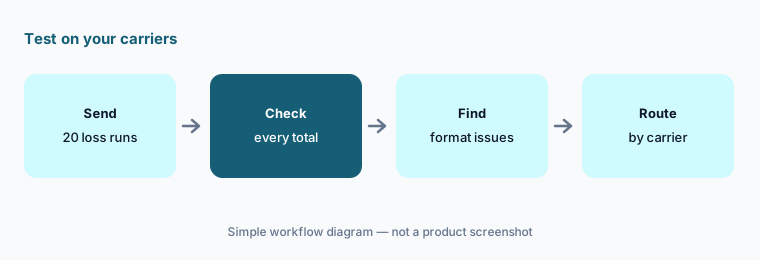
Test on your carriers:
Have the underwriting operations lead run twenty of your own loss runs through Bevaya. Check every total and claim count before any loss run skips review.
4. Policy servicing agents: endorsements, certificates, and audits
What it is: Bevaya’s policy servicing agents read endorsement requests, validate them against the policy, draft the change, and route it for approval; generate certificates of insurance from policy data and check additional insured wording; and extract payroll and classification data for premium audits. Its home page shows a customer quote about certificate turnaround going from 24 hours to minutes.
A certificate or endorsement tells a client what they are covered for. Fast turnaround is useful only if a licensed person has checked the wording that matters.
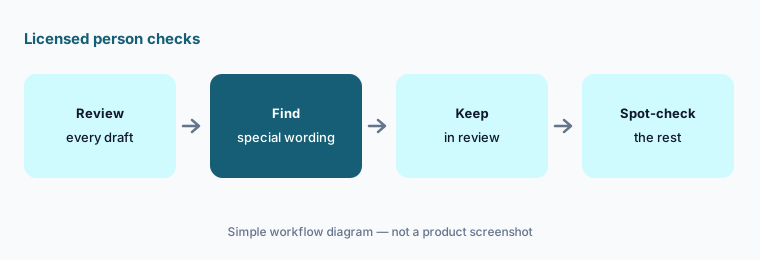
Licensed person checks:
Have the account manager review every certificate Bevaya drafts for two weeks. Keep any with contract-specific additional insured wording in review before certificates go out unchecked.
5. InsurGPT and the AI Assistant: reading vendor accuracy claims
What it is: InsurGPT is Bevaya’s ensemble of specialised models, which it says are trained on more than 300 million non-public insurance documents labeled by insurance practitioners on its staff. The launch release adds an AI Assistant that helps build agents and answers questions about documents with reasoning, confidence, and citations, plus multimodal reading of photos, diagrams, and scans.
Accuracy figures depend on the documents and fields measured. Ask which fields, which lines of business, and whether the figure includes human review.
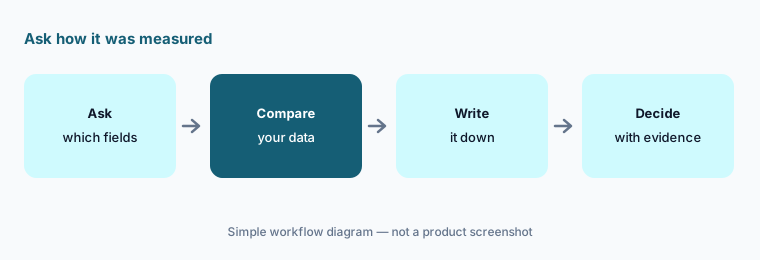
Ask how it was measured:
Have the claims technology lead ask Bevaya for field-level accuracy on your three most common document types, before and after human review, and compare it with your own correction rates.
6. Governed flows: versions, environments, and go-live sign-off
What it is: Bevaya’s governed automation page describes locked flow versions that can be rolled back, separate draft, staging, and production environments, role-based access, and an audit log of every publish, role change, review, and correction. Its pricing page lists connectors for Guidewire, Duck Creek, OnBase, Outlook, file transfer, and custom APIs.
Moving a flow to production is the moment an agent starts acting on real claims or policies. That step should have a named approver and a written test result.
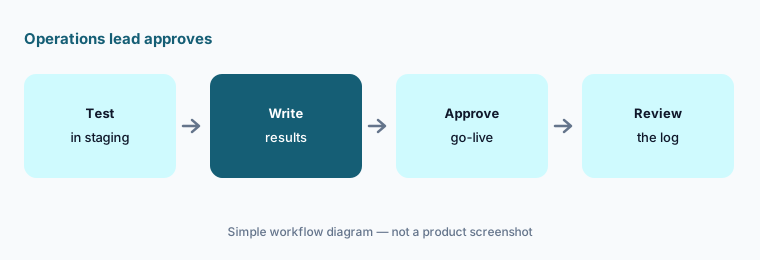
Operations lead approves:
Have the operations lead approve every Bevaya flow before production, only after a staging test on one hundred past documents with written results.
Pricing context (October 2026)
Bevaya publishes prices. Its pricing page (read 18 Oct 2026) says an AI agent subscription starts “as low as $4,000 per AI agent / month”, billed annually, with credits pooled across all agents. It shows discounts of 5% for two agents, 10% for three (an example of $10,800 a month), and up to 20% for four or more, plus up to 15% off at higher credit volumes. One credit is roughly the work of extracting one standard page; its examples range from 1 credit to classify a page to 60 credits for a full first notice of loss setup.
The same page lists 200,000 included credits per agent per year in one place and 100,000 in others, so confirm the included credits in writing. Bevaya cites 98%+ accuracy, 120+ production deployments, 70%+ straight-through processing within 90 days, and 3–4× capacity gains. These are vendor claims, not our measurement.
Uncertainty: We read Bevaya’s own pages and releases. Prices are as published on 18 Oct 2026 and may change; the included-credit figure differs within the pricing page. Deployment counts differ between 115+ and 120+ across Bevaya’s materials. The loss-run benchmark is Bevaya’s own test. We did not test Bevaya ourselves.
When it’s useful (honest take)
Useful when your claims, underwriting, or servicing teams spend hours sorting and keying documents, you want agents that run on your existing systems (Guidewire and others) with confidence-based review, and a named operations lead will approve every agent before it runs on its own.
Less useful when you want a full claims system with AI built in (see Five Sigma AI), your gap is fraud screening (see FRISS AI), or you need casualty severity signals (see CLARA Analytics AI).
Paying for Bevaya AI and a few other AI tools? The $9 AI toolkit spreadsheet lists every AI subscription you have, what each one costs, and how fast it pays for itself, so you can see which ones are worth the money.
Want someone to do it for you? AI toolkit audit — $19
Related options (educational)
| Need | Better home | Why |
|---|---|---|
| Insurance AI agents for claims, underwriting, and servicing documents | Bevaya AI (this page) | From $4,000 per agent per month, billed annually |
| Claims system or add-on with multi-agent AI | Five Sigma AI | Quote only |
| Medical and legal document summaries tied to claim signals | CLARA Analytics AI | Quote only |
| Agency document extraction inside the agency system | Applied Epic AI or Vertafore AI | Quote only |
| Underwriting submission recommendations | Sixfold AI | Quote only |
FAQ
Is Bevaya the same company as Roots Automation?
Yes. Bevaya launched on 28 May 2026 as the company’s new platform and brand; Roots Automation, Inc. remains the legal entity.
What does Bevaya cost in October 2026?
Bevaya’s pricing page says agents start at $4,000 per AI agent per month, billed annually, with pooled credits and multi-agent discounts. Confirm included credits, since the page gives two different figures.
What is InsurGPT?
Bevaya’s ensemble of specialised AI models, which it says are trained on more than 300 million insurance documents.
Does Bevaya work with Guidewire?
Bevaya says its Document Indexing Accelerator was validated by Guidewire and is available to ClaimCenter users on Guidewire Cloud through the Guidewire Marketplace (7 January 2026).
Who should approve Bevaya output?
The operations lead for every agent’s go-live, the review queue owner for thresholds and low-confidence items, the claims operations lead for indexing, and an account manager for every certificate and endorsement.
Optional next step (if seats overlap)
If your operations team pays per AI agent, plus a document capture tool, a claims system add-on, and chat seats that all read the same documents, that overlap is worth mapping. Map the overlap with the $19 AI toolkit audit or the $9 AI toolkit spreadsheet. Email Audit $19 or Toolkit spreadsheet $9.
Checkout is live via Stripe. After you pay, we email delivery (spreadsheet) or intake next steps (audit).