Tool · Insurance ops · CLARA Analytics · Oct 2026
CLARA Analytics AI review (Oct 2026): Agentic Intelligence, claim document intelligence, and predictive triage for casualty and workers' comp claims
CLARA Analytics builds claims AI for workers’ comp, auto liability, and general liability: predictions about which claims will grow in cost, attract an attorney, or need an SIU look, built from its own large claims dataset. In September 2026 it launched Agentic Intelligence, AI agents on every claim from first notice of loss to close, inside its CLARAty.ai platform. This page explains each part, what it reads, and who approves what it suggests. Each section has a Try this.
What this CLARA Analytics page covers
This page is for casualty and workers’ comp claims leaders, adjusters, nurse case managers, legal panel managers, and SIU teams at carriers, MGAs, third-party administrators, and self-insured employers. The question it answers: what CLARA predicts or summarizes, what it reads to get there, and which named person acts on it.
Sources are CLARA’s own pages, read on 18 October 2026: its home page, its Agentic Intelligence release (22 September 2026), its Triage and DocIntel Pro integration release (27 July 2026), and its DocIntel Pro, Triage, Fraud, Litigation, and Treatment pages. CLARA says its agents draw on a 10-year dataset of more than 7 million claims, and that it can be fully implemented in 8 to 12 weeks.
CLARA’s own line on control is clear: “Adjusters keep the decision; CLARA owns the evidence trail behind it.” Its product pages describe its predictions with numeric values; this page calls them signals and focuses on the reasons CLARA shows next to them.
Ground rules: the claims supervisor approves every reserve change and every attorney referral, the adjuster decides every next step on a claim, the SIU lead decides every fraud referral, and the nurse case manager owns care recommendations. CLARA’s results figures are its claims, not our measurement. This page explains features. It is not coverage, claims, medical, or legal advice.
Major features (with how someone uses them)
Examples at a glance: each feature has a concrete example from a real job plus a short Try this you can run this week.
1. Agentic Intelligence: severity changes with reasons (primary)
What it is: Launched 22 September 2026, Agentic Intelligence puts “a team of AI agents on every claim, from first notice of loss through resolution, while adjusters stay in control of every decision.” CLARA says the agents watch how a claim develops and surface changes in severity, litigation potential, fraud risk, and closure opportunities, with a transparent rationale tied to the claim’s documents and fields, data-freshness checks, cohort drill-downs, and a conversational agent for questions.
A rising-severity flag is an invitation to look, not a reserve change. The reasoning matters more than the flag: if it points to the wrong document or stale data, the supervisor should see that before money moves.
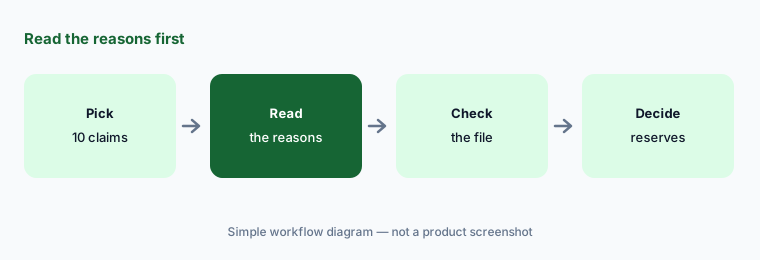
Primary workflow:
Pick ten open workers' comp claims CLARA flags for rising severity. Have the claims supervisor read its reasoning against the file before any reserve moves.
2. DocIntel Pro: visit-level medical summaries with in-line citations
What it is: CLARA Claims DocIntel Pro (formerly CLARA Optics) indexes, transcribes, and summarizes medical records and legal demands. In July 2026 CLARA added Visit Level Summary, which groups clinical notes into a timeline by patient visit, and In-Line Citations, which link each summary line to the exact page and highlighted text in the source. CLARA cites an 83% reduction in time spent reviewing medical records.
A citation makes checking fast, which is the point. The adjuster or nurse case manager still needs to click through on anything that changes the claim’s direction.
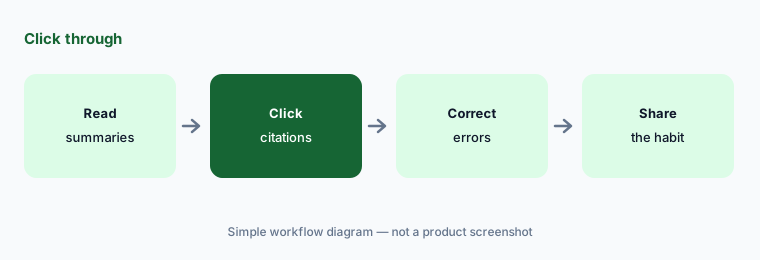
Click through:
Have a nurse case manager click every in-line citation on five DocIntel Pro visit summaries. Note any line the source doesn’t support before summaries are used in a reserve or treatment discussion.
3. Triage and Risk Notes: alerts that now read the documents
What it is: CLARA Triage predicts claim severity from years of prior claims, sends real-time alerts (severity, attorney involvement, subrogation, and custom alerts), and explains them in Risk Notes. Since CLARA’s 27 July 2026 integration, insights from medical records and legal demands in DocIntel Pro feed the Triage models, alerts can change as documents arrive, and Risk Notes include document summaries. CLARA also says Triage can fast-track simple claims with 95% accuracy on day-one data.
Alerts that move when a document arrives are useful, and noisy. The claims supervisor should decide which alerts reach adjusters and which only reach a team lead.
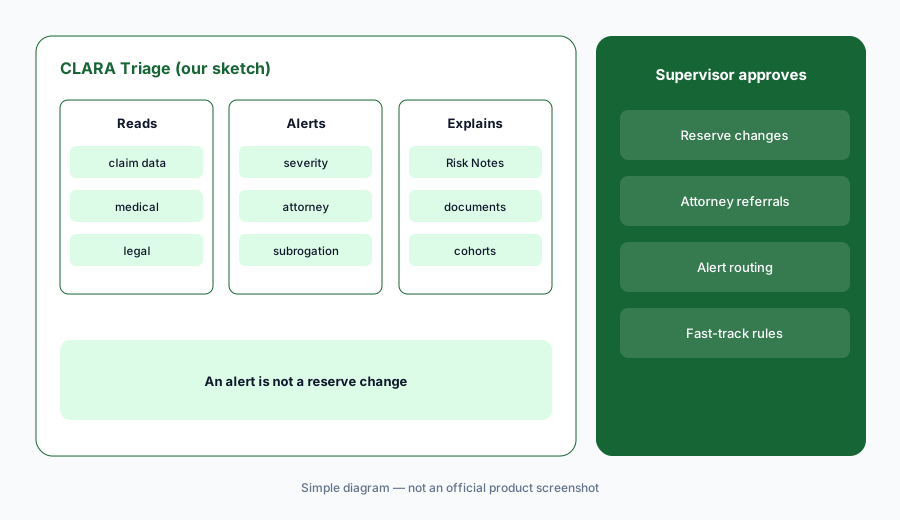
Supervisor routes alerts:
Have the claims supervisor review one month of CLARA Triage alerts with team leads. Write down which alert types go to adjusters and which only to leads before adding any new alert.
4. Litigation: attorney involvement and defense counsel insight
What it is: CLARA Litigation predicts how likely a claim is to involve an attorney or go to litigation, and analyzes defense and plaintiff attorney outcomes on prior claims so adjusters and legal panel managers can compare counsel, with the contributing factors shown. CLARA’s own research says represented casualty claims cost about 390% more in indemnity than unrepresented ones.
Changing counsel or settling early are legal strategy calls. The tool can show history; the claims supervisor and legal panel manager should decide, with counsel, what to do with it.
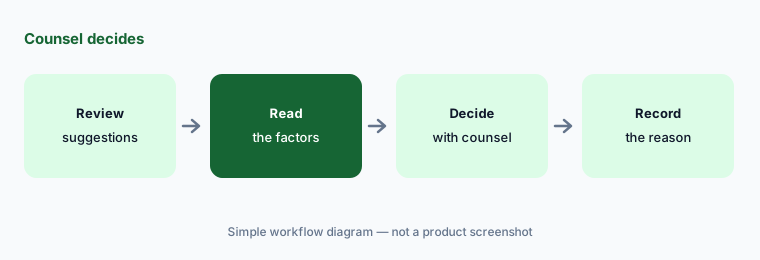
Counsel decides:
Have the legal panel manager review ten CLARA counsel suggestions with the claims supervisor and in-house counsel. Record the reason for each decision before any panel change.
5. CLARA Fraud: provider, attorney, and claimant networks for SIU
What it is: CLARA Fraud looks at relationships between medical providers, legal counsel, and claimants across workers’ comp claims, maps suspicious networks, alerts when a set threshold is crossed as a claim develops, and drafts SIU referrals with summarized claim notes and the indicators behind them, such as multiple open claims for one claimant or one attorney on many similar claims.
A network pattern is not proof against any one claimant or provider. The SIU lead should read the indicators and decide whether a referral is justified.
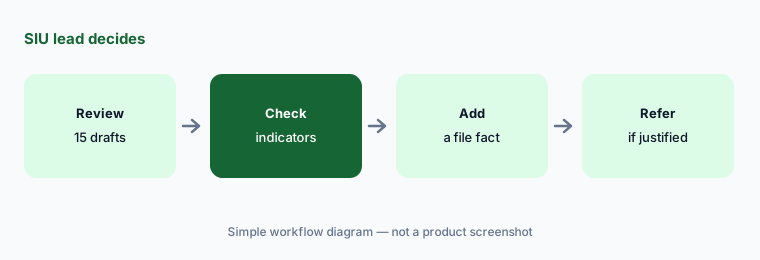
SIU lead decides:
Have the SIU lead review fifteen CLARA-drafted referrals against the files. Require one supporting fact from the file on every referral before any is accepted.
6. Treatment: provider outcome data and care direction
What it is: CLARA Treatment uses outcomes on closed claims to show which medical providers are associated with better results across cost, treatment duration, opioid use, and other factors, so adjusters, nurse case managers, and network teams can see what to expect when a provider joins a claim. CLARA says its database covers more than 300,000 providers.
Where an injured worker can be directed is set by each state’s rules. Provider data can inform a conversation; it should not override the worker’s rights or a treating doctor’s judgment.
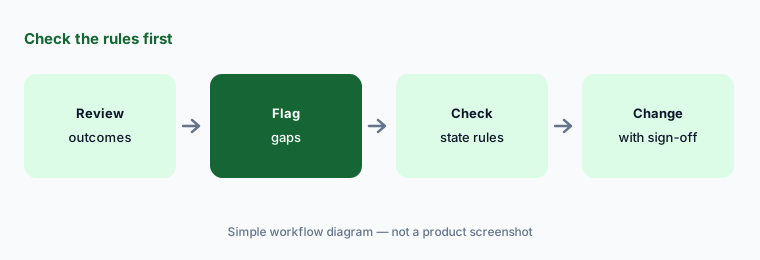
Check the rules first:
Have the network manager review CLARA provider outcomes for one specialty with the medical director. Confirm with counsel what your state allows before changing any provider list.
Pricing context (October 2026)
CLARA does not publish prices; its /pricing address returns “not found”, and its pages offer demos, a proof of concept, and an ROI calculator. Pricing is quote-only as of 18 Oct 2026. Ask whether Agentic Intelligence is included in CLARAty.ai or priced separately, whether DocIntel Pro is priced per page or per claim, and what the 8–12 week implementation includes.
CLARA cites a dataset of more than 7 million claims, an 83% reduction in medical-record review time, 95% accuracy fast-tracking simple claims on day-one data, and indemnity costs about 390% higher on represented claims. These are vendor claims and vendor research, not our measurement.
Uncertainty: We read CLARA’s own pages and releases. CLARA calls Agentic Intelligence the industry’s first end-to-end agentic claims platform; that is its claim. Its product pages describe predictions with numeric values, which we call signals. We could not confirm which features need Agentic Intelligence versus the existing modules, or prices, and we did not test CLARA ourselves.
When it’s useful (honest take)
Useful when you handle workers’ comp, auto liability, or general liability claims with medical and legal complexity, you want earlier severity and attorney signals with reasons, and a named claims supervisor will approve every reserve and attorney referral.
Less useful when your main need is fraud screening across personal lines (see FRISS AI), you want a claims system with AI built in (see Five Sigma AI), or your gap is group health underwriting (see Gradient AI).
Paying for CLARA Analytics AI and a few other AI tools? The $9 AI toolkit spreadsheet lists every AI subscription you have, what each one costs, and how fast it pays for itself, so you can see which ones are worth the money.
Want someone to do it for you? AI toolkit audit — $19
Related options (educational)
| Need | Better home | Why |
|---|---|---|
| Severity, litigation, and fraud signals with document summaries for casualty claims | CLARA Analytics AI (this page) | Quote only |
| Workers’ comp severity triage and reserve support | Gradient AI | Quote only |
| Fraud and risk signals at claims, underwriting, and SIU | FRISS AI | Quote only |
| Claims system with multi-agent AI | Five Sigma AI | Quote only |
| Claim document indexing and summaries as AI agents | Bevaya AI | Public per-agent price |
FAQ
What is CLARA Agentic Intelligence?
AI agents CLARA launched on 22 September 2026 inside CLARAty.ai that follow each casualty or workers’ comp claim from first notice of loss to close and surface changes in severity, litigation potential, fraud risk, and closure opportunities, with reasons. CLARA says adjusters keep every decision.
What is CLARA DocIntel Pro?
CLARA’s document tool (formerly CLARA Optics) that indexes and summarizes medical records and legal demands. Since July 2026 it offers visit-level summaries with in-line citations to the source page.
Which lines of business does CLARA cover?
Workers’ comp, auto liability, and general liability, for carriers, MGAs, third-party administrators, and self-insured organizations.
How much does CLARA cost in October 2026?
CLARA does not publish prices. Treat it as quote-only and ask how claims or pages are counted.
Who should approve CLARA output?
The claims supervisor for every reserve change and attorney referral, the adjuster for next steps on each claim, the SIU lead for fraud referrals, and the nurse case manager for care recommendations.
Optional next step (if seats overlap)
If your claims team pays for a claims intelligence platform, a document summary tool, a fraud add-on, and chat seats that all read the same medical records, that overlap is worth mapping. Map the overlap with the $19 AI toolkit audit or the $9 AI toolkit spreadsheet. Email Audit $19 or Toolkit spreadsheet $9.
Checkout is live via Stripe. After you pay, we email delivery (spreadsheet) or intake next steps (audit).