Tool · Insurance ops · FRISS · Oct 2026
FRISS AI review (Oct 2026): Trust Automation fraud detection at claims, underwriting, and SIU, plus AI-made document checks for P&C insurers
FRISS sells what it calls Trust Automation to property and casualty insurers: real-time risk signals on claims, applications, and renewals, each with the reasons attached, so low-risk files move straight through and the rest go to a person. Around that sit Investigations for SIU case work, Media Check for altered or AI-made photos and PDFs, and daily sanctions screening. This page explains each part, who owns its thresholds, and why a flag is never a finding. Each section has a Try this.
What this FRISS page covers
This page is for claims leaders, SIU leads and investigators, underwriting managers, and compliance officers at P&C insurers. The question it answers: where FRISS flags a claim, an application, or a document, which settings decide what gets flagged, and which named person decides what happens next.
Sources are FRISS’s own pages, read on 18 October 2026: its home page and FAQ, its Claims Analytics, Underwriting Analytics, Investigations, KYC & Compliance, and Media Check pages, and its State of Insurance Fraud 2026 report. FRISS says it launched its Trust Automation platform in 2022 and runs it across more than 300 implementations in over 45 countries.
FRISS’s 2026 report adds context for buyers: in its chapter on AI threats, 78% of the fraud practitioners surveyed said agentic AI is somewhat or very likely to influence insurance fraud within two years, and only 2% said they feel very well prepared. Synthetic documents or IDs (76%) and deepfake evidence (71%) topped their list of concerns. These are survey answers reported by a vendor that sells detection tools, not our findings.
Ground rules: a FRISS flag is a risk signal, not a finding of fraud. The SIU lead decides every referral, the adjuster decides every payment, the underwriter decides every decline, and the compliance officer decides every sanctions match. FRISS’s results figures are its claims, not our measurement. This page explains features. It is not coverage, claims, or legal advice.
Major features (with how someone uses them)
Examples at a glance: each feature has a concrete example from a real job plus a short Try this you can run this week.
1. Claims Analytics: risk signals and the referral threshold (primary)
What it is: FRISS Claims Analytics checks each claim against the insurer’s policy and claims history plus outside data, and returns a risk signal with the reasons behind it. FRISS says it “reveals networks” and hidden patterns using transparent predictive models and text mining. Claims above the insurer’s threshold are flagged for a person; FRISS’s FAQ says a reviewer can always see why a file was flagged and overrule it. FRISS cites a 75% reduction in false positives.
The threshold is the real decision. Lower it and the SIU gets more referrals, more honest customers wait, and investigators spread thinner. Raise it and real problems pass. Someone should see evidence before it moves either way.
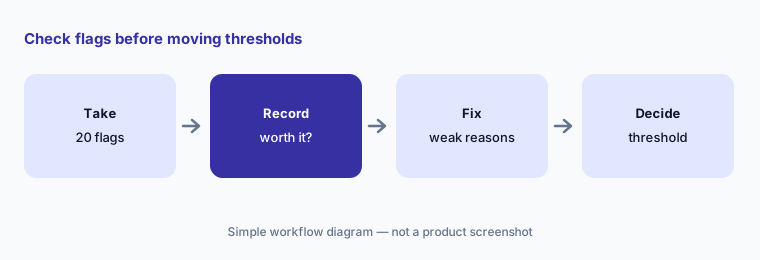
Primary workflow:
Take the last twenty claims FRISS flagged for review. Have the SIU lead record which ones were really worth investigating before any threshold change raises the number of referrals.
2. Fast-tracking low-risk claims: who owns the straight-through rule
What it is: The other side of the same threshold is the fast track. FRISS says its claims tool can raise fast-tracked claims to 90% and “safely enable straight-through processing”, and its home page says “90% of honest claims fast-tracked”. In practice the insurer decides which claim types, amounts, and lines can be paid without a person once FRISS shows no concern.
A fast-tracked claim is a payment decision made by a rule. The claims supervisor who owns that rule should know which claims it covers and sample them.
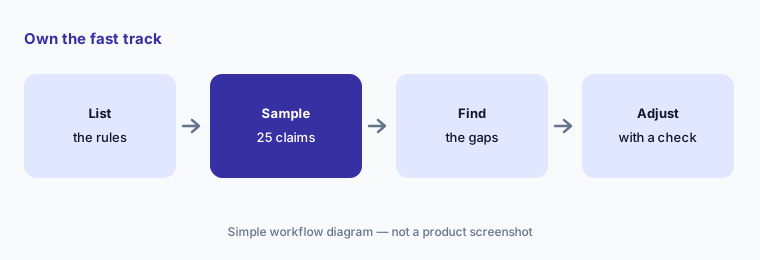
Own the fast track:
Have the claims supervisor list every claim type FRISS lets skip review. Sample twenty-five fast-tracked claims each month, and add a check for any gap before widening the fast track.
3. Underwriting Analytics: screening at the quote
What it is: FRISS Underwriting Analytics checks a new application or renewal in real time against internal and external data and answers three questions FRISS puts plainly: who am I doing business with, am I allowed to do business with them, and do I want to. Applications that clear the insurer’s settings can bind straight through; the rest go to an underwriter. FRISS says it plugs into Guidewire, Sapiens, Duck Creek, or other core systems, and cites up to 50% shorter processing times.
A signal at the quote can stop a good customer at the front door. The underwriter, not the model, decides whether an application is declined or simply needs more information.
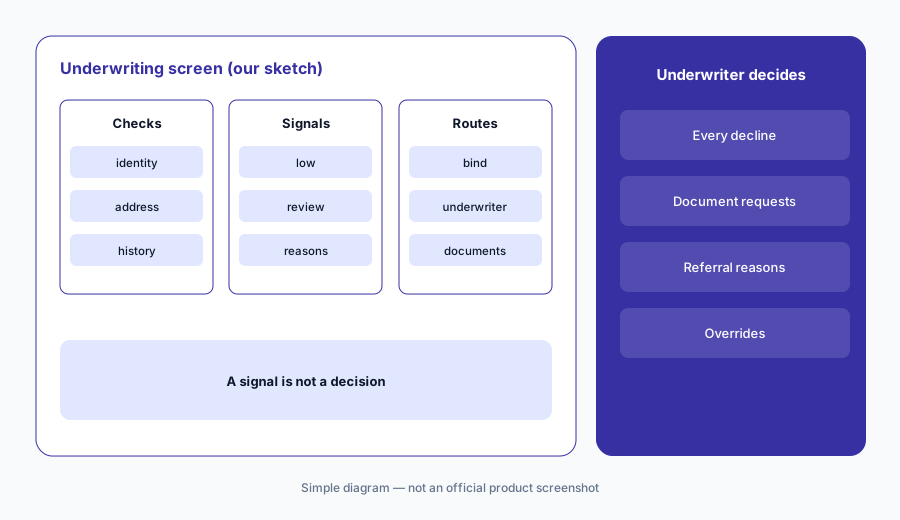
Underwriter decides:
Have the underwriting manager review thirty applications FRISS referred. Write down why each was flagged, and keep every decline with a named underwriter before any setting sends more applications to review.
4. Investigations: SIU case management and shared evidence
What it is: FRISS Investigations (FRISS Enterprise Investigations) is a case system for special investigation units: manage workloads, register findings, “connect the dots between files”, and share authorized case information with internal and external parties, with every step traceable. FRISS says it works on its own or with its other tools, and cites a 47% productivity gain; one insurer it quotes reports 300% more case volume with the same staff.
A case system makes investigations faster, but the conclusion is still a person’s. Every closed case should say who decided, on what evidence, and what the claimant was told.
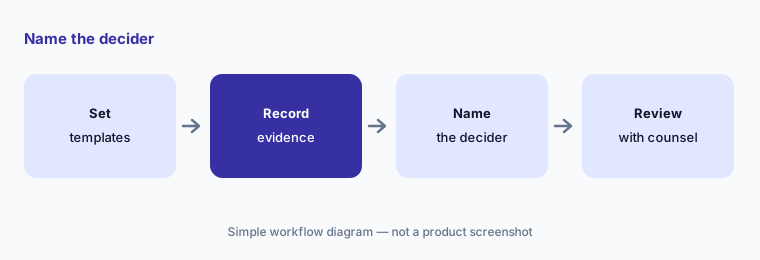
Name the decider:
Have the SIU lead add a required field to every FRISS case for the named investigator who made the decision. Review ten closed cases with counsel each quarter before changing referral rules.
5. Media Check: altered, reused, and AI-made images and PDFs
What it is: FRISS Media Check checks claim photos and documents inside the existing workflow: duplicate image detection against images seen online or in databases, metadata extraction, image manipulation detection, a PDF integrity check for altered invoices and official documents, and AI deepfake detection, across common image formats and PDF. In FRISS’s 2026 report, 58% of practitioners expect deepfakes to become the main fraud tool, yet only 20% treat media verification as a critical priority.
A manipulation flag is a reason to ask questions, not proof. Phones and editing apps change files for innocent reasons, so a person should look before anyone treats a photo as faked.
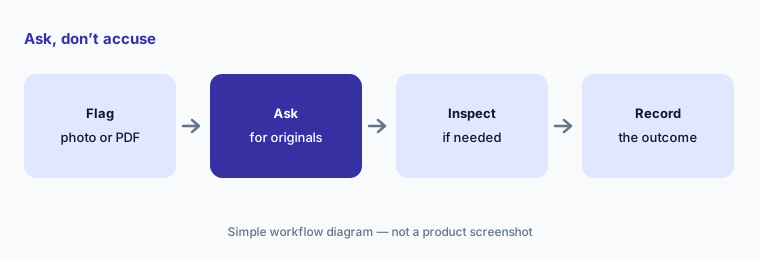
Ask, don’t accuse:
Have the adjuster ask for original files on the next ten Media Check flags before any referral. Record how many cleared, and share the tally with the SIU lead monthly.
6. KYC & Compliance: daily sanctions and PEP screening
What it is: FRISS KYC & Compliance (FRISS Compliance Screening) screens customers against sanctions and politically exposed person lists, not once but daily as the lists change, supports customer due diligence and beneficial-owner checks, and keeps an audit trail of each step. FRISS says it can go live within two weeks.
Name matches are common and most are false. A compliance officer, not the screening tool, should decide whether a match is real and what to do about it.
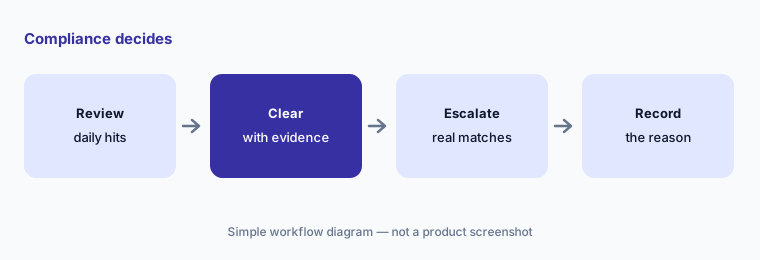
Compliance decides:
Have the compliance officer review every FRISS screening hit for one month. Write a clearing procedure with a named reviewer and reason for each, before any hit is cleared automatically.
Pricing context (October 2026)
FRISS does not publish prices; its /pricing address returns “not found”, and its pages offer demos and specialist calls. Pricing is quote-only as of 18 Oct 2026. Ask whether claims, underwriting, investigations, compliance screening, and Media Check are priced separately, what counts as a screened transaction, and what implementation and core-system integration cost.
FRISS cites a 75% reduction in false positives, up to 90% of claims fast-tracked, a 66% decrease in claims handling time, up to 50% shorter underwriting processing, and a 47% productivity gain for investigators; one customer it quotes reports $21 million in fraud savings in its first two years. These are vendor and customer claims, not our measurement.
Uncertainty: We read FRISS’s own pages and report chapters. FRISS uses its own wording for each flag; we call them risk signals. The report’s exact publication date isn’t shown on FRISS’s site. FRISS’s release on Santalucía Seguros expanding from claims and investigations into underwriting carries a 2026 date, while Spanish press covered the same news in 2025, so we cite it without a date. Results figures are vendor and customer claims. We could not confirm prices, and we did not test FRISS ourselves.
When it’s useful (honest take)
Useful when you are a P&C insurer that wants consistent fraud and risk signals at claims, underwriting, and SIU in one platform, your core system is Guidewire, Duck Creek, Sapiens, or similar, and a named SIU lead will own every referral threshold.
Less useful when your main gap is casualty and workers’ comp severity (see CLARA Analytics AI), you want AI to handle whole claims (see Five Sigma AI), or your problem is document intake rather than fraud (see Bevaya AI).
Paying for FRISS AI and a few other AI tools? The $9 AI toolkit spreadsheet lists every AI subscription you have, what each one costs, and how fast it pays for itself, so you can see which ones are worth the money.
Want someone to do it for you? AI toolkit audit — $19
Related options (educational)
| Need | Better home | Why |
|---|---|---|
| Fraud and risk signals at claims, underwriting, and SIU; media checks | FRISS AI (this page) | Quote only |
| Fraud, severity, and litigation signals on casualty and workers’ comp claims | CLARA Analytics AI | Quote only |
| Multi-agent claims handling with fraud signals built in | Five Sigma AI | Quote only |
| Photo estimating with claim review for auto | Tractable AI | Quote only |
| Fraud checks inside a carrier core system | Guidewire AI or Duck Creek AI | Quote only; several items early or restricted access |
FAQ
What is FRISS Trust Automation?
FRISS’s name for its platform that returns a real-time risk signal, with reasons, on each claim, application, and renewal, so low-risk files move straight through and the rest go to a person. It covers claims, underwriting, investigations, compliance screening, and media checks.
Does a FRISS flag mean a claim is fraudulent?
No. A flag is a risk signal that a person should look. The SIU lead decides whether to refer, and the adjuster decides whether to pay.
What does FRISS Media Check look for?
Reused images, metadata that doesn’t fit, edited images, altered PDFs such as invoices, and AI-generated images, inside the claims workflow.
How much does FRISS cost in October 2026?
FRISS does not publish prices. Treat it as quote-only and ask how transactions are counted and which modules are separate.
Who should approve FRISS output?
The SIU lead for every referral threshold and referral, the adjuster for every payment, the claims supervisor for fast-track rules, the underwriter for every decline, and the compliance officer for every sanctions match.
Optional next step (if seats overlap)
If your claims team pays for a fraud platform, a media forensics add-on, a claims intelligence tool, and chat seats that all touch the same file, that overlap is worth mapping. Map the overlap with the $19 AI toolkit audit or the $9 AI toolkit spreadsheet. Email Audit $19 or Toolkit spreadsheet $9.
Checkout is live via Stripe. After you pay, we email delivery (spreadsheet) or intake next steps (audit).