Compare · Insurance ops · Oct 2026
Sixfold vs Federato (Oct 2026): AI underwriting recommendations vs a RiskOps underwriting workbench for P&C carriers
Sixfold and Federato both put AI in front of commercial underwriters, but they start from different jobs. Sixfold reads each submission and gives a recommendation with its rationale and cited sources. Federato began as a RiskOps underwriting workbench that ranks the queue against portfolio goals and guardrails, and now sells itself as a full AI-native core system. This page splits the two by job, by what each may do without a person, and by who signs off. It is not a ranking, and each section has a Try this.
What this comparison covers
This page is for chief underwriting officers, underwriting managers, and underwriting operations leads at commercial P&C carriers and MGAs choosing between Sixfold and Federato, or wondering whether they need both. The question it answers: which underwriting job each tool takes on, what each may do without an underwriter, and which person approves the output.
Facts come from our Sixfold AI and Federato AI reviews, both checked against the vendors’ own pages on 18 October 2026: Sixfold’s AI Underwriter launch post (16 June 2026), P&C product page, Institutional Intelligence post (17 April 2026) and Distribution Intelligence post (24 September 2026); and Federato’s Control Tower page, Control Tower launch post (13 October 2025), Submission Triage post (29 April 2025) and platform overview. Neither publishes prices.
A note on labels. “RiskOps underwriting workbench” describes how Federato began and how many carriers use it. Its site today leads with being an AI-native core system covering policy administration, billing, and claims, so a buyer may be pitched a core replacement. Sixfold sells a layer that works with whatever workbench or policy system you already have.
Ground rules for either tool: a senior underwriter approves every decline, referral, and broker email; the underwriting manager owns the written guidelines and every automatic control; an underwriter approves every drafted quote; and vendor results figures are their claims, not our measurement. This comparison is not a ranking, and it is not coverage, underwriting, or legal advice.
| Question | Sixfold (AI Underwriter) | Federato (Control Tower and AI-native core) |
|---|---|---|
| Published price | None; quote only (pricing URL returns page not found) | None; quote only (pricing URL goes to the home page) |
| Main job | A recommendation and rationale for each submission, with facts cited to source | A queue ranked by fit, goals, winnability, and urgency, with portfolio guardrails |
| What it may do alone | Acts “when given authority”; carriers set limits by line, risk size, and action type | Controls can clear in-appetite risks, flag referrals, and decline out-of-appetite submissions |
| How it learns appetite | Underwriting Brain, Playbooks, Institutional Intelligence (first phase available, 17 Apr 2026) | Objectives and controls drafted from uploaded guidance (Control Tower, 13 Oct 2025) |
| Portfolio and brokers | Distribution Intelligence (24 Sep 2026): broker views against growth targets | Objectives and Insights: each submission’s effect on portfolio goals |
| Scope | Layer on your current systems; also life and health (2 Sep 2026) | Underwriting plus policy admin, billing, claims, Product Studio; first line 12–16 weeks |
| Who signs off | Senior underwriter for every decline, referral, and broker email | Underwriting manager for every control; underwriter for every drafted quote |

Major features (with how someone uses them)
Examples at a glance: each feature has a concrete example from a real job plus a short Try this you can run this week.
1. Run the same twenty submissions through both (primary)
What it is: The fairest test is identical input. Sixfold returns a recommendation and rationale for each submission with facts cited to source (Sixfold AI); Federato ranks each submission by fit, goals, winnability, and urgency and, through Control Tower, can clear, flag, or decline it (Federato AI). Both turn on how well they have absorbed your appetite, so compare each tool’s appetite call against your own written guidelines, not against each other.
Two trials on different submissions tell you little. Twenty of the same submissions, checked against the guide your underwriters actually use, show where each one reads appetite differently from you.
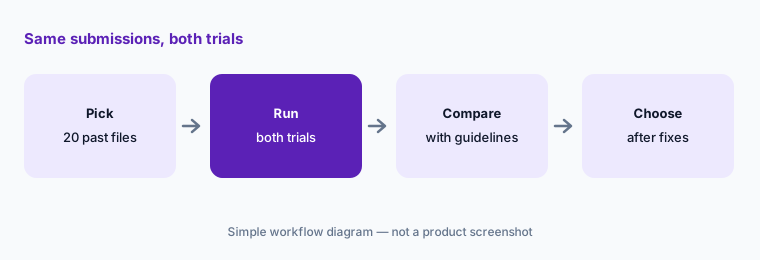
Primary workflow:
Run the same twenty submissions through both trials. Have the underwriting manager compare each tool's appetite call with your written guidelines before choosing.
2. Recommendation per submission vs a ranked queue
What it is: Sixfold’s AI Underwriter extracts and cleans the data (including SOVs and loss runs), finds what is missing, checks appetite, portfolio fit, and broker history, and gives a recommendation with its rationale (16 June 2026). Federato’s Control Tower page says it ranks every submission by fit, goals, winnability, and urgency so underwriters work the best deals first; its Submission Triage became generally available on 29 April 2025.
These answer different questions. A recommendation says what to do with this file; a ranked queue says which file to open next. Teams short on time to read files feel the first; teams drowning in volume feel the second.
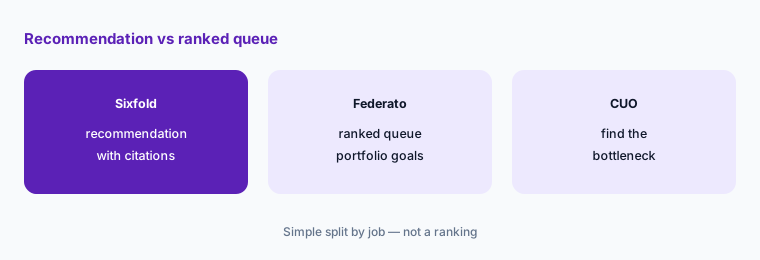
Find the bottleneck:
Have the chief underwriting officer ask each team lead whether time is lost waiting in the queue or reading files. Trial the tool that matches each segment’s bottleneck.
3. What each may do without an underwriter
What it is: Sixfold says its AI Underwriter “takes action when given authority to do so”, drafting referrals, declines, and broker emails, and that carriers set what it may do alone by line, risk size, and action type (product page). Federato’s Control Tower controls can clear in-appetite risks, flag referrals, and decline out-of-appetite submissions as they arrive, and its multi-agent system can prepare entire quotes for underwriter approval (Federato AI).
Both can say no to a broker without a person if you let them. An automatic decline built on a stale rule turns away business the team wants, so limits should start narrow on both.
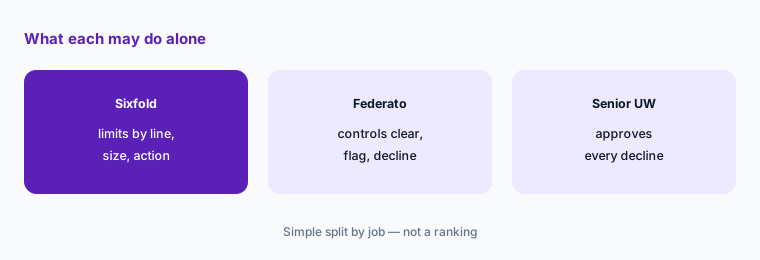
Drafts only first:
In either trial, allow drafting only. Have a senior underwriter approve every decline and broker email for a month before giving either tool authority over any action.
4. How each learns your appetite
What it is: Sixfold loads your guidelines into what it calls the Underwriting Brain through its appetite ingestion engine, adds Playbooks, and, through Institutional Intelligence, learns from your decision and outcome data; its 17 April 2026 post says the first phase is available and that “agentic self-learning comes next” (Sixfold AI). Federato drafts objectives and controls from uploaded guidance and strategy documents, which the team then edits (Federato AI).
Whatever you upload becomes the yardstick. An outdated bulletin or last year’s strategy will be applied as faithfully as the current guide, in either tool.
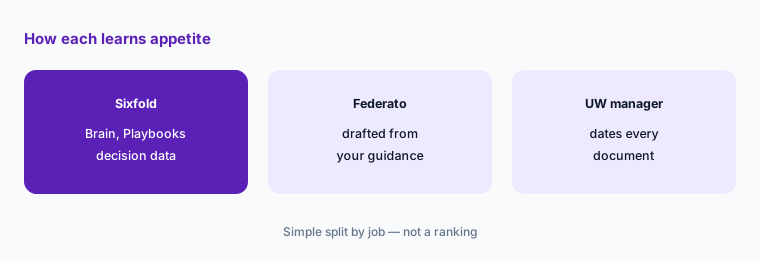
Date what goes in:
Have the underwriting manager list every guideline uploaded to either tool with its date. Ask ten appetite questions with known answers and remove outdated documents before live use.
5. Brokers and portfolio goals
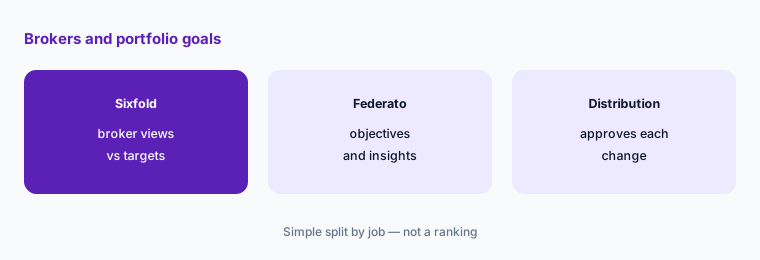
What it is: Sixfold’s Distribution Intelligence (24 September 2026) looks at each broker’s submission volume, quality, appetite fit, and hit ratio against growth targets that leaders set, and passes suggested initiatives to the AI Underwriter; it is the first part of its Portfolio Intelligence Suite, and we found no availability label beyond the launch post. Federato’s Control Tower Objectives put portfolio goals into the system (its example is a 6% average rate increase across a business line) and show each submission’s likely effect, and Insights report progress for auditors and reinsurers.
Moving one broker up the queue makes another wait. Portfolio steering affects relationships and results, so the underwriting leader, not either tool, should approve it.
Approve each change:
Set one growth target in each trial. Have the head of distribution check every suggested broker or class change against loss history before any queue order changes.
6. Add-on or core system — and when you need neither
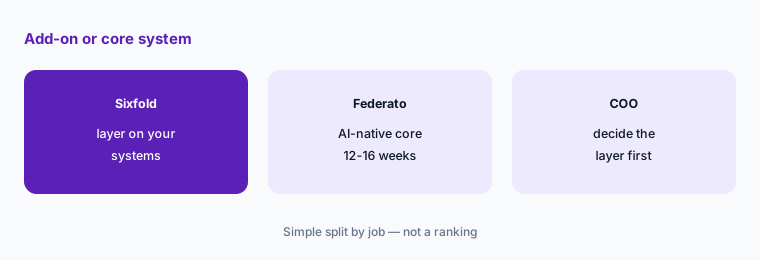
What it is: Sixfold works with your existing workbench or policy system and, since 2 September 2026, also covers life and health underwriting (launch post). Federato’s platform now covers policy administration, billing, claims, and Product Studio, with a first implementation that “typically takes 12-16 weeks” (policy administration). Carriers on Guidewire or Duck Creek can also look at the agents their core vendor is adding (Guidewire vs Duck Creek).
Some carriers use both kinds of tool; many need only one, and some need neither if their core vendor’s new agents cover the job. Decide which layer you are buying before comparing features.
Decide the layer:
Have the chief operating officer write down whether you are buying a recommendation layer, a ranked workbench, or a new core. Get each vendor to price only that scope in writing.
Pricing context (October 2026)
Neither vendor publishes prices. Sixfold’s pricing URL returns “page not found” and Federato’s goes to its home page. Both are quote-only as of 18 Oct 2026.
Ask each whether price follows submissions, lines, underwriters, or written premium; what a trial on twenty submissions costs; whether Distribution Intelligence or Control Tower is extra; and, for Federato, how an underwriting-only scope is priced compared with the full core.
Uncertainty: Federato’s positioning has moved from an underwriting workbench toward a full core system, so what you are offered may differ from this page. Sixfold’s Distribution Intelligence has no availability label beyond its launch post, and its agentic self-learning is described as coming next. Vendor figures (Sixfold’s 50% to 97% faster processing; Federato’s 89% less time to quote) are their claims. We did not test either tool ourselves.
When it’s useful (honest take)
Useful when you are choosing an underwriting AI for commercial P&C and want to see whether your gap is reading each file (Sixfold) or deciding which file to open next under portfolio guardrails (Federato).
Less useful when your gap is getting clean data out of broker emails first (see Indico Data AI), you want submission triage and risk research in one assistant (see Kalepa AI), you run an agency (see Applied vs Vertafore), or you are weighing your core vendor’s own agents (see Guidewire vs Duck Creek).
Still choosing between Sixfold and Federato? The $19 AI toolkit audit gives you a written plan for which tools to keep using and which to drop across your whole AI stack, including this pair.
Prefer to do it yourself? Spreadsheet — $9
Related options (educational)
| Need | Better home | Why |
|---|---|---|
| Recommendation and cited rationale per submission | Sixfold AI | Quote only |
| Ranked workbench, portfolio controls, AI-native core | Federato AI | Quote only |
| Submission intake and clean data before underwriting | Indico Data AI | Quote only |
| Commercial submission triage and risk research | Kalepa AI | Quote only |
| Agents from your core vendor | Guidewire AI or Duck Creek AI | Quote only; several items early or restricted access |
FAQ
What is the main difference between Sixfold and Federato?
Sixfold gives a recommendation and cited rationale for each submission and works on top of your systems. Federato ranks the submission queue against portfolio goals and guardrails and now sells a full AI-native core system. This is not a ranking.
Can either decline a submission automatically?
Both can if you allow it: Sixfold acts within limits you set by line, risk size, and action type, and Federato controls can decline out-of-appetite submissions. A senior underwriter should approve every decline at first.
Do we need both?
Sometimes. A carrier can use a ranked workbench for the queue and a recommendation layer for reading files, but many need only one. Decide which job is your bottleneck first.
How much do Sixfold and Federato cost in October 2026?
Neither publishes prices. Both are quote-only (checked 18 Oct 2026).
Is Federato still an underwriting workbench?
It began as one and many carriers use it that way, but its site now leads with being an AI-native core system covering policy administration, billing, and claims.
Optional next step (if seats overlap)
If your underwriting team pays for an AI underwriting layer, a workbench, a data provider, and chat seats that all read the same submissions, that overlap is worth mapping. Map the overlap with the $19 AI toolkit audit or the $9 AI toolkit spreadsheet. Email Audit $19 or Toolkit spreadsheet $9.
Checkout is live via Stripe. After you pay, we email delivery (spreadsheet) or intake next steps (audit).