Tool · Nonprofit CRM · Salesforce · Oct 2026
Agentforce Nonprofit review (Oct 2026): Salesforce's nonprofit CRM with AI agents, NPSP vs Agentforce Nonprofit, pricing, and what a development team still checks
Agentforce Nonprofit is Salesforce's nonprofit CRM — the product Salesforce used to call Nonprofit Cloud, renamed in December 2025. It adds prebuilt AI agents: Prospect Research, Participant Management, Volunteer Capacity & Coverage, and Donor Support, alongside Gift Entry and the nonprofit data model. Through the Power of Us program, eligible nonprofits get 10 Core licenses at no cost; paid editions run from $70 to $285 per user per month, billed annually. Many nonprofits still run the older Nonprofit Success Pack (NPSP), and moving is a new implementation, not an upgrade. This page is about using the agents while a database manager tests them in a sandbox and a development director checks every output. Each section has a Try this.
What this Agentforce Nonprofit page covers
This page is for a development director, database manager, Salesforce admin, or executive director at a nonprofit that runs on Salesforce today, or is weighing it against a smaller donor CRM. It is not legal, tax, or gift-acceptance advice; a named person owns every donor-facing message, gift record, ask amount, and funder submission.
Facts come from Salesforce's Agentforce Nonprofit page, nonprofit pricing page, Agentforce pricing page, and its 2 December 2025 announcement, read on 24 October 2026, plus a Salesforce partner's NPSP comparison (RSM US). We did not test the product. Customer time savings quoted in Salesforce's announcement are Salesforce's and its customers' figures.
Ground rules before any agent goes near donor records: the database manager tests every agent on test records in a sandbox first; the development director checks every summary, draft, and gift record an agent produces before anyone relies on it; the executive director approves what data agents may read and how many Flex Credits the organization will spend.
Major features (with how someone uses them)
Examples at a glance: each feature has a concrete example from a real job plus a short Try this you can run this week.
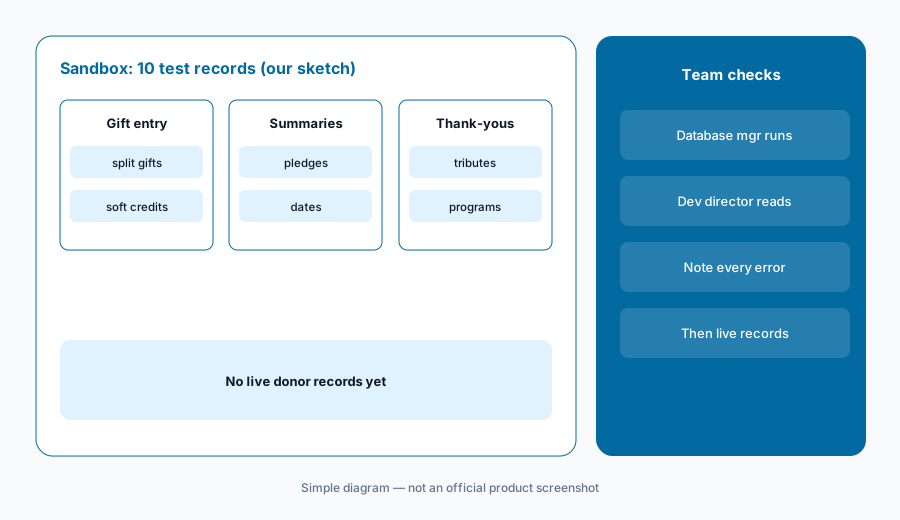
1. Three agent tasks, ten test records, one sandbox (primary)
What it is: Pick the three jobs your team wants help with first, such as gift entry, donor summaries before meetings, and thank-you drafts. Load ten test records into a sandbox, with made-up names and real-looking gift patterns, and run each job there. Salesforce's pricing page lists a Full Sandbox in the Advanced edition and up; on Core, ask Salesforce or your partner what sandbox you have before testing.
An agent that writes to records can make the same mistake on every record it touches. Ten test records are enough to see the pattern: a soft credit dropped, a tribute gift coded as unrestricted, a thank-you that names the wrong program.
Primary workflow:
List the three agent tasks your team wants first (gift entry, donor summaries, thank-you drafts). Have the database manager run each on ten test records in a sandbox and the development director check every output before any agent touches live donor records.
2. Editions, Power of Us, and the annual contract
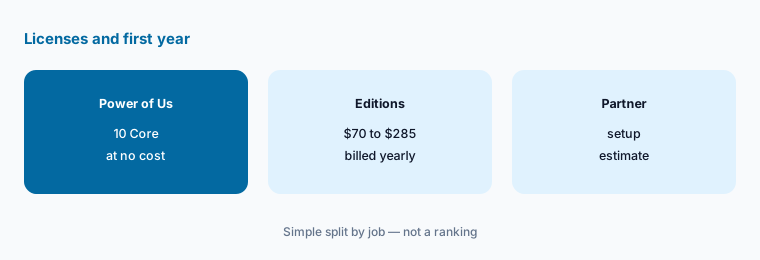
What it is: Salesforce's nonprofit pricing page lists Nonprofit Cloud Sales & Service Core at $70 per user per month, billed annually, with the nonprofit data model, Slack Business+ with Slackbot, Tableau Next, Premier Success, and 500K Flex Credits per org per year; Advanced at $125 with Full Sandbox, Backup & Recover, Help Agent, and 1M Flex Credits; and Sales Max or Service Max at $285 with 2.75M Flex Credits and the Grantmaking suite. It says “these editions require an annual contract.” Through Power of Us, any eligible nonprofit receives 10 Nonprofit Cloud Core licenses at no cost, and Premier Success activates on the first paid purchase.
Ten free licenses cover a small team's staff seats, not the partner who sets it up. The license is free; the implementation usually is not.
Price the whole first year:
Count the staff who need a login, then get a written partner estimate for setup and migration. Have the executive director compare that first-year total with a smaller CRM before signing an annual contract.
3. NPSP vs Agentforce Nonprofit: a new implementation, not an upgrade
What it is: Salesforce calls Agentforce Nonprofit the product “formerly Nonprofit Cloud” (announcement). Many nonprofits run the older Nonprofit Success Pack (NPSP) instead. Salesforce partner RSM US's comparison says Agentforce Nonprofit is built on the core Salesforce platform, that “currently, Salesforce has no plans to sunset NPSP,” and that a move from NPSP “still requires a new implementation and comes with changes to your data model.” That is RSM's reading, not a Salesforce statement on the pages we read.
If you are on NPSP and it works, there is no deadline on the pages we read. The question is whether the agents and newer features are worth a full new implementation.
Map before moving:
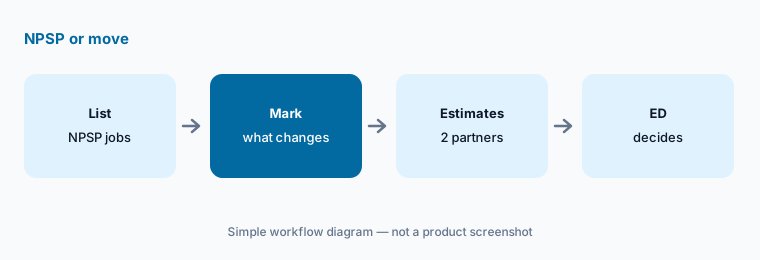
List the jobs your team does in NPSP today and mark which ones Agentforce Nonprofit would change. Have the executive director get two written partner estimates before deciding whether to move.
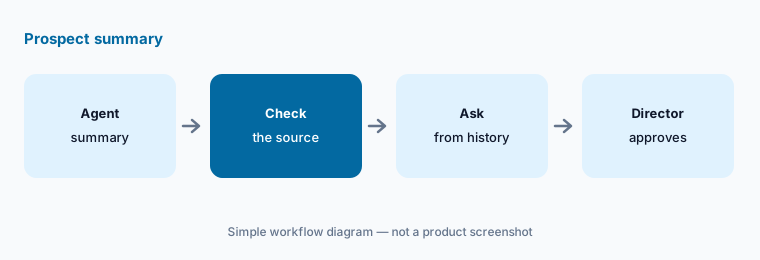
4. Prospect Research Agent: summaries before a donor meeting
What it is: Salesforce's Agentforce Nonprofit page says the Prospect Research Agent can “summarize wealth capacity, create philanthropic assessments and summarize philanthropic milestones.” The announcement listed it as generally available in December 2025, with Slack support coming the following summer.
A wealth capacity summary is a match to public and screening data. It can be the wrong person, out of date, or miss that a donor asked not to be solicited this year.
Check the source:
Run the Prospect Research Agent on five donors you know well. Have the major gifts officer check each wealth claim against its source and the development director approve any ask amount.
5. Donor Support and Volunteer Capacity & Coverage agents
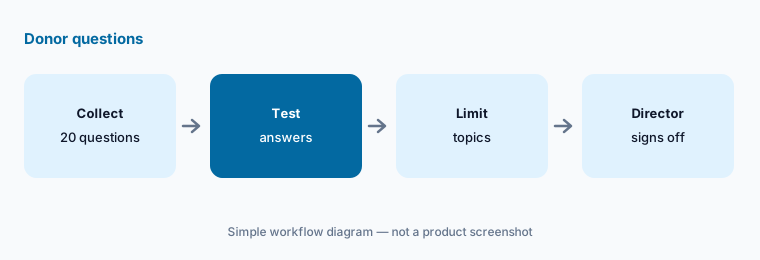
What it is: Salesforce's December 2025 announcement says the Donor Support agent “helps deflect key donor questions and allows for better self-service for donors,” and listed it as beta in spring and generally available in summer 2026. The Volunteer Capacity & Coverage agent was listed as beta, with general availability in early 2026, and Participant Management as generally available for program and case managers. Check the current status with Salesforce; dates in an announcement can move.
A donor-facing agent answers donors directly. A wrong answer about a tax receipt or a recurring gift reaches the donor before anyone on staff sees it.
Test with real questions:
Collect twenty donor questions from last year's inbox with names removed. Have the development director test the Donor Support agent's answers and limit it to the topics it gets right.
6. Flex Credits: what agent actions cost
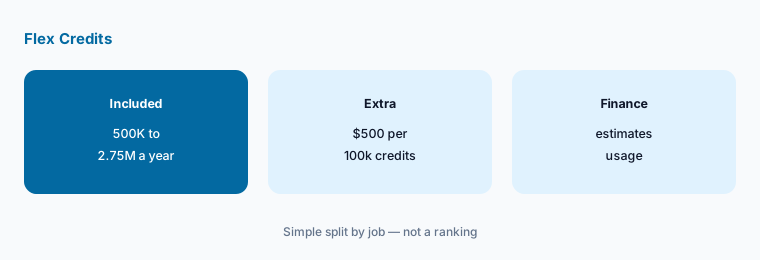
What it is: Salesforce's Agentforce pricing page lists Flex Credits at $500 per 100,000 credits, “Pay per Action,” and a $0 Salesforce Foundations starting point. The nonprofit pricing page includes 500K Flex Credits per org per year with Core, 1M with Advanced, and 2.75M with the Max editions. The pages we read do not say how many credits each nonprofit agent task uses; ask Salesforce or your partner for that in writing.
Included credits run out faster if an agent runs on every new gift or every donor email. Watch usage monthly in the first quarter.
Estimate usage first:
Ask Salesforce or your partner in writing how many Flex Credits each agent task uses. Have the finance lead estimate a year of usage and the executive director set a monthly limit.
Pricing context (October 2026)
Salesforce's nonprofit pricing page (checked 24 Oct 2026) lists, in USD per user per month billed annually: Nonprofit Cloud Sales & Service Core $70 (500K Flex Credits per org per year), Advanced $125 (1M Flex Credits, Full Sandbox, Backup & Recover), and Sales Max or Service Max $285 (2.75M Flex Credits, Grantmaking suite). These editions require an annual contract. Through Power of Us, eligible nonprofits receive 10 Nonprofit Cloud Core licenses at no cost, with discounts on additional licenses.
Salesforce's Agentforce pricing page lists Flex Credits at $500 per 100,000 credits and Salesforce Foundations at $0. Partner implementation, data migration, and ongoing admin time are not on Salesforce's price list; get a written estimate.
Uncertainty: We did not test Agentforce Nonprofit. Facts come from Salesforce pages as read on 24 Oct 2026 and can change; agent availability dates come from a December 2025 announcement, and Salesforce says unreleased features may not be delivered on time or at all. The NPSP view is a Salesforce partner's (RSM US), not Salesforce's. Credits used per agent task are not printed on the pages we read. Customer time savings in the announcement are Salesforce's and its customers' figures.
When it’s useful (honest take)
Useful when your nonprofit already runs on Salesforce or has a Salesforce admin or partner, you want agents for prospect research, program work, or donor questions, and a database manager will test every agent in a sandbox while the development director checks every output.
Less useful when you are a small office without an admin or partner budget (Little Green Light vs Bloomerang, Keela AI), you want AI inside the office tools your team already uses (Microsoft 365 Copilot for nonprofits), or you are comparing the large nonprofit suites (Blackbaud vs Bonterra).
Paying for Agentforce Nonprofit and a few other AI tools? The $9 AI toolkit spreadsheet lists every AI subscription you have, what each one costs, and how fast it pays for itself, so you can see which ones are worth the money.
Want someone to do it for you? AI toolkit audit — $19
Related options (educational)
| Need | Better home | Why |
|---|---|---|
| Salesforce nonprofit CRM with prebuilt agents | Agentforce Nonprofit (this page) | Core $70/user/month billed annually; 10 Core licenses via Power of Us |
| AI across a general Salesforce org | Salesforce Einstein | See review |
| Large nonprofit suites side by side | Blackbaud vs Bonterra | Compare |
| Donor CRM for small and mid-size teams | Bloomerang AI | CRM from $125/month billed annually |
| Two small-office CRMs side by side | Little Green Light vs Bloomerang | LGL from $45/month by record count |
| Prospect research before a major-gift ask | DonorSearch vs Kindsight | Compare |
FAQ
Is Agentforce Nonprofit the same as Nonprofit Cloud?
Yes. Salesforce's December 2025 announcement calls it Agentforce Nonprofit (formerly Nonprofit Cloud). The pricing page still uses Nonprofit Cloud in edition names such as Nonprofit Cloud Sales & Service Core.
How much does Agentforce Nonprofit cost in October 2026?
As printed on 24 Oct 2026, in USD per user per month billed annually: Core $70, Advanced $125, Sales Max or Service Max $285, each with an annual contract. Eligible nonprofits get 10 Core licenses at no cost through Power of Us. Extra Flex Credits are $500 per 100,000.
Do we have to move from NPSP?
Not on the pages we read. Salesforce partner RSM US says Salesforce currently has no plans to sunset NPSP, and that a move to Agentforce Nonprofit still requires a new implementation with data model changes. Get written partner estimates before deciding.
Which AI agents does Agentforce Nonprofit include?
Salesforce's announcement lists Prospect Research, Participant Management, Volunteer Capacity & Coverage, and Donor Support agents, with templates included in the Agentforce Nonprofit 1 Sales or Service Edition or as an add-on. Check current availability with Salesforce.
Who approves agent outputs?
The database manager tests every agent on test records in a sandbox; the development director checks every summary, draft, and gift record before anyone relies on it; the executive director approves what data agents may read and the Flex Credit budget.
Optional next step (if seats overlap)
If you pay for a CRM, a partner retainer, Flex Credits, and separate chat seats that all write the same donor summaries, that overlap is worth mapping. Map the overlap with the $19 AI toolkit audit or the $9 AI toolkit spreadsheet. Email Audit $19 or Toolkit spreadsheet $9.
Checkout is live via Stripe. After you pay, we email delivery (spreadsheet) or intake next steps (audit).