Compare · Prospect research · Oct 2026
DonorSearch vs Kindsight (Oct 2026): wealth screening, AI prospect summaries vs Kindsight Intelligence agents, quote-only vs printed iWave prices, and the researcher who checks every profile
DonorSearch and Kindsight both sell prospect research to nonprofit development teams: screen your donor file against wealth and giving records, then tell you who might give more. DonorSearch, part of EverTrue since October 2025, adds DonorSearch Ai models trained on your own giving history, generative AI prospect summaries, and DonorSearch360+ inside Salesforce; it prints no prices. Kindsight sells iWave with printed starting prices and adds Kindsight Intelligence: briefings, a Screening Agent, a Prospect Summary, and a Trip Planning Agent. In both, a match to public records can be wrong, so the prospect researcher checks every profile before a name reaches a gift officer.
What this comparison covers
This page is for a prospect researcher, major gifts director, or development director choosing a wealth screening and prospect research vendor, or renewing one. It is not legal, tax, or gift-acceptance advice; a named person owns every donor-facing message, gift record, ask amount, and funder submission.
DonorSearch facts come from its home page, DonorSearch Ai page, Enhanced CORE page, generative AI page, and screening page, read on 24 October 2026, and EverTrue's 29 June 2026 release. Kindsight facts come from its pricing page, Kindsight Intelligence page, and iWave page, read the same day. Single-vendor detail: DonorSearch AI review and Kindsight AI review.
The real difference is where the AI sits. DonorSearch puts predictive models on your own file and writes summaries from its research data; Kindsight is building agents that plan trips, scope screens, and draft briefings and contact reports. Both rest on the same thing: matching your donors to public records. Wrong matches are the main risk in both, and neither vendor's AI removes them.
Ground rules for either choice: the prospect researcher confirms identity and checks every wealth or giving claim; the major gifts director sets every ask amount; the executive director signs the contract and the data agreement. Donor privacy promises and opt-out requests are honored before any list is used. This comparison is not a ranking.
| Question | DonorSearch | Kindsight |
|---|---|---|
| Prospect research product | Wealth and philanthropic screening; ProspectView Online 2 | iWave screening and live profiles |
| Prices printed? | No; quote-only (pricing page returns 404) | iWave from $4,500 and $5,800; Premium by contact |
| Models on your own data | DonorSearch Ai: custom Acquisition and Retention models | Not described as custom models on the pages we read |
| AI summaries | Generative AI prospect bio summaries in PVO2 | Prospect Summary and KI Briefings |
| Agents | None named on the pages we read | Screening Agent; Trip Planning Agent |
| CRM side | DonorSearch360+ inside Salesforce (29 Jun 2026) | Ascend CRM and the Fundraising Platform, by quote |
| Owner | Part of EverTrue since Oct 2025 | Kindsight (iWave, engage, Ascend) |
| Who signs off | Prospect researcher on every match and profile; major gifts director on every ask amount; executive director on the contract | |
Major features (with how someone uses them)
Examples at a glance: each feature has a concrete example from a real job plus a short Try this you can run this week.
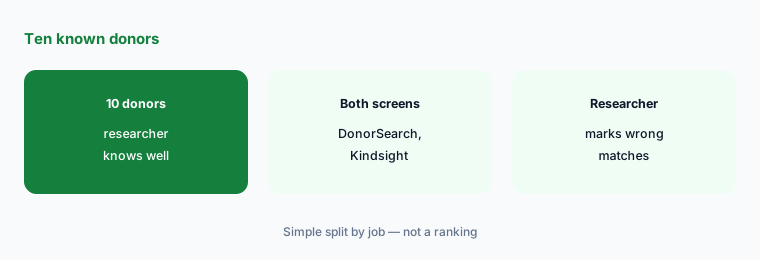
1. Test both on ten donors you already know (primary)
What it is: Neither vendor's accuracy can be judged from its marketing. DonorSearch's generative AI page tells users to “always review outputs from any generative AI tool”; Kindsight's Kindsight Intelligence page says human review is “built into every workflow.” The cheapest test is your own file: ten donors your researcher knows well, screened by both, marked line by line.
Pick donors with common names, recent moves, and a spouse with separate assets — the cases where matching goes wrong. A clean result on easy names tells you little.
Primary workflow:
Pick ten donors your prospect researcher already knows well. Run them through a DonorSearch and a Kindsight trial or demo screen, and have the researcher mark every wrong match and unsupported wealth claim in each before either contract is signed.
2. Quote-only vs printed starting prices
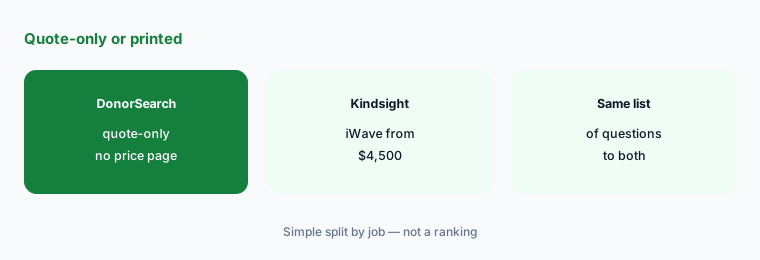
What it is: DonorSearch prints no prices; donorsearch.net/pricing returned 404 on 24 October 2026 and every product page asks for a demo. Kindsight's pricing page prints iWave starting prices: Starter from $4,500 (1 user, up to 1,500 subscription screens, 750 live profiles), Professional from $5,800 (3 users, 5,000 screens, 2,500 live profiles), Premium by contact. The page doesn't say whether iWave prices are annual.
A printed starting price is a floor, not a quote. Ask both vendors the same questions in writing: users, screens, live profiles or monitored records, AI summaries included, CRM integration, renewal terms.
Same questions to both:
Send both vendors one written list: users, screens, profiles, AI summaries, CRM integration, and renewal terms. Have the development director put both answers in the same sheet before the executive director decides.
3. DonorSearch Ai models on your own file
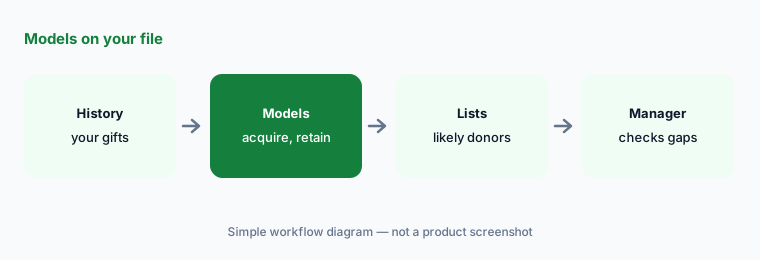
What it is: DonorSearch's DonorSearch Ai page describes two models trained on your organization's own giving history: Acquisition (who is likely to make a first gift) and Retention (who is likely to give again). Its Enhanced CORE page adds national models such as Most Likely to Raise, which predicts who is likely to make the highest-value gifts in the next 12 months. DonorSearch's page quotes a customer who cut mailing volume by 75%; that is a customer statement, not our measurement.
A model trained on your history learns your past habits, including who you never asked. Check what the list leaves out as well as what it puts in.
Check what it leaves out:
Compare a model's likely-to-lapse list with the donors who actually lapsed last year. Have the annual fund manager note who the list missed before it drives any appeal.
4. AI prospect summaries vs KI Briefings
What it is: DonorSearch says its generative AI turns wealth and philanthropic data into “clear, concise prospect bio summaries,” produced in ProspectView Online 2 (generative AI page, screening page). Kindsight's Kindsight Intelligence page lists KI Briefings, which pull giving history, involvement, and key relationships into one summary before meetings, and a Prospect Summary that turns screening and profile data into a written narrative. Kindsight quotes the Texas A&M Foundation saying briefing prep time fell by about 95%; that is the customer's figure.
A summary reads the same whether its facts are right or wrong. If the screen matched the wrong person, the summary describes a stranger in confident prose.
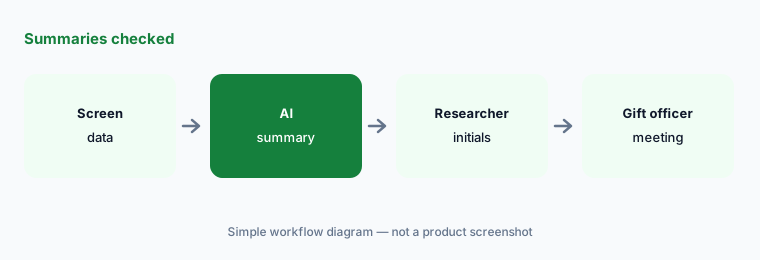
Initial before use:
Generate summaries for five prospects your researcher already knows. Have the prospect researcher check every fact against the source records before any summary reaches a gift officer.
5. Kindsight's Trip Planning Agent and contact reports
What it is: Kindsight's Kindsight Intelligence page lists a Trip Planning Agent that “ranks who to see, where and when” — with the line “You set the itinerary” — and contact reports from rough notes: turn a voice memo into a CRM-ready report with action items, checked for missing details and privacy risks. DonorSearch's pages we read do not describe a trip or contact-report agent; its generative AI page mentions drafting emails and summarizing prospect data (DonorSearch generative AI page).
A ranked trip list is a suggestion about people. Relationship history the system can't see — a recent loss, a board disagreement, a promise made over dinner — belongs to the gift officer.
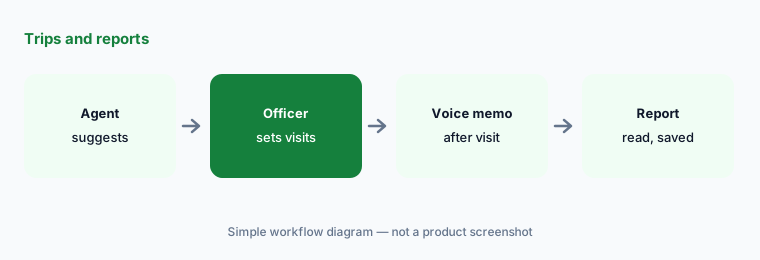
You set the visits:
Have the gift officer review every name an AI trip plan suggests and read every generated contact report before it is saved to the donor record.
6. Privacy, opt-outs, and where the data goes
What it is: DonorSearch keeps a database opt-out page where individuals can ask to be removed from its data services. Kindsight's Kindsight Intelligence page says donor data is “never used to train models” and is held for a 30-day window for quality assurance. Both are vendor statements; your contract and data processing agreement are what bind them.
Prospect research uses public records about people who never agreed to be researched. Your donor privacy statement should say you do it, and opt-out requests should be honored before any list is used.
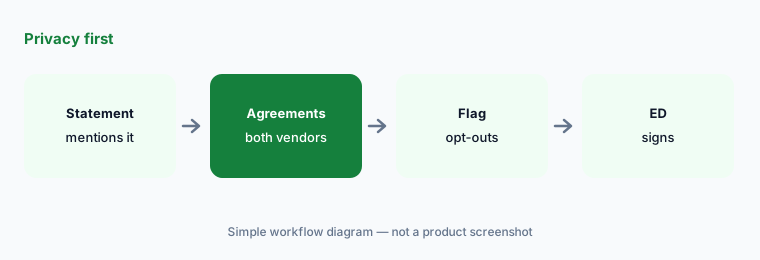
Flag opt-outs first:
Have the prospect researcher add a do-not-research flag for every donor who asked not to be researched, and the executive director read both vendors' data agreements, before any file is sent for screening.
Pricing context (October 2026)
DonorSearch: no printed prices. donorsearch.net/pricing returned 404 on 24 October 2026 and product pages ask you to request a demo; treat it as quote-only. Ask what a one-time screen costs versus an annual subscription, which models are included, how many ProspectView Online 2 users and AI summaries you get, and whether DonorSearch360+ for Salesforce is separate.
Kindsight (pricing page, checked 24 October 2026): iWave Starter starting at $4,500 (1 user, up to 1,500 subscription screens, 750 live profiles); Professional starting at $5,800 (3 users, 5,000 screens, 2,500 live profiles); Premium by contact. engage (AI writing) starting at $545, $1,095, or $3,295 per year. Ascend and the Fundraising Platform are by quote. No separate price is printed for Kindsight Intelligence.
Uncertainty: We did not test either product. Facts come from vendor pages as read on 24 Oct 2026 and EverTrue's 29 June 2026 release, and can change. Some Kindsight Intelligence features were announced for iWave in the third calendar quarter of 2026; confirm they are on your account. Customer figures (75% mailing cut, ~95% faster briefings) are vendor-published quotes. Prices for DonorSearch are quote-only.
When it’s useful (honest take)
Useful when you have a prospect researcher (or a development director who does that job), a donor file large enough that screening changes who gets a visit, and a rule that no screened name or AI summary reaches a gift officer until research has checked it.
Less useful when your file is a few hundred donors your team already knows, your CRM's built-in tools cover the job (Blackbaud AI, Bloomerang AI, Dataro AI), or the real need is grant research (Instrumentl vs Candid).
Still choosing between DonorSearch and Kindsight? The $19 AI toolkit audit gives you a written plan for which tools to keep using and which to drop across your whole AI stack, including this pair.
Prefer to do it yourself? Spreadsheet — $9
Related options (educational)
| Need | Better home | Why |
|---|---|---|
| Screening plus custom models, Salesforce side | DonorSearch AI | Quote-only |
| Screening plus AI briefings and agents | Kindsight AI | iWave from $4,500 |
| Predictive lists inside your CRM data | Dataro AI | See review |
| Research built into a large CRM | Blackbaud AI | Quote |
| Drafting with no donor data | Gemini for nonprofits | $0 plan |
FAQ
Is DonorSearch or Kindsight cheaper?
We can't say. DonorSearch prints no prices (its pricing page returned 404 on 24 October 2026). Kindsight prints iWave starting prices of $4,500 and $5,800, with Premium by contact. Send both the same written list of questions and compare quotes line by line.
What AI does each one have?
DonorSearch: DonorSearch Ai custom Acquisition and Retention models, Enhanced CORE national models, generative AI prospect summaries in ProspectView Online 2, and DonorSearch360+ in Salesforce. Kindsight: Kindsight Intelligence with KI Briefings, a Screening Agent, a Prospect Summary, a Trip Planning Agent, and contact reports from voice memos.
How do we test accuracy before signing?
Screen ten donors your prospect researcher already knows, including common names and recent moves, through both. Have the researcher mark every wrong match and unsupported wealth claim, and bring that sheet to both contract calls.
What about donor privacy?
DonorSearch has a database opt-out page; Kindsight says donor data is never used to train models and is held 30 days for quality assurance. Both are vendor statements. Read the data agreements, mention prospect research in your privacy statement, and honor opt-outs. This is not legal advice.
Who approves outputs?
The prospect researcher approves every match, profile, and summary; the major gifts director sets every ask amount; the gift officer owns every visit and contact report; the executive director signs the contract and data agreement.
Optional next step (if seats overlap)
If you pay for a screening vendor, a CRM with built-in prospect tools, and AI seats that all summarize the same donors, map that overlap before the next renewal. Map the overlap with the $19 AI toolkit audit or the $9 AI toolkit spreadsheet. Email Audit $19 or Toolkit spreadsheet $9.
Checkout is live via Stripe. After you pay, we email delivery (spreadsheet) or intake next steps (audit).