Tool · Nonprofit fundraising ops · Dataro · Oct 2026
Dataro AI review (Oct 2026): predictive donor propensity lists, mid-level and major-gift prospects, and AI prospect research for fundraising teams
Dataro is a predictive analytics platform for fundraising teams. It sits on top of your donor CRM (Raiser’s Edge NXT, Salesforce, HubSpot, Virtuous, Bloomerang and others), ranks every donor by how likely they are to give, upgrade, or lapse, and turns those rankings into audiences, research reports, and draft copy. On this page we call its outputs likelihood signals and rankings. This page is about testing them on past campaigns before they decide who gets a letter. Each section has a Try this.
What this Dataro page covers
This page is for a database manager, development director, or individual giving manager at a nonprofit with enough donor history to model (Dataro’s plans start at a five-figure annual fee). It is not legal, tax, or fundraising-ethics advice, and prospect research should follow your own donor-privacy policy.
Dataro’s predictions page says it ranks your whole donor file by likelihood to give, upgrade, or lapse, suggests channel, timing, and ask amount, and shows the signals behind each prediction. Core models come with every plan (next gift likelihood, recommended channel, lifetime value forecast, estimated age), and specialist models are added by plan (pricing page).
Ground rules before you rely on it: the database manager tests every list on a past campaign first; the development director decides every cutoff and exclusion; whoever does prospect research reads every ProspectAI report; a named person edits every AI Assist draft. A ranking is never a reason on its own to stop thanking a donor.
Major features (with how someone uses them)
Examples at a glance: each feature has a concrete example from a real job plus a short Try this you can run this week.
1. Lapse-risk and churn-risk rankings (primary)
What it is: Dataro’s specialist models include Lapsed Donor Mail Reactivation (the likelihood a donor with no gift for 24 months or more gives again by mail in the next three months) and Recurring Gift Churn Risk (the risk an active monthly donor cancels in the next six months), per its pricing page. Its predictions page says lapse risk is ranked and surfaced before donors drift away.
A model trained on your own history repeats your history. If you never contacted a group, the model has little to say about them.
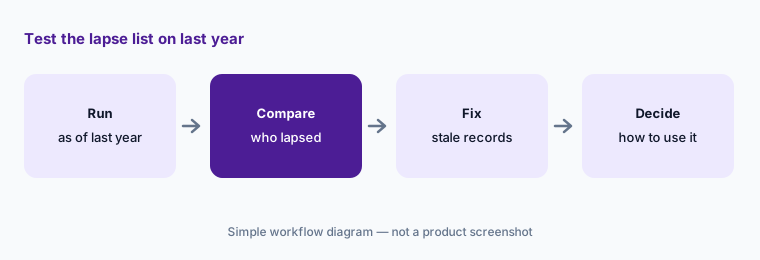
Primary workflow:
Run Dataro’s lapse-risk list against last year’s data. Have the database manager compare its top fifty donors with who actually lapsed before using it on a live campaign.
2. Mid-level and major-gift prospect lists
What it is: Dataro’s Mid-Level Prospect and Major Gift Prospect models rank donors by the likelihood they give at mid-value or major-gift levels in the next year, for pipeline building and cultivation (pricing page). The Essentials plan includes three specialist models, Growth six, and Enterprise all of them.
A list of likely major donors is a list of people to research and meet, not people to ask. Order matters less than whether the right person is on it.
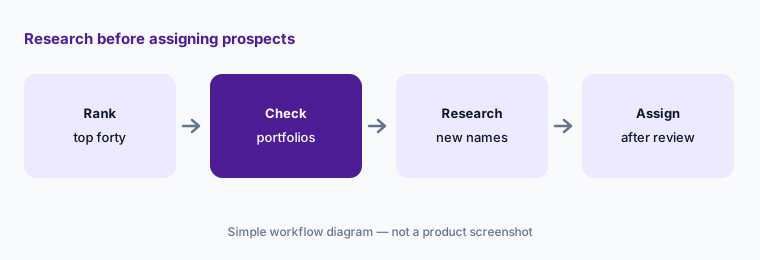
Research before assigning:
Take the top forty names from the Major Gift Prospect list. Have the major gifts officer check each against current portfolios and your exclusion rules before any name is assigned.
3. Audience Builder and smart audiences
What it is: Dataro’s audience page says it builds and ranks audiences for mail, phone, and digital appeals and lets you layer your own suppression rules on top. Its updates added a refreshed Audience Builder with AND/OR filter sets and presets (30 September 2026), then fixed-size audiences, anniversary filters, and pushing saved audiences to Mailchimp as tags (16 October 2026; being turned on per organization).
A fixed-size audience cuts off at a count, not at a judgment. The donors just below the line deserve a look.
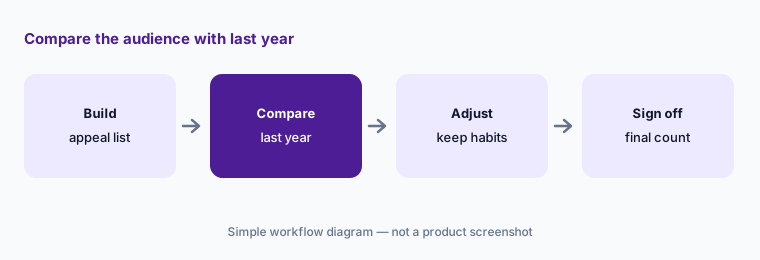
Compare before mailing:
Build your next appeal audience in Dataro and compare it with last year’s hand-built list. Have the development director sign off on every group added or dropped before the file goes to the mail house.
4. ProspectAI research reports
What it is: ProspectAI scans public sources (news, foundation relationships, annual reports, wealth databases) and builds a cited donor brief with capacity, affinity, giving history, relationships, conversation starters, and due diligence (ProspectAI page). It covers US records only for now and uses credits: 300 a year on Essentials, 1,000 on Growth, 3,000 on Enterprise. Since 30 September 2026 you can switch a report to the right person when ProspectAI matched someone else with the same name, with no extra credit.
Name matches are the main risk. Dataro added an identity switch because wrong matches happen.
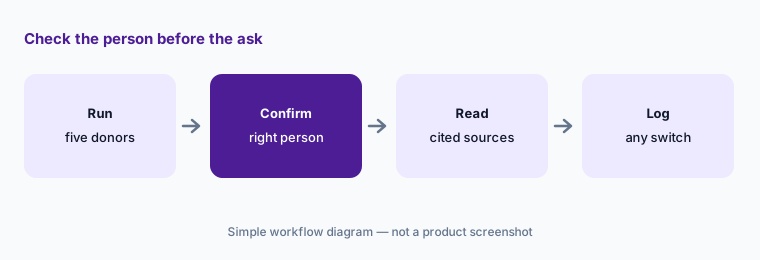
Check the person first:
Run ProspectAI on five donors you have already researched. Have the prospect researcher confirm each report is the right person and read every cited source before any report shapes an ask.
5. AI Assist content drafts
What it is: Dataro’s AI Content Assistant drafts appeals, emails, and donor journey copy for an audience you built in Dataro, using the interest areas and giving behavior it found in your data. Dataro says your team edits and approves every draft. AI-assisted content is included in every plan.
A draft that leans on “what motivates this group” can invent a reason. Every program claim still has to come from your reports.
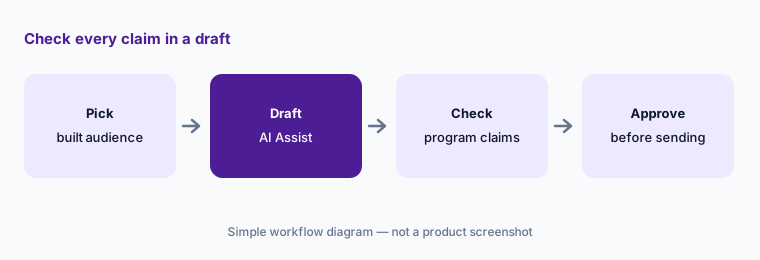
Check every claim:
Draft one appeal email with AI Assist for an audience you already built. Have the development director check every program claim and number against your reports before it is sent.
6. Dataro 3.0 Insights, actions, and CRM sync
What it is: Dataro’s product updates say Dataro 3.0 became the default interface on 25 September 2026, with four paths: Act on Insights, Research Donors, Playbooks, and Build an Audience. On 16 October 2026 Insights cards gained an Actions page (this week and archive) and an Outcomes tab that shows gifts given after completed actions. Dataro syncs with your CRM weekly in both directions (pricing page), and its Bloomerang integration went live on 1 July 2026.
A weekly sync means a gift entered on Tuesday may not change a ranking until the next run. Writing likelihood values back into the CRM also changes what other users see.
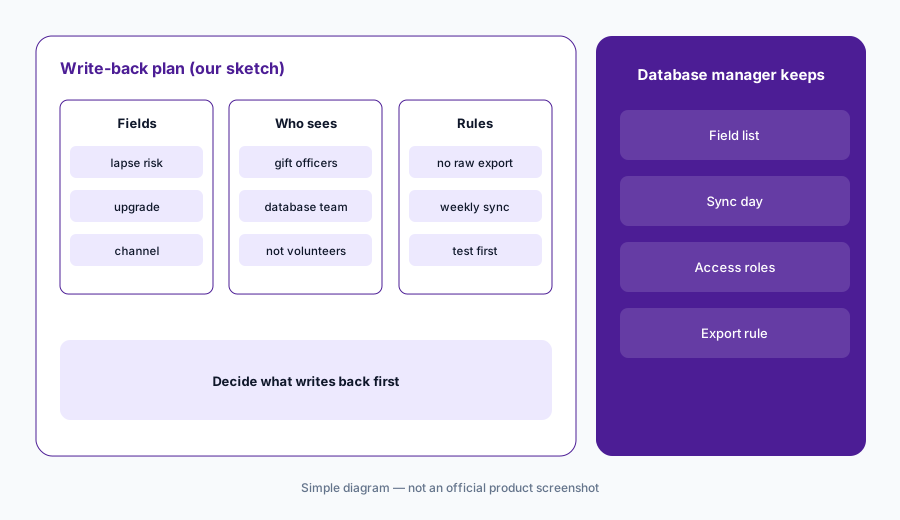
Decide what writes back:
Before Dataro writes anything back to your CRM, have the database manager list which fields it may change and who can see them, and log the weekly sync day for the team.
Pricing context (October 2026)
Dataro’s pricing page (checked 22 Oct 2026) prints an annual platform fee plus a per-active-donor rate: Essentials from $15,000 a year + $0.10 per active donor (5 users, three specialist models, AI-assisted content, 300 ProspectAI credits a year); Growth from $25,000 a year + $0.12 per active donor (10 users, six specialist models, marketing platform integrations, 1,000 credits); Enterprise by quote + $0.14 per active donor (unlimited users, all models, 3,000 credits, SSO).
An active donor is anyone with a gift in the past 24 months. Dataro’s estimator shows about $16,000 a year on Essentials for 10,000 active donors. There is no self-serve trial; demos use your own data, and onboarding usually takes four to six weeks. Data can be hosted in the US, Canada, the UK, or Australia.
Dataro publishes customer results (for example, Greenpeace retaining 531 extra monthly donors through churn-risk outreach). Those are the vendor’s and customers’ figures, not ours.
Uncertainty: We did not test Dataro. Features, dates, and prices come from Dataro’s website, pricing page, product updates, and a Dataro press release as read on 22 Oct 2026, and can change. ProspectAI is US-only; some updates (Mailchimp push, Donor Map) are in beta or turned on per organization; your total depends on donor count.
When it’s useful (honest take)
Useful when you mail or call thousands of donors a year, your CRM has several years of clean giving history, and a database manager will test every list on a past campaign before it decides who hears from you.
Less useful when you have a few hundred donors (a printed-price CRM such as Neon One AI may be enough), you are already on Bloomerang and can buy the Dataro-powered upgrade there (Bloomerang AI), or you mainly need gift officer next steps (Virtuous AI).
Paying for Dataro AI and a few other AI tools? The $9 AI toolkit spreadsheet lists every AI subscription you have, what each one costs, and how fast it pays for itself, so you can see which ones are worth the money.
Want someone to do it for you? AI toolkit audit — $19
Related options (educational)
| Need | Better home | Why |
|---|---|---|
| Likelihood lists, audiences, and research on top of your CRM | Dataro AI (this page) | From $15,000/year + per-donor fee |
| Dataro-powered predictions inside Bloomerang | Bloomerang AI | Upgrade by interest form |
| Gift officer next steps, plans, and drafts | Virtuous AI | Quote-only |
| Prospect Insights inside Raiser’s Edge NXT | Blackbaud AI | Quote-only |
| Writing prompts and smart gift amounts for small teams | Neon One AI | Neon CRM about $1,188/year at entry |
FAQ
What does Dataro do?
It connects to your donor CRM, ranks every donor by the likelihood they give, upgrade, or lapse, builds appeal audiences from those rankings, writes ProspectAI research reports, and drafts appeal copy. It syncs with your CRM weekly.
How much does Dataro cost in October 2026?
Dataro prints Essentials from $15,000 a year plus $0.10 per active donor and Growth from $25,000 a year plus $0.12 per active donor; Enterprise is by quote plus $0.14 per active donor. Its estimator shows about $16,000 a year on Essentials for 10,000 active donors.
Which CRMs does Dataro work with?
Dataro lists Raiser’s Edge NXT, Salesforce Nonprofit Success Pack and Nonprofit Cloud, HubSpot, CharityCRM, Beacon, and Virtuous on Essentials, with Blackbaud CRM and Microsoft Dynamics on Growth. Its Bloomerang integration went live on 1 July 2026.
How should we test Dataro’s rankings?
Run a list as of a past date and compare it with what actually happened, such as who lapsed or who upgraded. Have the database manager write down the hit rate and what the list missed before using it on a live campaign.
Who should check Dataro output?
The database manager for every list and CRM write-back; the development director for cutoffs and exclusions; the major gifts officer for prospect lists; whoever does prospect research for ProspectAI reports; a named editor for AI Assist drafts.
Optional next step (if seats overlap)
If you pay for Dataro, a wealth screening service, and CRM add-ons that all rank the same donors, that overlap is worth mapping. Map the overlap with the $19 AI toolkit audit or the $9 AI toolkit spreadsheet. Email Audit $19 or Toolkit spreadsheet $9.
Checkout is live via Stripe. After you pay, we email delivery (spreadsheet) or intake next steps (audit).