Tool · Nonprofit prospect research · Kindsight · Oct 2026
Kindsight AI review (Oct 2026): Ascend AI prospect research, iWave wealth screening, and major-gift prospect lists for development teams
Kindsight is the company behind iWave (prospect research and wealth screening), Ascend (a Salesforce-based fundraising CRM), and engage (AI writing for fundraisers). Its AI layer, Kindsight Intelligence, adds a Screening Agent, Prospect Summary, KI Briefings, a Trip Planning Agent, and contact reports from voice memos. iWave starts at $4,500 and engage at $545 a year; the CRM is quote-only. This page is about using it while a prospect researcher checks every wealth and giving claim and a major gifts officer decides who to ask. Each section has a Try this.
What this Kindsight page covers
This page is for a prospect researcher, major gifts officer, or development director at a nonprofit, school, or hospital foundation that is weighing Kindsight or already uses iWave. It is not legal, tax, or gift-acceptance advice; a named person owns every donor-facing message, gift record, ask amount, and funder submission.
Facts come from Kindsight's home page, iWave page, Ascend page, pricing page, Kindsight Intelligence page, press page, and its 2026 AI Fundraising Judgment Benchmark, read on 23 October 2026. We did not test the product. People searching “Kindsight vs iWave” are usually looking at the same company: iWave is now a Kindsight product.
Kindsight's own principle is that prediction shows “where to look” and “whether to reach out is your call.” Ground rules before you rely on it: no wealth or capacity figure is a fact about a person until the prospect researcher checks it against public sources; the major gifts officer decides who is asked and for how much; the development director decides what donor data goes into the system.
Major features (with how someone uses them)
Examples at a glance: each feature has a concrete example from a real job plus a short Try this you can run this week.
1. Prospect research on donors you know (primary)
What it is: iWave builds a profile from 44+ premium datasets, including 150 million+ household real estate records and corporate and foundation data, by Kindsight's count, and Kindsight Intelligence adds a Prospect Summary that “turns screening and profile data into a written narrative in seconds” (iWave page, Kindsight Intelligence page). Kindsight says the AI draws on 150M+ prospect profiles.
A profile mixes public facts (a property record, a foundation filing, a political gift) with estimates built from them. A summary can turn an estimate into a sentence that reads like a fact.
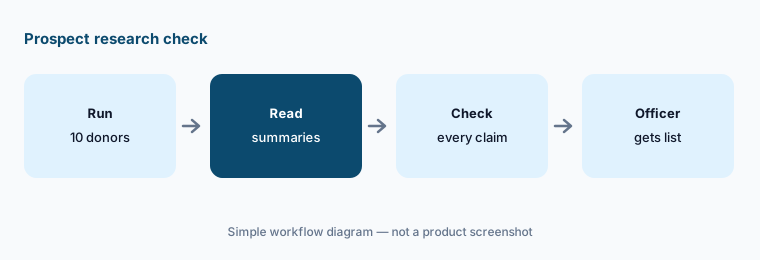
Primary workflow:
Run ten known donors through Kindsight's prospect research. Have the prospect researcher check every wealth and giving claim against public sources before any name goes on a major-gift list.
2. Screening Agent: a list screened in one pass
What it is: Kindsight announced Kindsight Intelligence for iWave on 2 June 2026: a Screening Agent that, in Kindsight's words, “scopes and guides your screening efforts for donor acquisition and pipeline growth,” and a Prospect Summary, both “available within iWave” in the third calendar quarter of 2026, with an option to turn the AI features off (Kindsight press page, Kindsight Intelligence page).
A screened list is a set of matches to public records. Common names, a spouse's assets, or an old address can attach the wrong wealth to the right donor, and the list looks equally confident either way.
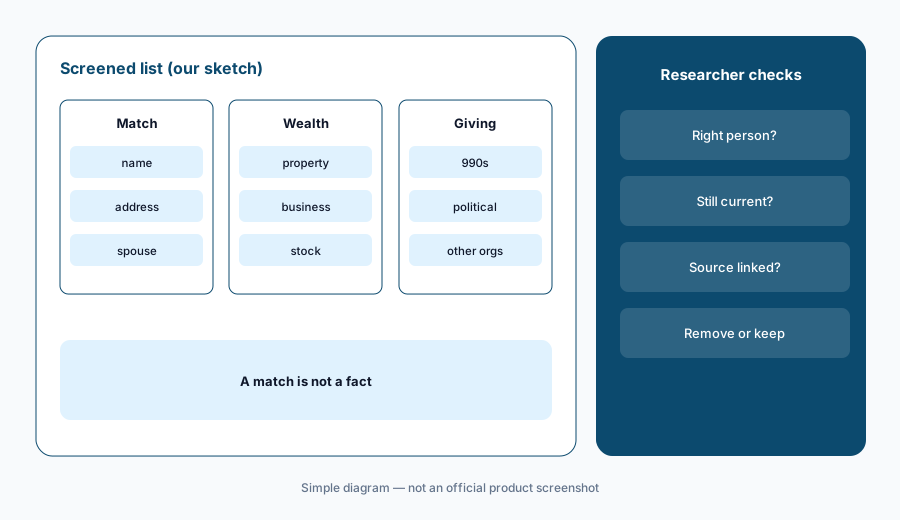
Open every match:
Screen one list you already know well. Have the prospect researcher open every flagged match and remove any that is the wrong person or out of date before the list goes to a gift officer.
3. KI Briefings before a donor meeting
What it is: In Ascend and AdvancementRM, KI Briefings pull “giving history, involvement and key relationships into one summary” before donor meetings and events. Kindsight quotes the Texas A&M Foundation saying briefing prep fell by about 95%, from 20–30 minutes to about one minute (Kindsight Intelligence page). That is Kindsight's and its customer's figure.
A brief is only as current as the CRM. A missed pledge payment, a recent complaint, or a death in the family may not be in the record yet, and the brief can't tell you what nobody entered.
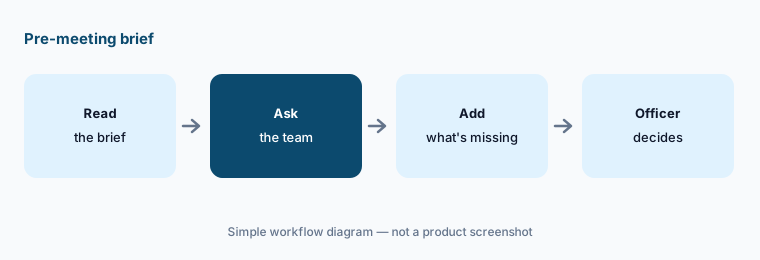
Ask what is missing:
Before the next three donor meetings, have the major gifts officer compare the KI Briefing with what the stewardship team knows and write down anything the brief missed.
4. Trip Planning Agent: who to see on a visit
What it is: The Trip Planning Agent “ranks who to see, where and when”; Kindsight adds “You set the itinerary” (Kindsight Intelligence page).
A ranked visit list leans toward whatever the model can see — recent gifts, wealth signals — and away from relationships that live in an officer's head, such as a donor who is grieving or a board member's introduction.
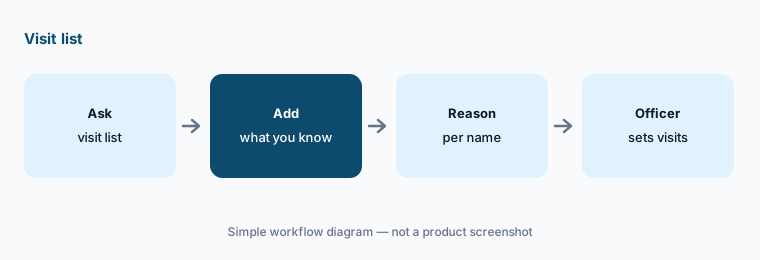
Set the visits yourself:
For one planned trip, ask the agent for a visit list and have the major gifts officer write a one-line reason for every name she keeps, moves, or adds before any meeting request goes out.
5. Contact reports from voice memos, and outreach drafts
What it is: After a visit you record a voice memo and Kindsight Intelligence turns it into a contact report, with action items, “checked for missing details and privacy risks”; generative AI also drafts emails, call scripts, and stewardship messages, and Kindsight says “You review before anything is sent” (Kindsight Intelligence page). The separate engage product offers 70+ guided writing prompts on its Starter plan (pricing page).
A contact report becomes part of the donor's record, and some donors can ask to see what you keep about them. A memo transcribed word for word can capture health details or family matters that do not belong in a CRM.
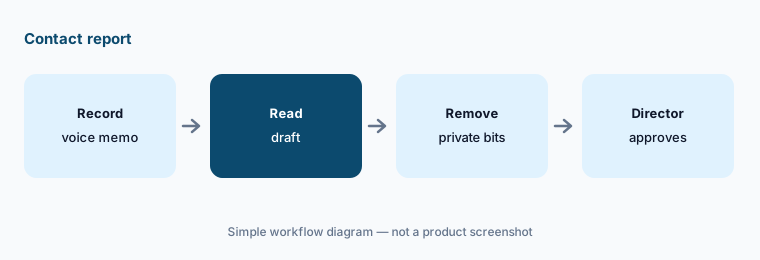
Read before you save:
Have each officer record one voice memo after a visit. Have the director of major gifts read every draft report and remove anything private before it is saved to the record.
6. Where donor data goes
What it is: Kindsight's Kindsight Intelligence page says donor data is never used to train models and is held for a 30-day window for quality checks; it runs on AWS Bedrock with Guardrails and a “Kindsight Trust Layer,” and is “aligned with ISO, SOC and GDPR.” Its January 2026 launch release said “zero long-term data retention” (press page). Kindsight's own 2026 benchmark, built from 363 respondents and 1,452 blinded comparisons, found only 1.7% supported AI acting without human review (benchmark report).
“Aligned with” is not the same as holding a certificate, and a 30-day window is not the same as zero retention. If a board, donor, or privacy policy asks, you need the exact answer in writing.
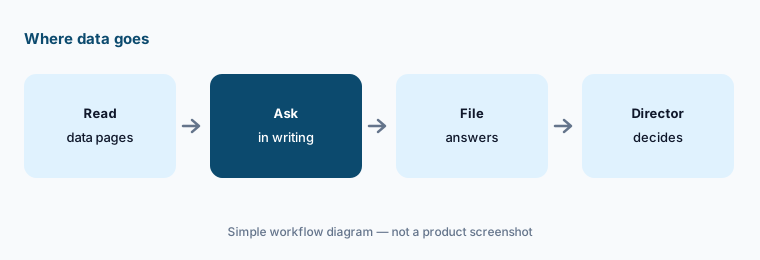
Ask in writing:
Before turning on any AI feature, have the development director ask Kindsight in writing about data retention, current security reports, and how to turn the AI features off, and file the answers with the contract.
Pricing context (November 2026)
Kindsight's pricing page (checked 7 Nov 2026) prints iWave prices: Starter starting at $4,500 (1 user, up to 1,500 subscription screens, 750 live profiles); Professional: “Contact us for pricing” as of 7 Nov 2026, so the price isn’t public (3 users, 5,000 screens, 2,500 live profiles, planned-giving analytics, SSO); Premium by contact (5 users, 20,000 screens, 10,000 live profiles, one CRM integration or API). The page does not say whether the iWave Starter figure is per year.
engage (AI writing): Starter $545/year (1 user), Professional $1,095/year (3 users), Premium $3,295/year (10 users, with a grant writer, team feed, custom prompts, and omnichannel campaigns). Ascend and the combined Fundraising Platform are by demo and quote; no price is printed.
The pricing page does not list a separate price for Kindsight Intelligence; ask which AI features are included in your plan and which are still rolling out.
Uncertainty: We did not test Kindsight. Facts come from Kindsight pages as read on 23 Oct 2026 (pricing re-checked 7 Nov 2026) and can change. The Screening Agent and Prospect Summary were announced for iWave in the third calendar quarter of 2026; confirm they are on your account. The January 2026 release says “zero long-term data retention” while the Kindsight Intelligence page describes a 30-day window; ask which applies. The 44+ datasets, 150 million+ records and profiles, and 95% figures are Kindsight's or its customer's.
When it’s useful (honest take)
Useful when you have a prospect researcher (or someone doing that job) who will check every wealth and giving claim, a major gifts program with portfolios to plan, and a budget for research at roughly the iWave price level.
Less useful when you are a small shop without a researcher and mostly need a donor CRM (Keela AI, Bloomerang AI), you want giving predictions across your whole file (Dataro AI), or your main work is grants rather than individual donors (Grantable AI, Submittable AI).
Paying for Kindsight AI and a few other AI tools? The $9 AI toolkit spreadsheet lists every AI subscription you have, what each one costs, and how fast it pays for itself, so you can see which ones are worth the money.
Want someone to do it for you? AI toolkit audit — $19
Related options (educational)
| Need | Better home | Why |
|---|---|---|
| Prospect research, screening, and a fundraising CRM | Kindsight (this page) | iWave from $4,500; engage from $545/year; Ascend quote-only |
| Prospect research and screening | DonorSearch AI | Quote-only |
| Giving predictions across a donor file | Dataro AI | Essentials from $15,000/year + $0.10 per active donor |
| AI agents inside Raiser's Edge NXT | Blackbaud AI | Quote-only |
| Donor CRM for a small team, with suggested asks | Keela AI | From $164/month billed annually, by contact count |
| Grant review on the funder side | Submittable AI | Quote-only |
FAQ
What is Kindsight?
Kindsight is the company behind iWave (prospect research and wealth screening), Ascend (a Salesforce-based fundraising CRM), and engage (AI writing for fundraisers). Its AI layer, Kindsight Intelligence, adds a Screening Agent, Prospect Summary, KI Briefings, a Trip Planning Agent, and contact reports from voice memos.
Is Kindsight the same as iWave?
iWave is now a Kindsight product. Kindsight sells iWave for prospect research alongside its Ascend CRM and engage writing tool, and the combined offer is called the Fundraising Platform.
How much does Kindsight cost in November 2026?
As printed on 7 Nov 2026: iWave Starter starting at $4,500; Professional and Premium say “Contact us for pricing” on kindsight.io/pricing, so their price is not public; the page does not say whether the Starter figure is per year. engage is $545, $1,095, or $3,295 a year. Ascend and the Fundraising Platform are quote-only.
Can Kindsight decide who to ask for a major gift?
No. Kindsight says prediction shows where to look and whether to reach out is your call. A prospect researcher should check every wealth and giving claim against public sources, and a major gifts officer decides who is asked and for how much.
Does Kindsight train AI on donor data?
Kindsight's Kindsight Intelligence page says donor data is never used to train models and is held for a 30-day window for quality checks. Its January 2026 release said zero long-term data retention. Ask Kindsight in writing which applies to your account.
Optional next step (if seats overlap)
If you pay for prospect research, a donor CRM, and chat seats that write the same donor briefs, that overlap is worth mapping. Map the overlap with the $19 AI toolkit audit or the $9 AI toolkit spreadsheet. Email Audit $19 or Toolkit spreadsheet $9.
Checkout is live via Stripe. After you pay, we email delivery (spreadsheet) or intake next steps (audit).