Compare · Grant research and prospecting · Oct 2026
Instrumentl vs Candid (Oct 2026): grant prospecting, funder research, AI features, and pricing for nonprofit grant teams
Instrumentl and Candid both help a nonprofit find funders, and both added AI this year, but they are built for different jobs. Instrumentl is a grants workspace: a Prospecting Assistant that matches you to open opportunities, Apply for drafting from your past proposals with source citations, and pipeline and post-grant tools, from $299 a month paid annually. Candid (formed from Foundation Center and GuideStar) sells funder research as Candid search, with an AI fundraising assistant that finds funders, checks eligibility, and drafts LOIs, from a free tier to $219 a month. This page splits them by job, shows how to test both on funders you know, and is not a ranking. Each section has a Try this.
What this comparison covers
This page is for a grants manager, development director, or executive director at a nonprofit that writes grants and is choosing, renewing, or adding a funder research tool. It is not legal, tax, or gift-acceptance advice; a named person owns every donor-facing message, gift record, ask amount, and funder submission.
Instrumentl facts come from its pricing page, what's new page, and Apply page. Candid facts come from its pricing page, Candid search page, and fundraising assistant post (31 August 2026). All were read on 23 October 2026. We did not test either product. Database sizes are each vendor's own figures; Instrumentl's site shows both 450k+ and 550k+ funder profiles in different places.
The short version: Instrumentl is organized around open opportunities and your pipeline, from first match to spending the money. Candid is organized around organizations and their giving history, with a free tier and a nonprofit discount. Many grant teams use one for research and the other for pipeline, or pair either with a writing tool such as Grantable AI or Claude for nonprofits, which lists a Candid connector.
Ground rules for either tool: the grants manager checks every funder fact against the funder's own site and filings; the development director decides which funders to approach; the executive director approves every submission and every renewal. This comparison is not a ranking.
| Question | Instrumentl | Candid |
|---|---|---|
| What it mainly is | Grant prospecting, pipeline, and post-grant management workspace | Funder and nonprofit research database (Candid search) |
| Size claims | 37k+ active RFPs, 450k+ funder profiles (its plan table) | 1.9 million organizations to search |
| AI for finding funders | Prospecting Assistant (beta, all plans) | Fundraising assistant (Premium and Ultimate) |
| AI for writing | Apply: answer snippets with source citations ($499 plan and up) | Fundraising assistant drafts LOIs |
| Funders of similar organizations | Peer prospecting ($499 plan and up) | Funders of your peers (Premium and up) |
| After you win a grant | Deadlines from grant letters; spenddown and budget vs actuals (Full Lifecycle) | Compliance status from 6 federal and state sources (Ultimate) |
| Entry price | $299/month paid annually, or $349 monthly; 14-day trial | Free registered tier; Premium $219/month, or $1,199/year for verified nonprofits |
| Who signs off | Grants manager on every funder fact and draft; development director on which funders to approach; executive director on every submission and renewal | |
Major features (with how someone uses them)
Examples at a glance: each feature has a concrete example from a real job plus a short Try this you can run this week.
1. Test both tools on funders you already know (primary)
What it is: The quickest honest comparison is on funders you know well: you know their real priorities, deadlines, grant sizes, and whether they take unsolicited proposals. Both tools show funder profiles and giving history; Instrumentl ties them to open opportunities (pricing page), and Candid ties them to grants data and organization profiles across 1.9 million organizations (Candid search).
Every database lags. Filings are a year or more old, and guidelines change between cycles. What matters is what each tool gets wrong about funders you can check.
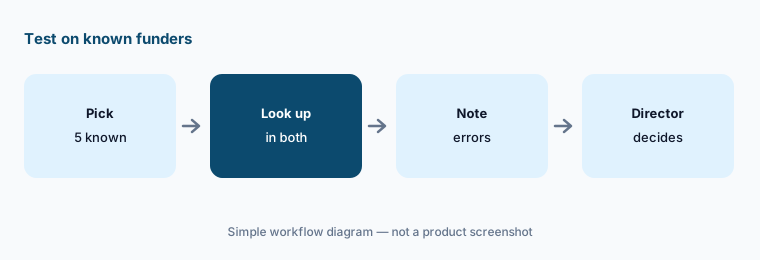
Test on known funders:
Pick five funders you already know well. Have the grants manager look each up in both tools and write down what each got wrong or missed before either subscription is renewed.
2. AI for finding new funders
What it is: Instrumentl's Prospecting Assistant (beta, on all plans) lets you describe a program “the way you'd explain it to a colleague” and refine matches with rules like “Nothing invite-only”; Instrumentl says new opportunities are “sourced, vetted, and maintained by human grant experts” (what's new). Candid's fundraising assistant is an AI agent you ask in plain language to search funders and grants and get a focused list; Candid says its pilot is complete and it is now available broadly to Candid search users (Candid blog, 31 Aug 2026).
A good-sounding match list can still include funders that don't fund your region or don't accept applications. The AI list is a starting point for research, not a prospect list.
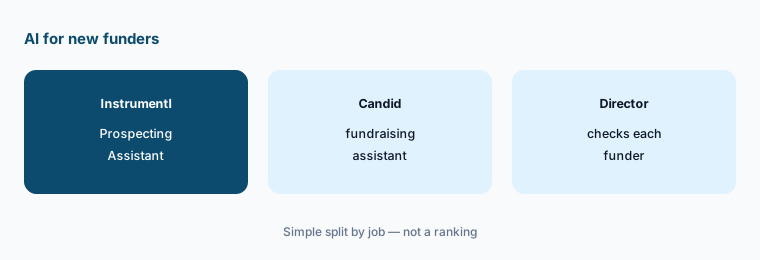
Check every match:
Ask each tool's AI for funders for one program. Have the development director check every name on the funder's own site before anyone is contacted.
3. Who funds organizations like yours
What it is: Instrumentl's peer prospecting shows funders of similar organizations on its $499-a-month plan and up (pricing page). Candid's Funders of your peers “shows you which funders support organizations like yours, how much they gave, and whether they accept applications,” on Premium and Ultimate (pricing page).
A peer's funder gave for a peer's reasons: a board connection, a location, a program you don't run. Similar is not the same.
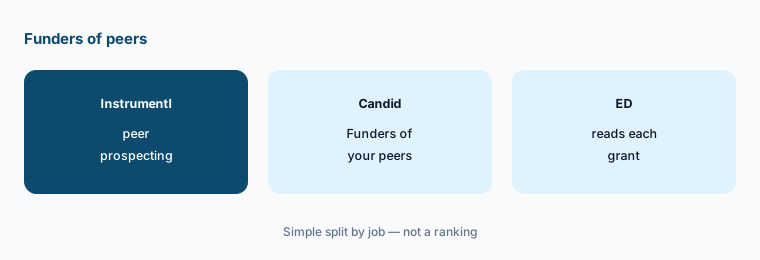
Read the actual grants:
Look up funders of three peer organizations in either tool. Have the executive director read what each grant was for before any funder moves to the approach list.
4. AI drafting help
What it is: Instrumentl's Apply pulls answer snippets from your past proposals and documents “with source citations so you know exactly where it came from,” with a Document Library and an Apply Advisor that uses funder giving history; it is on the $499 plan and up (Apply page). Candid's fundraising assistant can draft an LOI and flag eligibility requirements such as minimum operating budget (Candid blog).
Citations show where a sentence came from, not whether it is still true. An LOI drafted from a funder's general guidelines can miss what this year's call asks for.
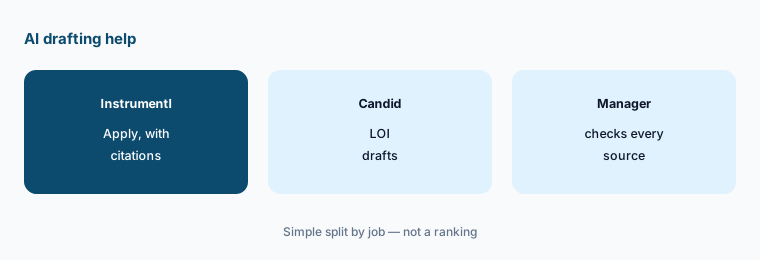
Check the cited source:
Draft one section in either tool. Have the grants manager open every cited source, update anything out of date, and get the executive director's approval on the ask before it is sent.
5. After you win: deadlines, spending, and compliance status
What it is: Instrumentl's $499 plan extracts deadlines and requirements from grant letters; Full Lifecycle adds a real-time view of grant spenddown, accounting sync, and budget vs actuals reports (pricing page). Candid's Ultimate plan adds Landscapes, a funding-trends tool, and instant nonprofit compliance status from 6 federal and state sources including BMF, Pub78, automatic revocations, and OFAC, verified daily (pricing page).
These answer different questions: Instrumentl helps you meet the terms of your own grants; Candid's compliance status reports what public sources say about an organization. Neither is legal advice.
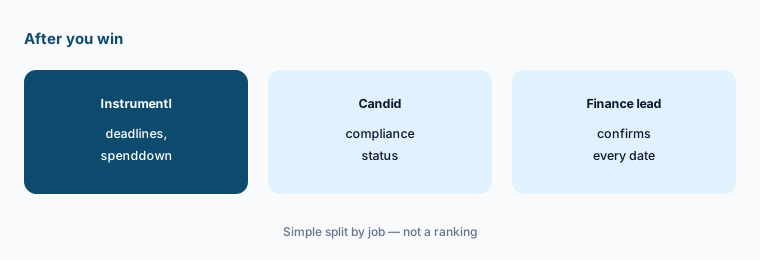
Check every date:
Load one grant letter into a post-grant tool. Have the finance lead compare every extracted date and requirement with the letter before the calendar is shared.
6. Price, users, and what you renew
What it is: Instrumentl: Discover $299/month paid upfront annually or $349 monthly (up to 3 users); the $499 plan paid annually or $579 monthly (up to 5 users); Full Lifecycle $999 or $1,159 monthly (up to 15 users); Enterprise custom; 14-day free trial (pricing page). Candid: free registered tier; Premium $219/month monthly; verified nonprofits pay $1,199/year for Premium or $1,699/year for Ultimate; standard annual prices are $2,199 and $2,499; Enterprise for 10+ users (pricing page).
The cheaper tool is the one your team actually opens every week. Count users and logins, not plan features.
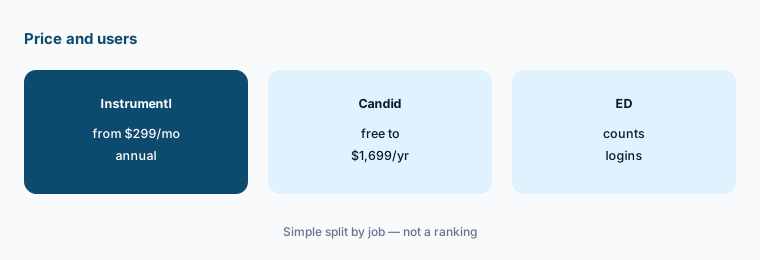
Count what gets used:
Before renewing, have the executive director list who logged in to each tool in the last 90 days and which features they used, then pick the plan that matches.
Pricing context (October 2026)
Instrumentl: its pricing page (checked 31 Oct 2026) prints Discover at $299/month paid upfront annually (or $349 paid monthly, up to 3 users), a $499 plan paid upfront annually (or $579 paid monthly, up to 5 users) that adds Apply, peer prospecting, CRM sync, and deadline extraction from grant letters, Full Lifecycle at $999 (or $1,159 monthly, up to 15 users), and Enterprise at custom pricing. Each plan has a 14-day free trial. Instrumentl says over 5,500 nonprofits use it.
Candid: its pricing page (checked 23 Oct 2026) prints a free registered tier, Premium monthly at $219/month, and annual plans that verified nonprofits get at a discount: Premium $100/month ($1,199 billed annually) and Ultimate $142/month ($1,699 billed annually). Standard annual prices are $2,199 (Premium) and $2,499 (Ultimate). Enterprise is custom, for 10 or more users or API access.
If you are weighing a single AI tool instead of either, Grantable says it “fully replaces” grant database subscriptions; that is its claim, covered in our Grantable AI review.
Uncertainty: We did not test either product. Facts come from Instrumentl and Candid pages as read on 23 Oct 2026 and can change. Database sizes are vendor figures, and Instrumentl shows two different funder-profile counts on its site. Instrumentl's Prospecting Assistant is labeled beta, and its Claude integration was listed in its Summer 2026 release; check what is live on your plan. Instrumentl's Fall Launch webinar is scheduled for 29 October and 4 November 2026 and may change features.
When it’s useful (honest take)
Useful when you write grants every month, a grants manager will check every funder fact against the funder's own site, and you want either an opportunity-and-pipeline workspace (Instrumentl) or deep funder and organization research with a free tier (Candid).
Less useful when your main need is drafting from your own past proposals (Grantable AI, ChatGPT for nonprofits), individual donor research (DonorSearch AI), or online giving forms (Zeffy vs Givebutter).
Still choosing between Instrumentl and Candid? The $19 AI toolkit audit gives you a written plan for which tools to keep using and which to drop across your whole AI stack, including this pair.
Prefer to do it yourself? Spreadsheet — $9
Related options (educational)
| Need | Better home | Why |
|---|---|---|
| Open opportunities, pipeline, and post-grant spending | Instrumentl (this page) | From $299/month paid annually |
| Funder and organization research with a free tier | Candid (this page) | Free; Premium $219/month or $1,199/year for nonprofits |
| Drafts from your own library, plus prospecting | Grantable AI | Free; Starter $50/month; Pro $150/month |
| Drafting with a Candid connector | Claude for nonprofits | Team plan, up to 75% off for nonprofits |
| Individual donor research | DonorSearch AI | Quote-only |
| Grant fit analysis inside a donor CRM | Bonterra Que | Quote-only |
FAQ
What is the main difference between Instrumentl and Candid?
Instrumentl is a grants workspace built around open opportunities, your pipeline, and post-grant management. Candid sells funder and nonprofit research as Candid search, with a free tier and a nonprofit discount. Both added AI assistants in 2026. This page is not a ranking.
How much do Instrumentl and Candid cost in October 2026?
As printed on 31 Oct 2026 (Instrumentl; Candid checked 28 Oct 2026): Instrumentl Discover is $299/month paid annually or $349 monthly, with higher plans at $499 and $999 a month paid annually. Candid has a free tier, Premium at $219/month monthly, and annual plans for verified nonprofits at $1,199 or $1,699 a year.
What AI do they have?
Instrumentl has a Prospecting Assistant (beta) for matching and Apply for drafting with source citations. Candid has a fundraising assistant that searches funders and grants in plain language, checks eligibility, and drafts LOIs. A person should check every result against the funder's own site.
Can we use both?
Yes. Some teams use Candid for funder research and Instrumentl for the pipeline and post-grant work. Before paying for both, test each on five funders you know well and count who actually uses each tool.
Who should own the decision?
The grants manager tests both on known funders and checks every funder fact; the development director decides which funders to approach; the executive director approves every submission and renewal.
Optional next step (if seats overlap)
If you pay for a grant database, a grant writing tool, and chat seats that do the same research, that overlap is worth mapping. Map the overlap with the $19 AI toolkit audit or the $9 AI toolkit spreadsheet. Email Audit $19 or Toolkit spreadsheet $9.
Checkout is live via Stripe. After you pay, we email delivery (spreadsheet) or intake next steps (audit).