Compare · Ecommerce ops · Oct 2026
Salsify vs Akeneo (Oct 2026): AI product content and PIM platforms compared
Salsify and Akeneo both hold your product data and send it to retailers, marketplaces, and your own store, and both now use AI to fill gaps and prepare content. The clearest practical difference is where a filled-in value comes from: Salsify’s Intelligence Suite works mainly from your own assets and workflows, while Akeneo’s web-based enrichment proposes values from public websites with the source attached. This page compares the jobs a product data team runs every week, what each vendor publishes, and who approves a value — it is not a ranking, and each section has a Try this.
What this comparison covers
This page is for a product data lead, merchandiser, or ecommerce manager at a brand, manufacturer, or retailer choosing between Salsify and Akeneo, or running one and curious about the other’s AI. The question it answers: by AI enrichment, how each shows its sources, governance and approval, assistants, syndication and AI-channel exports, MCP access, and pricing, how do the two compare.
Facts align with our Salsify AI and Akeneo AI reviews (read 16 October 2026), with Salsify’s AI page, Intelligence Suite page, and SalsifyIQ release (5 May 2026), and Akeneo’s AI page, web enrichment guide, and package comparison re-read the same afternoon. Neither vendor publishes a real price for its paid platform.
Ground rules for either tool: a named product data lead or merchandiser accepts every AI-filled value after opening its source; safety, allergen, age, and legal attributes are never filled automatically; AI-written copy is checked against the spec sheet before syndication; the team decides which outside AI tools may read the catalog; and vendor time-saving figures are left out or attributed only. This comparison is not a ranking. If the gap is on-site search rather than data, see Algolia vs Bloomreach.
| Question | Salsify | Akeneo |
|---|---|---|
| Published price | None; quote only | Paid packages by quote (Growth shows a $0 “starting at” figure we don’t treat as a price); Community Edition free |
| Filling missing values | Intelligence Suite extracts from your own assets (packaging, nutrition labels, spec sheets) and generates copy | Web-based enrichment proposes values from public websites, each with a cited source; extraction from images and PDFs |
| How the source is shown | The asset the value came from; no web citations described | At least one source website per value; “no citation, no suggestion”; sources kept in product history |
| Approval steps | Workflow-based tasks with human review at any step | Review step required before automated enrichment; Agentic Ziggy plans are proposed, then approved |
| Assistant | Angie, conversational assistant (platform-wide status worded two ways) | Ask Ziggy (read-only) and Agentic Ziggy (8 Jul 2026) |
| AI-channel exports | OpenAI syndication channel (launched as a pilot, Oct 2025) | AI Discovery shows how ChatGPT, Gemini, and Claude describe products (Premium) |
| MCP and model choice | MCP layer “introduced” May 2026, availability not stated; OpenAI, Gemini, Anthropic, or SalsifyIQ | Connect your own models; outside AI tools such as Claude or ChatGPT can query catalog data through open standards |
| Who approves values | Merchandiser for every syndicated claim | Product data lead for every accepted value |
Major features (with how someone uses them)
Examples at a glance: each feature has a concrete example from a real job plus a short Try this you can run this week.
1. Start from five products with messy specs (primary)
What it is: Before comparing demos, pick five products whose data is a mess: a missing dimension, a material described three ways, a translated name nobody checked, a spec only in a PDF, and a claim on the packaging that isn’t in the PIM. In each vendor’s demo or trial, note which gaps the AI fills, how it shows where the value came from, and which step a person must approve before the value is saved.
The useful comparison is not how many gaps each tool fills, but how quickly a person can check each one and say yes or no.
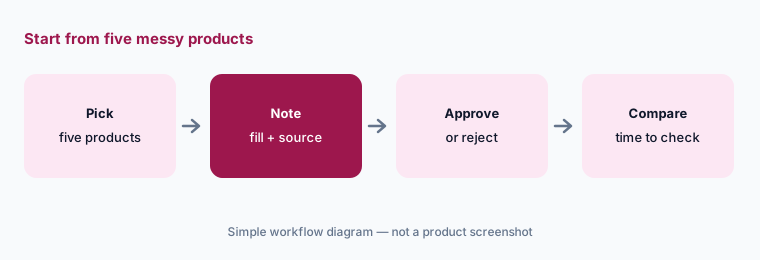
Five messy products:
Pick five products with messy specs. Note which platform's AI fills each gap, how it shows its source, and who approves the value.
2. Where filled values come from
What it is: Salsify’s Intelligence Suite extracts data from your own digital assets — packaging, nutrition labels, spec sheets — and turns it into structured attributes, then generates translations, Q&A content, and variants (Salsify AI). Akeneo extracts from images and PDFs too, and adds web-based attribute enrichment on Growth, Advanced, and Premium: it searches public websites for missing details, attaches at least one source to every proposed value, proposes nothing without one, and respects publisher opt-outs and sites you block (Akeneo AI).
Values extracted from your own asset are only as good as that asset; values from the web are only as good as the site. Prefer the manufacturer’s own documents either way.
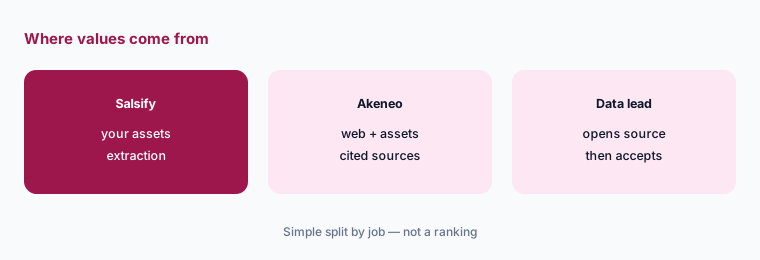
Same gap, two sources:
Pick three missing values. Fill each from your own asset in one tool and from the web in the other where offered. Have the product data lead open every source before accepting either.
3. Governance and approval steps
What it is: Salsify describes a workflow-centric approach where “the appropriate guardrails and human review take place at any point”, with audit, validation, and data-quality rules, and says it never uses your data for model training (Salsify AI). Akeneo requires a review step in the workflow before automated web enrichment can be switched on, and its Agentic Ziggy (Summer Release, 8 July 2026) proposes execution plans that people approve, with role-based permissions and a record of agent actions (Akeneo AI).
An approval step only works if someone owns it. Name the approver for each attribute group — safety, marketing copy, dimensions — before switching on any automated step.
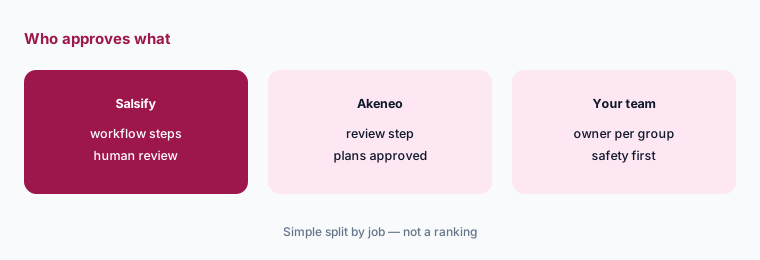
Owners per attribute group:
List your attribute groups (safety, copy, dimensions, images) and name one approver for each. Set the review step in each trial so no AI value in the safety group saves without that person.
4. Angie vs Ask Ziggy and Agentic Ziggy
What it is: Salsify’s Angie is a conversational assistant for tasks such as building computed properties and answering questions from the knowledge base; the 5 May 2026 release says both that Angie “is now platform-wide” and that Salsify “is extending” it across the platform (Salsify AI). Akeneo splits its assistant in two: Ask Ziggy is read-only, and Agentic Ziggy turns requests and catalog signals into plans carried out by specialised agents after approval (Akeneo AI).
An assistant that can change data needs the same review as a bulk import. Ask each vendor which actions its assistant can take on your account without a person approving.
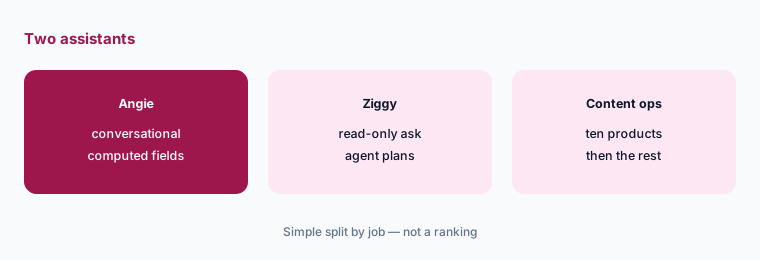
Same task, both assistants:
Give each assistant the same task on ten products. Have the content operations manager check every changed field and write down which actions the assistant took without approval.
5. Syndication and AI-channel exports
What it is: Salsify’s OpenAI syndication channel publishes product data to OpenAI for agentic shopping, launched as a pilot in October 2025, and its May 2026 release adds Automapping and Auto-healing to fix retailer schema errors (Salsify AI). Akeneo’s Channel Readiness Guide flags missing fields before you connect a channel, automated mapping shows why it chose each match, Intelligent Error Management explains retailer errors, and AI Discovery on Premium shows how ChatGPT, Gemini, and Claude describe your products (Akeneo AI).
Automatic mapping and auto-fixing speed syndication up — and can send a wrong safety field to every retailer at once. Review mappings for regulated fields by hand before the first export.
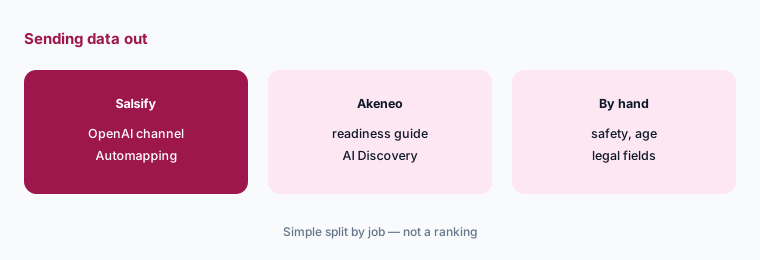
One channel, regulated fields first:
Run each tool’s readiness or mapping step for one channel. Have the syndication manager review every mapping for safety, age, and legal fields by hand before the first export.
6. MCP access, model choice, and price
What it is: Salsify says its Intelligence Suite works with OpenAI, Gemini, and Anthropic or its own SalsifyIQ, and its May 2026 release “introduced” an MCP layer for customers’ agents, with availability not stated; Salsify publishes no prices (Salsify AI). Akeneo lets you connect your own AI models and says outside AI tools such as Claude or ChatGPT can query catalog data through open standards; its paid packages are by quote, Growth shows a $0 “starting at” figure we don’t treat as a price, and the Community Edition is free (Akeneo AI).
Ask both vendors the same questions in writing: which AI credits are included, what extra usage costs, whether bringing your own model changes the price, and who can grant an outside AI tool read access.
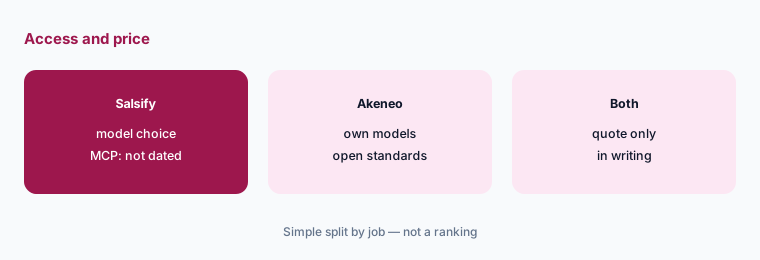
Same questions, in writing:
Send both vendors your SKU count, channels, languages, and wanted AI features. Ask for a written quote with AI credits, extra usage, and who can grant outside AI tools catalog access.
Pricing context (October 2026)
Salsify (re-read 16 Oct 2026 via Salsify AI): no published prices; quote only. Its pricing link led to a sales page rather than a price list on the day we checked.
Akeneo (re-read 16 Oct 2026 via Akeneo AI): paid packages by quote — Growth shows “Starting at” a $0 figure “Annually”, which we don’t treat as a price; Advanced and Premium “Call for quote”; free trials offered; open-source Community Edition free. Web enrichment on Growth, Advanced, and Premium; prompt-based image edits on Advanced and Premium at 5 credits per asset; AI Discovery on Premium.
Uncertainty: Neither vendor gives a real price on 16 Oct 2026, so any cost comparison depends on written quotes. Salsify’s 5 May 2026 release describes Angie as both “now platform-wide” and being extended across the platform, and its MCP layer is “introduced” without an availability date; its OpenAI channel launched as a pilot and its current status isn’t stated. Akeneo shows a $0 Growth figure on its package page that we don’t treat as a price, and calls its Summer Release the first of several investments through 2026, so which agents are switched on varies by account. Vendor time-saving and customer figures are their claims, not our measurement. This page is not a ranking — decide from your five messy products, two quotes, and named approvers.
When it’s useful (honest take)
Salsify is useful when you syndicate brand content to many retailers, want AI steps inside existing workflows working from your own assets, and are interested in feeding product data to AI shopping channels, with a merchandiser who approves every syndicated claim.
Akeneo is useful when supplier data arrives with gaps you want filled from cited public sources, you want a free open-source edition to start or an assistant that only reads, and you have a product data lead who opens every source.
Less useful when (either one) your catalog is small enough for your store platform (BigCommerce AI), you mainly sell on Amazon (Jungle Scout AI), or nobody will own approvals.
Still choosing between Salsify and Akeneo? The $19 AI toolkit audit gives you a written plan for which tools to keep using and which to drop across your whole AI stack, including this pair.
Prefer to do it yourself? Spreadsheet — $9
Related options (educational)
| Need | Better home | Why |
|---|---|---|
| Salsify on its own | Salsify AI | Quote only |
| Akeneo on its own | Akeneo AI | Paid packages by quote; Community Edition free |
| Store-platform AI copy and catalog enrichment | BigCommerce AI | Core $39 → Scale $399/mo (monthly billing) |
| Amazon listings and review themes | Jungle Scout AI | Catalyst $49–$149/mo on monthly billing |
| Site search on top of product data | Algolia vs Bloomreach | Not a ranking |
FAQ
Is Salsify or Akeneo better for product data?
Neither is ranked here. Salsify leans on workflows and your own assets and syndicates to many retailers and an OpenAI channel; Akeneo adds web-sourced values with citations and a read-only assistant. Test five messy products in both.
Do Salsify and Akeneo publish prices?
No real prices (checked 16 Oct 2026). Salsify is quote only. Akeneo’s paid packages are by quote; its Growth package shows a $0 starting figure we don’t treat as a price, and its Community Edition is free.
How do they show where an AI value came from?
Akeneo’s web enrichment attaches at least one source website to every proposed value and proposes nothing without one. Salsify’s Intelligence Suite extracts values from your own assets such as packaging and spec sheets.
Do both support MCP or outside AI tools?
Salsify introduced an MCP layer in May 2026 without an availability date. Akeneo says outside AI tools such as Claude or ChatGPT can query catalog data through open standards. Ask each who can grant that access.
Who should approve AI-filled values in either tool?
A named product data lead accepts every value after opening its source, a merchandiser approves syndicated claims, compliance owns safety and age fields, and the syndication manager reviews mappings before the first export.
Optional next step (if seats overlap)
If you pay for a PIM with AI enrichment, a separate content-writing tool, a translation service, and chat seats your team uses to research specs, that overlap is worth mapping. Map the overlap with the $19 AI toolkit audit or the $9 AI toolkit spreadsheet. Email Audit $19 or Toolkit spreadsheet $9.
Checkout is live via Stripe. After you pay, we email delivery (spreadsheet) or intake next steps (audit).