Compare · Ecommerce ops · Oct 2026
Attentive vs Postscript (Oct 2026): AI SMS and email marketing platforms for ecommerce compared
Attentive and Postscript both sell text-message marketing to ecommerce brands, and both now wrap it in AI. Attentive spans SMS, email, RCS, and push, with AI sold as add-on products and no published prices. Postscript is text-first, mostly for Shopify stores, with published per-message pricing and a set of AI agents called Shopper. This page compares the jobs a retention team runs every week, what each vendor publishes, and who approves — it is not a ranking, and each section has a Try this.
What this comparison covers
This page is for a retention lead, SMS manager, or ecommerce marketing manager choosing between Attentive and Postscript, or running one and hearing about the other’s AI. The question it answers: by recurring text-message jobs, published prices, AI features and their status, channels, and who approves, how do the two compare.
Facts align with our Attentive AI and Postscript AI reviews (read 16 October 2026), with Attentive pricing, Attentive Concierge, Postscript pricing, and the Postscript Shopper page re-read the same day. Attentive publishes no amounts; Postscript publishes plan fees and per-message rates. Carrier fees, short codes, and add-ons are extra on both.
Ground rules for either platform: a named retention lead approves every campaign, offer, audience, and AI feature before it sends; SMS consent, quiet-hour, and opt-out rules are the brand’s to check even where the platform applies them automatically; no subscriber phone lists or order exports go into an outside chat tool; vendor lift and return figures are left out or attributed only. This comparison is not a ranking. If search and merchandising are the bigger AI question, see Algolia AI, Bloomreach AI, or Nosto AI.
| Question | Attentive | Postscript |
|---|---|---|
| Channels | SMS, MMS, RCS, email, and push | SMS, MMS, and RCS; Postscript Email launched 23 Sep 2026 with a waitlist |
| Published price | No amounts; priced by messages, list size, channels, and AI products (quote, free trial) | Starter $0 + $49 minimum · Growth $100 · Professional $500 per month plus message fees · AI Plan $699/mo + $0.003–$0.30 per message |
| AI copy | AI Essentials (messages and subject lines; included with all plans) and brand-voice copy in AI Pro | Infinity Testing writes and tests ~10 versions per campaign, up to thousands per automation |
| Who gets the message | Audiences AI and Identity AI (AI Pro); Lifecycle Intelligence: Product Affinity generally available, RFM and Customer LTV in beta | Shopper Campaigns decides who should and shouldn’t get a campaign (Alpha); Ask Shopper surfaces themes; segments hand-built |
| Two-way conversations | Attentive Concierge: live agents and conversational AI together | Shopper Responses: AI agent over SMS and RCS, hands off to Gorgias or Zendesk |
| Triggered flows | AI Journeys (pay per click) and Send Time AI | Shopper Automations (13 Aug 2026) with a control group on existing flows |
| Agents and outside tools | Reporting Agent and Attentive MCP, both beta | Ask Shopper; Brand Center Playground for previews |
| Who approves | Retention lead for every campaign, audience, and journey; brand owns consent and quiet hours | Retention lead for every campaign, offer, and AI feature; brand owns consent and quiet hours |
Major features (with how someone uses them)
Examples at a glance: each feature has a concrete example from a real job plus a short Try this you can run this week.
1. Start from five recurring SMS jobs (primary)
What it is: Before comparing feature names, list the five text-message jobs your team runs every week — welcome, browse abandon, cart abandon, back in stock, and win-back are common. For each, note which platform’s AI would handle it (copy, audience, timing, or the whole flow), on which plan or product, and who approves the copy before it sends.
A job with no named approver is not ready on either platform. On Attentive the AI for flows sits in AI Journeys and AI Pro; on Postscript it sits in Infinity Testing and Shopper Automations, and Postscript bundles Brand Center, Infinity Testing, and Shopper in its AI Plan.
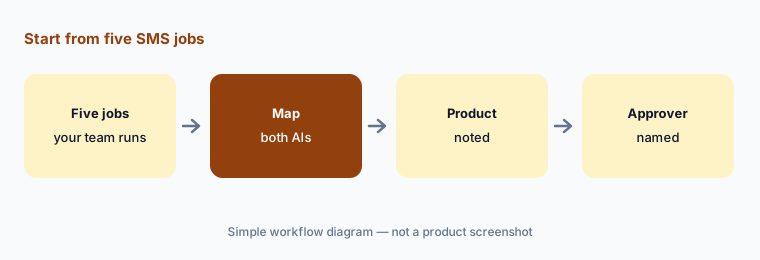
Your five jobs:
List your five recurring SMS jobs (welcome, browse abandon, cart, back in stock, win-back). Note which platform's AI handles each and who approves the copy.
2. Published prices vs a quote
What it is: Postscript publishes its plans: Starter $0/month with a $49 monthly minimum, Growth $100/month, Professional $500/month, plus per-message rates and carrier fees; the AI Plan is $699/month plus $0.003 to $0.30 per message, and a free trial gives a $100 credit (Postscript AI). Attentive publishes no amounts. Its pricing page (re-read 16 Oct 2026) builds a plan from messages sent, list size, channels, and AI products: AI Pro and AI Grow are each a flat monthly fee, AI Journeys is pay per click, and AI Essentials — faster messages and subject lines — is included with all plans; bundles get discounts and a free trial is available (Attentive AI).
Ask both vendors for a written quote at the same list size and monthly message volume, with each AI product named line by line, before you compare demos.
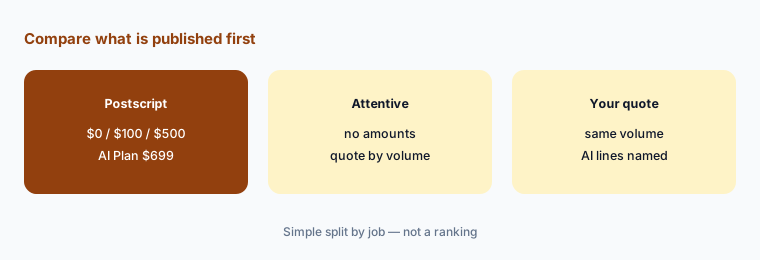
Same volume, two quotes:
Send both vendors your list size and last quarter’s monthly message volume. Ask for a written twelve-month total with every AI product and carrier fee named on its own line.
3. AI copy and campaign versions
What it is: Attentive drafts SMS and email copy in your brand voice; AI Pro shapes it from your past top-performing messages, and the drafts sit in the normal campaign builder. Postscript’s Infinity Testing writes and tests many versions — about 10 for a campaign, up to thousands for an automation — and updates after each send, drawing on the guidelines, policies, and offers stored in Brand Center. Either way, the copy can quote a wrong discount or make a claim the product can’t back.
Ten versions can be read by a person before sending; thousands cannot. With Postscript automations the checks sit in Brand Center’s banned language and offers; with Attentive drafts the check is the person scheduling the send.
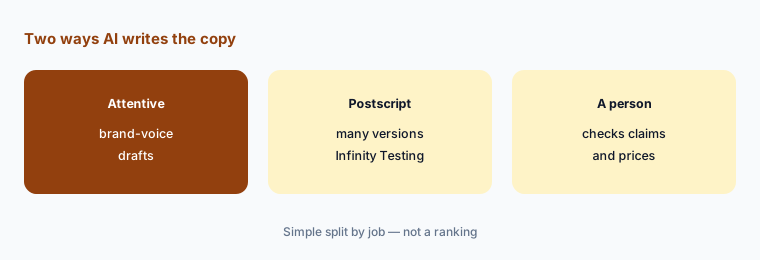
Same brief, both tools:
Give both platforms the same launch brief. Have the retention lead read every version and mark any price, discount, or product claim the promo sheet doesn’t support.
4. Who gets the message
What it is: Attentive’s Audiences AI adds subscribers likely to buy and removes those unlikely to, Identity AI recognises more site visitors, and Lifecycle Intelligence (22 Sep 2026) adds Product Affinity (generally available to AI Pro customers) plus RFM and Customer LTV (beta). Postscript’s Shopper Campaigns decides who should and shouldn’t get a campaign and was listed as Alpha on 16 Oct 2026; Ask Shopper turns subscriber conversations into themes you can build a segment from. Postscript has no feature called “segment suggestions”.
When AI drops people from a send, ask who was left out and why. Compare the AI audience with your usual segment on orders and unsubscribes before using it for every campaign.
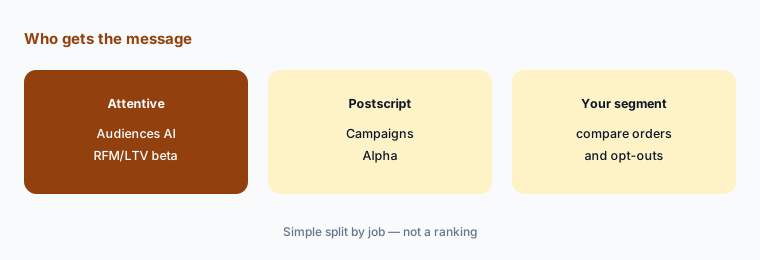
AI audience vs yours:
Send one campaign to the platform’s AI audience and the same campaign to your usual segment. Have the retention lead compare orders and unsubscribes per 1,000 messages before using the AI audience again.
5. Two-way conversations by text
What it is: Attentive Concierge answers subscriber replies with “live agents and conversational AI working together”, around the clock, using your brand voice, tone, and catalogue; LiveSMS moves on-site chat into a text thread. Postscript’s Shopper Responses is an AI agent that answers product questions and objections over SMS and RCS, trained on Brand Center and your Shopify store; Postscript says it handles about 92% of conversations on its own (its figure) and hands the rest to your support email, phone, form, or a Gorgias or Zendesk ticket with the last ten messages.
Whoever answers — a person, an AI, or both — is quoting your shipping times, returns rules, and discounts. Read a week of conversations on either platform before trusting it with a sale.
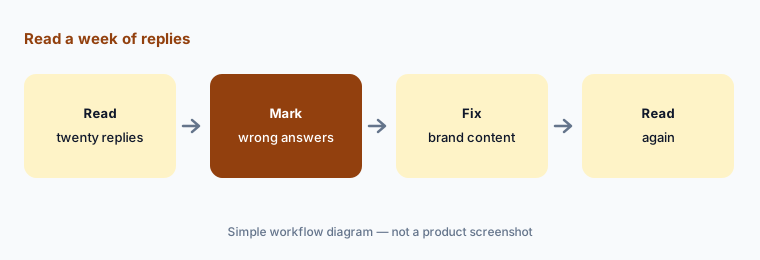
Read a week of replies:
Read twenty two-way conversations from one week on the platform you’re testing. Mark every answer about shipping, returns, or discounts the retention lead would change.
6. Channels, consent, and who approves
What it is: Attentive covers SMS, MMS, RCS, email, and push, lists built-in TCPA and compliance tools on every plan, and has two beta tools that reach beyond the dashboard — the Reporting Agent and Attentive MCP, where you choose what a connected assistant can read or change. Postscript covers SMS, MMS, and RCS today, with email on a waitlist since 23 September 2026; it says Shopper inherits its TCPA standards (opt-outs, quiet hours, consent rules applied automatically) and that its compliance team reviews any uploaded list. On both, the rules themselves are the brand’s.
Keep one approval sheet with columns for copy, audiences, offers, triggered flows, two-way replies, and connected AI tools — and a named person in each. The same sheet works on Attentive or Postscript.
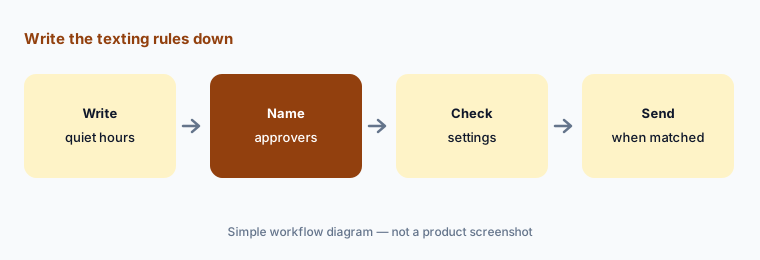
One approval sheet:
Write down your quiet-hour window, opt-out keywords, and consent sources, and name an approver for copy, audiences, offers, flows, and replies. Check each setting matches on the platform before any AI feature sends a text.
Pricing context (October 2026)
Postscript (re-read 16 Oct 2026 via Postscript AI): Starter $0/month with a $49 monthly minimum ($0.009 per SMS), Growth $100/month ($0.008 per SMS), Professional $500/month ($0.007 per SMS), Enterprise by quote; carrier fees passed through; AI Plan $699/month plus $0.003–$0.30 per message; $100 trial credit for 30 days.
Attentive (re-read 16 Oct 2026 via Attentive AI): no published amounts. Price depends on messages, list size, channels, and AI products; AI Pro and AI Grow are flat monthly fees, AI Journeys is pay per click, AI Essentials is included with all plans; bundle discounts; free trial through the sales form.
Uncertainty: Attentive publishes no prices, so any cost comparison depends on your quote. Status labels change: Postscript Shopper Campaigns was Alpha and Email waitlist-only; Attentive RFM, Customer LTV, the Reporting Agent, and MCP were beta on 16 Oct 2026. Attentive’s Concierge page does not say how replies are split between people and AI. Vendor figures (Postscript’s ~92% of conversations handled, Attentive’s revenue and ROI lifts) are their claims, not our measurement. This page is not a ranking — pick from your five jobs, two quotes, and named approvers.
When it’s useful (honest take)
Attentive is useful when you want SMS, email, RCS, and push on one platform with AI add-ons you can bundle, and you are fine getting a quote rather than a price list.
Postscript is useful when text messaging is your main retention channel on Shopify, you want published plan fees and per-message rates, and you’re comfortable with Alpha labels on its campaign-audience agent today.
Less useful when (either one) nobody will read conversations and AI audiences every week, email is your main channel (Klaviyo AI), or the bigger problem is shoppers not finding products (Algolia AI, Nosto AI).
Still choosing between Attentive and Postscript? The $19 AI toolkit audit gives you a written plan for which tools to keep using and which to drop across your whole AI stack, including this pair.
Prefer to do it yourself? Spreadsheet — $9
Related options (educational)
| Need | Better home | Why |
|---|---|---|
| Attentive on its own | Attentive AI | Usage-based — quote |
| Postscript on its own | Postscript AI | Starter $0 + $49 minimum → AI Plan $699/mo |
| Email-first lifecycle with AI drafts | Klaviyo AI | See its review |
| Email and SMS with search on one profile | Bloomreach AI | Custom; most brands $60K+/yr (vendor) |
| Reviews and loyalty data for messages | Yotpo AI | Free → Starter $89/mo at 500 orders |
FAQ
Should I choose Attentive or Postscript?
This page is not a ranking. List your five recurring text-message jobs, note which platform’s AI handles each and who approves, get written quotes at the same volume, and compare those — not marketing headlines.
Which one publishes prices?
Postscript publishes plan fees, per-message rates, and a $699/month AI Plan (checked 16 Oct 2026). Attentive publishes no amounts; it prices by messages, list size, channels, and AI products, with AI Pro and AI Grow as flat monthly fees and AI Journeys pay per click.
Do both answer customer text replies with AI?
Postscript Shopper Responses is an AI agent over SMS and RCS that hands off to your support team. Attentive Concierge combines live agents and conversational AI. On either, read a week of conversations before trusting what they promise.
Does either do email?
Attentive covers email, SMS, RCS, and push today. Postscript Email launched on 23 September 2026 with a waitlist.
Who should approve AI on either platform?
A named retention lead for every campaign, audience, offer, and AI feature; the CX team for escalated conversations; and the brand — not the platform — owns consent, quiet hours, and opt-out rules.
Optional next step (if seats overlap)
If you pay for an SMS platform with AI, an email tool with its own AI, and a help desk that also answers texts, that overlap is worth mapping. Map the overlap with the $19 AI toolkit audit or the $9 AI toolkit spreadsheet. Email Audit $19 or Toolkit spreadsheet $9.
Checkout is live via Stripe. After you pay, we email delivery (spreadsheet) or intake next steps (audit).