Tool · Ecommerce ops · Yotpo · Oct 2026
Yotpo AI review (Oct 2026): AI review summaries, Yotpo Discover AI visibility, and loyalty for ecommerce brands
Yotpo collects and displays customer reviews for online stores, runs loyalty and referral programs, and now sells Yotpo Discover, a tool for seeing how AI assistants such as ChatGPT and Gemini talk about your products. Its AI drafts replies to reviews, writes a summary of what customers say on each product page, nudges shoppers to write more useful reviews, and summarises review feedback for your team. This page is about using that AI without bending the one thing a reviews tool has to protect: that the reviews are real and the unhappy ones are visible too. A named CX lead approves every public reply. Each section has a Try this.
What this Yotpo page covers
This page is for a CX lead, retention manager, or ecommerce manager who runs Yotpo or is choosing a reviews and loyalty platform. The question it answers: what each Yotpo AI feature does, which plan it sits on, what Yotpo publishes about price, and who has to read the output before shoppers do.
Yotpo’s pricing page, Reviews page, Discover page, product releases, and help-center articles on the Reviews Summary, AI comments, and Manage Reviews were read on 16 October 2026.
Ground rules: never filter, buy, or invent customer reviews, and never make an incentive depend on a positive review; the CX lead reads and approves every public reply and every email reply before it is sent; product claims in AI-drafted content are checked against the spec sheet; no customer contact lists go into an outside chat tool; and Yotpo’s results figures are its claims, not our measurement. The FTC’s guidance on its consumer reviews rule is worth reading before you change how you collect or show reviews; this page is not legal advice.
Major features (with how someone uses them)
Examples at a glance: each feature has a concrete example from a real job plus a short Try this you can run this week.
1. AI reply drafts for customer reviews (primary)
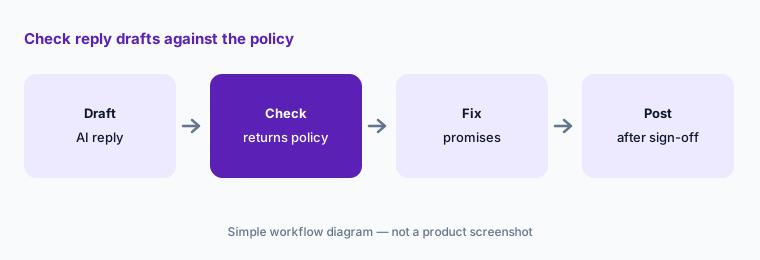
What it is: Yotpo’s AI-assisted comments suggest a reply to a review based on what it says, its sentiment, and whether your reply will be public or private, in a friendly, professional, or playful tone, and you can edit the text before posting. In Manage Reviews you choose Reply publicly, which shows on your site and can be edited or deleted later, or Reply via email, which goes privately to the customer and cannot be edited or deleted once sent. Yotpo’s pricing table marks AI-assisted comments as “talk to us”.
A warm reply can promise a refund, a replacement, or free return shipping your policy does not offer — and a public reply makes that promise to every shopper who reads the page.
Primary workflow:
Pick ten recent customer reviews in Yotpo. Have the CX lead check each AI reply draft for promises your returns policy does not make before publishing.
2. AI Reviews Summary: “What customers say”
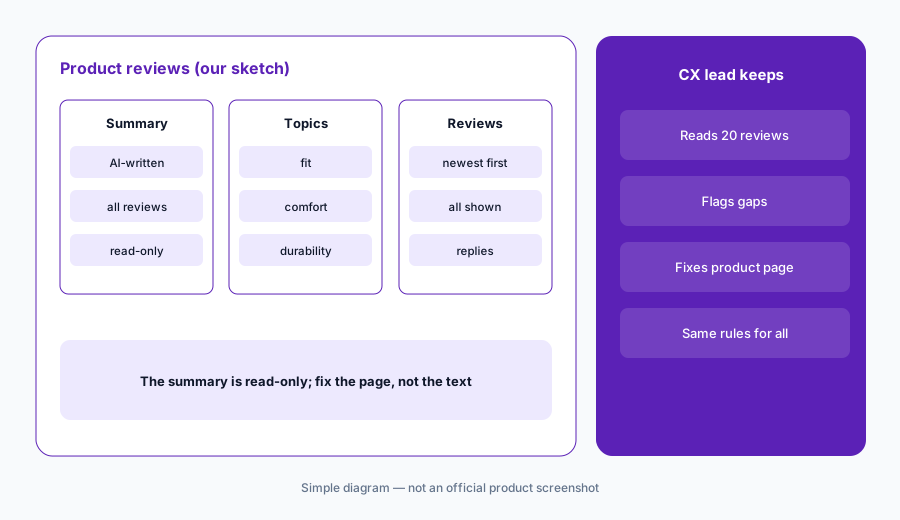
What it is: Yotpo’s Reviews Summary adds an always-visible section called What customers say to the reviews widget: a short AI-written overview of all Yotpo reviews for a product, plus a drawer of topic-by-topic summaries. A product needs at least 20 reviews and at least two topics with five reviews each before a summary appears. It refreshes only when the product has 50% more reviews, at least two of its top ten topics have changed, and two months have passed. Yotpo says the summaries are generated by AI and cannot be changed or edited.
Because you cannot edit the summary, the fix for a misleading one is in the product, the product page, or the review content itself — not in the summary text. Read it the way a shopper would.
Check it against the reviews:
Open the AI summary on your five most-reviewed products. Have the CX lead compare each with twenty recent customer reviews and flag any line the reviews do not support.
3. Smart Prompts and collection: more detail, never bought
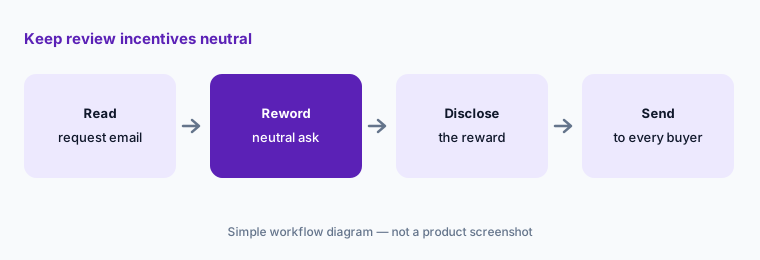
What it is: Yotpo sends automatic post-purchase review requests with email and SMS reminders, and its pricing page lists Smart Prompts, which suggest AI-picked topics to encourage shoppers to write more detailed reviews (marked “talk to us”). Plans from Starter up also include review coupons — incentives for writing a review. The FTC’s rule on consumer reviews, in effect since 21 October 2024, does not ban incentives, but the business cannot make them depend, openly or by implication, on a positive or negative review; FTC staff also say incentives should be disclosed.
Wording matters as much as the setting. “Tell us how much you loved it for 10% off” implies the review must be positive. Offer the same reward for any honest review and say so.
Check the wording:
Read your review request email and any coupon offer for reviews. Have the CX lead confirm the reward goes to every honest review, positive or negative, and is disclosed where the review appears.
4. Moderation, sentiment checks, and AI Insights
What it is: Yotpo’s moderation includes a sentiment and profanity check, auto-publish settings, review tagging, and templates; the newer Manage Reviews workspace puts all of it in one list. On Premium, AI Insights summarises your review content into an analytics dashboard, and Reviews Atlas, which links review content to conversion, is “talk to us”. Yotpo’s Reviews page says its AI-powered moderation and FTC-aligned workflows are meant to keep only authentic reviews published.
Moderation is for spam, profanity, personal data, and reviews about the wrong product — not for holding back unhappy customers. FTC staff warn that making negative reviews hard to find can break the FTC Act, so set auto-publish rules the same for good and bad news.
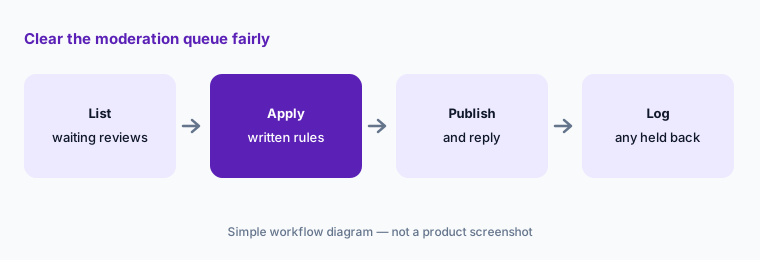
Clear the queue fairly:
List every review that has waited in moderation for more than a week. Have the CX lead publish each one that meets your written guidelines and log the reason for any held back.
5. Yotpo Discover: AI visibility and agents
What it is: Yotpo Discover tracks how your products appear in AI answers from engines such as ChatGPT, Gemini, and Google AI Mode — by product, category, and region — and shows which competitors appear instead. Three agents act on it: an Onsite Agent that checks your pages for AI readiness, a Content Agent that drafts content from your reviews and catalogue, and an Activation Agent that engages real reviewers and loyalty members on sites such as Reddit, marketplaces, and publishers. A Discover connector for Claude lets you pull insights and drafts into a Claude conversation. Yotpo team members described Discover as officially live in early September 2026, but the Discover page’s FAQ still says the initial release is designed for brands with $10M+ in annual sales, with a waitlist below that.
AI-drafted content still makes product claims, and anyone posting about you because you asked must make that connection clear. Treat Content Agent drafts like any marketing copy and keep outreach honest.
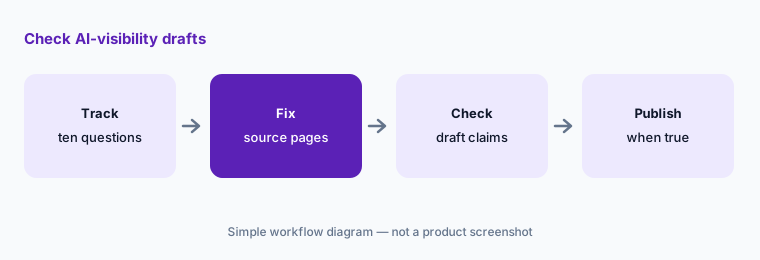
Check drafts against the spec:
Pick ten shopper questions Discover tracks for your top category. Have the merchandiser check every product claim in the Content Agent's drafts against the spec sheet before anything is published.
6. Loyalty & Referrals and the hand-off to SMS
What it is: Yotpo Loyalty & Referrals runs points, VIP tiers, referral programs, and wallet passes for Apple Wallet and Google Pay; a recent release lets you send expiring bonus points to a chosen segment. AI is not the headline here: the loyalty data feeds other tools. Yotpo’s product releases list integrations that trigger SMS from points balance, VIP tier, and rewards in Postscript and Attentive, where AI may write the message.
Once points data flows into AI-written texts, a wrong expiry date or reward value goes out at scale. Check a few real member accounts before every points campaign.
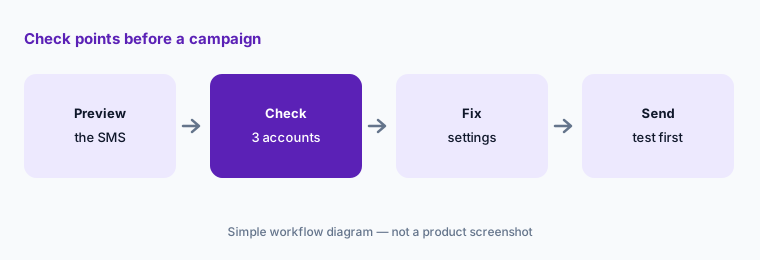
Check real accounts first:
Send one expiring-points campaign to a small test segment. Have the retention lead check the points balance, expiry date, and reward wording against three member accounts in Yotpo before the full send.
Pricing context (October 2026)
Yotpo’s pricing page (read 16 Oct 2026) prices Reviews & UGC and Loyalty by monthly order volume, set with a slider. Reviews & UGC has a limited free plan (up to 50 orders a month) and paid plans “starting at $15/month”; at the default 500 orders a month the page shows Starter $89/month and Pro $169/month, with Premium and Enterprise by custom quote. Loyalty & Referrals has a free plan and paid tiers from $199/month, with Premium and Enterprise quoted. Discover is custom-priced. A Reviews and Loyalty bundle costs less than buying both separately.
Where the AI sits: Pro adds “AI-driven display features” and “AI tools so shoppers write better reviews”; Premium adds the Reviews AI summary and AI-powered analytics; Smart Prompts, AI-assisted comments, and Reviews Atlas are marked “talk to us”.
Uncertainty: Prices move with order volume, so your amount depends on the slider and, above Pro, a quote. Yotpo’s plan card lists the Reviews AI summary under Premium, while its feature table appears to include it on Pro as well — confirm on a call. Discover’s availability is unclear: team posts in early September called it officially live, but the Discover FAQ still describes an initial release for $10M+ brands with a waitlist. Yotpo’s results figures for Discover and its customer counts are Yotpo’s claims and are not repeated here.
When it’s useful (honest take)
Useful when customer reviews and repeat purchases drive your store, you want help replying to reviews, summarising review feedback, and seeing how AI assistants describe your products — and a CX lead reads every reply, keeps moderation rules the same for good and bad reviews, and owns the review request wording.
Less useful when you mainly need store-wide product content help (Wix AI or BigCommerce AI), support-ticket replies rather than review replies (Gorgias AI), or you are below Discover’s stated sales threshold and want AI visibility now.
Paying for Yotpo AI and a few other AI tools? The $9 AI toolkit spreadsheet lists every AI subscription you have, what each one costs, and how fast it pays for itself, so you can see which ones are worth the money.
Want someone to do it for you? AI toolkit audit — $19
Related options (educational)
| Need | Better home | Why |
|---|---|---|
| Customer reviews with AI replies and summaries | Yotpo AI (this page) | Free → Starter $89 / Pro $169 per month at 500 orders |
| Store platform with AI product copy | Wix AI | Light $204 → Business Elite $1,908 a year |
| Text messaging fed by loyalty data | Postscript AI | Starter $0 + $49 minimum → AI Plan $699/mo |
| SMS and email with AI audiences | Attentive AI | Usage-based — quote |
| Help-desk replies to support tickets | Gorgias AI | See its review |
| On-site behaviour and journeys | Contentsquare AI | See its review |
FAQ
How much does Yotpo cost?
Yotpo prices by monthly order volume. Reviews has a limited free plan and paid plans from $15/month; at 500 orders a month Starter is $89 and Pro $169. Loyalty has a free plan and paid tiers from $199/month. Premium, Enterprise, and Discover are quoted.
Does Yotpo’s AI write reviews?
No. Its AI summarises existing customer reviews, suggests replies, suggests topics to prompt more detailed reviews, and analyses review feedback. Customers write the reviews; never buy, invent, or filter them.
Can I edit the AI review summary?
No. Yotpo says the summaries are generated by AI and cannot be changed or edited. If one is misleading, fix the product page or the underlying issue and wait for the next refresh.
Is Yotpo Discover generally available?
Yotpo team members called it officially live in early September 2026, but on 16 October 2026 the Discover FAQ still said the initial release is designed for brands with $10M+ in annual sales, with a waitlist for smaller brands. Ask Yotpo for your status.
Who should approve Yotpo AI output?
A named CX lead for every public and email reply, the review request and incentive wording, and moderation rules; the merchandiser for product claims in Discover content; the retention lead for loyalty messages.
Optional next step (if seats overlap)
If you pay for a reviews platform with AI replies, a help desk with its own AI, and a chat assistant that all answer the same customers, that overlap is worth mapping. Map the overlap with the $19 AI toolkit audit or the $9 AI toolkit spreadsheet. Email Audit $19 or Toolkit spreadsheet $9.
Checkout is live via Stripe. After you pay, we email delivery (spreadsheet) or intake next steps (audit).