Tool · Ecommerce ops · Postscript · Oct 2026
Postscript AI review (Oct 2026): AI SMS campaigns, conversational SMS, and segment suggestions for ecommerce
Postscript is a text-message marketing platform built mostly for Shopify stores, now adding RCS and email. Its AI comes as a suite: Shopper, a set of AI agents that hold text conversations with subscribers, decide what each one receives, and report what customers are saying; Infinity Testing, which writes and tests many versions of a campaign; and Brand Center, which holds the policies, offers, and voice every AI message draws on. This page is about letting that AI handle the volume while the retention lead still owns what is promised, who gets texted, and when. Each section has a Try this.
What this Postscript page covers
This page is for a retention lead, SMS manager, or ecommerce marketing manager who runs Postscript or is comparing text-message platforms. The question it answers: what each Postscript AI product does, which parts are new or still early, what Postscript publishes about price, and who must check conversations, campaigns, and audiences before and after they reach a subscriber’s phone.
Postscript’s AI page, Shopper page, Infinity Testing page, Brand Center page, product launches, compliance page, and pricing page were read on 16 October 2026. Postscript does not sell a feature called “segment suggestions”; on this page that job means Shopper Campaigns deciding who should and should not get a campaign (in Alpha) and Ask Shopper surfacing themes you can build a segment from.
Ground rules: the retention lead approves every campaign, offer, and AI feature before it sends; SMS consent, quiet hours, and opt-out rules are the brand’s to check, even where Postscript applies them automatically; no subscriber phone lists or order exports go into an outside chat tool; and Postscript’s revenue and return figures are its claims, not our measurement.
Major features (with how someone uses them)
Examples at a glance: each feature has a concrete example from a real job plus a short Try this you can run this week.
1. Shopper Responses: conversational SMS (primary)
What it is: Shopper Responses answers subscribers who text in: product questions, objections, recommendations, and closing the sale in the same thread, over SMS and RCS. Postscript says it is trained on your Brand Center inputs, Shopify store, and knowledge base, that you can preview real conversations in the Shopper Playground before it goes live, and that it handles about 92% of conversations without escalation — Postscript’s figure. For the rest, such as cancellations or refunds, it can point to your support email, phone, or form, or open a Gorgias or Zendesk ticket with the last ten messages and pause while your team handles it.
An agent that answers around the clock is quoting your shipping times, return rules, and discounts. Reading a week of conversations is the only way to know what it is promising.
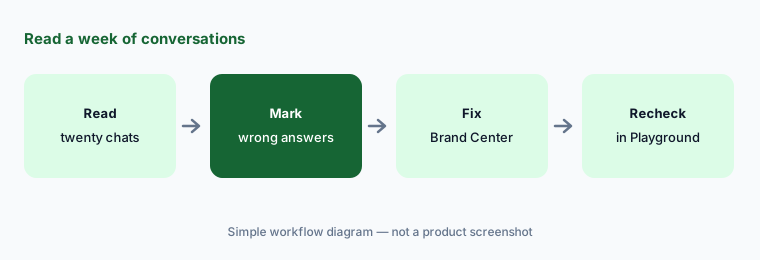
Primary workflow:
Read twenty Postscript AI SMS conversations from one week. Mark every answer about shipping, returns, or discounts the retention lead would change.
2. Infinity Testing: AI-written campaign variants
What it is: Infinity Testing combines predictive analytics and generative AI to write and test many on-brand versions of a message: about 10 for a campaign and up to thousands for an automation. At the end of a test you see how each version did against the control, and the model updates for the next send. Postscript says its AI products are tested against your own holdout group, and the page’s lift figures are Postscript’s and its customers’ claims.
With hundreds of versions nobody reads them all, so the guardrails have to sit in Brand Center. For a 10-version campaign, someone can and should read every one before it sends.
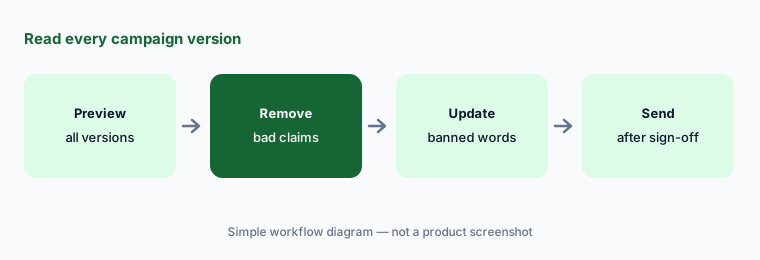
Read every version:
Run one Infinity Testing campaign. Before it sends, have the retention lead preview every version in the Playground and remove any with a price, claim, or tone your brand guidelines rule out.
3. Brand Center: the inputs every AI message uses
What it is: Brand Center is where you train all Postscript AI products. It holds your brand guidelines (tone, style, banned language), a Content Library of policies, FAQs, shipping details, and sizing guides, your product catalogue synced from Shopify, and your offers — since July 2026 managed centrally, including stacking, buy-one-get-one, gift with purchase, and free shipping, with the same active code reused for a subscriber across touchpoints. A Playground lets you simulate Shopper conversations and preview Infinity Testing messages; a feedback loop and message details show which inputs the AI used for a message.
Every AI answer about returns or discounts is only as current as this page. An expired offer or an old returns policy left here will be repeated, politely, to every subscriber who asks.
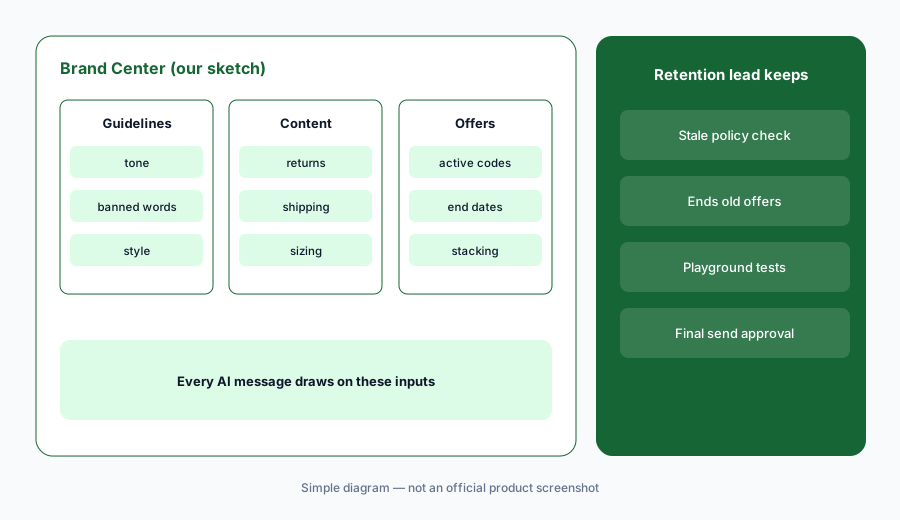
Audit the inputs:
Open Brand Center and list every policy, FAQ, and offer it holds. Have the retention lead mark anything out of date and fix it before turning on another AI feature.
4. Shopper Campaigns and Ask Shopper: who gets what
What it is: Postscript does not offer a feature by the name “segment suggestions”. The closest are two Shopper agents. Shopper Campaigns “decides who should get a campaign (and who shouldn’t), and what it should say to them”; on 16 October 2026 Postscript listed it as Alpha. Ask Shopper, launched 3 June 2026, lets you type a question about subscriber conversations and get back themes, objections, buying signals, and the conversations behind them. Ordinary segments stay hand-built, and every plan includes unlimited segments.
When AI drops people from a campaign, ask who was left out and why. When it suggests a theme, a person still decides the rule, checks the audience size, and confirms everyone in it has opted in.
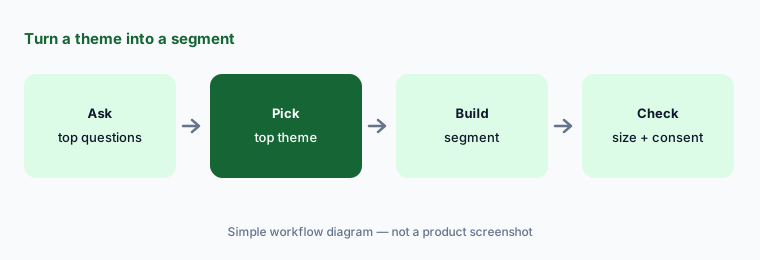
Turn a theme into a segment:
Ask Shopper what subscribers asked about most last month. Have the retention lead turn the top theme into one hand-built segment and check its size and rules before sending.
5. Shopper Automations: one-to-one journeys in place of flows
What it is: Shopper Automations, launched 13 August 2026, replaces fixed welcome, abandonment, and lifecycle flows with a message chosen for each subscriber: when to send, what to say, which offer, and how often, based on site behaviour, purchase history, and past conversations. You set an audience split, keep a control group on your existing flows, and see test-versus-control results on revenue per subscriber, ROI, and click-through. Brands start with Brand Center and Shopper Responses before Automations. Postscript’s return figures (13x on the launch note, 15x on the Shopper page) are its claims.
A control group only helps if it runs long enough and someone looks at unsubscribes and complaints, not just revenue. Keep the split small until the numbers hold.
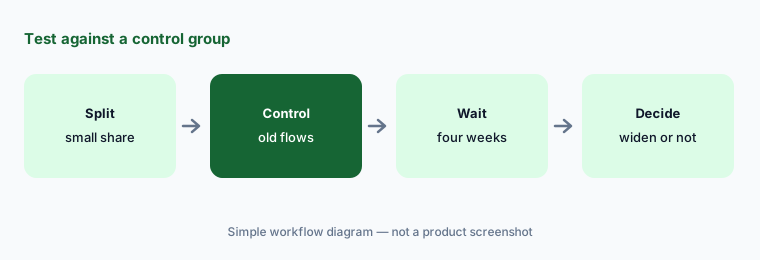
Test before widening:
Start Shopper Automations on a small audience split with a control group on your current flows. Have the retention lead compare revenue per subscriber and unsubscribes after four weeks before widening it.
6. Consent, quiet hours, and the CX hand-off
What it is: Postscript’s Shopper FAQ says Shopper inherits its platform-wide TCPA standards — opt-outs, quiet hours, and consent rules apply automatically — and runs extra guardrails for regulated categories such as health and supplements, with individual use cases reviewed before going live. The compliance page describes Quiet Hours playbooks and message and consent records for subscribers collected through Postscript-powered pop-ups, and the pricing FAQ says the compliance team reviews any list you upload. On 1 October 2026 Postscript also posted about an FCC rule on opt-out methods; read the rule itself or ask counsel before relying on it.
Automatic settings help, but the rules are the brand’s: who opted in and how, the quiet-hour window in each subscriber’s time zone, which words count as an opt-out, and what happens when a conversation turns into a complaint.
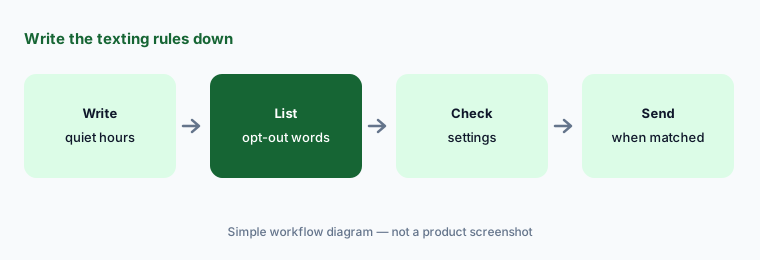
Write the rules down:
Write down your quiet-hour window, opt-out keywords, and consent sources. Have the retention lead check that each setting in Postscript matches before any AI feature sends a text.
Pricing context (October 2026)
Postscript’s pricing page (read 16 Oct 2026) publishes its text-message plans: Starter $0/month with a $49 monthly minimum spend ($0.009 per SMS, $0.045 per MMS); Growth $100/month ($0.008 per SMS, $0.03 per MMS); Professional $500/month ($0.007 per SMS, $0.024 per MMS, API access); and Enterprise by custom quote. Carrier fees are passed through at cost (the page lists US averages of $0.0033 per SMS and $0.00799 per MMS); a dedicated short code costs $750/month through the carriers; no contract is required.
The Postscript AI Plan is $699/month plus per-message rates of $0.003 to $0.30 depending on product and message type, and bundles Brand Center, Infinity Testing, and Shopper. The Agentic Context Platform (ACP) is included with every plan. A free trial gives a $100 credit for the first 30 days. Postscript Email launched on 23 September 2026 with a waitlist; Postscript says email is priced 20–30% below older providers, which is its claim.
Uncertainty: Shopper Campaigns was Alpha on 16 Oct 2026, so the who-gets-a-campaign choice is early; Postscript Email was waitlist-only. The page does not say whether every Shopper agent sits inside the $699 AI Plan or which message types fall at each end of the $0.003–$0.30 range, so ask for a quote for your volume. Postscript’s figures — about 92% of conversations handled, 13x or 15x median return, and Infinity Testing lifts — are its and its customers’ claims, not our measurement.
When it’s useful (honest take)
Useful when text messaging is a major revenue channel for a Shopify store and you want AI to handle inbound conversations, write and test campaign copy, and pick the next message per subscriber — and a retention lead keeps Brand Center current, reads conversations weekly, and owns consent and quiet hours.
Less useful when email is your main channel today (Klaviyo AI or Attentive AI cover both now), your store is not on Shopify and you would rely on the SDK, or you need review content and loyalty more than messaging (Yotpo AI). For store-side product copy, see Wix AI.
Paying for Postscript AI and a few other AI tools? The $9 AI toolkit spreadsheet lists every AI subscription you have, what each one costs, and how fast it pays for itself, so you can see which ones are worth the money.
Want someone to do it for you? AI toolkit audit — $19
Related options (educational)
| Need | Better home | Why |
|---|---|---|
| SMS with AI conversations and campaign testing | Postscript AI (this page) | Starter $0 + $49 minimum → AI Plan $699/mo |
| SMS, email, RCS, and push with AI audiences | Attentive AI | Usage-based — quote |
| Email-first lifecycle with AI drafts | Klaviyo AI | See its review |
| Reviews and loyalty data for messages | Yotpo AI | Free → Starter $89/mo at 500 orders |
| Store platform with AI product copy | Wix AI | Light $204 → Business Elite $1,908 a year |
| Help-desk tickets escalated from SMS | Gorgias AI | See its review |
FAQ
How much does Postscript cost?
Starter is $0/month with a $49 monthly minimum spend, Growth $100/month, Professional $500/month, plus per-message rates and carrier fees; Enterprise is quoted. The Postscript AI Plan is $699/month plus $0.003 to $0.30 per message. A free trial gives a $100 credit for 30 days.
What is Postscript Shopper?
A suite of AI agents: Responses (text conversations), Automations (one-to-one journeys in place of flows), Campaigns (who gets a campaign and what it says; Alpha), and Ask Shopper (questions about what customers are saying). It works over SMS and RCS.
Does Postscript suggest segments?
Not as a feature by that name. Shopper Campaigns, in Alpha, decides who should and should not get a campaign, and Ask Shopper surfaces themes you can turn into a hand-built segment. A person still checks the rules, the size, and consent.
Does Postscript handle quiet hours and consent for me?
Postscript says opt-outs, quiet hours, and consent rules apply automatically in Shopper. The rules are still the brand’s: check how each subscriber opted in, the quiet-hour window, and opt-out keywords.
Who should approve Postscript AI output?
A named retention lead for every campaign, offer, Brand Center change, and AI feature turned on, plus a weekly read of Shopper conversations; the CX team for escalated conversations.
Optional next step (if seats overlap)
If you pay for an SMS platform with AI conversations, an email tool with its own AI, and a help desk with AI replies that all talk to the same customers, that overlap is worth mapping. Map the overlap with the $19 AI toolkit audit or the $9 AI toolkit spreadsheet. Email Audit $19 or Toolkit spreadsheet $9.
Checkout is live via Stripe. After you pay, we email delivery (spreadsheet) or intake next steps (audit).