Tool · Ecommerce ops · Attentive · Oct 2026
Attentive AI review (Oct 2026): AI Pro, Lifecycle Intelligence, AI Grow, AI Journeys, and the Reporting Agent for SMS and email
Attentive is an SMS, email, RCS, and push marketing platform used mostly by retailers and ecommerce brands. Its AI sits in a premium bundle called AI Pro (who to message, when, and with what copy), plus AI Grow for sign-up units, AI Journeys for triggered messages, and two newer betas: a Reporting Agent you can question in plain words and Attentive MCP for connecting tools like ChatGPT or Claude. This page is about using that AI for the repeatable jobs while a retention lead still decides what every subscriber receives. Each section has a Try this.
What this Attentive page covers
This page is for a retention lead, CRM manager, or ecommerce marketing manager who runs Attentive or is comparing SMS and email platforms. The question it answers: what each Attentive AI feature does, which are generally available and which are beta, what Attentive publishes about price, and who must approve copy, audiences, and anything that reaches a subscriber’s phone.
Attentive’s AI page and AI Pro page (read 16 October 2026) describe brand-voice copy, Audiences AI, Identity AI, Send Time AI, and Lifecycle Intelligence. AI Grow became generally available on 19 August 2026. The 22 September release put the Reporting Agent and Attentive MCP into beta. The pricing page shows no amounts.
Ground rules: a named retention lead approves every campaign and journey before it sends; consent, quiet-hour, and opt-out rules for SMS are the brand’s to check, and no AI timing feature replaces them; no subscriber phone lists or order exports go into an outside chat tool; and vendor lifts and ROI figures are Attentive’s claims, not our measurement.
Major features (with how someone uses them)
Examples at a glance: each feature has a concrete example from a real job plus a short Try this you can run this week.
1. Brand-voice copy for SMS and email (primary)
What it is: Attentive AI drafts SMS and email copy. The AI Pro page says it creates copy “shaped by your past top-performing messages” that you then refine, and the main AI page says you can create on-brand SMS and email copy faster and then build retargeting campaigns from it. The drafts sit inside the normal Attentive campaign builder, so a person still schedules every send.
A draft that sounds like your brand can still quote the wrong discount or an end date that has passed. Check every number and claim against the promo plan, not against the last message.
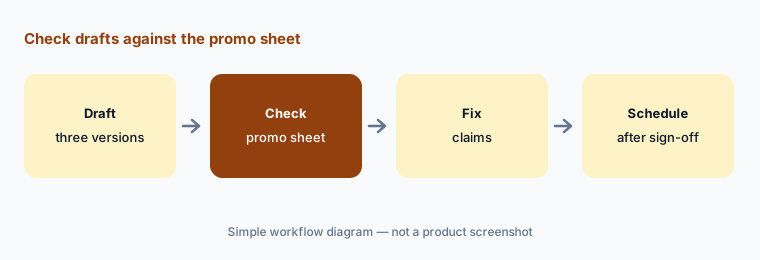
Primary workflow:
Have Attentive AI draft three SMS versions of next week's campaign in your brand voice. Have the retention lead check every price, discount code, and claim against the promo sheet before anything is scheduled.
2. Audiences AI and Identity AI: who gets the message
What it is: Audiences AI, part of AI Pro, refines a campaign audience using historical and real-time data, adding subscribers likely to buy and removing those unlikely to buy. Identity AI aims to recognise more site visitors and tie their browsing to subscriber profiles, so more abandonment and browse messages can trigger. Both change who receives a message without the marketer hand-building the segment.
Adding and removing people automatically is useful and hard to see. Compare against your usual segment on orders and unsubscribes, not just revenue, before you trust it for every send.
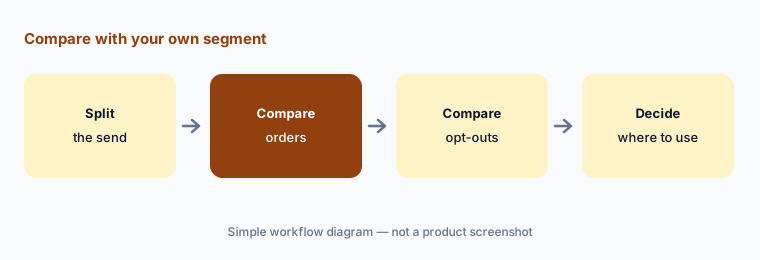
Compare with your segment:
Send one campaign to an Audiences AI audience and the same campaign to your usual segment. Have the retention lead compare orders and unsubscribes per 1,000 messages before using it again.
3. Lifecycle Intelligence: Product Affinity, RFM, and Customer LTV
What it is: Attentive’s 22 September 2026 release added Lifecycle Intelligence to AI Pro. Product Affinity, generally available to AI Pro customers, builds audiences around interest in specific products and categories. RFM (how recently and how often customers buy, and how much they spend) and Customer LTV (what customers have spent and may spend over time) are available to AI Pro customers in beta. Attentive says its AI keeps those audience segments current as customer signals change.
A segment the AI keeps updating is still your list. Read who is in it before you send, and treat beta lifetime-value figures as estimates, not facts about a person.
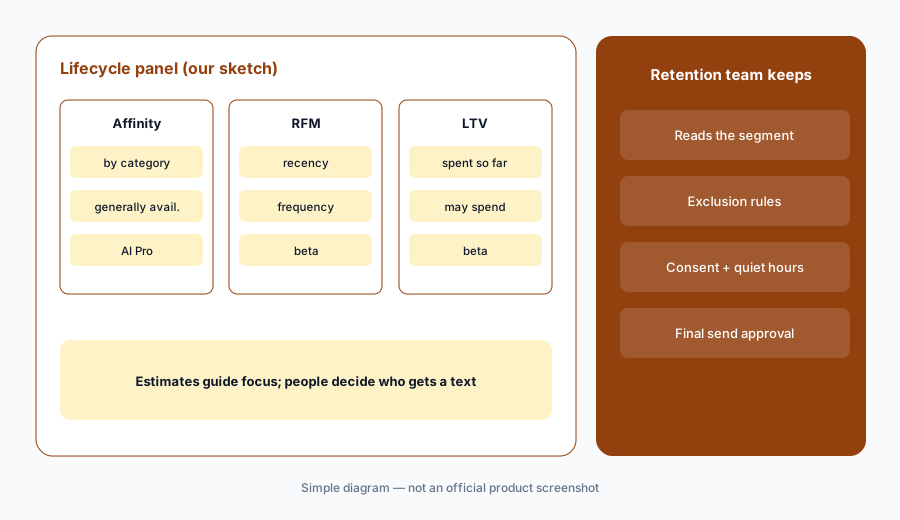
Read the segment:
Build one Product Affinity audience for your top category. Have the retention lead read twenty profiles in it and remove anyone whose orders do not fit before sending.
4. Send Time AI and AI Journeys for triggered messages
What it is: Send Time AI picks when each subscriber gets a message from their engagement patterns. AI Journeys adapts triggered messages — browse, cart, and post-purchase — to each shopper: timing, frequency, product recommendations, images, copy, and calls to action, with built-in controls meant to keep each message on brand. Attentive says the more shoppers engage, the more the journey learns.
When AI picks the products and offer inside a triggered message, nobody sees each one before it sends. Read a sample every week, and keep quiet hours and frequency caps set by people.
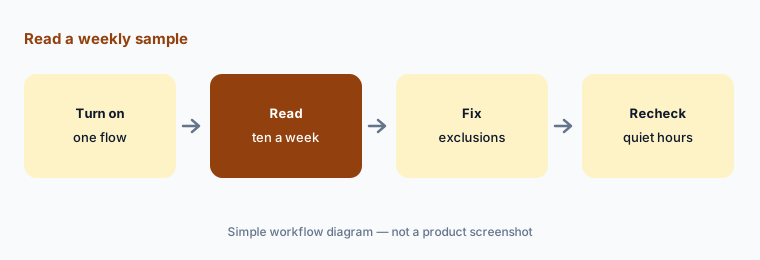
Read a weekly sample:
Turn on AI Journeys for one browse-abandon flow. For two weeks, have the retention lead read ten sent messages a week and check every product, price, and offer it chose.
5. AI Grow: sign-up units that pick their moment
What it is: AI Grow, generally available since 19 August 2026, watches real-time browsing and shopping behaviour to decide when, where, and how an email or SMS sign-up invitation appears — for example a small bubble or a full-screen unit — instead of one fixed rule for every visitor. Attentive says each deployment is measured with cohort-level A/B testing against the brand’s existing setup, and that beta brands saw a median of about 25% more sign-ups and 35% more welcome-series revenue. Those are Attentive’s figures, not ours.
More sign-ups is good only if they buy and stay subscribed. Watch opt-outs and site conversion in your own analytics too, not only the vendor’s report.
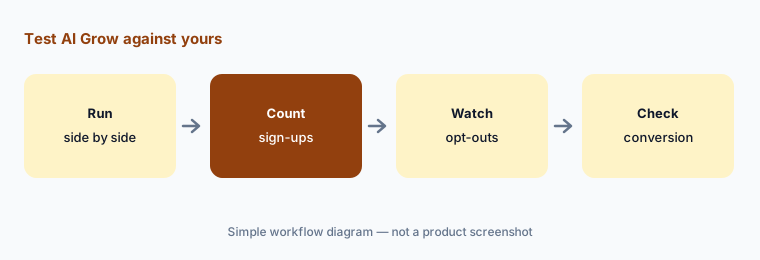
Test it against yours:
Run AI Grow against your current sign-up unit for two weeks. Have the retention lead compare sign-ups, opt-outs, and site conversion in your own analytics before keeping it.
6. Reporting Agent and Attentive MCP (beta)
What it is: The Reporting Agent, in beta, lets marketers ask questions about their Attentive program in plain words, see what changed and why, and get suggested next steps. Attentive MCP, also beta, connects compatible AI assistants such as ChatGPT or Claude to approved Attentive data and workflows; the release says over 70 tools are available in beta for campaign creation, audience building, and reporting. Attentive says you choose what the AI tool can access and whether it can make changes, and you review subscriber-facing work before it goes live.
An outside assistant with write access can draft campaigns and change journeys from a chat window. Start read-only, and check its answers against Attentive’s own reports first.
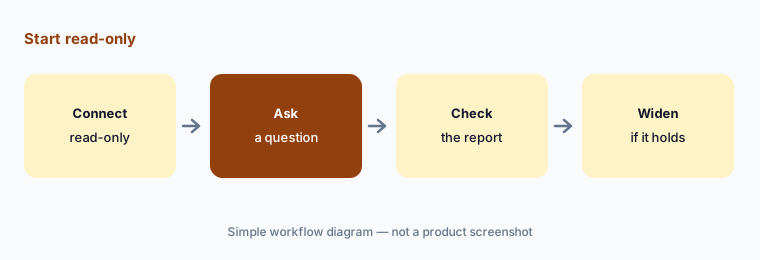
Start read-only:
Connect Attentive MCP with read-only access first. Ask for last month's top five campaigns by revenue and check each against Attentive's own campaign report.
Pricing context (October 2026)
Attentive’s pricing page (read 16 Oct 2026) shows no published prices. Pricing is usage-based and built around the number of messages you send, the size of your subscriber list, the channels you use (SMS, email, RCS, push), and the premium AI tools you choose. The FAQ says there is no credit system, discounts apply when you bundle channels or premium AI products, and a free trial is available through the sales form.
Every plan includes the core platform: onboarding and deliverability support, 150+ integrations, the Attentive Signal identity tag, pre-built journeys, campaign builders, A/B testing, reporting, and built-in TCPA and compliance tools. AI Pro, AI Grow, and AI Journeys are positioned as premium AI products; Attentive does not say on the pages we read which are included in which package. Treat it as quote-only.
Uncertainty: No public prices on 16 Oct 2026, so cost depends on your quote. RFM, Customer LTV, the Reporting Agent, and Attentive MCP were beta; Product Affinity and AI Grow were generally available. Lifts on Attentive’s pages and releases (for example 576% email revenue growth, 48x ROI, AI Grow’s ~25% and 35% medians, and a customer’s 13% revenue lift) are Attentive’s and its customers’ claims, not our measurement.
When it’s useful (honest take)
Useful when SMS and email drive a large share of your online revenue and you want help with copy, audiences, timing, and sign-up units — and you have a retention lead who reads drafts and samples, owns consent and quiet hours, and compares AI audiences against hand-built ones.
Less useful when you mainly need store-wide product content help (BigCommerce AI), ad attribution across channels (Triple Whale AI), or you want published prices before a sales call. A smaller email-first program may find Klaviyo AI or Customer.io AI a closer fit.
Paying for Attentive AI and a few other AI tools? The $9 AI toolkit spreadsheet lists every AI subscription you have, what each one costs, and how fast it pays for itself, so you can see which ones are worth the money.
Want someone to do it for you? AI toolkit audit — $19
Related options (educational)
| Need | Better home | Why |
|---|---|---|
| SMS + email platform with AI audiences and copy | Attentive AI (this page) | Usage-based — quote |
| Email-first lifecycle with AI drafts | Klaviyo AI | See its review |
| Lifecycle messaging for product-led teams | Customer.io AI | See its review |
| Store platform AI for product content | BigCommerce AI | Core $39 → Scale $399 /mo (monthly) |
| Checking which channel drove the order | Triple Whale AI | Free plan → tiers by annual sales |
FAQ
How much does Attentive cost?
Attentive does not publish prices. Its pricing page says cost depends on message volume, subscriber list size, channels, and the premium AI products you choose; it offers a free trial and bundle discounts. Treat it as quote-only.
What is Attentive AI Pro?
A set of premium AI features: brand-voice copy, Audiences AI, Identity AI, Send Time AI, and Lifecycle Intelligence (Product Affinity generally available; RFM and Customer LTV in beta as of the 22 September 2026 release).
Is AI Grow generally available?
Yes. Attentive announced general availability on 19 August 2026. It decides when and how sign-up units appear based on each visitor’s behaviour.
Can Attentive MCP change my campaigns?
It can if you allow it. Attentive says you choose what the connected AI tool can access and whether it can make changes, and you review subscriber-facing work before it goes live. MCP was in beta on 16 October 2026.
Who should approve Attentive AI output?
A named retention or CRM lead for every campaign, journey, and audience before it sends, including checking prices, discount codes, product claims, consent, and quiet hours.
Optional next step (if seats overlap)
If you pay for an SMS platform with AI copy, an email tool with its own AI, and a separate chat assistant that all draft the same campaigns, that is worth mapping. Map the overlap with the $19 AI toolkit audit or the $9 AI toolkit spreadsheet. Email Audit $19 or Toolkit spreadsheet $9.
Checkout is live via Stripe. After you pay, we email delivery (spreadsheet) or intake next steps (audit).